Seven minutes and one bad clause
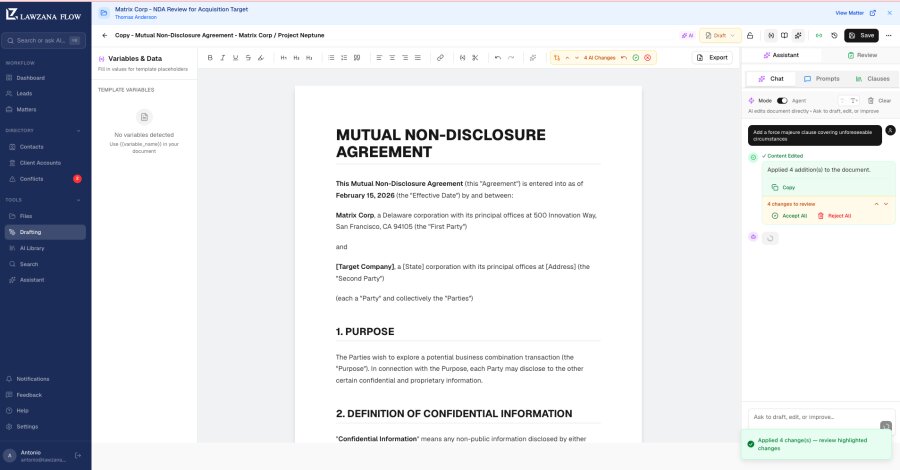
A solo practitioner in Chicago drafts a standard NDA. With her firm's template, it takes 45 minutes of customization. With AI drafting through Lawzana Flow, the first draft appears in 7 minutes. But the AI version includes a non-compete clause she did not ask for. She catches it, deletes it, and sends the NDA in 12 minutes total.
That is the reality of AI legal drafting in 2026. Fast and useful and not something you can blindly trust.
How it works
Modern AI drafting tools use large language models trained on legal text. They generate documents based on attorney instructions, prior documents in the matter file, and jurisdiction-specific rules. They do not copy-paste from a template library. They write.
The process looks like this: the attorney describes what they need ("draft an NDA for a SaaS company licensing data to a healthcare provider, New York law, mutual obligations, two-year term"). The AI assembles context from the matter file (party names, addresses, prior agreements), generates a draft that accounts for the specified parameters, and highlights sections where it made assumptions.
This is different from template-based document assembly, where you fill in blanks and toggle conditional clauses. Templates are predictable. AI drafting is flexible. The tradeoff is that templates always produce the same output, while AI output varies.
What it handles well
NDAs, engagement letters, demand letters, lease agreements, basic motions, corporate resolutions, employment agreements, and most standard commercial contracts. These share a common trait: their structure is well-established, variations are mostly in the details, and there are millions of examples in the training data.
For these document types, AI drafting saves 30 to 60 minutes per document. Over a month, that adds up to days of recovered time.
Where it struggles
Novel legal arguments. If you need to make a creative constitutional argument, AI will give you something that sounds plausible but lacks the originality a court wants to see.
Highly jurisdiction-specific filings. Louisiana civil law vs. common law states, for example. Local court rules with unusual requirements. AI training data is broad, and it sometimes defaults to majority approaches when a specific jurisdiction does something differently.
Anything requiring strategic judgment. A settlement demand is not just about the numbers. It is about reading the opposing party, timing, and leverage. AI cannot do that.
The hallucination question
"Will it hallucinate case law?" Yes, it can. This is the most serious risk in AI drafting, and the one that got a New York attorney sanctioned in 2023 for citing cases that did not exist.
Lawzana Flow handles this by citing to a verified legal database rather than generating citations from training data. When the AI drafts a document that references a statute or case, it cross-checks against actual sources. Other platforms vary in how they handle this. Some do not check at all.
Regardless of the platform: always verify citations. Every time. No exceptions.
The real workflow
AI replaces the first step of drafting: getting something on the page. It does not replace review, redlining, or finalization. The attorney saves time on the blank-page problem, not on the thinking.
A realistic workflow: AI generates a first draft in 5 to 10 minutes. Attorney reviews and marks up the draft in 15 to 20 minutes. Final version goes out in under 30 minutes total. Compare that to 60 to 90 minutes starting from a template, or 2+ hours starting from scratch.
AI drafting vs. templates vs. starting from scratch
|
Method |
Speed |
Consistency |
Flexibility |
Risk level |
|
AI drafting |
Fastest (5-10 min) |
Variable |
High |
Moderate (needs review) |
|
Templates |
Medium (30-45 min) |
High |
Low |
Low |
|
From scratch |
Slowest (60-120 min) |
Variable |
Highest |
Lowest |
The value is in time-to-usable-draft. AI with 15 minutes of review beats a template that needs 30 minutes of customization, which beats starting from scratch at 60+ minutes.
Getting started
Lawzana Flow integrates AI drafting with case management and CRM, so the AI has your matter context when it drafts. That context is what separates a useful first draft from a generic one. Try it with a standard NDA or engagement letter first, and compare the output to your current process.