


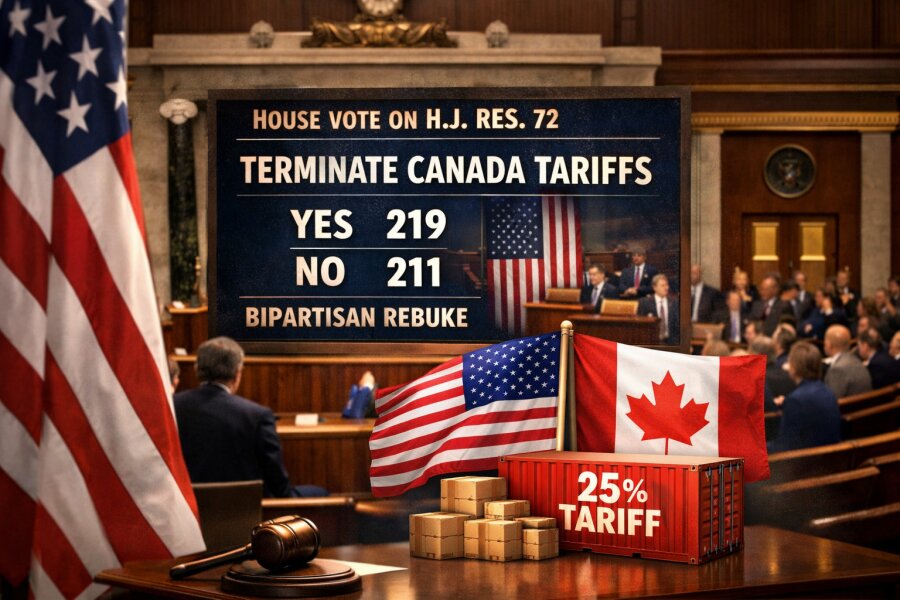
On February 11, 2026, the United States House of Representatives delivered a significant, bipartisan rebuke to the executive branch's trade policy by passing House Joint Resolution 72 (H.J. Res. 72). The resolution, which passed by a vote of 219 to 211, is designed to terminate the national emergency declared by the President on February 1, 2025, via Executive Order 14193. That executive order had controversially imposed a sweeping 25% ad valorem tariff on Canadian goods, citing the flow of illicit fentanyl across the northern border as the primary justification for utilizing emergency economic powers.
The legal mechanism enabling this congressional pushback is deeply rooted in the National Emergencies Act of 1976 (50 U.S.C. 1622) and the International Emergency Economic Powers Act (IEEPA) of 1977. IEEPA was originally enacted by Congress a half-century ago to constrain the sweeping executive powers historically utilized under previous administrations. It requires that a president declare a formal national emergency before imposing unilateral economic sanctions or tariffs. Crucially, the statute also provides Congress with a privileged mechanism to terminate such emergencies via a joint resolution. Because H.J. Res. 72 enjoys this privileged status, it successfully bypassed standard committee bottlenecks in the House and now moves to the Senate, where it cannot be filibustered and requires only a simple majority to pass.
The passage of this resolution in the House—with six Republicans crossing the aisle to join the Democratic minority—highlights the growing domestic economic unrest stemming from retaliatory tariffs and disrupted supply chains. Lawmakers representing border states noted that sectors reliant on cross-border trade, including agriculture, tourism, and manufacturing, have suffered significantly under the reciprocal tariff environment, emphasizing that Congress should not abdicate its Constitutional authority to levy tariffs.
Simultaneously, the executive branch's reliance on IEEPA for blanket tariffs remains under severe judicial scrutiny. The US Court of International Trade (CIT) previously ruled that the administration's fentanyl and reciprocal tariffs exceed the statutory authority granted by IEEPA, a ruling upheld by the Court of Appeals for the Federal Circuit. The Supreme Court heard oral arguments for the consolidated case in November 2025, and a highly anticipated ruling is expected as early as late February 2026. If the Supreme Court strikes down the tariffs, it will trigger a massive wave of litigation regarding potential tariff refunds and redefine the limits of delegated economic powers.
Source: CFR