Key Takeaways
Obtaining a Cyprus Investment Firm (CIF) license grants non-EU financial brokers lawful access to the European Economic Area. The process requires precise corporate structuring, significant capital allocation, and strict regulatory compliance.
- EU Market Access: A CIF license allows foreign brokers to passport their financial services across all 27 EU member states without requiring local licenses in each country.
- Capital Thresholds: Under updated European regulations, base capital requirements range from 75,000 EUR to 750,000 EUR depending on your brokerage model.
- Local Substance: CySEC strictly enforces physical presence requirements, meaning your firm must have a real office and resident executive directors in Cyprus.
- Application Timeline: The end-to-end process of structuring the company, compiling documentation, and receiving CySEC approval typically takes 9 to 12 months.
What is a Cyprus Investment Firm (CIF) License?
A CIF license is a regulatory authorization issued by the Cyprus Securities and Exchange Commission (CySEC) that allows financial brokerages to operate legally within the European Union. It enables foreign forex, crypto, and traditional securities brokers to passport their services across all European Economic Area (EEA) member states.
Cyprus serves as the premier jurisdiction for non-EU financial firms seeking European market entry due to its robust regulatory framework, favorable corporate tax rate of 12.5 percent, and highly skilled financial workforce. Operating under the Markets in Financial Instruments Directive (MiFID II), a CIF must adhere to strict transparency, investor protection, and corporate governance standards. Securing this license proves to institutional partners and retail clients that your brokerage operates with high integrity and financial stability.
CIF License Application Checklist
Successfully applying for a CIF license requires strict adherence to CySEC procedural guidelines and EU directives. Use this checklist to organize your corporate, financial, and regulatory documentation before initiating the application process.
- Corporate Incorporation: Register a domestic limited liability company in Cyprus specifically structured to operate as a financial institution.
- Capital Allocation: Open a corporate bank account and deposit the exact initial capital required for your specific license category.
- Personnel Appointment: Select a four-person Board of Directors, ensuring at least two executive directors reside full-time in Cyprus.
- Business Plan Drafting: Create a comprehensive three-year business plan detailing target markets, revenue models, and financial projections.
- Operations Manual Formulation: Draft an Internal Operations Manual (IOM) covering compliance, Anti-Money Laundering (AML) policies, and risk management procedures.
- Technology Audit: Document your IT infrastructure, disaster recovery plans, and cybersecurity measures for protecting client data and trading systems.
- Submission and Fees: Compile the application dossier, pay the official CySEC submission fees, and formally submit the paperwork for regulatory review.
How to Determine the Appropriate CIF License Category
Your business activities dictate which CIF license category you must apply for under the MiFID II framework. CySEC divides investment licenses into distinct tiers based on the level of risk the firm assumes and the exact financial services it provides to clients.
Selecting the correct category is critical because it directly impacts your capital requirements, compliance obligations, and operational costs.
| License Category | Permitted Activities | Target Brokerage Type |
|---|---|---|
| Class 1 | Dealing on own account, underwriting, placing financial instruments on a firm commitment basis. | Market Makers, B-Book Brokers, large liquidity providers. |
| Class 2 | Execution of orders on behalf of clients, holding client funds, portfolio management. | Straight Through Processing (STP) Brokers, A-Book Brokers. |
| Class 3 | Investment advice, reception and transmission of orders (without holding client funds). | Introducing Brokers, financial advisors, independent asset managers. |
2026 Capital Requirements for Cyprus Brokers
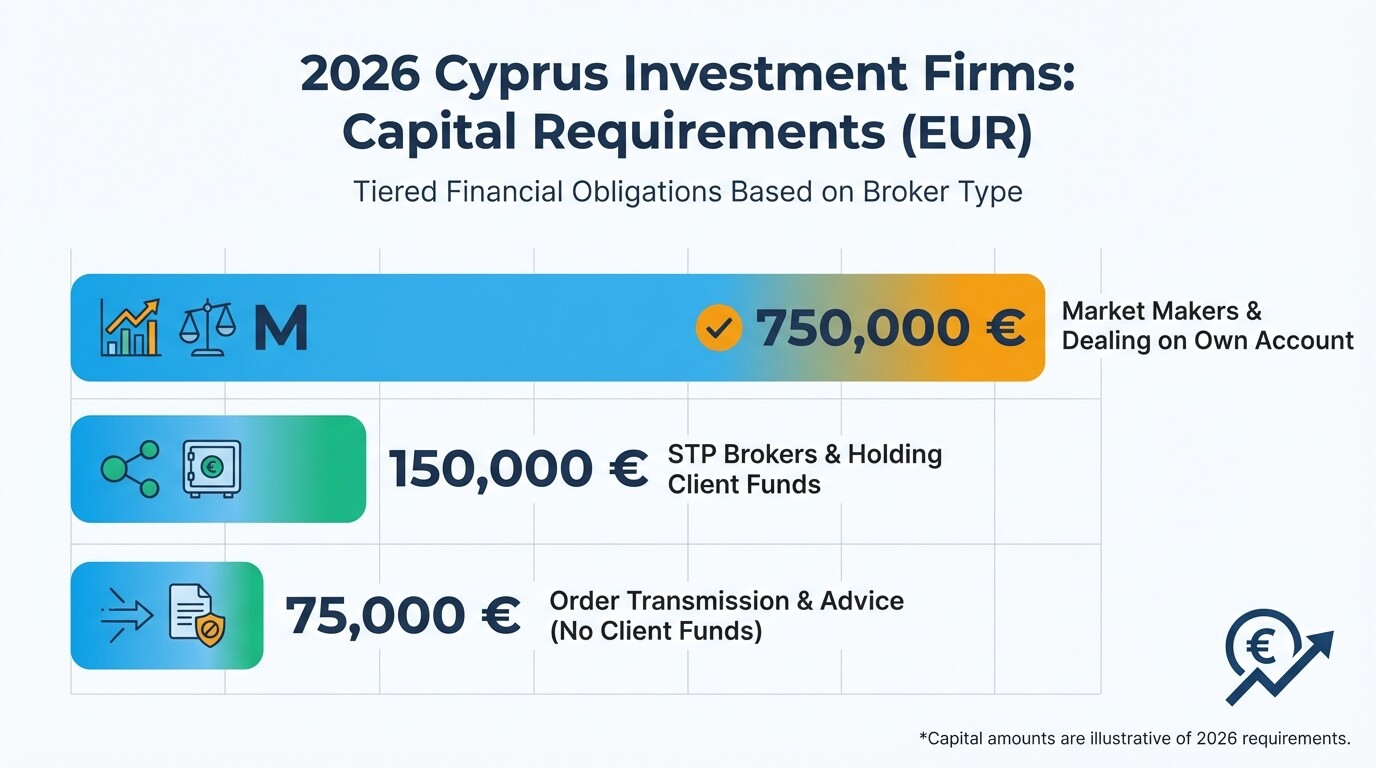
New European financial regulations under the Investment Firms Directive and Regulation (IFD/IFR) mandate strict initial capital thresholds that all Cyprus Investment Firms must maintain continuously. Depending on your firm's classification, base capital requirements range from 75,000 EUR to 750,000 EUR.
This capital must be deposited into a corporate bank account and remain entirely unencumbered, meaning it cannot be used for daily operational expenses or marketing.
- 750,000 EUR: Required for Market Makers and brokers dealing on their own account.
- 150,000 EUR: Required for STP brokers who execute client orders and hold client funds.
- 75,000 EUR: Required for brokers who only transmit orders or offer advice without ever holding client capital.
Firms must also continuously monitor their capital adequacy ratios to ensure they meet the K-factor requirements, which scale based on trading volume, client assets under management, and daily market risks.
Drafting the Business Plan and Internal Operations Manual
CySEC requires a comprehensive business plan and an Internal Operations Manual (IOM) to prove your brokerage is viable, compliant, and secure. These documents must detail your exact financial projections, target retail or institutional markets, and internal risk management protocols.
The business plan must look forward at least three years, outlining your marketing strategy, expected client acquisition costs, and revenue forecasts. It should clearly justify why Cyprus is the appropriate jurisdiction for your operations and how your business model will remain profitable under stressed market conditions.
The Internal Operations Manual serves as the rulebook for your daily business activities. It must exhaustively detail your Anti-Money Laundering (AML) and Countering the Financing of Terrorism (CFT) procedures. Furthermore, it must outline the exact reporting lines between departments, internal compliance monitoring systems, and protocols for handling client complaints.
Passing the CySEC Fit and Proper Test for Directors
CySEC evaluates the board of directors and senior management to ensure they possess the necessary integrity, experience, and knowledge to run a financial institution safely. Your firm must appoint at least four directors, including two executive directors who reside permanently in Cyprus.
To pass the "fit and proper" assessment, all directors and key personnel must provide clean criminal records, certificates of non-bankruptcy, and certified academic credentials. They must undergo intense scrutiny regarding their past financial dealings to ensure they have never been involved in fraud or regulatory breaches.
Additionally, CySEC strictly enforces the "four eyes" principle. This means the daily operations of the brokerage must be actively managed by at least two distinct individuals. The board must also include two independent, non-executive directors who are tasked with overseeing the executive team and protecting client interests.
Navigating the EU Passporting Legal Process
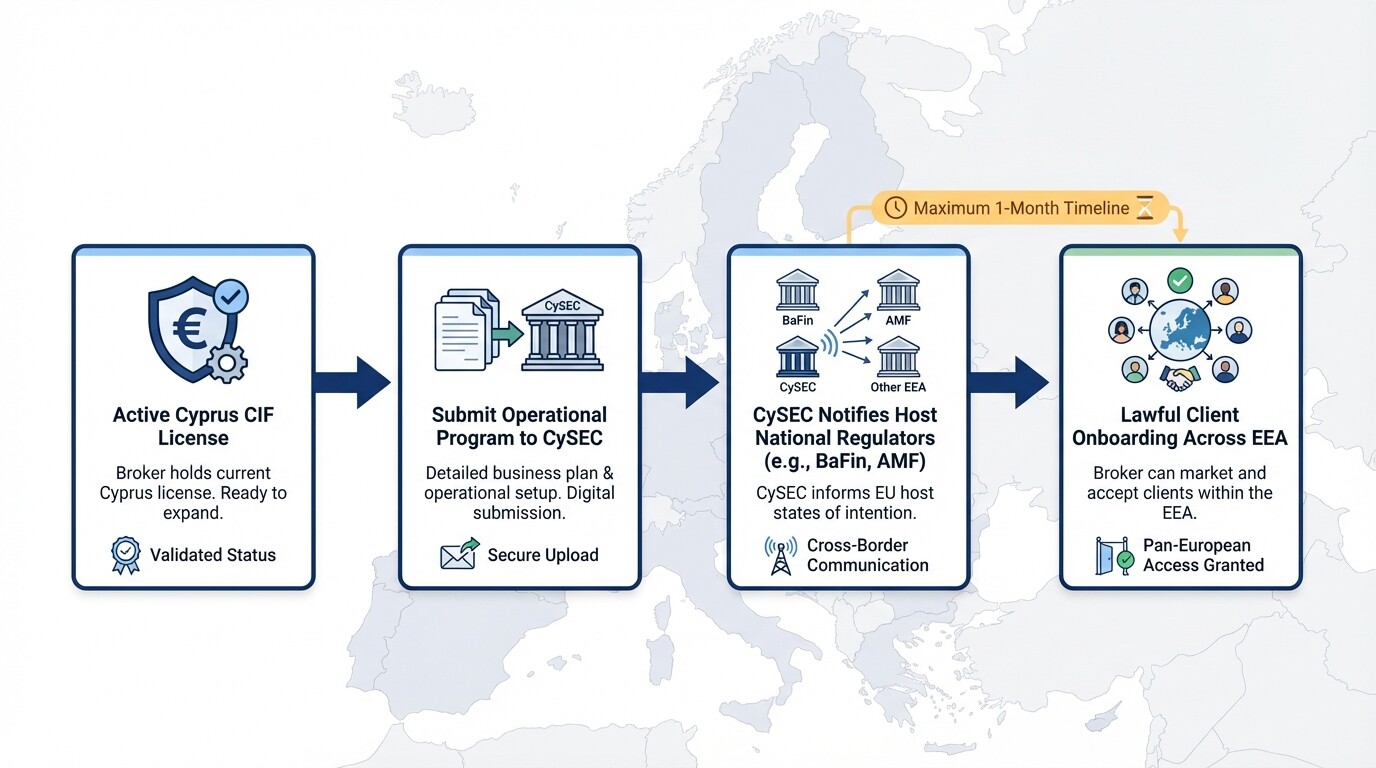
EU passporting allows a Cyprus-licensed broker to offer financial services across the entire European Economic Area without needing separate regulatory licenses in each member state. Once your CIF license is active, you must submit a formal notification to CySEC indicating the specific countries where you intend to acquire clients.
The process is highly streamlined compared to applying for multiple national licenses. You provide CySEC with an operational program detailing the services you will offer in the target host countries. CySEC then assumes responsibility for notifying the respective national regulators, such as BaFin in Germany or the AMF in France.
Within one month of CySEC sending this notification, your brokerage may lawfully begin onboarding clients and marketing its services in those specific European jurisdictions. If you are structuring a cross-border brokerage, consulting with Cyprus business registration lawyers ensures your passporting notifications are filed accurately and without delay.
Common Misconceptions About CySEC Licensing
Foreign brokers often misunderstand the operational and regulatory commitments required to maintain a Cyprus investment license. Clearing up these errors prevents application rejections, operational delays, and costly regulatory fines.
- Virtual offices are sufficient: Many applicants believe they can operate via a simple post office box or virtual office. In reality, CySEC mandates heavy local substance, requiring a fully functional physical office space in Cyprus staffed by local employees and compliance officers.
- Capital is a one-time fee: Brokers frequently assume the initial capital requirement is a fee paid to the regulator. This money remains yours, but it must be locked as a permanent safety net to protect client funds and cannot be spent on operating costs.
- Crypto services are automatically included: Traditional forex and securities brokers often assume a CIF license covers digital assets. To operate a cryptocurrency exchange or brokerage, you must obtain a specific Crypto Asset Services Provider (CASP) registration alongside or instead of your standard CIF license.
Frequently Asked Questions
How long does it take to get a CIF license?
CySEC officially aims to process licensing applications within six months of receiving a complete file. However, when factoring in the time required to incorporate the company, draft manuals, and respond to regulatory inquiries, the entire process typically takes 9 to 12 months.
What are the official CySEC application fees?
The initial application fee for a CIF license ranges from 4,000 EUR to 10,000 EUR depending on the core investment services your firm intends to offer. Additional fixed fees apply if you plan to extend your services later or operate a multilateral trading facility.
Can a foreign national own 100 percent of a Cyprus brokerage?
Yes, foreign nationals or foreign corporate entities can hold 100 percent of the shares in a Cyprus Investment Firm. The ultimate beneficial owners must simply pass CySEC's stringent due diligence and anti-money laundering background checks.
When to Hire a Lawyer and Next Steps
Engaging a specialized financial services lawyer is critical before you initiate company formation or draft your business plan. Legal counsel ensures your corporate structure aligns with MiFID II directives and CySEC's stringent operational criteria.
Do not attempt to navigate European financial regulations independently, as application errors result in immediate rejection and forfeiture of submission fees. A lawyer will project-manage the entire lifecycle, from drafting the Internal Operations Manual to communicating directly with CySEC examiners.
To move forward, define your exact brokerage model and identify your target European markets. Next, secure the required initial capital and partner with experienced lawyers in Cyprus to compile your corporate documentation and formally launch the application process.