


Registering a European Tech Subsidiary in Ireland: 2026 Legal Guide
- The Private Company Limited by Shares (LTD) is the most common corporate structure for international tech companies entering Ireland.
- You must appoint at least one company director who resides in the European Economic Area (EEA), or secure a Section 137 non-resident director bond.
- Base incorporation with the Companies Registration Office (CRO) takes 5 to 10 days. Fully setting up the company with banking and tax registrations averages 6 to 8 weeks.
- A subsidiary limits parent company liability, whereas a branch office leaves the parent entity legally and financially exposed to Irish operational risks.
- Operating an Irish tech subsidiary puts your company under the jurisdiction of the Irish Data Protection Commission for EU GDPR compliance.
Step-by-Step Process to Incorporate an Irish Tech Subsidiary
Incorporating an Irish tech subsidiary requires registering a Private Company Limited by Shares (LTD) with the Companies Registration Office (CRO) under the Companies Act 2014. The process involves drafting a constitution, appointing compliant directors, and establishing a physical registered office within the state. You do not need to visit Ireland to incorporate the company; you can complete the entire registration process remotely using legal representatives.
Follow these phases to execute your corporate registration:
- Reserve a corporate name: Submit your proposed company name to the CRO. It must be unique and include the suffix "Limited" or "Teoranta."
- Appoint directors: You must appoint at least one natural person as a director and a separate company secretary. A corporate entity cannot act as a director, though it can act as the secretary. If no directors reside in the EEA, you must purchase a Section 137 Non-Resident Director Bond. This €25,000 insurance bond acts as a guarantee to the Irish government against unpaid fines or tax liabilities and costs a premium of around €1,500 for a two-year period.
- Draft the constitution: An LTD requires a simplified constitution containing the company's name, share capital structure, and liability clause.
- File Form A1: Submit Form A1 online through the Companies Registration Office portal. This document details the registered office address, director details, secretary details, and subscriber information.
- File beneficial ownership: Within five months of incorporation, you must file details of the individuals who ultimately own or control more than 25% of the subsidiary with the Central Register of Beneficial Ownership.
- Register for tax: Submit your tax registration to the Revenue Commissioners to obtain your Tax Reference Number and VAT number. These are mandatory before conducting commercial activity.
Timeline Expectations: From Registration to Launch
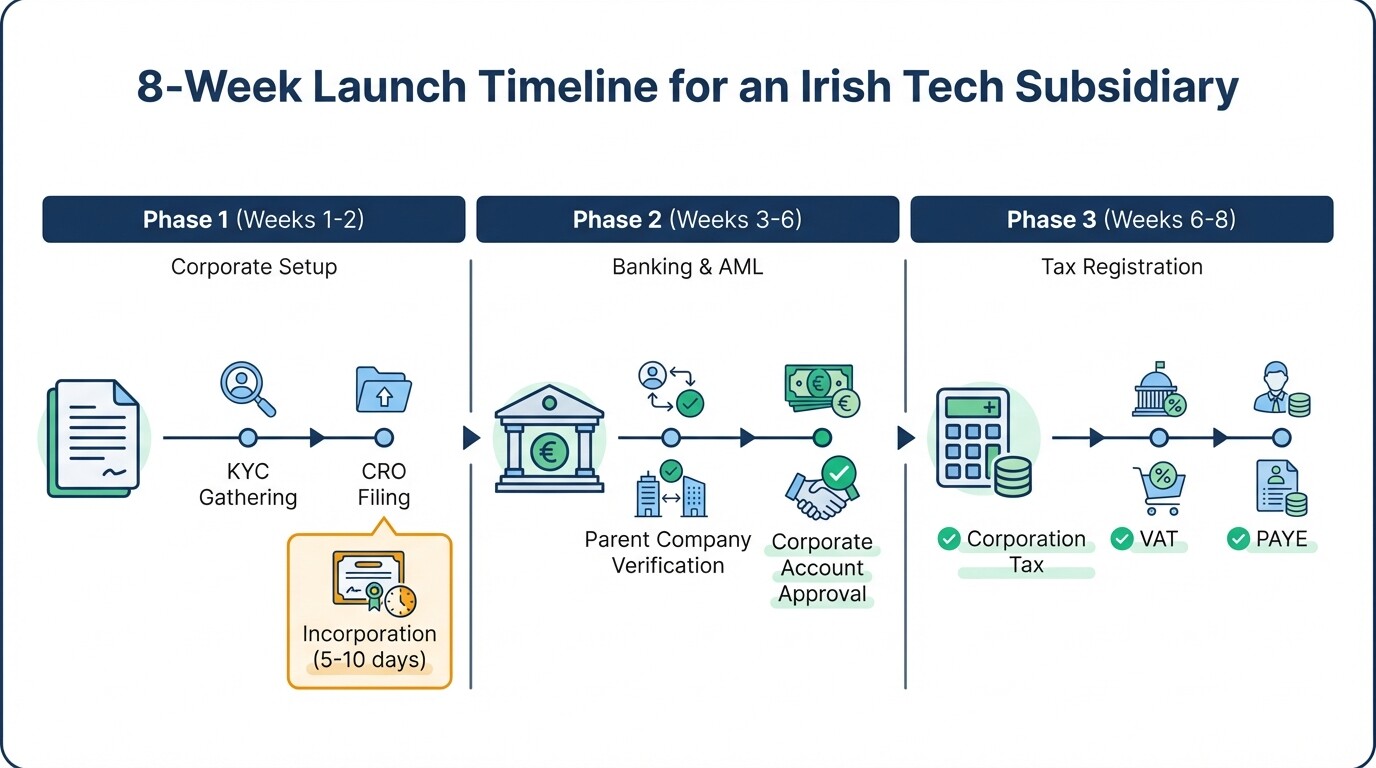
Setting up a fully operational tech subsidiary in Ireland takes an average of six to eight weeks. While the actual corporate registration with the government is fast, securing corporate bank accounts and tax registrations takes time.
- Weeks 1-2: Gather KYC (Know Your Customer) documents, draft the constitution, sign Form A1, and submit it to the CRO. The CRO issues the Certificate of Incorporation within 5 to 10 working days of receiving correct documentation.
- Weeks 3-6: Opening an Irish corporate bank account is the most time-consuming phase. Irish banks enforce strict Anti-Money Laundering (AML) regulations. They require extensive documentation regarding parent company ownership and the subsidiary's business model.
- Weeks 6-8: Register with the Revenue Commissioners for Corporation Tax, VAT, and PAYE (Pay As You Earn) for your local workforce. VAT registration takes 2 to 4 weeks depending on how quickly you prove domestic trading activities.
Estimated Registration Costs and Share Capital
You can expect the initial legal and administrative setup costs for an Irish tech subsidiary to range from €2,000 to €5,000, depending on your corporate structure. Irish law does not dictate a high minimum paid-up share capital for LTDs, keeping the financial barrier to entry low.
The standard authorized share capital is typically set at €100,000 divided into 100,000 shares of €1 each. You can incorporate the company with just €100 issued and paid up.
| Registration Expense | Estimated Cost (EUR) | Description |
|---|---|---|
| CRO Filing Fees | €50 - €100 | Statutory filing fee for Form A1 via the online portal. |
| Section 137 Bond | €1,500 - €2,000 | Required only if the company has no EEA-resident director. Valid for two years. |
| Registered Office | €300 - €600 | Annual fee for a physical commercial address in Ireland. |
| Legal Counsel | €1,500 - €3,500 | Fees for drafting the constitution, corporate governance advisory, and CRO filings. |
| Tax Services | €500 - €1,000 | Professional assistance registering for VAT, PAYE, and Corporation Tax. |
Subsidiary vs. Branch Office: Structuring Operations
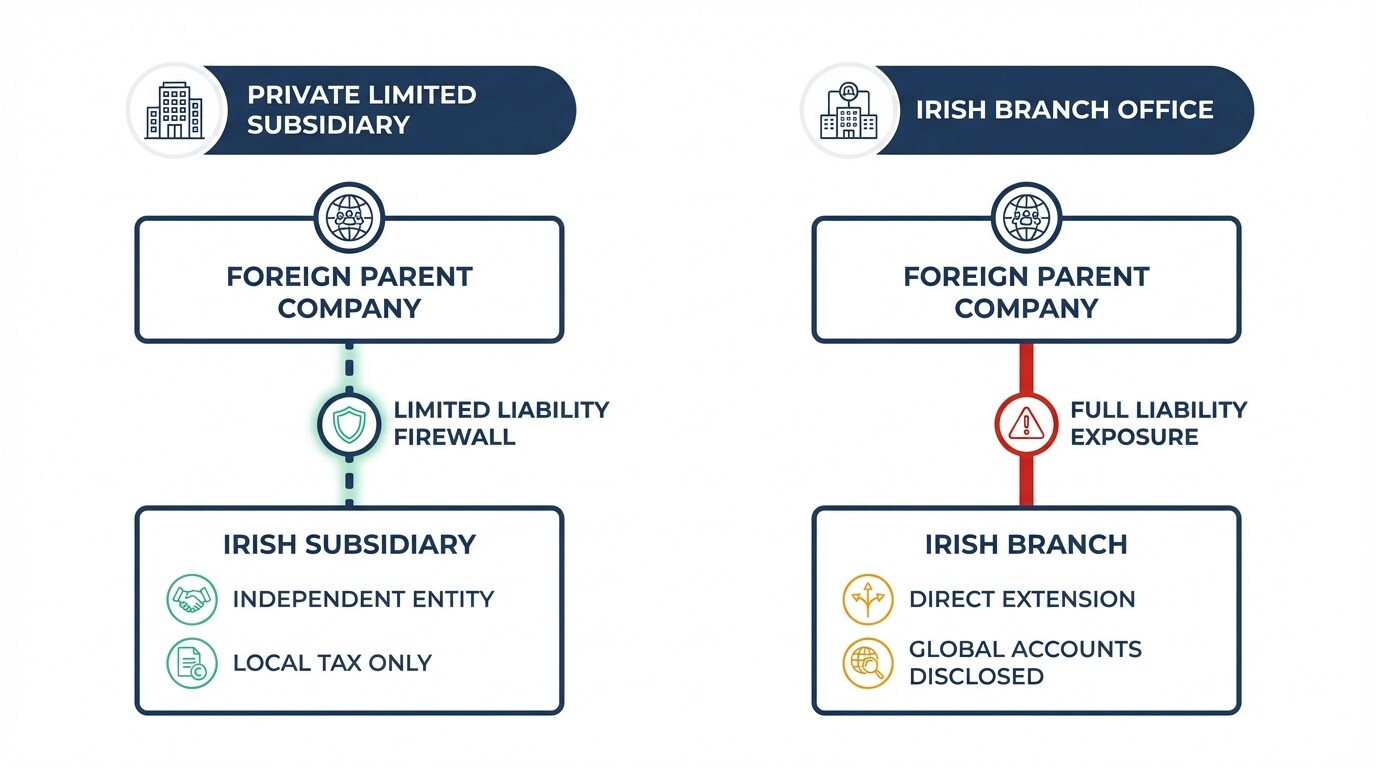
Foreign tech companies enter the Irish market by incorporating a local subsidiary or registering a branch office. A subsidiary is an independent legal entity that limits the parent company's liability. A branch is a direct operational extension of the foreign parent company.
For tech companies handling intellectual property, software licensing, and local employment, a subsidiary is the preferred route. When structuring a subsidiary, tech companies commonly use inter-company licensing agreements. The parent company retains ownership of the core IP and licenses the right to distribute, sell, or modify the software to the Irish subsidiary on an arm's-length basis.
| Feature | Private Limited Subsidiary | Irish Branch Office |
|---|---|---|
| Legal Independence | Separate legal entity. | Extension of the parent company. |
| Liability | Parent company liability is limited to its share capital contribution. | Parent company assumes full legal and financial liability for the branch. |
| Tax Treatment | Taxed at the Irish corporate rate on worldwide income. | Taxed at the Irish corporate rate only on income generated by the Irish branch. |
| Public Disclosure | Must file subsidiary accounts with the CRO. | Must file the parent company's global financial accounts with the CRO. |
| Setup Speed | 5 to 10 days for CRO incorporation. | 3 to 4 weeks for branch registration. |
Cross-Border Compliance and Data Privacy
Operating a tech subsidiary in Ireland requires compliance with Irish corporate governance and European Union data protection regulations. The Irish Data Protection Commission (DPC) acts as the lead supervisory authority for many global tech firms under the General Data Protection Regulation (GDPR).
Your ongoing compliance obligations include:
- GDPR accountability: If your subsidiary processes data of EU citizens, you must map data flows, establish legal bases for processing, and manage cross-border data transfers using Standard Contractual Clauses (SCCs). You can find specific guidance on data transfer mechanisms through the Data Protection Commission.
- Annual returns: Every Irish company must file an Annual Return with the CRO at a designated Annual Return Date (ARD). This filing details the current directors, secretary, registered office, and share capital.
- Economic substance: To qualify for Ireland's 12.5% corporate tax rate on trading income, the subsidiary must demonstrate real economic substance. This requires local employees, a physical footprint, and independent local management making strategic decisions. Shell entities do not qualify for the active trading rate.
Common Misconceptions About Irish Incorporation
International founders often misunderstand the residency requirements and tax structures associated with Irish companies. Clarifying these rules early prevents costly delays in your market entry.
- Director residency: You only need one director who is a resident of the European Economic Area (EEA). If you lack an EEA resident director, you bypass this requirement by purchasing a Section 137 non-resident director bond.
- Corporate tax rate: Merely registering a company does not grant you the 12.5% tax rate. You must actively trade in Ireland to qualify. Passive income, such as certain royalty streams or global investments channeled through an inactive local office, is taxed at 25%.
- Bank accounts: Strict AML checks mean corporate bank accounts for foreign-owned entities take weeks to authorize. You cannot open a bank account on the day of incorporation.
When to Hire a Business Registration Lawyer
Engaging a lawyer ensures your corporate structure complies with the Companies Act 2014 and protects your intellectual property during cross-border transfers. Hire legal counsel before finalizing shareholder agreements, applying for tax registration, or signing commercial leases in Ireland. A local lawyer will draft a tailored constitution, manage the AML requirements for banking, and ensure your director setup aligns with residency laws.
Next Steps
To begin your expansion into the Irish market, gather KYC documentation (passports and utility bills) for your proposed directors and shareholders. Next, determine whether you will deploy an EEA-resident director or require a Section 137 bond. Once these structural decisions are made, connect with business registration lawyers in Ireland to reserve your company name and initiate the CRO filing process.