

Incorporating a Foreign-Owned Tech Startup in Nigeria: The Complete Guide
Key Takeaways
Foreign founders entering Nigeria face a specific regulatory framework designed to protect local markets while encouraging international investment.
- A minimum share capital of 100 million Nigerian Naira (NGN) is legally required for any company with foreign shareholders.
- Registration with the Corporate Affairs Commission (CAC) is only the first step; foreign entities must also secure post-incorporation permits.
- The Nigerian Investment Promotion Commission (NIPC) mandates registration for all foreign-backed businesses to guarantee the repatriation of profits.
- Securing a Business Permit from the Ministry of Interior is mandatory before a foreign-owned startup can legally commence operations.
Minimum Share Capital Requirements for Foreign Ownership
Foreign-owned companies in Nigeria must register with a minimum issued share capital of 100,000,000 NGN. This mandatory threshold ensures that international entities demonstrate sufficient financial capacity to operate within the local economy and qualifies the company to apply for necessary business permits.
This requirement applies whether the startup is a joint venture with Nigerian partners or a wholly foreign-owned subsidiary. The capital does not need to be deposited as a lump sum in cash into a bank account prior to incorporation. Instead, the shares must be legally allotted to the shareholders during the registration process. You will, however, be required to pay stamp duties and filing fees based on this 100 million NGN valuation. Attempting to register with a lower share capital will result in the Ministry of Interior rejecting your subsequent applications for business permits and expatriate quotas.
Local Directorship and Registered Office Requirements
The Companies and Allied Matters Act (CAMA) 2020 allows foreign companies to be 100 percent foreign-owned, but they must maintain a registered physical office address in Nigeria. While the law permits a company to have entirely foreign directors, having at least one resident director simplifies compliance and banking procedures.
To operate legally, your registered office must be a verifiable commercial address in Nigeria, not a post office box. This address will be used for all statutory correspondence and tax filings. Regarding directorship, foreign directors are perfectly legal. However, opening a corporate bank account in Nigeria requires a Bank Verification Number (BVN). Obtaining a BVN requires physical capture of biometrics, meaning foreign directors must either travel to Nigeria or visit specific authorized centers abroad. Appointing a trusted local director or a nominee director can bypass these immediate banking delays and accelerate your launch timeline.
Step-by-Step Checklist: Navigating the CAC Registration Process
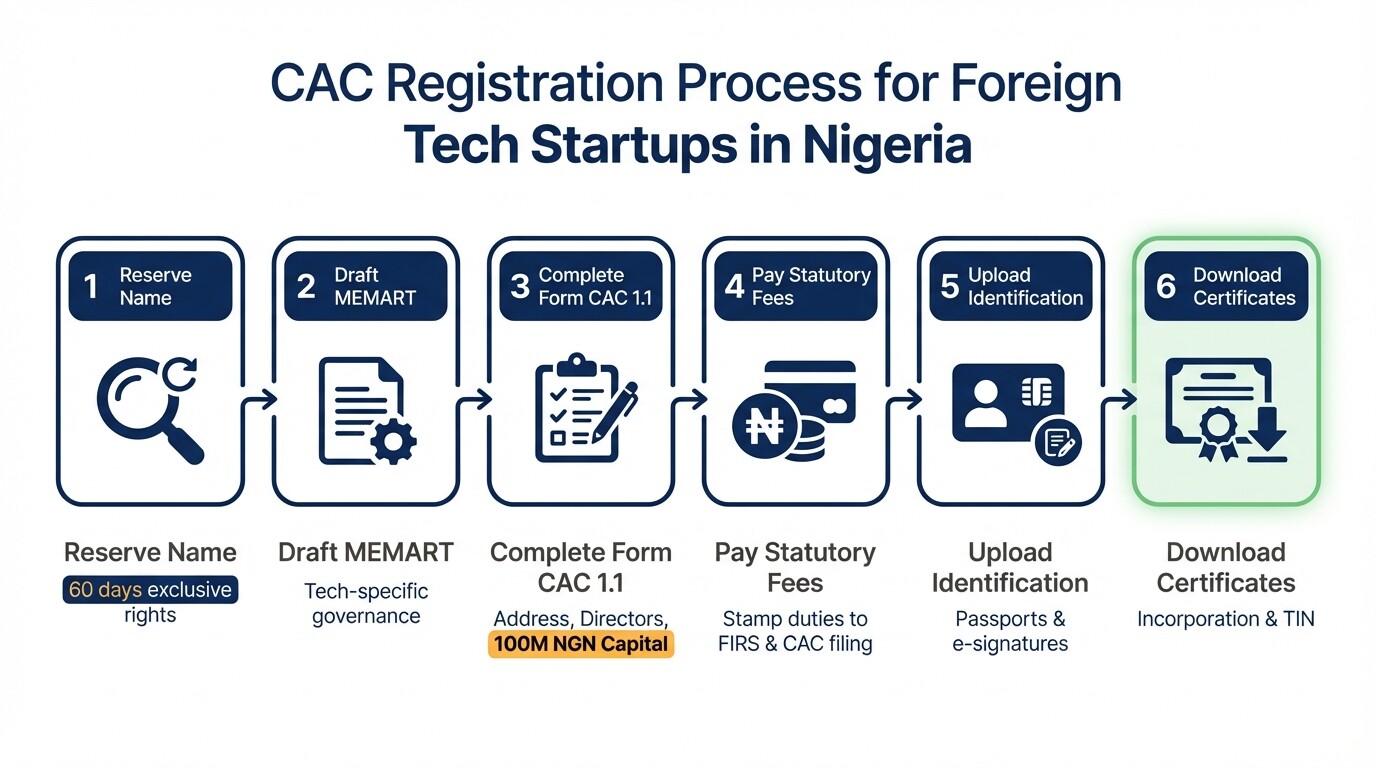
Registering a company with the Corporate Affairs Commission (CAC) is a digitized process completed through the national Company Registration Portal. Foreign founders must complete name reservation, document submission, and fee payment to receive their certificate of incorporation.
To successfully incorporate your tech startup, follow this procedural checklist:
- Reserve the Company Name: Submit two preferred names to the CAC portal to check for availability and secure exclusive rights to the name for 60 days.
- Draft the MEMART: Prepare a Memorandum and Articles of Association tailored to a technology business, outlining your operational scope and governance rules.
- Complete Form CAC 1.1: Fill out the statutory incorporation documents detailing the registered address, directors, shareholders, and the 100 million NGN share capital allotment.
- Pay Statutory Fees: Remit the required stamp duties to the Federal Inland Revenue Service (FIRS) and the filing fees to the CAC through the government's Remita payment gateway.
- Upload Identification: Provide valid government-issued identification (international passports) and electronic signatures for all foreign directors and shareholders.
- Download Certificates: Once approved, download your Certificate of Incorporation, Status Report, and automatically generated Tax Identification Number (TIN).
Registering with the Nigerian Investment Promotion Commission (NIPC)
Every business with foreign participation must register with the NIPC before commencing active tech operations. This mandatory registration protects foreign investments and guarantees the unconditional transfer of capital and profits out of Nigeria.
The Nigerian Investment Promotion Commission (NIPC) serves as the primary federal agency coordinating foreign direct investment. By registering, your startup gains legal protection against nationalization and becomes eligible to apply for the Pioneer Status Incentive. This incentive can grant your tech startup a tax holiday from corporate income tax for up to five years, provided your specific technology sector qualifies under the current pioneer industry list. Registration requires submitting your newly acquired CAC documents, proof of capital importation, and a completed NIPC form.
Securing Business Permits and Expatriate Quotas
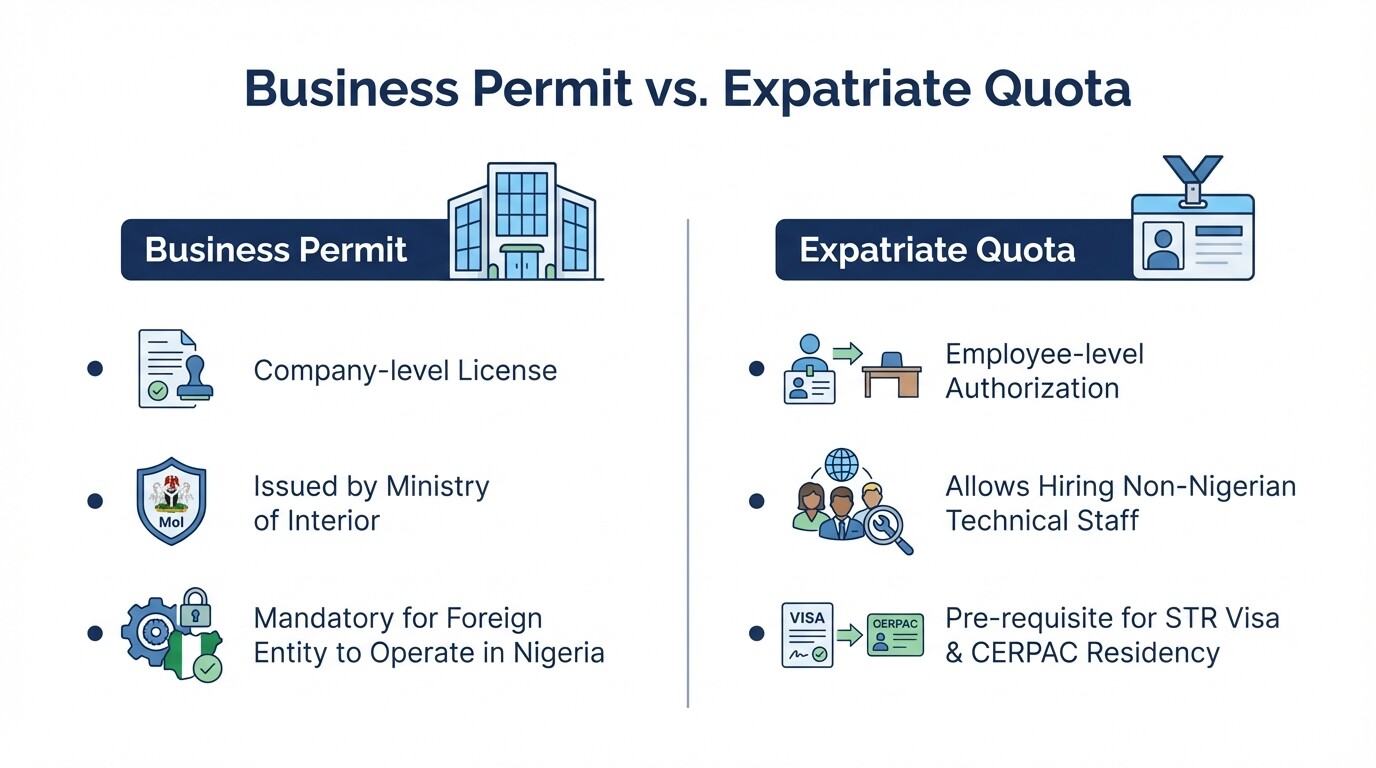
A Business Permit is the official authorization from the Ministry of Interior allowing foreign-owned companies to conduct business in Nigeria. If you plan to relocate foreign technical staff or founders to Nigeria, you must also secure an Expatriate Quota.
A Business Permit is a company-level license required for the entity itself to operate legally. Without it, your company is not fully compliant, regardless of your CAC registration. Conversely, an Expatriate Quota is an employee-level authorization. It permits your startup to hire non-Nigerians for specific technical or managerial roles where local expertise might be scarce. Once the quota is granted, your foreign staff can apply for a Subject to Regularization (STR) visa, which is eventually converted into a Combined Expatriate Residence Permit and Aliens Card (CERPAC) for long-term residency and work.
Cost Breakdown: Statutory Fees for Tech Startups
The cost of incorporating a foreign-owned tech startup in Nigeria depends heavily on the 100 million NGN share capital requirement. Statutory fees are directly calculated as a percentage of this share capital, making the initial setup cost higher for foreign founders than for local entrepreneurs.
| Fee Category | Governing Body | Estimated Cost Profile |
|---|---|---|
| Stamp Duties | Federal Inland Revenue Service | 0.75 percent of the share capital |
| CAC Filing Fees | Corporate Affairs Commission | NGN 5,000 for the first 1M, plus NGN 2,500 per subsequent 1M |
| NIPC Registration | NIPC | Flat fee of NGN 15,000 |
| Business Permit | Ministry of Interior | Flat processing fee of NGN 100,000 |
Common Misconceptions About Nigerian Tech Incorporation
Navigating the Nigerian regulatory landscape often brings up misunderstandings about ownership limits and tax obligations. Clearing up these myths prevents costly delays in your launch timeline and ensures regulatory compliance.
First, many founders believe they are legally required to have a Nigerian co-founder to start a tech company. This is false. Except for a few heavily restricted sectors like oil and gas or broadcasting, technology startups can be 100 percent foreign-owned under CAMA 2020.
Second, foreign investors often assume the 100 million NGN minimum share capital must be deposited in cash into a Nigerian bank account before registration. In reality, this is authorized and issued capital. You must pay the government stamp duties and filing fees based on that amount, but the actual cash does not need to be sitting in a bank account on day one.
Frequently Asked Questions (FAQs)
Can a foreign tech startup operate in Nigeria without local registration?
No. Under Nigerian corporate law, a foreign company cannot routinely conduct business or exercise corporate powers in Nigeria without first registering a local subsidiary with the Corporate Affairs Commission.
How long does the CAC business registration process take?
If all documents are correctly prepared and signed, the initial CAC registration typically takes 3 to 7 business days. However, acquiring post-incorporation permits like the Business Permit and NIPC registration can take several additional weeks.
Do I need to visit Nigeria to register my startup?
No. The entire CAC incorporation process is fully digitized and can be completed remotely. However, opening a local corporate bank account will require biometric verification, which may necessitate a brief visit or the use of authorized international centers.
What is a Certificate of Capital Importation (CCI)?
A CCI is an official document issued by an authorized Nigerian bank confirming an inflow of foreign currency for investment. You need a CCI to legally repatriate your dividends, profits, or capital back to your home country in the future.
When to Hire a Corporate Lawyer
While standard company registration might seem straightforward on a government portal, foreign founders face complex cross-border compliance, tax structuring, and immigration hurdles. A local corporate lawyer ensures your startup meets all statutory obligations without exposing your global entity to liability.
You should engage experienced business registration lawyers in Nigeria before you reserve a company name. Legal counsel will correctly structure your share capital to satisfy the Ministry of Interior, draft a tech-specific Memorandum and Articles of Association, and handle the physical follow-ups required for NIPC and Expatriate Quota approvals. They also ensure your intellectual property is correctly assigned to the new Nigerian entity.
Next Steps for Foreign Founders
Moving your tech startup into the Nigerian market requires a sequenced approach to avoid regulatory bottlenecks. Prioritize your corporate structure before applying for any specific operational licenses like fintech or healthtech regulatory approvals.
Begin by confirming your corporate structure and ensuring your founding team understands the 100 million NGN share capital fee implications. Next, gather notarized copies of international passports for all foreign shareholders and directors. Once your documents are ready, partner with local legal counsel to initiate the CAC name reservation and draft your incorporation documents.