- Determine Ownership Limits: Always consult the Foreign Investment Negative List (FINL) first to verify if your target industry permits 100% foreign ownership.
- Capital Requirements: Domestic market enterprises generally require a minimum paid-in capital of USD 200,000, while export market enterprises have significantly lower thresholds.
- Choose the Right Structure: Decide between a Domestic Subsidiary, a Branch Office, or a Representative Office based on liability, tax implications, and revenue generation goals.
- Sequential Registration: Philippine corporate registration requires a sequential process starting with the Securities and Exchange Commission (SEC), followed by local government units, and ending with the Bureau of Internal Revenue (BIR).
- Authentication is Mandatory: All foreign corporate documents submitted to the SEC must be apostilled in the home country prior to submission.
Navigating the Foreign Investment Negative List
The Foreign Investment Negative List (FINL) dictates which economic sectors in the Philippines restrict or prohibit foreign equity. Before drafting formation documents, you must verify that your planned business activities are not restricted to 100% or 60% Filipino ownership.
The Philippine government regularly updates the FINL to outline sectors reserved for domestic control. The list is divided into two parts:
- List A: Sectors restricted by constitutional mandate or specific laws. This includes mass media (0% foreign ownership allowed), retail trade enterprises with paid-up capital below the required threshold, and professions like engineering and law.
- List B: Sectors restricted for reasons of national security, defense, public morals, and public health. This limits foreign ownership in industries like arms manufacturing or the operation of domestic saunas and bathhouses to 40%.
If your business activity does not fall under List A or List B, you can generally register as a 100% foreign-owned entity.
Comparing Business Structures: Branch vs. Subsidiary vs. Representative Office
Foreign companies typically expand into the Philippines through a Domestic Subsidiary, a Branch Office, or a Representative Office. The best choice depends on your planned revenue generation, liability limits, and intended operations.
Selecting the right corporate vehicle determines your legal exposure and operational flexibility under the Revised Corporation Code.
| Feature | Domestic Subsidiary | Branch Office | Representative Office |
|---|---|---|---|
| Legal Status | Separate legal entity from the parent company. | Extension of the foreign parent company. | Extension of the foreign parent company. |
| Liability | Limited to the subsidiary; parent company assets are protected. | Parent company assumes full liability for branch obligations. | Parent company assumes full liability. |
| Revenue Generation | Fully allowed to generate income in the Philippines. | Fully allowed to generate income in the Philippines. | Not allowed to generate income locally. |
| Primary Use | Independent local operations and broad commercial activities. | Executing parent company contracts locally (e.g., BPO, manufacturing). | Market research, client support, and quality control. |
| Taxation | Taxed on worldwide income (if domestic corp) or Philippine-sourced income. | Taxed only on Philippine-sourced income. | Exempt from income tax (as it earns no revenue). |
Minimum Paid-In Capital Requirements for Foreign Firms
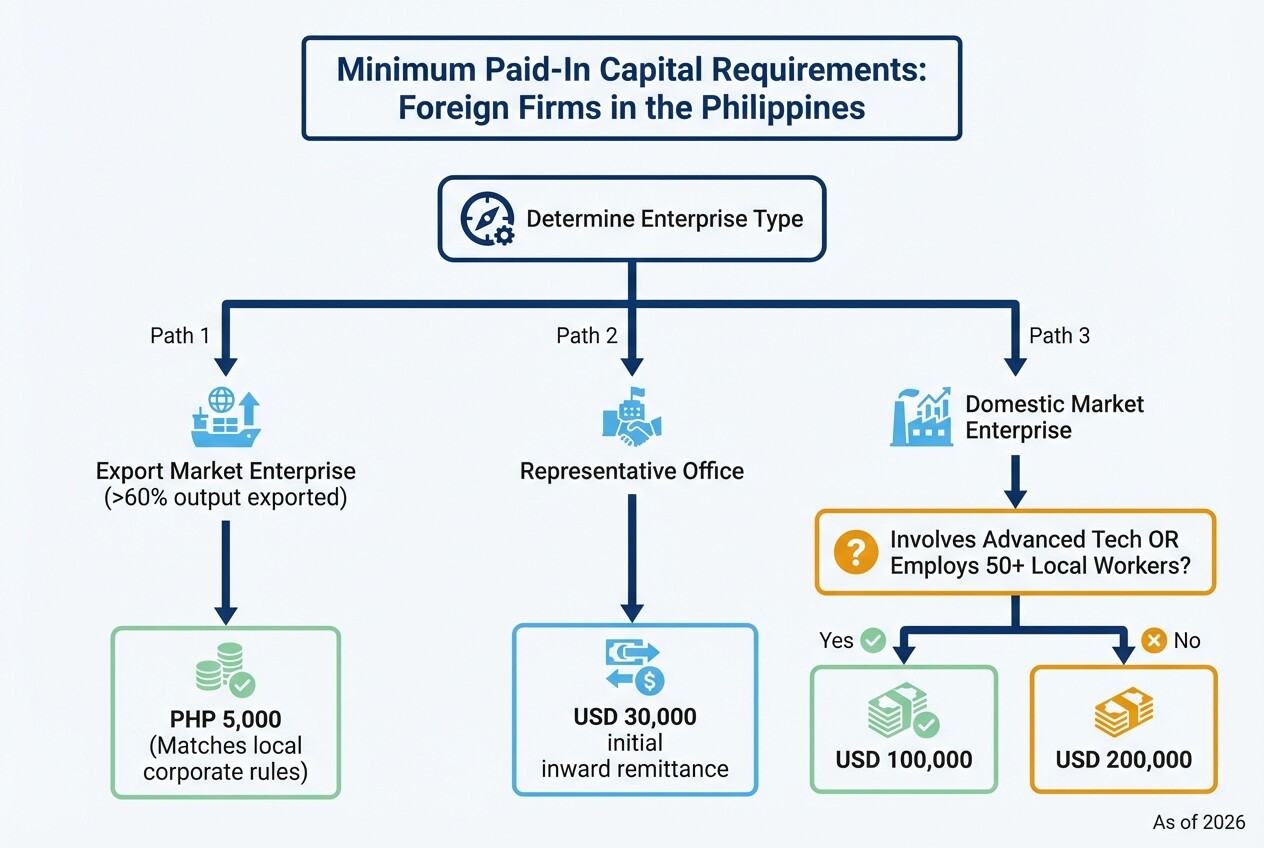
Minimum capital requirements for foreign-owned businesses in the Philippines range from zero to USD 200,000, depending on the chosen corporate structure and whether operations target the domestic or export market.
Understanding these capital thresholds is critical for successful SEC registration:
- Domestic Market Enterprise (DME): If the company will sell goods or services primarily within the Philippines (more than 40% domestic sales), the standard minimum paid-in capital is USD 200,000.
- DME Capital Reductions: The USD 200,000 requirement can be reduced to USD 100,000 if the business involves advanced technology (certified by the Department of Science and Technology) or directly employs at least 50 local workers.
- Export Market Enterprise (EME): If at least 60% of the company's output or services are exported, the business is considered an EME. The minimum capital requirement drops significantly, often matching standard local corporation rules (PHP 5,000), though banks will require practical operating amounts. Most Business Process Outsourcing (BPO) firms fall into this category.
- Representative Office: Must remit a minimum initial inward remittance of USD 30,000 to cover operating expenses.
Step-by-Step SEC Guide to Registering a Foreign Company
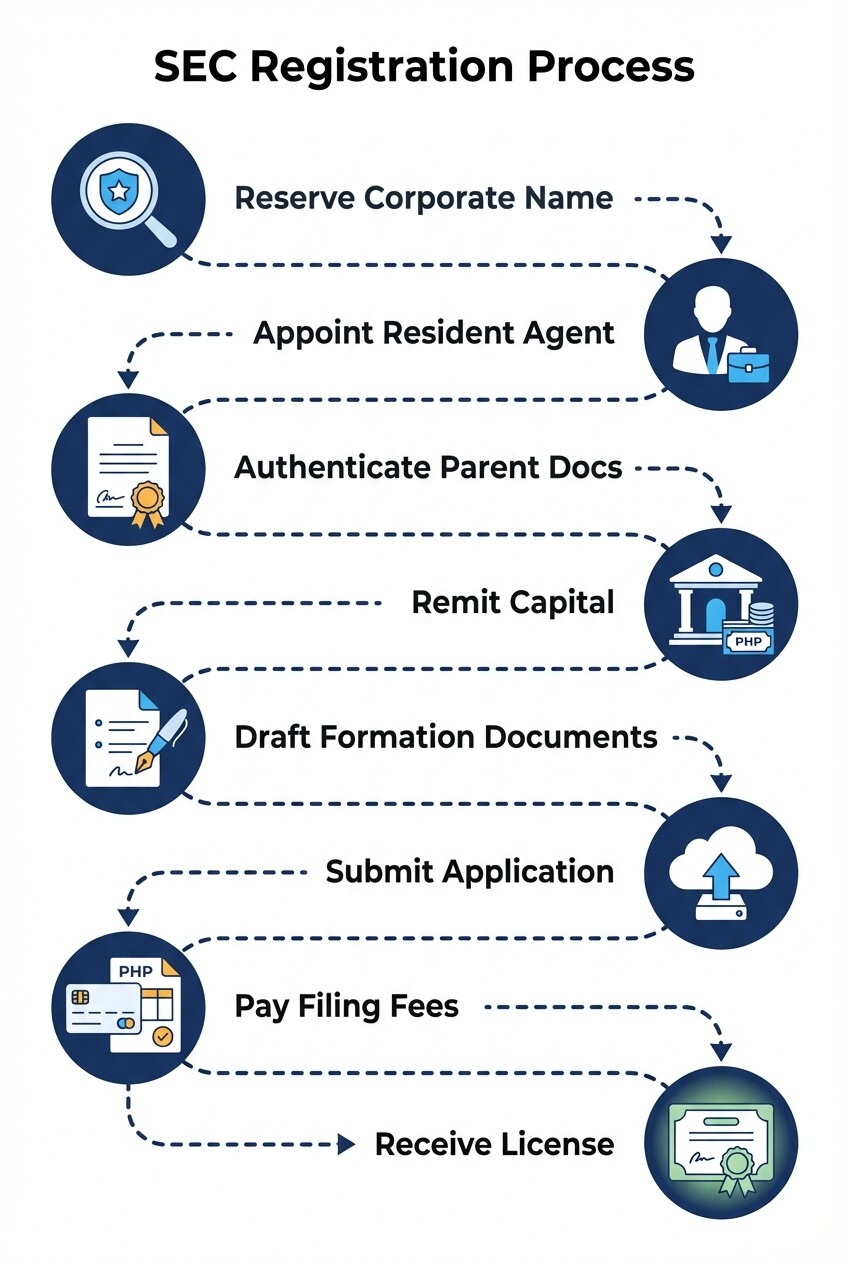
Securing a License to Do Business or incorporating a subsidiary requires formal approval from the Philippine Securities and Exchange Commission (SEC). This process involves reserving a corporate name, authenticating foreign documents, and filing through the SEC's digital portal.
Follow this checklist to establish your foreign entity via the SEC Electronic Simplified Processing of Application for Registration of Company (eSPARC):
- Reserve a Corporate Name: Search for and reserve your proposed business name through the SEC eSPARC portal. The name must include the corporate suffix (e.g., Inc., Corp.) and avoid restricted terms.
- Appoint a Resident Agent: All foreign branches and representative offices must appoint a Resident Agent. This individual must be a Philippine resident or a domestic corporation tasked with receiving legal summons on behalf of the foreign entity.
- Authenticate Parent Company Documents: Gather the parent company's Articles of Incorporation, By-laws, and Board Resolutions authorizing the Philippine expansion. These must be apostilled in the parent company's home country.
- Remit Required Capital: Open an "In-Trust-For" (ITF) or temporary corporate bank account in a Philippine bank and remit the required minimum paid-in capital (e.g., USD 200,000 or USD 30,000). Obtain a Certificate of Inward Remittance.
- Draft Formation Documents: Prepare the Articles of Incorporation and By-laws (for a subsidiary) or SEC Form F-104/F-108 (for a branch or representative office).
- Submit the Application: Upload all authenticated documents, bank certificates, and filled SEC forms to the eSPARC system.
- Pay Filing Fees: Once the SEC reviews and accepts the application, they will issue an Order of Payment. Fees vary based on the authorized capital stock and the type of entity.
- Receive the License: Upon clearing final review, the SEC will issue the Certificate of Incorporation (for subsidiaries) or the License to Do Business (for branches/representative offices).
Registering with the Bureau of Internal Revenue (BIR)
After SEC approval, all foreign entities must register with the Bureau of Internal Revenue (BIR) to obtain a Tax Identification Number (TIN), register books of accounts, and secure authority to print receipts. Operating without BIR registration is illegal and triggers severe financial penalties.
Registration must occur within 30 days of the SEC issuing your registration certificate. The process requires submitting BIR Form 1903 alongside your SEC documents, paying required Documentary Stamp Taxes (DST) on your capital stock, and registering your accounting books (manual, loose-leaf, or computerized). Once completed, the BIR issues a Certificate of Registration (BIR Form 2303), which must be displayed at your local office.
Common Misconceptions About Philippine Foreign Incorporation
Many foreign investors encounter operational delays due to misunderstandings about local corporate regulations. Clarifying these myths prevents costly setup errors and legal liabilities.
- Misconception: You always need a Filipino partner. While true for industries heavily restricted by the FINL (like real estate and retail under certain thresholds), a vast majority of commercial sectors, especially export-oriented businesses and BPOs, allow 100% foreign ownership.
- Misconception: A Representative Office can close sales. A Representative Office is strictly prohibited from generating revenue. If an employee in a Representative Office signs a local client contract, the entity violates its SEC license and faces immediate revocation and tax penalties.
- Misconception: SEC registration means you can start operating. SEC approval is only the first step. You cannot legally commence operations without securing a Mayor's Business Permit from the local government unit and completing your BIR tax registration.
Frequently Asked Questions
How long does SEC registration take for a foreign company?
The timeline typically ranges from 4 to 8 weeks after all apostilled documents are submitted. Delays most commonly occur during the authentication of foreign documents in the parent company's home country and the bank remittance process.
Do foreign corporate documents need to be authenticated?
Yes. Any document originating outside the Philippines, such as the parent company's charter or board resolutions, must be apostilled by the competent authority in the country of origin before the SEC will accept it.
Can a foreign company own land in the Philippines?
No. Foreign-owned companies (more than 40% foreign equity) cannot own private land in the Philippines. However, they can enter into long-term lease agreements, typically up to 50 years, renewable for another 25 years.
What is a Resident Agent?
A Resident Agent is a designated individual residing in the Philippines, or a domestic corporation, appointed by a foreign branch or representative office strictly to receive legal notices and court summons on behalf of the foreign parent company.
When to Hire a Business Registration Lawyer
Engaging local counsel is essential for navigating foreign equity restrictions, drafting compliant bylaws, and ensuring documents meet strict Philippine procedural requirements. A single error in equity allocation or an improper corporate classification can lead to rejected applications or heavy tax burdens.
Consulting business registration lawyers in the Philippines ensures your capital structure perfectly aligns with the Foreign Investment Negative List and expedites the complex multi-agency approval process.
Next Steps
- Review the Negative List: Cross-reference your exact business activity against the current Foreign Investment Negative List to confirm allowable foreign equity.
- Select Your Structure: Decide between a subsidiary, branch, or representative office based on your intended operations and revenue model.
- Prepare Initial Capital: Secure the required funding (e.g., USD 200,000 for domestic enterprises) and initiate discussions with a Philippine corporate bank for inward remittance.
- Gather Parent Documents: Begin drafting parent company board resolutions and send your existing corporate charters for apostille authentication in your home country.