- The Philippines operates on a "first-to-file" system, meaning the first entity to register a trademark or patent secures the rights, regardless of who used or invented it first.
- Registering your business name with the Department of Trade and Industry (DTI) or Securities and Exchange Commission (SEC) does not grant trademark protection.
- Software code and user interfaces are protected under copyright law in the Philippines, though registering them with the government provides crucial evidence of ownership.
- The Intellectual Property Office of the Philippines (IPOPHL) handles all formal IP registrations, with trademark processing typically taking 6 to 9 months.
- Sending a well-drafted cease-and-desist letter is the standard first step for resolving IP infringement before escalating to the IPOPHL Bureau of Legal Affairs.
Why Trademark Registration is Vital Before Launching a Product
Registering a trademark grants your startup exclusive rights to use your brand name, logo, or slogan in commerce and prevents competitors from hijacking your identity. Because the Philippines follows a strict "first-to-file" rule under the Intellectual Property Code, failing to register early leaves your brand vulnerable to theft.
When you launch an unregistered product, a competitor or trademark squatter can file an application for your exact name with the IPOPHL. If they secure the registration, they can legally force you to rebrand your entire company, destroying the goodwill and market presence you have built. Securing your trademark creates a legally enforceable barrier to entry, protects your domain name rights, and increases your startup's valuation in the eyes of investors who require clear ownership of core brand assets.
For official guidelines and filing procedures, you can reference the IPOPHL Trademark Services portal.
Startup IP Protection Checklist
Conducting a comprehensive IP audit ensures your startup secures its core assets before entering the market. Use this checklist to identify, organize, and protect your intellectual property before public launch.
- Audit Brand Assets: List all business names, product names, logos, and slogans that distinguish your startup in the market.
- Conduct Clearance Searches: Search the IPOPHL database and the World Intellectual Property Organization (WIPO) Global Brand Database to ensure your proposed names do not infringe on existing marks.
- Secure Domains and Social Handles: Register your primary domain names (.com and .ph) and claim corresponding social media handles before filing your public trademark application.
- Execute IP Assignment Agreements: Ensure all founders, employees, and independent contractors sign agreements legally transferring any IP they create for the startup to the company itself.
- File Priority Applications: Submit trademark and patent applications to the IPOPHL before publicly presenting your product at pitch competitions, trade shows, or crowdfunding platforms.
Timelines and Costs for IPOPHL Registration in 2024
Securing intellectual property requires strategic budgeting for government filing fees, publication fees, and processing times. Trademark registrations typically cost around PHP 3,000 to PHP 4,000 in government fees for a single class and take 6 to 9 months, assuming no office actions or oppositions.
The table below outlines the estimated timelines and base government fees for filing intellectual property in the Philippines as of 2024. These estimates exclude legal fees for patent drafting or attorney representation.
| IP Type | Estimated Timeline | 2024 Estimated IPOPHL Fees (Base) | | : | : | : | | Trademark | 6 - 9 Months | PHP 1,200 per class + PHP 1,800 publication fees + 1% Legal Research Fund (LRF) | | Patent (Invention) | 3 - 5 Years | PHP 4,000 filing + PHP 3,500 substantive examination + publication fees + 1% LRF | | Utility Model | 10 - 12 Months | PHP 3,000 filing + publication fees + 1% LRF | | Copyright | 1 - 2 Months | PHP 1,000 base fee + PHP 200 documentary stamp tax (per work) |
The Process of Filing a Patent for Local Inventions
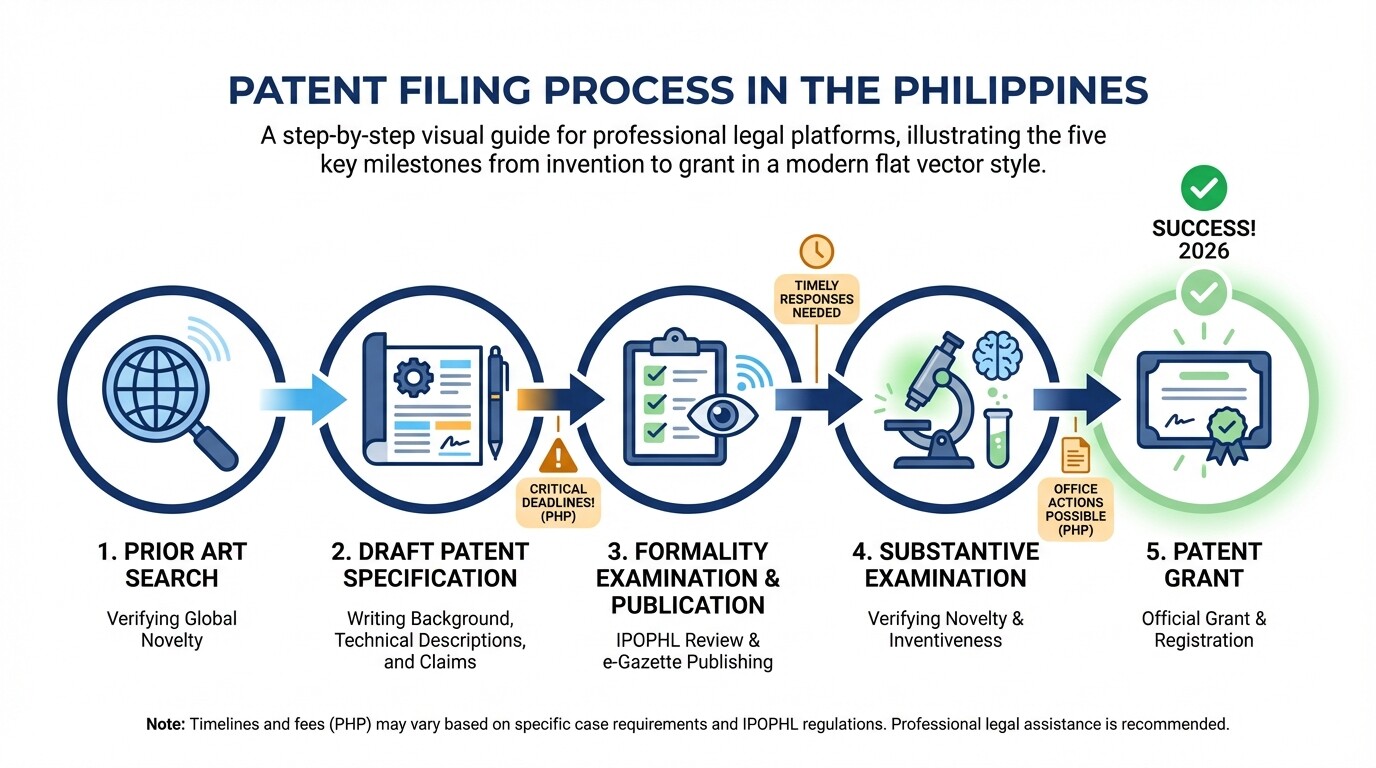
Filing a patent involves submitting a detailed technical disclosure to the IPOPHL to secure exclusive commercial rights for a novel, inventive, and industrially applicable invention. The process requires a prior art search, drafting claims, formal application submission, and a substantive examination by a patent examiner.
Start by conducting a thorough prior art search to confirm your invention has not been publicly disclosed anywhere in the world. Next, draft a patent specification that includes the background of the invention, detailed technical descriptions, drawings, and precise "claims" defining the exact scope of your legal protection. Once filed, the IPOPHL conducts a formality examination, publishes the application in the e-Gazette, and performs a substantive examination to verify novelty and inventiveness before granting the patent.
Copyright Protection for Software and Creative Works in the Philippines
Copyright protection in the Philippines applies automatically the moment original software code, user interfaces, or marketing materials are created in a tangible medium. However, securing a formal Certificate of Copyright Registration from the IPOPHL provides definitive legal proof of ownership, which is crucial during infringement disputes or due diligence.
Under Republic Act No. 8293, computer programs are explicitly protected as literary works. This covers your startup's source code, object code, and original database structures. While ideas and algorithms cannot be copyrighted, the specific way you express them in code can be. Filing a copyright deposit with the IPOPHL requires submitting a complete application form, a copy of the work (often the first and last 25 pages of source code), and paying the nominal registration fee.
How to Handle IP Infringement and Cease-and-Desist Letters
Addressing IP infringement begins by sending a formal cease-and-desist (C&D) letter that outlines your legal rights and demands the infringing party stop using your assets immediately. If the infringer ignores the letter, you can escalate the matter by filing an administrative complaint with the IPOPHL Bureau of Legal Affairs or initiating a civil lawsuit.
A strong C&D letter establishes a paper trail showing you actively defend your rights, which is legally necessary to maintain trademark validity. It should clearly identify the protected IP, provide proof of your IPOPHL registration, describe the infringing activity, and state a firm deadline for compliance.
Sample Cease-and-Desist Letter Structure
When drafting your notice to an infringing party, structure your communication using these core elements:
- Header & Delivery: Send via registered mail and email, explicitly stating "FOR SETTLEMENT PURPOSES ONLY."
- Identification of Rights: "Our company, [Startup Name], is the exclusive owner of the registered trademark [Trademark Name], registered with the IPOPHL under Registration No. [Number] on [Date]."
- Notice of Infringement: "It has come to our attention that your business is using an identical/confusingly similar mark, [Infringing Mark], in connection with [Products/Services]."
- Demand for Action: "We hereby demand that you immediately cease and desist all use of the mark, remove it from all digital and physical properties, and provide written confirmation of your compliance within [e.g., ten (10)] days."
- Consequences: "Failure to comply will result in our company pursuing all available legal remedies under the Intellectual Property Code of the Philippines, including damages and attorney's fees."
Common Misconceptions About Intellectual Property in the Philippines
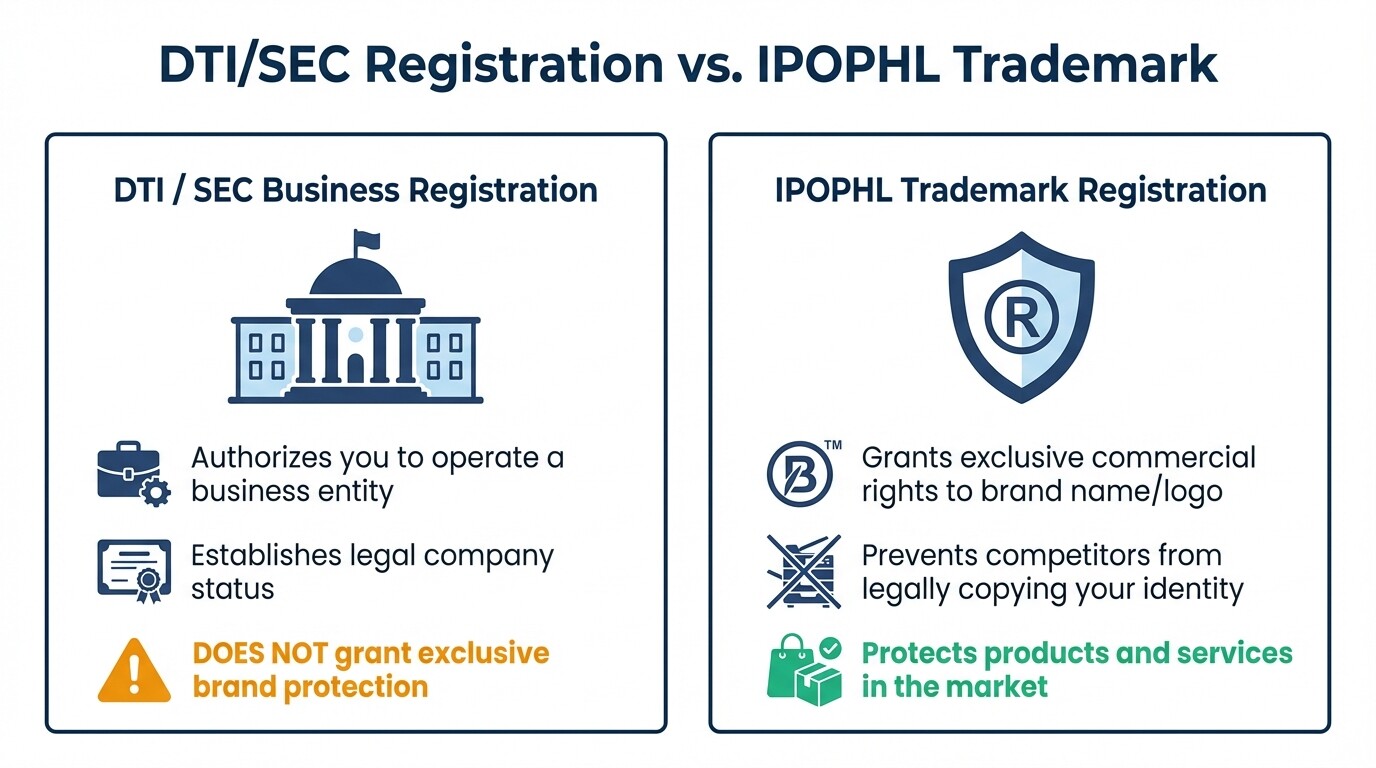
Many founders wrongly assume that registering a business name with the DTI or SEC automatically grants them trademark protection over that name. DTI and SEC registrations only authorize you to operate a business entity; they do not give you exclusive rights to use the name as a brand on products or services, which requires an IPOPHL trademark registration.
Another frequent myth is that intellectual property protection is global by default. IP rights are strictly territorial, meaning a trademark or patent registered in the Philippines only protects you within the country. If your startup plans to expand to Singapore or the United States, you must file separate applications in those jurisdictions or use international filing systems like the Madrid Protocol for trademarks.
Frequently Asked Questions
How long does a trademark last in the Philippines?
A trademark registration in the Philippines lasts for 10 years from the date of registration. It can be renewed indefinitely for consecutive 10-year periods, provided you file a Declaration of Actual Use (DAU) at the 3rd, 5th, and renewal anniversaries to prove the mark is still active in commerce.
Can I protect my startup's app idea?
No, pure ideas, concepts, and business methods cannot be protected by intellectual property law. You can only protect the execution of the idea: the source code and visual design through copyright, the branding through trademarks, and truly novel technical processes through patents.
Is software patentable in the Philippines?
Generally, computer programs per se are not patentable in the Philippines and are instead protected by copyright. However, software can be patented if it is part of a "computer-implemented invention" that provides a technical solution to a specific technical problem and interacts directly with hardware to produce a physical result.
When to Hire a Lawyer
You should hire an intellectual property lawyer when you need to respond to an "Office Action" from the IPOPHL examiner, draft complex patent claims for a novel invention, or enforce your rights against an infringing competitor. While founders can file simple trademarks on their own, navigating objections regarding "confusing similarity" or generic terms requires specialized legal arguments based on Philippine case law. Partnering with experienced business lawyers in the Philippines ensures your applications are structured correctly to withstand future legal challenges.
Next Steps
To begin securing your startup's intellectual property, start by compiling a comprehensive list of your brand names, logos, and proprietary software. Conduct a preliminary search on the IPOPHL database to ensure your chosen brand name is available, and require all team members to sign IP assignment agreements to consolidate ownership within the company. Once your assets are organized, prepare to file your foundational trademark and copyright applications before launching your product to the public.