- Strict Timelines: In the Philippines, you generally have 30 calendar days to file a formal "Answer" after receiving a summons; failing to do so can result in a default judgment against your business.
- Small Claims Threshold: Disputes involving money claims of PHP 1,000,000 or less are handled in Small Claims Court, where lawyers are prohibited from representing you during the actual hearing.
- Mandatory Mediation: Most civil cases in the Philippines require Court-Annexed Mediation (CAM) to encourage an out-of-court settlement before the trial proceeds.
- Labor Primacy: Many small business lawsuits originate from labor disputes; these are handled by the National Labor Relations Commission (NLRC) rather than traditional civil courts.
- Documentation is King: Your defense relies almost entirely on written evidence, such as notarized contracts, official receipts, and payroll records, which must be attached to your initial response.
Common reasons small businesses get sued in the Philippines
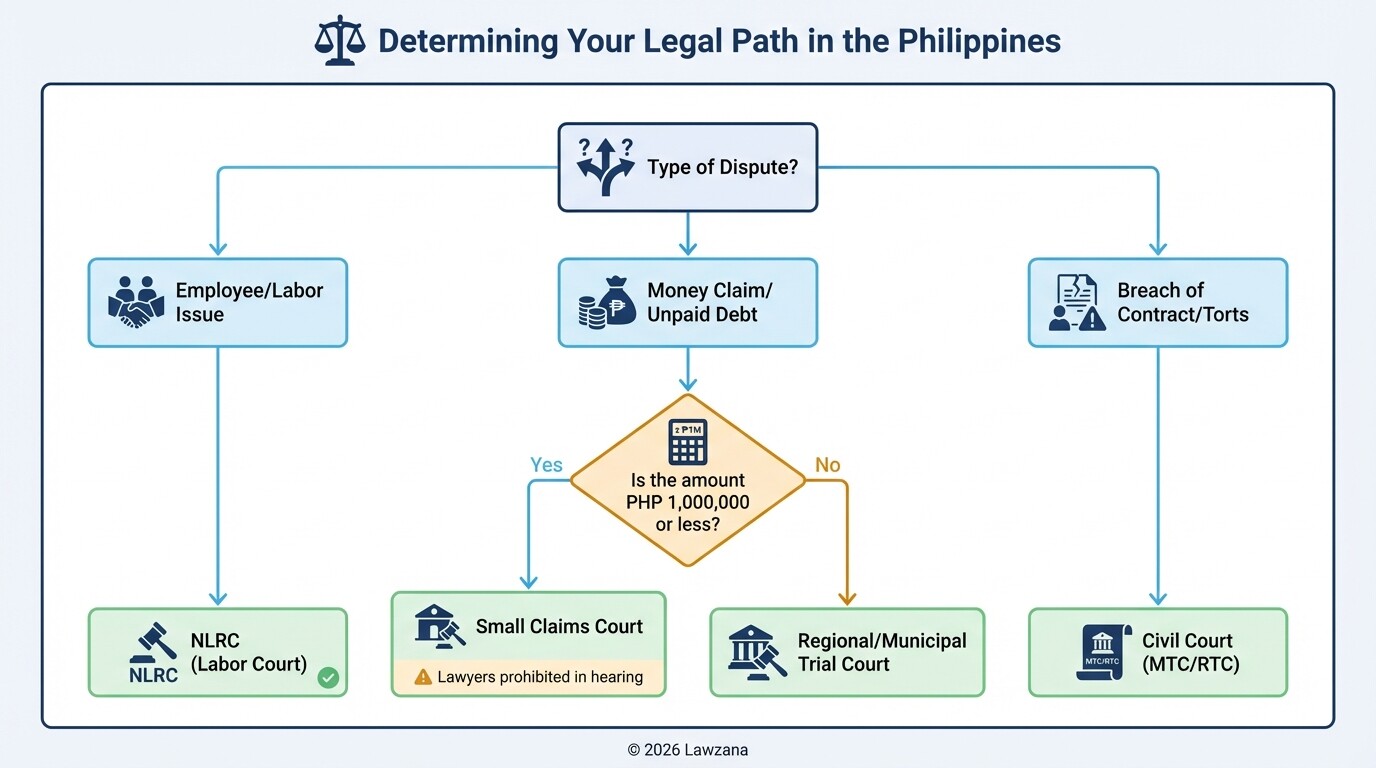
Small businesses in the Philippines typically face litigation due to labor disputes, unpaid debts, or breach of contract with suppliers and clients. These cases often stem from a lack of written agreements or a failure to follow the strict procedural requirements of the Philippine Labor Code.
- Labor and Employment Issues: This is the most common trigger. Employees may sue for illegal dismissal, non-payment of the 13th-month pay, or failure to remit SSS, PhilHealth, and Pag-IBIG contributions.
- Collection of Sum of Money: Suppliers or creditors may file a lawsuit if your business fails to settle outstanding invoices. If the amount is under PHP 1,000,000, it proceeds as a Small Claims case.
- Breach of Contract: This occurs when a business fails to deliver goods or services as promised, or when a lease agreement is violated.
- Consumer Complaints: Under the Consumer Act of the Philippines, customers can file complaints with the Department of Trade and Industry (DTI) for defective products or deceptive sales practices.
- Tort or Quasi-Delict: If someone is injured on your business premises or due to your business operations, they may sue for damages.
What to do as soon as you receive a summons, subpoena, or demand letter
Upon receiving a legal notice, you must immediately verify the nature of the document and note the exact date and time of receipt. Distinguishing between a private demand letter and a court-issued summons is critical, as the latter carries immediate legal consequences and strict deadlines.
- Verify the Document: A demand letter from a private lawyer is an invitation to settle. A Summons is an official order from a court requiring you to respond to a filed Complaint.
- Note the Receipt Date: The "clock" for your legal response starts the moment you or your authorized representative receives the document. In the Philippines, "Substituted Service" (leaving it with an adult at your office) is often considered valid service.
- Preserve All Evidence: Stop any routine document destruction. Gather all emails, text messages, receipts, and contracts related to the claimant.
- Identify the Court: Check if the case is in the Municipal Trial Court (MTC) or the Regional Trial Court (RTC). This determines the complexity and potential costs involved.
- Avoid Direct Contact with the Opposing Party: Once a formal lawsuit is filed, it is usually best to communicate only through legal counsel to avoid making self-incriminating statements.
Key timelines and documents you should not ignore
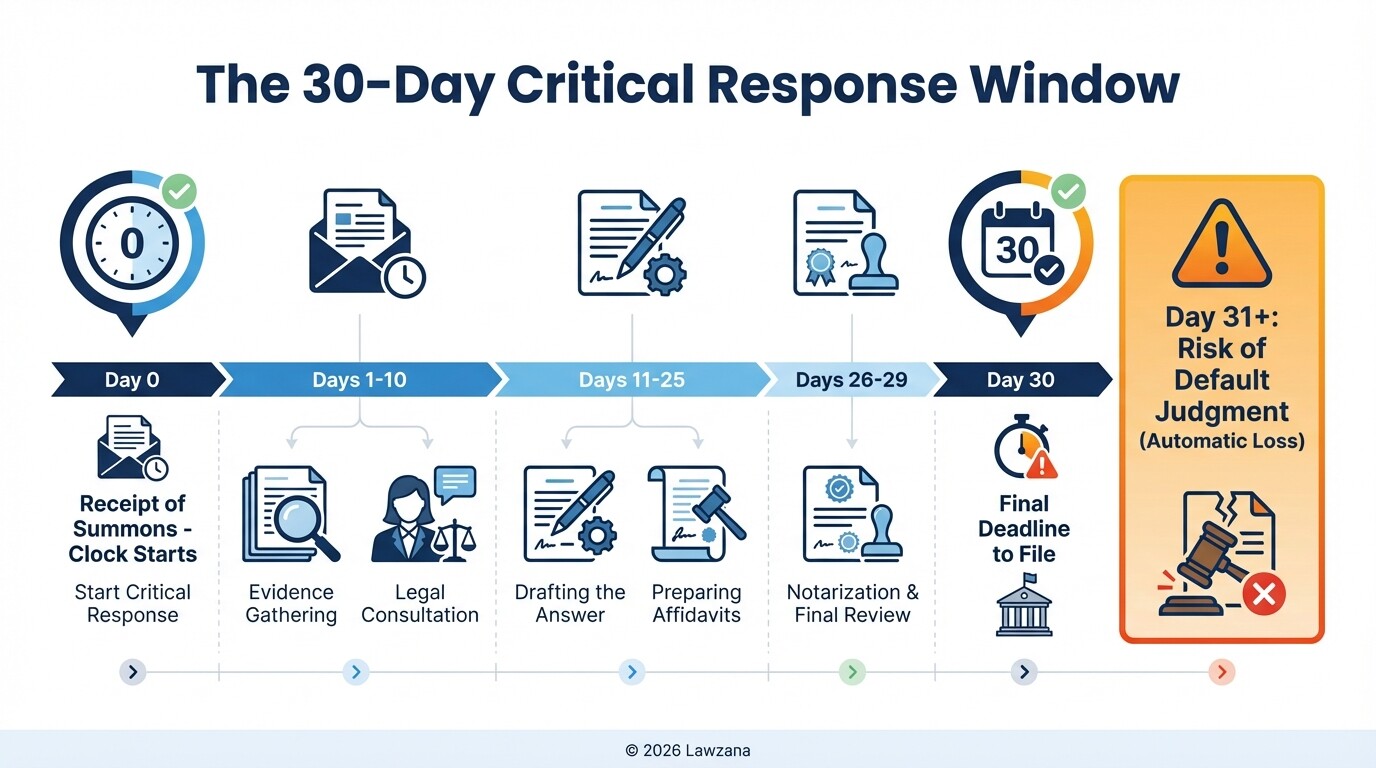
The Philippine legal system operates on rigid procedural windows, primarily governed by the 2019 Proposed Amendments to the 1997 Rules of Civil Procedure. Missing a deadline for filing a responsive pleading can lead to the court declaring your business "in default," meaning you lose your right to present a defense.
| Document/Action | Deadline | Consequence of Missing |
|---|---|---|
| Demand Letter | Usually 5-15 days | Potential filing of a formal lawsuit |
| Answer to Summons | 30 Calendar Days | Declaration of Default (Automatic Loss) |
| Small Claims Response | 10 Days | Immediate judgment based on the Complaint |
| Labor Case Position Paper | Usually 15 days from hearing | Case submitted for decision without your input |
| Notice of Appeal | 15 Days from Receipt of Decision | The judgment becomes final and executory |
Under the current rules, you must include all your "Affidavits" and "Object Evidence" (documents, photos) with your initial Answer. You generally cannot introduce new evidence later in the trial, making the first 30 days the most critical period for your defense.
Working with a lawyer to build your defense or negotiate settlement
Engaging a lawyer early allows you to explore "Compromise Agreements" which can save your business significant time and legal fees. In the Philippines, the court will almost always refer you to mediation, where a neutral third party helps both sides reach a middle ground.
- The Answer with Counterclaim: Your lawyer will draft an "Answer" that addresses each allegation in the complaint. If the plaintiff actually owes you money or caused you harm, your lawyer will file a "Compromise Counterclaim" to turn the tables.
- Court-Annexed Mediation (CAM): This is a mandatory stage. If you reach a settlement here, the case is closed, and the agreement has the force of a court judgment.
- Judicial Dispute Resolution (JDR): If mediation fails, a second attempt at settlement is often made before a different judge.
- Cost-Benefit Analysis: Legal fees in the Philippines can include a "Retainer Fee," "Appearance Fees" (PHP 3,000 to PHP 10,000+ per hearing), and "Pleading Fees." Sometimes, settling for a reasonable amount is cheaper than winning a five-year court battle.
How to prevent future disputes with better contracts and policies
Preventing lawsuits requires moving away from "handshake deals" and implementing standardized legal documentation for every business interaction. Most disputes in the Philippines arise from ambiguous verbal agreements that are difficult to prove in court.
- Standardized Employment Contracts: Ensure every employee-whether regular, probationary, or project-based-has a written contract that specifies job descriptions and causes for termination.
- Clear Terms and Conditions: Your invoices and quotations should include terms regarding payment deadlines, interest on late payments, and the "Venue of Action" (where you prefer to be sued, usually your local city).
- Compliance Audits: Regularly check your compliance with the Department of Labor and Employment (DOLE) regulations and local municipal ordinances to avoid administrative lawsuits.
- Notarization: Under Philippine law, notarizing a contract transforms it from a private document into a public document, which carries more weight as evidence in court.
Common Misconceptions
"I don't need to respond if the claims are lies."
Even if the lawsuit is completely baseless, the court will assume the allegations are true if you do not file a formal "Answer" within the 30-day window. Silence is legally treated as an admission in many procedural contexts.
"I can bring my lawyer to represent me in Small Claims."
While you should consult a lawyer to help you prepare your forms and evidence, the Supreme Court of the Philippines prohibits lawyers from appearing at the hearing to represent you in Small Claims cases. You must speak for your business yourself.
"If I close the business, the lawsuit goes away."
Closing a business does not automatically extinguish legal liabilities, especially for "Sole Proprietorships" where the owner's personal assets are at risk. For corporations, directors and officers can sometimes be held personally liable if fraud or gross negligence is proven.
Frequently Asked Questions
What is the maximum amount for a Small Claims case in the Philippines?
As of 2022, the threshold for Small Claims is PHP 1,000,000 in all Metropolitan Trial Courts, Municipal Trial Courts in Cities, Municipal Trial Courts, and Municipal Circuit Trial Courts. This process is designed to be fast, inexpensive, and informal.
Can I be jailed for an unpaid business debt?
The Philippine Constitution prohibits imprisonment for debt. However, if the debt involves "Bouncing Checks" (Batas Pambansa Blg. 22) or "Estafa" (fraud), you can face criminal charges which may result in imprisonment.
How long does a typical civil lawsuit take in the Philippines?
While the 2019 Revised Rules aim for "Continuous Trial," a typical civil case can still take 1 to 3 years to reach a decision in the lower courts, and longer if it is appealed to the Court of Appeals or the Supreme Court.
Do I have to attend every court hearing?
For civil cases, your lawyer can often represent you using a "Special Power of Attorney" (SPA). However, your presence is usually mandatory during the Pre-Trial Conference and Mediation stages, or when you are scheduled to testify.
When to Hire a Lawyer
You should consult a lawyer immediately if you receive a summons from a Regional Trial Court or a notice from the NLRC regarding labor issues. While Small Claims (under PHP 1M) can be handled solo, a lawyer is essential for:
- Drafting the "Answer" and "Affidavits" to ensure they meet the 2019 Procedural Rules.
- Handling cases involving complicated property titles, intellectual property, or large-scale debt.
- Navigating criminal allegations like Estafa or Bouncing Checks.
- Drafting a legally binding Compromise Agreement during mediation.
Next Steps
- Check the Date: Identify exactly how many days you have left in your 30-day window to file an Answer.
- Gather Documents: Print out all relevant emails and organize your contracts and receipts in chronological order.
- Consult a Professional: Schedule a consultation with a lawyer specializing in Philippine commercial or labor law to evaluate your defense.
- Prepare for Mediation: Think about your "bottom line"-the maximum you are willing to pay or the minimum you are willing to accept to end the dispute quickly.