Civil Transactions Law Impact on Saudi Mega-Project Contracts
- The Saudi Civil Transactions Law (CTL) introduces a codified legal framework that increases predictability for international contractors on Vision 2030 mega-projects.
- Courts have statutory power to adjust liquidated damages to reflect actual financial harm, overriding rigid penalty clauses.
- The law defines boundaries between Force Majeure (impossible performance) and Hardship (excessively burdensome performance).
- Statutory limitation periods cap the time to bring most commercial contract claims at 10 years.
- The CTL applies retroactively to existing construction agreements. Developers must audit active contracts for immediate compliance.
Mega-Project Contract Audit Checklist
International developers and engineering firms must evaluate their current project portfolios to align with the Civil Transactions Law. Use this checklist to structure legal audits of existing Saudi gigaproject contracts.
- Liquidated damages: Identify delay penalty clauses and build mechanisms to document actual financial harm. Courts can adjust these damages based on real losses.
- Hardship provisions: Compare existing contract definitions against the CTL's statutory definitions. Ensure procedures exist to notify partners if economic conditions create severe hardship.
- Dispute timelines: Log the dates of ongoing disputes or breaches to ensure claims are filed within the 10-year statutory limitation period.
- Termination clauses: Audit contracts for convenience clauses. They must comply with CTL requirements for good faith and mutual consent.
- Implied obligations: Review agreements for gaps in wording. The CTL imposes customary industry practices and good faith obligations where a contract is silent.
- Written change orders: Document all variations and side agreements in writing. The CTL requires written evidence for contracts or obligations exceeding SAR 100,000.
Statutory Rules for Contract Formation
The Civil Transactions Law establishes that contracts form through mutual offer and acceptance. Interpretation prioritizes the shared intent of the parties over the literal text. When contract wording is ambiguous, Saudi courts interpret the terms against the party who drafted them or the party holding the stronger bargaining position.
For international developers, this is a shift toward globally recognized contract principles. The law requires parties to negotiate, execute, and perform all contracts in good faith. If an agreement lacks specific details on a minor operational point, the CTL permits courts to fill these gaps using industry custom, the nature of the transaction, and statutory default rules. This reduces the risk of entire mega-project contracts being voided due to minor omissions.
The CTL does not replace Sharia law in Saudi Arabia. Instead, it codifies Sharia principles regarding civil and commercial transactions into a structured, written legal code.
Liquidated Damages and Penalty Clauses
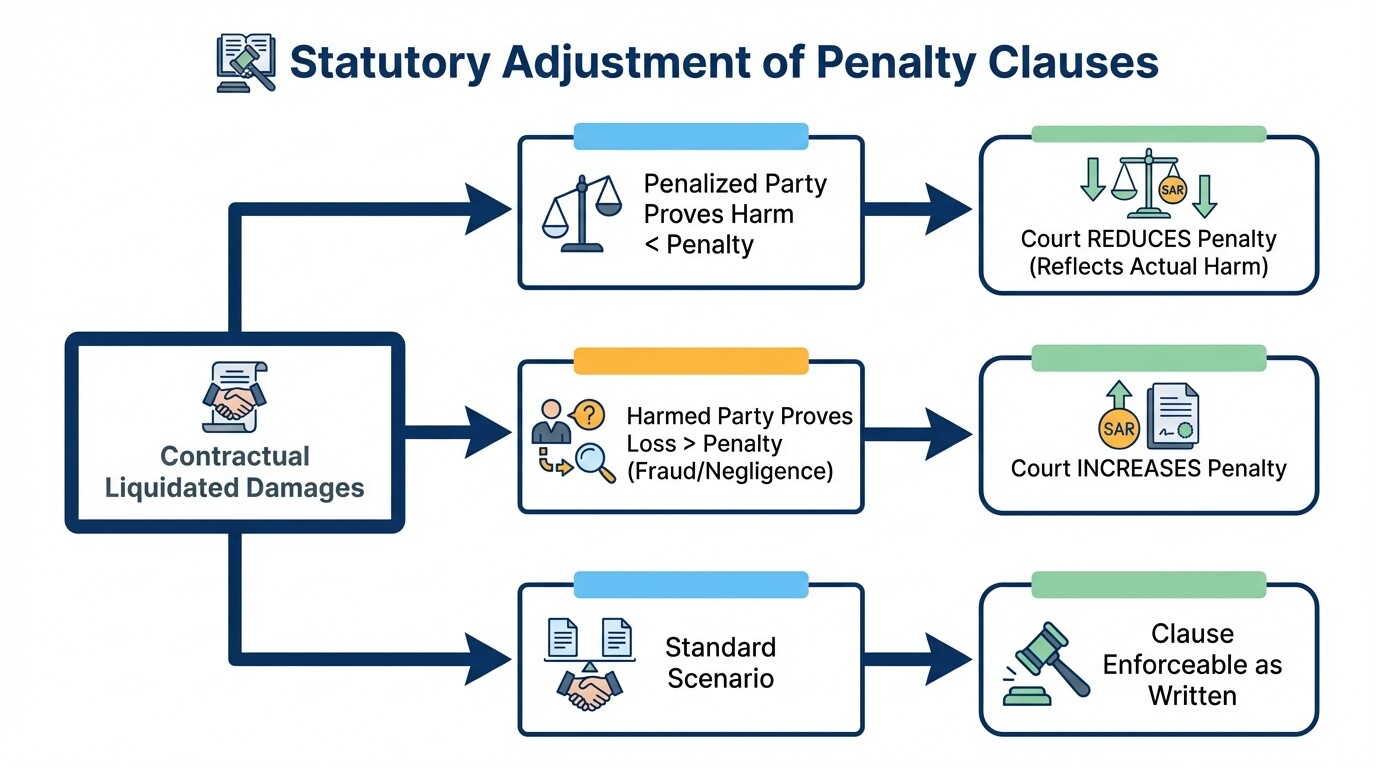
Liquidated damages clauses are generally enforceable. However, Saudi courts have statutory authority to reduce agreed-upon penalties if the penalized party proves the amount exceeds the actual harm. Conversely, courts can increase the penalty if the harmed party proves the actual loss was greater because of fraud or gross negligence.
Delay damages are standard in infrastructure projects. Previously, enforcing these clauses required navigating uncodified principles. The CTL provides a predictable statutory mechanism. Contractors facing massive delay penalties on gigaprojects can petition a court or arbitral tribunal to reduce the penalty if they demonstrate the employer did not suffer equivalent financial losses. Employers must maintain meticulous records of actual financial damages caused by contractor delays.
Force Majeure vs. Hardship
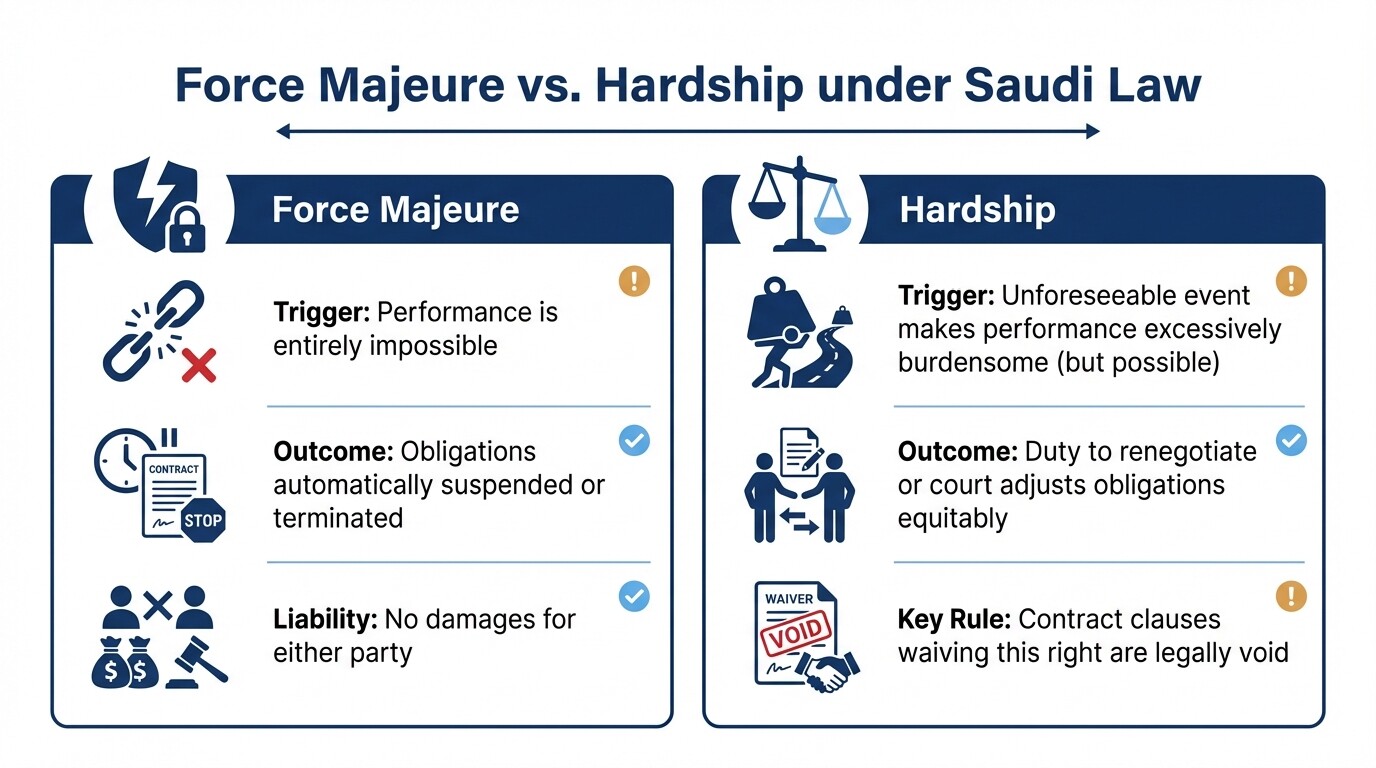
Saudi law differentiates between Force Majeure and Hardship. This affects how supply chain disruptions and material price spikes are handled in long-term engineering contracts.
When a Force Majeure event occurs, performance is entirely impossible. The affected obligations are automatically suspended or terminated, and neither party is liable for damages.
Hardship occurs when an unforeseeable, exceptional general event makes performance burdensome but not impossible. If the event threatens grave loss, the affected party can request the court to renegotiate the terms or restore balance to the contract. If the parties cannot reach an agreement, the judge has the power to adjust the obligations to distribute the loss equitably. Any contractual clause attempting to waive the right to claim Hardship is legally void.
Limitation Periods for Commercial Claims
The Civil Transactions Law introduces statutory limitation periods. The general time limit for civil or commercial contract claims is 10 years from the date the right becomes due. Shorter periods apply to specific categories, such as a five-year limit for claims related to professional services, physicians, and attorneys.
Prior to this, Saudi courts generally did not recognize strict statutes of limitation. Claims could be brought decades after a breach. These time bars provide financial certainty for joint ventures and international consortia winding down completed mega-projects. You can review the official text of this legislation via the Saudi Bureau of Experts at the Council of Ministers.
Impact on Existing Contracts and Arbitration
The Civil Transactions Law applies retroactively to existing construction and engineering contracts. Active projects are subject to its rules immediately. Exceptions exist only if a party has already acquired a final vested right or if applying the new law contradicts a specific provision of a previously applied statutory framework.
For firms using standard FIDIC contracts tailored for Saudi Arabia, the CTL is the governing background law. It overrides any contractual provisions that conflict with its mandatory rules. Standard FIDIC terms cannot override mandatory CTL provisions. Parties cannot contract out of rules governing public policy, good faith, or the court's authority to adjust liquidated damages.
While procedural arbitration rules remain governed by the Saudi Arbitration Law, arbitrators seated in Saudi Arabia or applying Saudi law must apply the CTL to resolve substantive contract disputes.
When to Hire a Lawyer
Transitioning to the Civil Transactions Law requires technical precision. Engage specialized Saudi legal counsel when auditing standard procurement templates, negotiating risk allocation for upcoming gigaprojects, or facing supply chain disruptions that trigger Hardship or Force Majeure clauses. Legal support is necessary to challenge or enforce liquidated damages on an active construction site, as proving actual harm requires clear evidence and strategic structuring.
Next Steps
Protect your investments and ensure compliance on current projects by executing a contract audit. Identify all long-term agreements, joint ventures, and subcontracts active in the Kingdom. Work with contract lawyers in Saudi Arabia to update your standard terms, modify dispute resolution protocols, and train commercial teams on statutory rights regarding hardship and delay penalties.