Key Takeaways
Foreign companies expanding into Saudi Arabia must structure their agency agreements to comply with strict local regulations. Securing a reliable local partner is essential, and protecting your commercial interests requires precise legal drafting.
- All commercial agency and distribution agreements must be registered with the Ministry of Commerce within three months of signing.
- The Civil Transactions Law (2023) enforces the principle of good faith and standardizes how courts interpret contracts and award damages.
- Local agents often have statutory rights to compensation upon termination or non-renewal, regardless of what the contract states.
- Arbitration provides a neutral and technically precise dispute resolution alternative to local litigation.
- Contracts must be translated into Arabic, as the Arabic version prevails in local courts and regulatory filings.
Why Saudi Commercial Agency Agreements Matter
Commercial agency agreements are the primary legal entry point for global manufacturers needing local distribution in Saudi Arabia. They establish the legal framework for a Saudi individual or wholly Saudi-owned entity to sell and distribute your products within the Kingdom.
Foreign entities rely on local agents to manage customs, domestic logistics, and regional marketing. A poorly drafted agreement exposes the foreign principal to financial liabilities and intellectual property risks. Structuring these contracts correctly protects your revenue and brand integrity in the region.
Compliance with the Civil Transactions Law (2023)
The Saudi Civil Transactions Law codifies contract law in the Kingdom. Commercial agency agreements must align with these rules, particularly regarding good faith and statutory damage assessments.
Before 2023, Saudi contract law relied on uncodified Sharia principles. The new law provides clear rules for foreign investors. Key impacts on agency agreements include:
- Good faith: Parties must perform contractual obligations in good faith. Terminating negotiations abruptly or acting deceptively during drafting can trigger liability.
- Codified damages: The statute outlines rules for claiming compensation, including actual losses and loss of profits, provided the damages are a natural and foreseeable result of the breach.
- Force majeure: The law defines circumstances where performance becomes impossible, allowing contracts to be suspended or terminated without penalty.
Mandatory Registration with the Ministry of Commerce
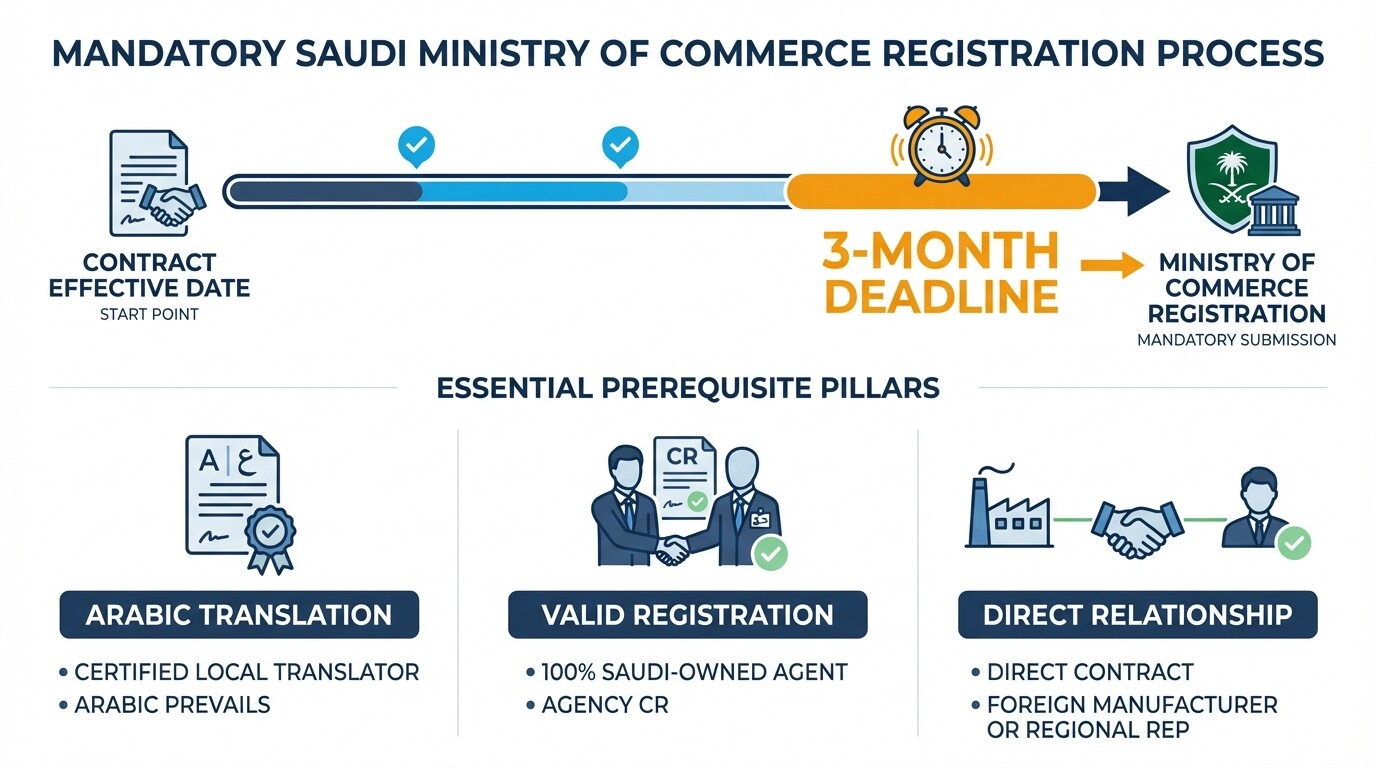
Under the Commercial Agency Law, all agency and distribution agreements must be registered with the Ministry of Commerce. Failing to register the agreement makes it unenforceable against third parties and blocks the local agent from lawfully importing the contracted goods.
Registration must be completed within three months of the contract's effective date. The process involves specific requirements:
- Arabic translation: A certified local translator must translate the agreement into Arabic. If there is a discrepancy between the texts, the Ministry and local courts rely entirely on the Arabic version.
- Valid registration: The Saudi agent must hold a valid commercial registration certificate that explicitly permits them to act as a commercial agent or distributor.
- Direct relationship: The Ministry requires the agreement to be directly between the foreign manufacturer (or their authorized regional representative) and the Saudi agent.
Exclusivity Clauses Under Saudi Law
Exclusivity clauses grant a Saudi agent the sole right to distribute a product within a specified territory. While exclusivity is not strictly mandatory by statute, the Ministry of Commerce often scrutinizes non-exclusive agreements during the registration process.
Foreign principals must carefully define the scope of exclusivity. Broad exclusivity can limit market penetration if the chosen agent lacks the capacity to service the entire country. To mitigate this risk, foreign companies should:
- Limit the territory: Restrict exclusivity to specific regions (such as the Eastern Province or Riyadh) rather than granting blanket Kingdom-wide rights.
- Define the products: Clearly specify which products the agent is authorized to sell, reserving the right to appoint different agents for future product lines.
- Set performance targets: Tie exclusivity to minimum sales quotas, allowing you to convert the agreement to non-exclusive if targets are missed.
Termination and the Agent's Right to Compensation
Terminating an agency agreement in Saudi Arabia carries financial risk for foreign principals. Local agents often have a right to statutory compensation. This protection applies even if a fixed-term contract simply expired, provided the agent proves their efforts increased the brand's customer base.
When drafting termination provisions, address these protections directly:
- Material breach: Define what constitutes a material breach (such as missing sales targets, bankruptcy, or IP violations) to justify immediate termination without compensation.
- Loss of profit: Agents frequently sue for loss of future profits and unamortized promotional expenses. Your contract must state how promotional costs are allocated during the life of the agreement.
- Inventory buy-back: Include a mechanism for handling unsold inventory upon termination, specifying whether the principal is obligated to repurchase the stock and at what price.
Dispute Resolution: Courts vs. Arbitration
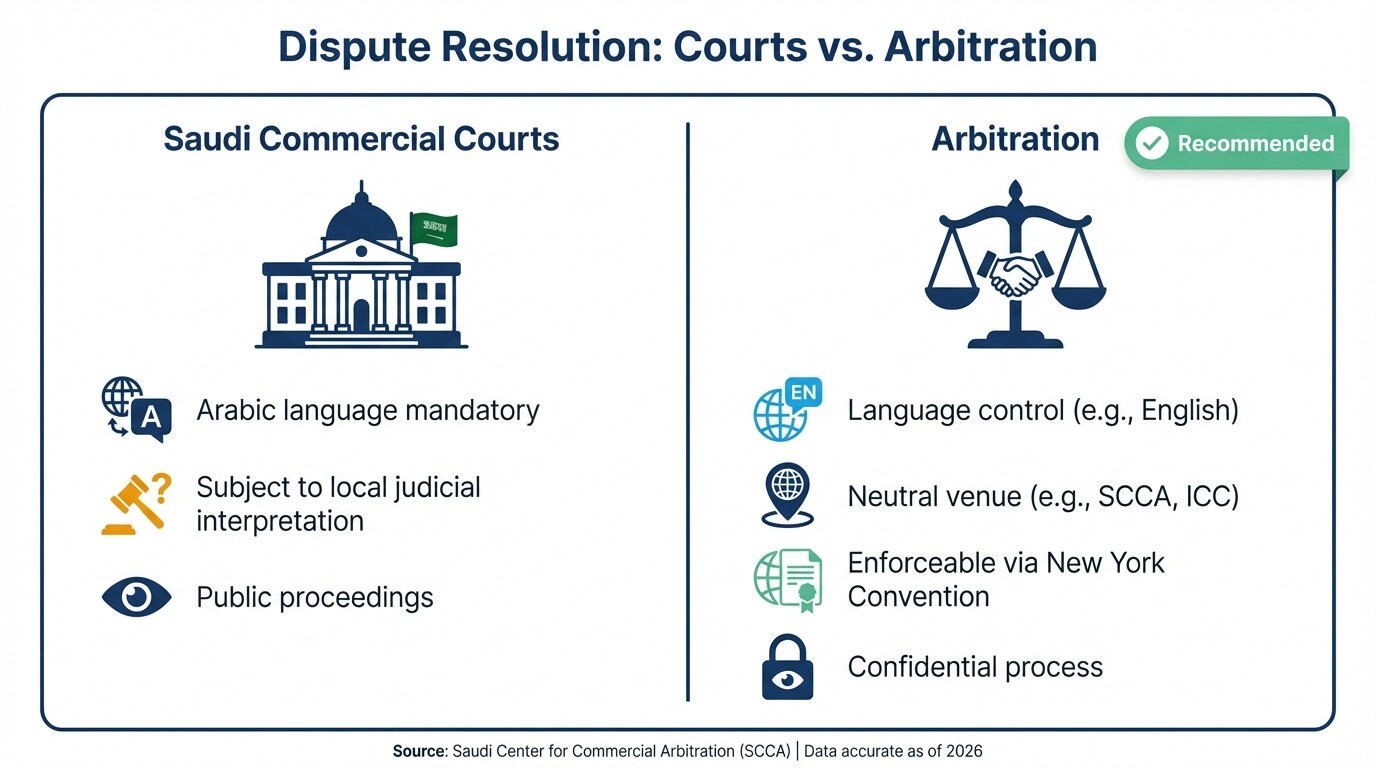
Foreign companies often choose arbitration over Saudi commercial courts for resolving agency disputes. Arbitration offers confidentiality, language flexibility, and control over arbitrator selection.
Litigating in local Saudi courts requires all proceedings to be conducted in Arabic and subjects the dispute to local judicial interpretations. By electing arbitration, parties gain distinct advantages:
- Neutral venue: Parties can select the Saudi Center for Commercial Arbitration (SCCA) or international venues like the ICC or LCIA.
- Enforceability: Saudi Arabia is a signatory to the New York Convention. Under the Saudi Enforcement Law, both domestic and international arbitral awards are generally enforceable without a full review of the case merits.
- Language control: You can specify English as the language of the arbitration, reducing translation costs and ensuring your foreign legal team can actively participate.
Sample Commercial Agency Clause: Arbitration
Drafting a precise dispute resolution clause minimizes the risk of lengthy local court battles. Below is standard sample language favoring the SCCA that you can adapt for your agreement.
Sample SCCA Arbitration Clause: Any dispute, controversy, or claim arising out of or relating to this Agreement, including its interpretation, execution, breach, termination, or invalidity, shall be settled by arbitration administered by the Saudi Center for Commercial Arbitration (SCCA) in accordance with its Arbitration Rules. The number of arbitrators shall be three. The seat, or legal place, of arbitration shall be Riyadh, Kingdom of Saudi Arabia. The language to be used in the arbitral proceedings shall be English. The governing law of the contract shall be the substantive law of the Kingdom of Saudi Arabia.
Common Misconceptions About Agency Agreements
Foreign investors frequently misunderstand Saudi commercial laws, leading to contract mistakes. Recognizing these common myths protects your financial interests.
- Myth 1: Expiration avoids compensation. Many foreign companies believe they owe the agent nothing if they simply choose not to renew a contract. If the agent successfully established a lucrative market for your goods, courts may still award compensation for the non-renewal.
- Myth 2: Foreign law overrides Saudi law. Even if your contract is governed by English or New York law, Saudi courts and arbitrators will refuse to enforce any provision that violates mandatory Saudi public policy or Sharia principles.
- Myth 3: Anyone can be your agent. By law, a commercial agent must be a Saudi national or an entity that is 100 percent owned by Saudi nationals. A foreign-owned local subsidiary cannot legally register as a commercial agent.
Commercial Agency Agreement Checklist
A legally sound agency agreement requires careful attention to procedural steps and localized documentation. Use this checklist to ensure your contract complies with Saudi regulatory standards.
- Verify credentials: Confirm the agent is 100 percent Saudi-owned and holds a valid commercial registration allowing agency activities.
- Define territory: Map out the geographic and product scope of the agreement.
- Establish quotas: Insert measurable Key Performance Indicators and minimum sales targets.
- Address costs: State which party is responsible for marketing, advertising, and regulatory compliance costs.
- Protect IP: State that the principal retains all ownership of trademarks and the agent receives only a limited, revocable license to use them.
- Draft termination: Detail the exact events of default that permit termination without notice or compensation.
- Translate: Secure a certified Arabic translation of the final executed agreement.
Frequently Asked Questions
What is the official language for Saudi agency agreements?
The Ministry of Commerce and local courts require all commercial agency agreements to be written in or translated into Arabic. While bilingual contracts are standard practice, the Arabic text legally prevails in the event of translation discrepancies or disputes.
Can a foreign company act as a commercial agent in Saudi Arabia?
No. Under the Commercial Agency Law, only Saudi nationals or corporate entities that are 100 percent owned by Saudi nationals are permitted to register and act as commercial agents or distributors within the Kingdom.
Are there government fees for registering an agency agreement?
Yes. The Ministry of Commerce charges administrative fees for processing and registering the agreement. Foreign companies should also budget for the certified legal translation and local legal counsel review required prior to submission.
When to Hire a Lawyer
Hire a lawyer before signing a term sheet or memorandum of understanding with a prospective Saudi agent. Local counsel ensures your contract is enforceable and minimizes statutory termination liabilities.
Attempting to repurpose a standard global distribution template for the Saudi market often leads to regulatory rejection or legal exposure. Engaging experienced contract lawyers in Saudi Arabia provides the strategic foresight needed to draft exclusivity limits, structure performance targets, and ensure compliance with the Civil Transactions Law.
Next Steps
Follow these immediate steps to secure your distribution rights in the Kingdom.
- Conduct due diligence: Verify your prospective partner's commercial registration, market capacity, and history of litigation with previous foreign principals.
- Draft a term sheet: Outline the core commercial terms, including territory, product scope, and minimum sales quotas, before drafting the full legal agreement.
- Engage legal counsel: Have a qualified attorney draft the agreement to align with the 2023 Civil Transactions Law and include a robust arbitration clause.
- Execute and translate: Sign the agreement and commission a certified Arabic translation.
- Submit to the Ministry: Work with your local agent to submit the dual-language agreement to the Ministry of Commerce within the mandatory three-month window.