Corporate Debt Restructuring under the Saudi Bankruptcy Law
- The Saudi Bankruptcy Law (Royal Decree No. M/50) prioritizes business rescue over liquidation, offering structured paths to rehabilitate financially distressed companies.
- The Financial Restructuring Procedure (FRP) is designed for bankrupt or imminently bankrupt companies and involves court oversight through an appointed trustee.
- Filing for an FRP triggers an automatic 180-day moratorium, protecting the debtor from creditor claims and legal execution while a plan is drafted.
- Foreign and domestic creditors hold equal standing under the law, ensuring international lenders have full rights to vote and participate in proceedings.
- Restructuring plans require approval from two-thirds of the debt value and a majority headcount of voting creditors in each class.
What is the Difference Between Financial Restructuring and Protective Settlement?
The Financial Restructuring Procedure (FRP) requires a court-appointed trustee and is strictly for companies that are already insolvent or facing imminent bankruptcy. Protective Settlement is a debtor-in-possession process designed for companies that are financially distressed but not yet insolvent, allowing current management to retain full control without a trustee.
Understanding which procedure to file for depends heavily on the company's financial status and the level of court intervention required.
Corporate Debt Restructuring Process Checklist
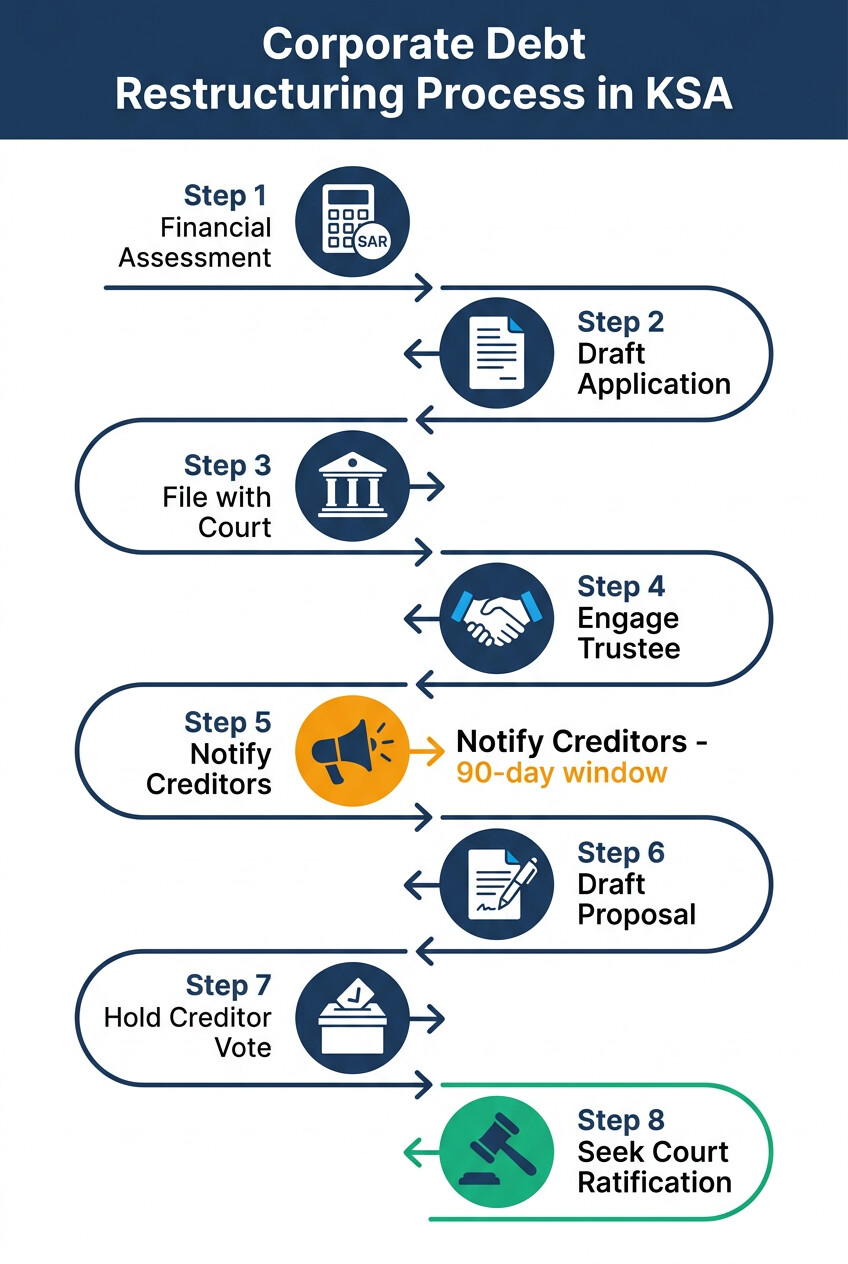
Navigating an FRP requires meticulous preparation and adherence to the timelines set by the Saudi Commercial Court. Use this checklist to structure your approach to corporate debt restructuring in Saudi Arabia.
- Conduct a Financial Assessment: Verify that the company meets the statutory definition of bankrupt (debts exceed assets) or imminent bankruptcy before filing.
- Draft the Application: Prepare the bankruptcy petition, including audited financial statements, creditor lists, and a preliminary economic feasibility report indicating the company can be saved.
- File with the Commercial Court: Submit the petition to the competent Commercial Court. Upon acceptance, the court sets a date for the first hearing.
- Engage with the Appointed Trustee: Once the court appoints a licensed bankruptcy trustee, management must provide full access to financial records and operational data.
- Notify Creditors: The trustee publishes the bankruptcy commencement in the official gazette and notifies known creditors to submit their claims within 90 days.
- Draft the Restructuring Proposal: Collaborate with the trustee and key creditors to draft a realistic payment and operational restructuring plan.
- Hold the Creditor Vote: Present the plan at the creditor meeting for voting, categorized by creditor classes (e.g., secured, unsecured).
- Seek Court Ratification: If creditors approve the plan, submit it to the Commercial Court for final ratification and binding enforcement.
What is the Role of the Bankruptcy Commission and Trustees?
The Bankruptcy Commission is a governmental body that regulates the insolvency ecosystem, licenses professionals, and maintains the public bankruptcy register. The court-appointed bankruptcy trustee is an independent professional who oversees the debtor's business, verifies creditor claims, and facilitates the drafting of the restructuring plan.
While the trustee holds significant authority during an FRP, they do not entirely replace the company's management. Their primary role is supervisory, ensuring the debtor does not dissipate assets and that the restructuring plan is fair.
- Bankruptcy Commission: You can access the official bankruptcy register and the full text of the law through the Saudi Bankruptcy Commission.
- Bankruptcy Trustee: The trustee approves transactions outside the normal course of business, evaluates the validity of creditor claims, and acts as the liaison between the debtor, the creditors, and the Commercial Court.
How the Moratorium Protects Debtors
Filing for a Financial Restructuring Procedure triggers an automatic stay, known as a moratorium, which pauses all creditor claims, execution procedures, and litigation against the debtor for up to 180 days. This breathing room prevents a "run on the assets" and allows the company to negotiate a viable restructuring plan without the threat of immediate liquidation.
The moratorium is a powerful tool, but it is not absolute. Key aspects include:
- Duration and Extension: The initial moratorium lasts 180 days from the date the court records the application. The court can extend this period up to a maximum of 270 days total.
- Secured Creditors: Secured creditors cannot enforce their security interests during the moratorium without explicit permission from the Commercial Court, which is rarely granted unless the asset is depreciating rapidly and is not essential to the restructuring.
- Contract Continuation: Suppliers and contractors cannot terminate ongoing contracts solely because the debtor entered an FRP, provided the debtor pays for new goods or services delivered during the moratorium.
Voting Requirements for the Restructuring Plan
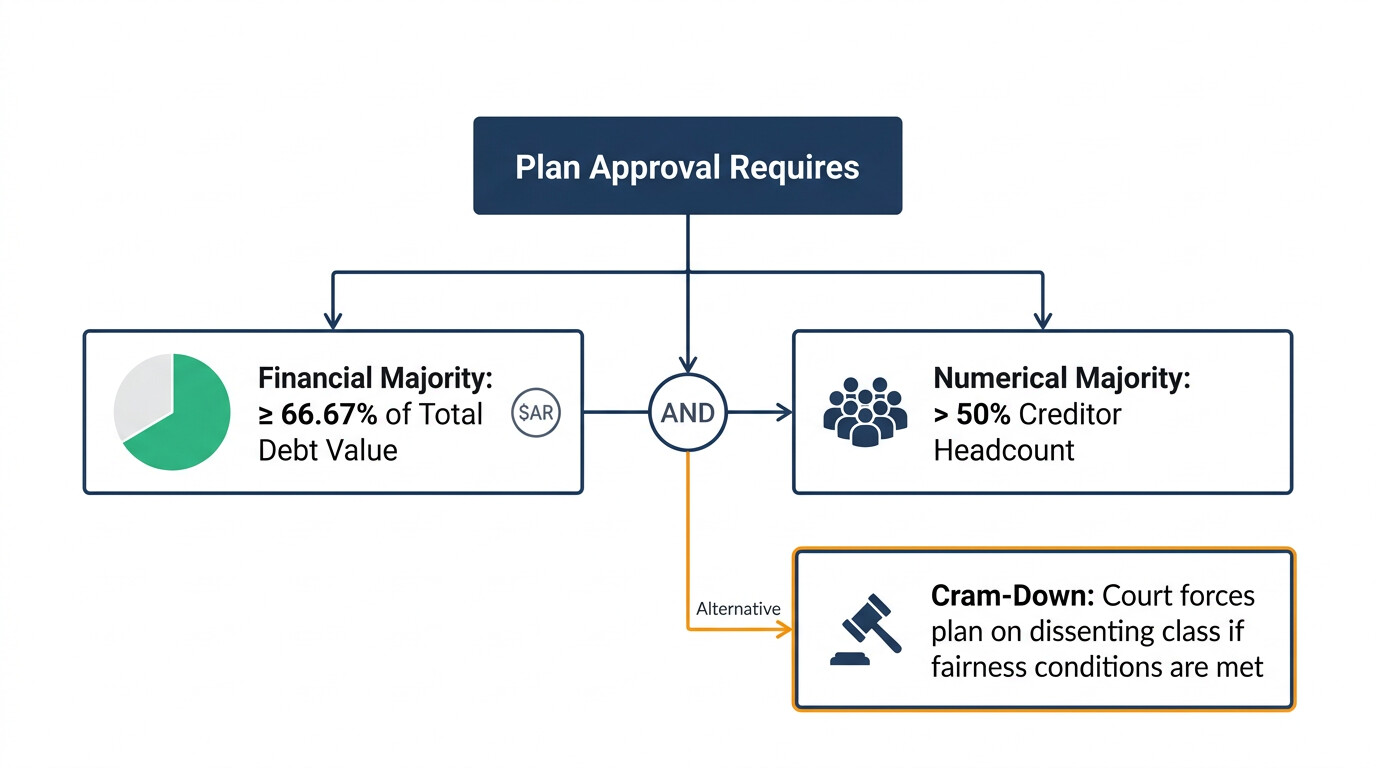
A restructuring plan is approved if it receives votes from at least two-thirds (66.67%) of the total value of creditor claims in each class, representing at least 50% of the individual creditors participating in the vote. The Commercial Court can also utilize a "cram-down" mechanism to force the plan on dissenting classes if specific fairness conditions are met.
Getting a plan approved requires strategic negotiation with major creditors. The voting mechanics work as follows:
- Creditor Classes: Creditors are grouped into classes with similar legal rights (e.g., secured creditors, ordinary unsecured creditors, government entities).
- Dual Majority Rule: Passing the vote requires both a financial majority (value of debt) and a numerical majority (headcount of voting creditors).
- Cram-Down: If one class rejects the plan but another approves it, the court can still ratify the plan if it determines the dissenting class is no worse off than they would be in a liquidation scenario.
Rights of Foreign Creditors Under KSA Bankruptcy Law
Foreign creditors possess the exact same legal rights as domestic Saudi creditors under the Bankruptcy Law, including the ability to file claims, vote on restructuring plans, and initiate insolvency proceedings against a Saudi debtor. The law operates on a strict principle of national treatment, ensuring international lenders are not deprioritized.
For international banks and foreign suppliers, this modern framework provides predictability when dealing with distressed Saudi entities.
- Submitting Claims: Foreign creditors must submit their claims to the trustee within the standard 90-day window following the public announcement of the procedure. Claims can be submitted in foreign currencies, though they will be evaluated based on the exchange rate at the time of the procedure's commencement.
- No Discrimination: Priority of claims (e.g., secured over unsecured) is determined entirely by the nature of the debt and registered security interests, not by the nationality or location of the creditor.
Common Misconceptions About KSA Bankruptcy Law
- Misconception: Filing for bankruptcy means the business is ending. Historically, insolvency in the region heavily favored liquidation. Today, the Saudi Bankruptcy Law is a rescue-focused regime. The FRP is designed specifically to keep the business alive, preserve jobs, and yield a better return for creditors than a fire sale of assets.
- Misconception: Debtors lose all control of their company during an FRP. Unlike liquidation, where a liquidator seizes total control, an FRP allows current management to continue running day-to-day operations. The trustee only supervises major financial decisions and ensures the restructuring plan is developed transparently.
Frequently Asked Questions
How much does filing for financial restructuring cost?
Court filing fees in Saudi Arabia are nominal, but the primary costs are the trustee fees and professional legal/financial advisory fees. Trustee fees are typically determined by the Commercial Court based on the complexity of the estate and can range from SAR 100,000 to over SAR 1,000,000 for large corporate restructurings.
Can a debtor continue managing the business during an FRP?
Yes. The debtor's management continues to operate the business in the ordinary course. However, transactions outside normal business operations, such as selling real estate or taking on new massive debt, require approval from the court-appointed trustee.
What happens if the FRP plan is rejected by creditors?
If the creditors reject the restructuring plan, or if the court refuses to ratify it, the Commercial Court may terminate the FRP. Following termination, the court, the debtor, or a creditor can petition to initiate a Liquidation Procedure.
Are government debts included in the restructuring plan?
Yes. Government claims (such as taxes or Zakat) are subject to the bankruptcy procedures. While some government claims hold preferential status in liquidation, they are still subject to the moratorium and must be addressed within the restructuring plan during an FRP.
When to Hire a Restructuring Lawyer
Corporate debt restructuring is a highly technical process requiring precise legal and financial navigation. You should retain legal counsel immediately if your company foresees an inability to meet its debt obligations within the next six months, or if a creditor threatens to file a liquidation petition against you. Furthermore, foreign creditors should hire local counsel the moment a Saudi debtor announces an insolvency procedure to ensure their claims are accurately filed and their voting rights are protected.
Next Steps
If you are an executive of a distressed Saudi company or a creditor seeking to protect your exposure, your first step is to secure a comprehensive financial audit to determine the true extent of the insolvency. Following the audit, consult with restructuring and insolvency lawyers in Saudi Arabia to determine whether an FRP or a Protective Settlement is the most viable strategy. Prompt action is critical, as waiting too long limits your options and increases the risk of forced liquidation.