International Arbitration vs Litigation for IP Disputes in Singapore
Key Takeaways
Resolving cross-border intellectual property (IP) disputes in Singapore means choosing between the strict confidentiality of arbitration and the public precedent of court litigation. Both paths offer distinct strategic advantages for multinational corporations protecting their commercial assets.
- The Singapore International Arbitration Centre (SIAC) is the preferred forum for B2B cross-border IP disputes requiring strict confidentiality and specialized adjudicators.
- The General Division of the Singapore High Court (SGHC) is ideal for establishing public legal precedent or securing broad, binding injunctions against third-party infringers.
- Arbitral awards issued in Singapore benefit from global enforcement under the New York Convention.
- Drafting an unambiguous choice-of-law and dispute resolution clause before a joint venture begins controls future litigation costs.
Comparing Procedural Speed and Privacy: SIAC vs High Court Litigation
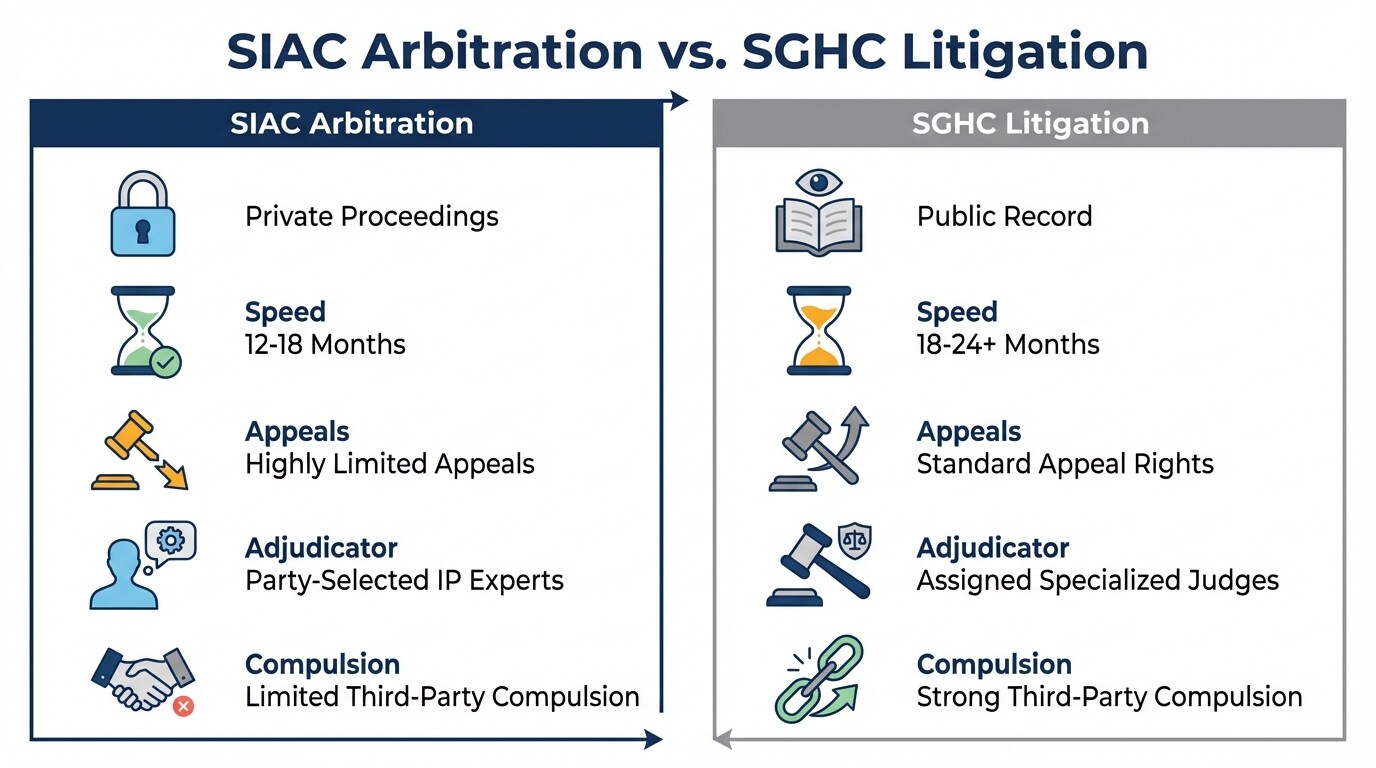
The Singapore International Arbitration Centre (SIAC) provides a private forum that is generally faster than litigation because of limited discovery and the lack of a lengthy appeals process. The Singapore High Court offers public vindication and established legal precedent. This takes longer but creates binding case law that deters future infringers.
Choosing the right forum directly affects your strategic advantage during an intellectual property conflict. SIAC proceedings are private. Trade secrets, patent designs, and the existence of the dispute remain hidden from competitors.
Court proceedings in Singapore are a matter of public record. However, if you litigate in the Singapore High Court, you can apply for confidentiality orders, request hearings in private (in camera), or ask to seal sensitive documents to protect technical trade secrets. The General Division of the Singapore High Court also has specialized intellectual property judges experienced in complex patent and trademark litigation.
| Feature | SIAC Arbitration | Singapore High Court Litigation |
|---|---|---|
| Privacy | Private proceedings and awards. | Public record (unless sealed). |
| Speed | 12 to 18 months on average. | 18 to 24+ months, extending if appealed. |
| Appeals | Extremely limited grounds (e.g., fraud, breach of natural justice). | Decisions can be appealed to the Court of Appeal. |
| Adjudicator | Parties select arbitrators with specific IP expertise. | Cases are assigned to specialized IP judges. |
| Third Parties | Difficult to compel third parties to join or provide evidence. | Strong judicial power to compel third-party compliance. |
Estimated Costs for Resolving B2B IP Disputes
Dispute resolution costs in Singapore depend on the claim amount, the technical complexity of the IP, and the chosen forum. Arbitration requires upfront institutional fees and arbitrator payments. Litigation involves lower court filing fees but higher long-term legal costs if the case goes to appeal.
In commercial litigation at the High Court, parties do not pay the judge's salary. Institutional fees are limited to administrative court filing and hearing fees. In arbitration, parties fully fund the private tribunal.
- SIAC Institutional Fees: SIAC charges a case management fee and arbitrator fees based on the sum in dispute. For a complex IP claim valued at SGD 5 million, the combined administrative and maximum arbitrator fees range from SGD 150,000 to SGD 250,000.
- High Court Fees: Court filing fees generally start around SGD 1,000 to SGD 5,000 depending on the writs and motions filed, plus daily hearing fees.
- Legal Counsel Fees: Specialist IP lawyers form the bulk of the expense. For a full trial or arbitration hearing involving cross-border patents or trade secrets, legal fees range from SGD 300,000 to over SGD 800,000.
- Expert Witness Fees: Technical IP disputes require industry experts to testify on patent infringement or trademark valuation. This adds SGD 50,000 to SGD 150,000 to the total cost.
Pre-Litigation Strategies to Protect Patents and Trademarks
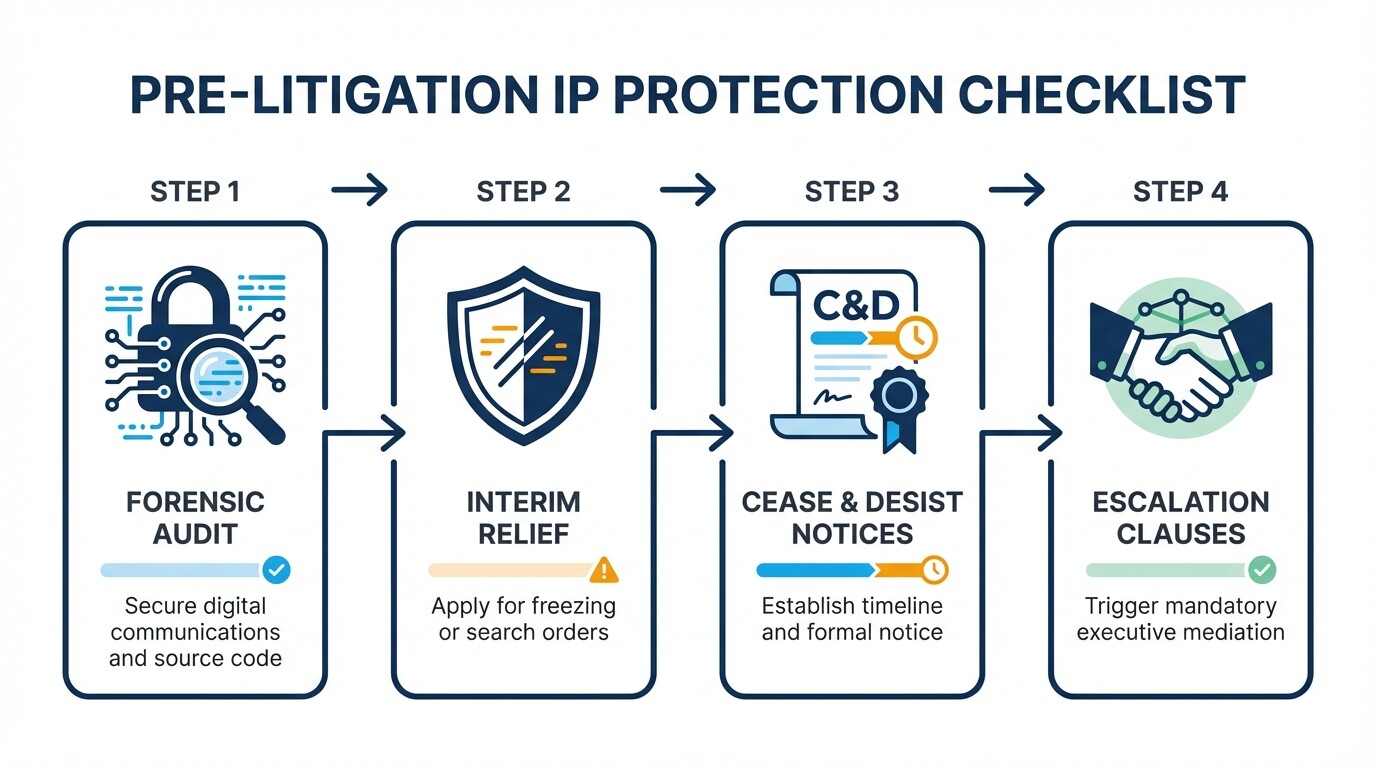
Safeguarding intellectual property during a cross-border conflict requires action before formally initiating a lawsuit or arbitration. Acting quickly prevents the opposing party from destroying technical evidence or leaking trade secrets.
- Conduct a forensic audit: Secure all digital communications, source code repositories, and patent filings. Ensure your venture partner cannot delete internal technical data or alter trademark registrations.
- Apply for interim relief: Even if your contract mandates arbitration, Singapore law allows parties to approach the High Court for emergency injunctions, such as freezing orders or search orders, to prevent immediate theft of trade secrets.
- Send cease and desist notices: Clearly document the alleged infringement. This establishes a timeline of the dispute and serves as formal notice, which helps calculate damages later.
- Trigger escalation clauses: Many B2B contracts require executive-level mediation before formal arbitration or litigation begins. Follow these steps meticulously to avoid having your case dismissed for procedural failures.
Sample Dispute Resolution Clauses and Common Drafting Mistakes
Foreign companies frequently draft defective choice-of-law and dispute resolution clauses by combining incompatible jurisdictions, failing to specify the seat of arbitration, or omitting the governing law entirely. These errors are called "pathological clauses." They derail proceedings and cost hundreds of thousands of dollars before the actual IP dispute is heard.
Common mistakes include naming non-existent arbitration centers, failing to specify the number of arbitrators, or creating a contradictory clause that names both arbitration and litigation as the exclusive forum.
Standard SIAC Arbitration Clause
To ensure your IP dispute is handled smoothly in Singapore, use the model clause provided by SIAC. You can insert this standard provision into your commercial contracts:
"Any dispute arising out of or in connection with this contract, including any question regarding its existence, validity or termination, shall be referred to and finally resolved by arbitration administered by the Singapore International Arbitration Centre in accordance with the Arbitration Rules of the Singapore International Arbitration Centre for the time being in force, which rules are deemed to be incorporated by reference in this clause.
The seat of the arbitration shall be Singapore. The Tribunal shall consist of [insert 1 or 3] arbitrator(s). The language of the arbitration shall be English."
Enforcing Singapore Arbitral Awards Internationally
Arbitral awards issued in Singapore are enforceable across international borders due to the 1958 New York Convention. Under Singapore's International Arbitration Act 1994, successful parties can register and enforce their SIAC awards in over 170 contracting states.
When a multinational company wins a court judgment in the Singapore High Court, enforcing that judgment in a foreign country depends on reciprocal treaties. These treaties are often limited. In contrast, an arbitral award seated in Singapore enjoys near-global recognition. Courts in other New York Convention member states are legally obligated to recognize and enforce the Singapore award as if it were a domestic court judgment. Grounds for refusal are very narrow, such as a violation of local public policy.
Common Misconceptions About IP Disputes in Singapore
Many multinational businesses operate under false assumptions regarding how intellectual property rights are contested in Southeast Asia. Misunderstanding Singapore's legal framework leads to poor forum selection and unprotected commercial assets.
- Arbitration is cheaper: Many assume arbitration saves money. While it is often faster, paying private institutional and arbitrator fees makes arbitration more expensive upfront than filing in a public court.
- Arbitrators lack injunction powers: There is a myth that only courts can stop ongoing IP infringement. SIAC tribunals have broad powers to issue binding interim injunctions and emergency relief to halt the theft of trade secrets.
- Governing law equals seat: The governing law dictates how the contract is interpreted (e.g., English law). The "seat" (e.g., Singapore) is the legal jurisdiction that anchors the proceedings and determines the procedural framework. If the seat is Singapore, the Singapore courts have supervisory jurisdiction over the arbitration. Any applications to freeze assets or set aside the final award must be filed in Singapore.
Next Steps for Securing Your Intellectual Property
Securing your intellectual property requires immediate action to preserve evidence and understand your contractual rights.
- Review the contract: Locate the choice-of-law and dispute resolution clauses in your commercial agreements to confirm whether you are obligated to arbitrate or litigate.
- Secure digital evidence: Lock down internal systems, back up communications, and revoke access for any dissenting joint venture partners to prevent the theft of trade secrets.
- Consult legal counsel: Consult arbitration lawyers in Singapore immediately to review your dispute resolution clauses, assess the viability of your claim, and determine whether filing an emergency arbitration or seeking a court injunction is the best path forward.