- South Africa is a favorable jurisdiction for cross-border dispute resolution following the enactment of the International Arbitration Act 15 of 2017, which incorporates the UNCITRAL Model Law.
- A valid arbitration agreement must clearly define the intent to arbitrate, the seat of the arbitration, the governing law, and the language.
- Multi-tier dispute resolution clauses require parties to attempt negotiation and mediation before escalating to arbitration, saving time and legal fees.
- South Africa is a signatory to the New York Convention. Foreign arbitral awards are recognized and enforceable against local entities.
- Confidentiality in alternative dispute resolution is not automatic. It must be expressly drafted into business-to-business mediation and arbitration agreements.
Sample Multi-Tier Dispute Resolution Clause
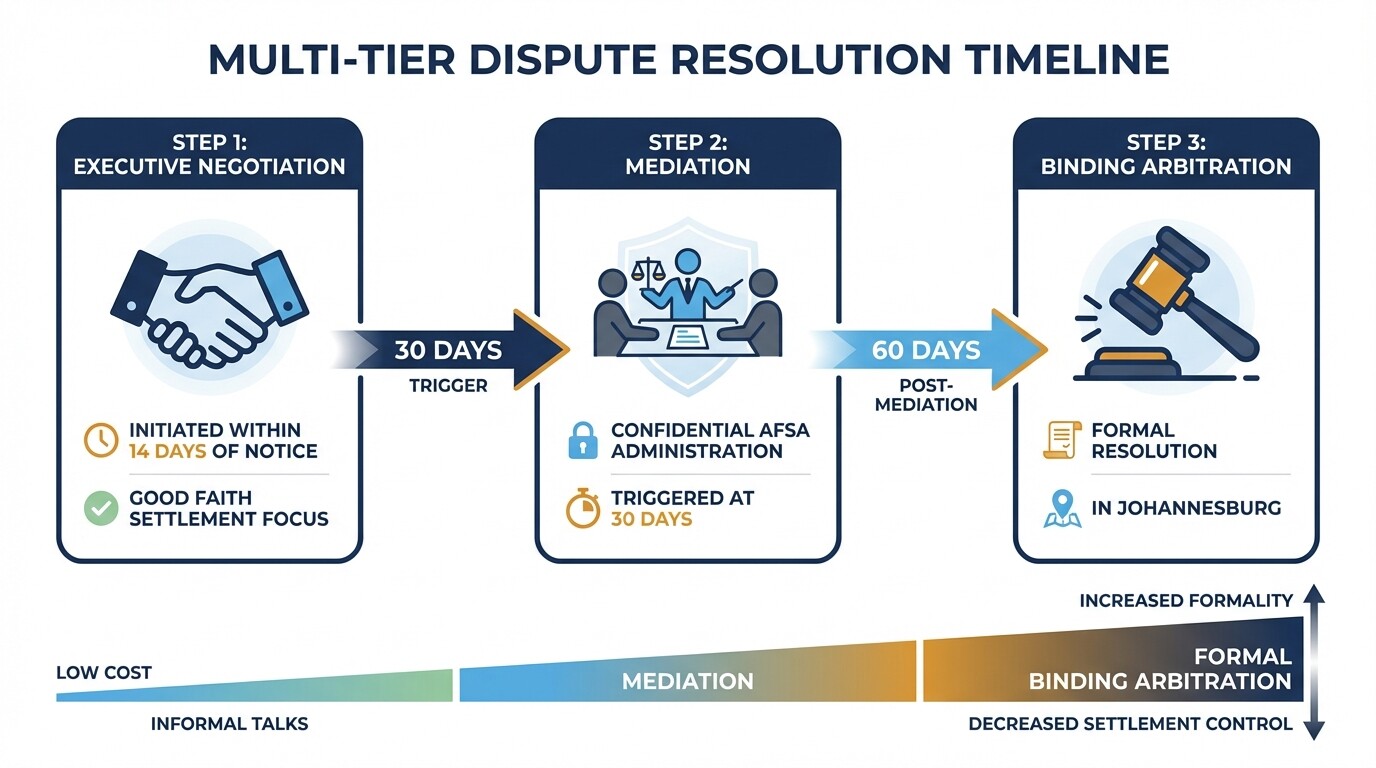
A well-drafted multi-tier clause forces parties to attempt negotiation and mediation before escalating to binding arbitration. This structure prioritizes commercial settlements over adversarial proceedings and keeps legal costs manageable.
When drafting an agreement with a South African commercial partner, you can adapt the following sample provision to ensure clear escalation steps:
Step 1: Executive negotiation "In the event of any dispute arising out of or relating to this agreement, the parties shall first attempt to resolve the dispute through good faith negotiations between their respective senior executives having authority to settle the matter. Such negotiations shall commence within 14 days of a written notice of dispute."
Step 2: Mediation "If the dispute is not resolved by negotiation within 30 days of the written notice, the parties agree to submit the dispute to confidential mediation administered by the Arbitration Foundation of Southern Africa (AFSA) under its Commercial Mediation Rules."
Step 3: Arbitration "If the dispute remains unresolved 60 days after the commencement of mediation, it shall be finally resolved by binding arbitration administered by AFSA in accordance with its International Arbitration Rules. The seat of arbitration shall be Johannesburg, South Africa. The number of arbitrators shall be three. The language of the arbitration shall be English."
Essential Elements of a Valid Arbitration Clause
To be valid under South African law, an arbitration agreement must be in writing and clearly define the scope of disputes submitted to the tribunal. Vague language can lead to costly jurisdictional battles in the High Court before the arbitration begins.
Under the International Arbitration Act 15 of 2017, a clause should contain these elements:
- Clear intent: The language must be mandatory ("shall be resolved by arbitration") rather than permissive ("may be resolved").
- Scope of disputes: Use broad language such as "any dispute, controversy, or claim arising out of or relating to this contract, including its validity, breach, or termination" to prevent parallel court litigation.
- Seat of arbitration: The seat determines the procedural law and the national courts that have supervisory jurisdiction. Specifying a South African city like Johannesburg or Cape Town provides clarity.
- Governing law: Distinct from the seat, this identifies the substantive law used to interpret the contract (e.g., the law of the Republic of South Africa or English law).
- Number of arbitrators: Specify either one or three arbitrators to avoid delays.
- Language: Explicitly state the language of the proceedings to control translation costs and procedural disputes.
Common Mistakes in Selecting the Seat and Rules
Foreign companies often confuse the seat of arbitration with the physical location of the hearings or the substantive governing law of the contract. Selecting the wrong seat subjects the arbitration to unfavorable procedural laws or heavy court interference.
Avoid these frequent drafting errors:
- Missing seat: Leaving the seat blank forces the arbitral tribunal to determine the procedural jurisdiction. This can result in unexpected legal frameworks applying to your dispute.
- Non-existent institutions: Drafting a clause that refers to an incorrect or dissolved institution (like a fictional "South African International Arbitration Court") makes the agreement difficult to enforce.
- Incompatible rules: Combining the rules of one institution with the administration of another creates administrative chaos. Use the model clause provided by your chosen arbitral institution as a baseline.
- High-intervention jurisdictions: South Africa is an UNCITRAL Model Law country, and its courts respect arbitral independence. Choosing a seat in a country with high judicial intervention defeats the purpose of private arbitration.
Documenting Confidentiality Requirements in B2B Mediation
Commercial arbitration is naturally private but not automatically confidential in all jurisdictions. Business-to-business mediation requires strict written confidentiality agreements. Documenting these requirements prevents sensitive trade secrets or settlement offers from being used in later litigation if mediation fails.
When structuring a mediation agreement in South Africa, ensure these protections are drafted clearly:
| Protection Type | Drafting Requirement |
|---|---|
| Without prejudice | State that all offers, concessions, and admissions made during mediation are "without prejudice" and inadmissible in future court or arbitration proceedings. |
| Non-disclosure | Prohibit the parties and the mediator from disclosing any documents, financial records, or trade secrets shared during the session to third parties. |
| Mediator immunity | Include a provision barring either party from calling the mediator as a witness or subpoenaing the mediator's notes in subsequent legal actions. |
| Enforcement carve-outs | Provide a specific exception stating that a finalized, signed settlement agreement may be disclosed solely to enforce its terms in court. |
Pre-Litigation Dispute Prevention
Dispute prevention strategies require executives to resolve conflicts commercially before external lawyers take control of the process. Using multi-tier clauses in cross-border supply agreements ensures minor operational issues do not immediately trigger hostile legal action.
International supply chains rely on ongoing cooperation. The following strategies help maintain relationships while managing risk:
- Cooling-off periods: Require a mandatory 15 to 30 day window after a dispute notice is filed where neither party can initiate formal legal proceedings.
- Executive escalation: Mandate that disputes move from operational managers to senior executives or board members. Senior leaders are often more focused on commercial outcomes than proving who is legally right.
- Standing dispute boards: For long-term infrastructure or supply contracts, appoint an independent expert panel at the start of the project. This board reviews disagreements in real time and issues fast, non-binding recommendations.
Common Misconceptions About South African Arbitration
Many foreign investors hold outdated views on the South African legal system regarding alternative dispute resolution. Understanding the current system prevents businesses from unnecessarily insisting on expensive European seats for arbitration.
- Court interference: The 2017 Act limits court intervention. South African courts adopt a pro-arbitration stance and will stay court proceedings if a valid arbitration agreement exists.
- Automatic confidentiality: Privacy is guaranteed, meaning strangers cannot attend hearings. However, strict confidentiality preventing parties from discussing the outcome publicly must be explicitly drafted into your arbitration clause.
- Enforcement difficulty: Because of international treaties, an arbitral award is often easier to enforce across borders than a standard South African High Court judgment.
Enforcing Arbitral Awards via the New York Convention
South Africa is a signatory to the 1958 New York Convention. Arbitral awards made in other member states are recognized and enforced by South African courts. The process is governed by the International Arbitration Act, providing a predictable route to enforcement against local corporate assets.
Enforcement Process
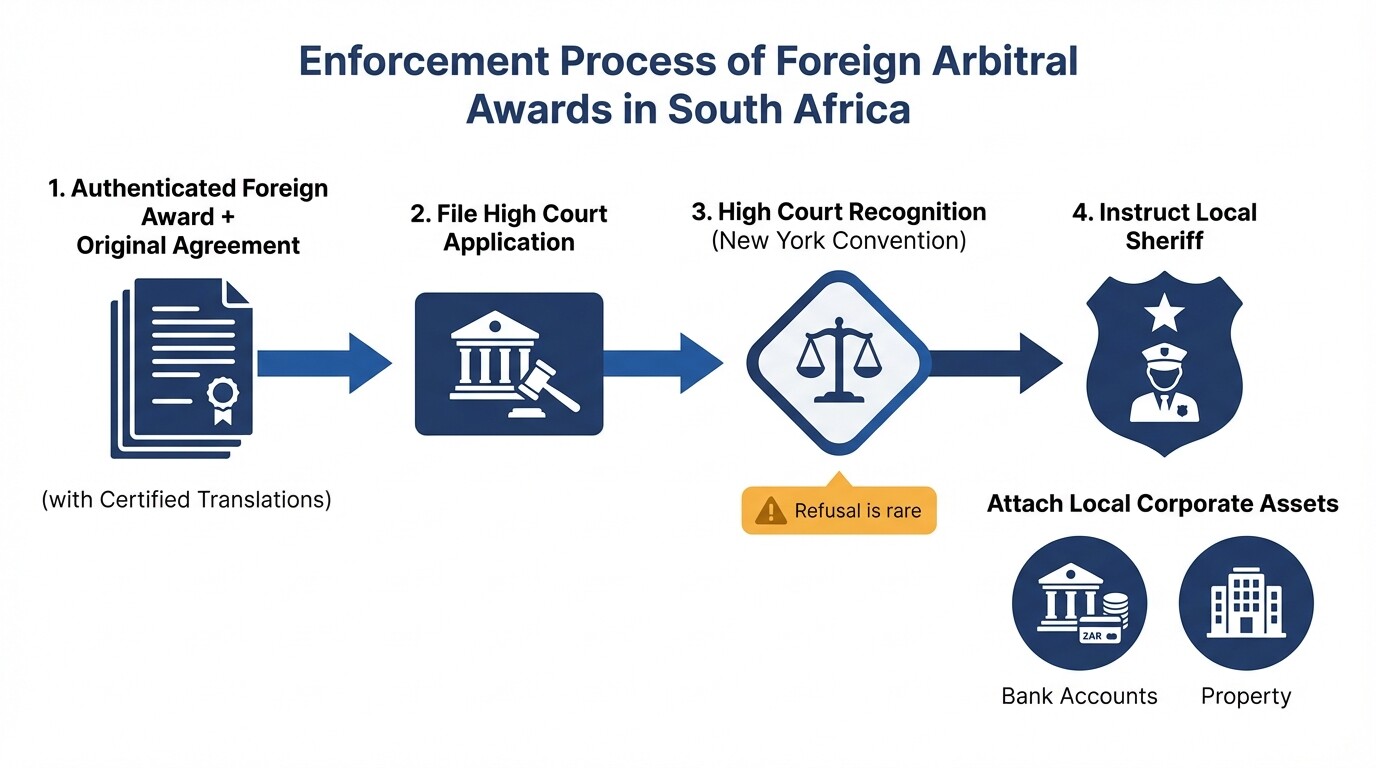
To enforce a foreign arbitral award against a South African company, you must file an application with the High Court of South Africa to have the foreign award recognized and made an order of court. You must provide the original authenticated award and the original arbitration agreement, along with certified translations if the documents are not in English.
Grounds for Refusal
Refusal is rare and only occurs under strictly limited grounds. A court may refuse enforcement if the arbitration agreement was invalid, a party was denied a fair hearing, the award deals with a dispute outside the scope of the clause, or enforcing the award would violate South African public policy.
Execution of Awards
An arbitral award does not grant direct power to seize assets. The High Court must first recognize the award and convert it into a court order. After this step, you can use the local sheriff to attach the local company's bank accounts or property.
Mediation Settlements
The New York Convention only applies to binding arbitral awards. International mediation settlements can be enforced globally if the parties reside in countries that have ratified the Singapore Convention on Mediation, or the settlement can be enforced locally as a standard breach of contract.
Getting Legal Assistance
Drafting cross-border commercial contracts requires precise legal insight. A poorly drafted dispute resolution clause can trap your business in preliminary litigation before the actual dispute is even addressed.
Consult a legal professional before signing any high-value commercial agreement, especially when selecting institutional rules, defining the seat of arbitration, or drafting complex multi-tier escalation clauses. Taking the time to structure your contracts upfront secures your rights and provides a predictable path to recovery if a commercial relationship breaks down. You can find experienced ADR mediation and arbitration lawyers in South Africa to assist with drafting enforceable clauses tailored to your industry.