Enforcement of Foreign Judgments in the UAE Courts
Key Takeaways
Enforcing a foreign court order or arbitration award in the United Arab Emirates (UAE) requires navigating strict procedural rules and proving reciprocity. Recent legislative updates have streamlined this process, allowing creditors to bypass full litigation and proceed directly to execution.
- Expedited Process: Under the current UAE Executive Regulations on Civil Procedures, foreign judgments are enforced directly through an execution judge rather than filing a new substantive lawsuit.
- Reciprocity is Mandatory: The UAE courts will only enforce a foreign judgment if the issuing country would reciprocally enforce a UAE judgment, often proven through bilateral treaties.
- Strict Formalities: All foreign documents must undergo a rigorous, multi-step attestation process and be translated into Arabic by a locally certified translator.
- Alternative Routes: Creditors frequently use the Dubai International Financial Centre (DIFC) Courts as a conduit to bypass certain onshore enforcement hurdles, though this strategy requires careful jurisdictional planning.
The Legal Framework: Article 85 of the Executive Regulations
Article 85 of the Executive Regulations on civil procedures establishes the direct mechanism for domesticating a foreign judgment in the UAE. It allows creditors to file an enforcement petition directly with an execution judge, transforming a previously prolonged trial process into a streamlined administrative procedure.
Prior to this regulatory shift, enforcing a foreign judgment required filing a completely new substantive claim in the onshore UAE courts. Today, under Article 85, the execution judge must issue an enforcement order within three days of the petition's filing, provided all statutory conditions are met. The judge's role is strictly limited to verifying procedural compliance, not reviewing the underlying merits of the commercial dispute.
To satisfy the execution judge under Article 85, the creditor must prove:
- The foreign court was legally competent to issue the judgment.
- The defendant was properly summoned and represented.
- The judgment is final and binding under the laws of the issuing country.
- The judgment does not conflict with any existing order issued by a UAE court.
Checklist for Enforcing a Foreign Judgment in the UAE
Executing a foreign commercial judgment in the onshore UAE courts requires meticulous adherence to local administrative procedures. Use this checklist to ensure your legal team completes all necessary steps before filing the execution petition.
1. Document Preparation and Certification
- Obtain the original judgment bearing the issuing court's official seal.
- Secure a certificate of finality from the foreign court proving the judgment is no longer subject to appeal.
- Procure proof that the defendant was legally summoned (especially critical in default judgments).
2. International Attestation Process
- Attest all documents at the Ministry of Foreign Affairs in the issuing country.
- Attest all documents at the UAE Embassy or Consulate in the issuing country.
- Attest the documents locally at the UAE Ministry of Foreign Affairs (MoFA) upon arrival in the Emirates.
3. Translation and Filing
- Have all attested documents translated into Arabic by a legal translator certified by the UAE Ministry of Justice.
- Draft the execution petition under Article 85 of the Executive Regulations.
- File the petition with the execution judge at the relevant onshore UAE court (e.g., Dubai Courts or Abu Dhabi Judicial Department).
Proving Reciprocity Between the UAE and Foreign States
Reciprocity is the foundational requirement for enforcing a foreign order in the UAE, meaning the local courts will only domesticate a judgment if the originating country affords the same treatment to UAE judgments. This is most easily established when a multilateral or bilateral treaty exists between the UAE and the foreign state.
The UAE is a signatory to several international agreements that guarantee reciprocity, such as the Riyadh Arab Agreement for Judicial Cooperation and the GCC Convention. For countries outside these regional blocs, bilateral treaties-such as those established with France, India, and China-serve as the legal bridge. In the absence of a treaty, creditors must provide legal precedents showing that the foreign court has previously enforced a UAE court decision.
Recently, the UAE Ministry of Justice issued directives acknowledging reciprocity with the United Kingdom, significantly easing the burden for creditors holding English High Court judgments. This marks a vital shift for international trade partners operating under English common law contracts.
Mandatory Legalizations and Translations for Court Filings
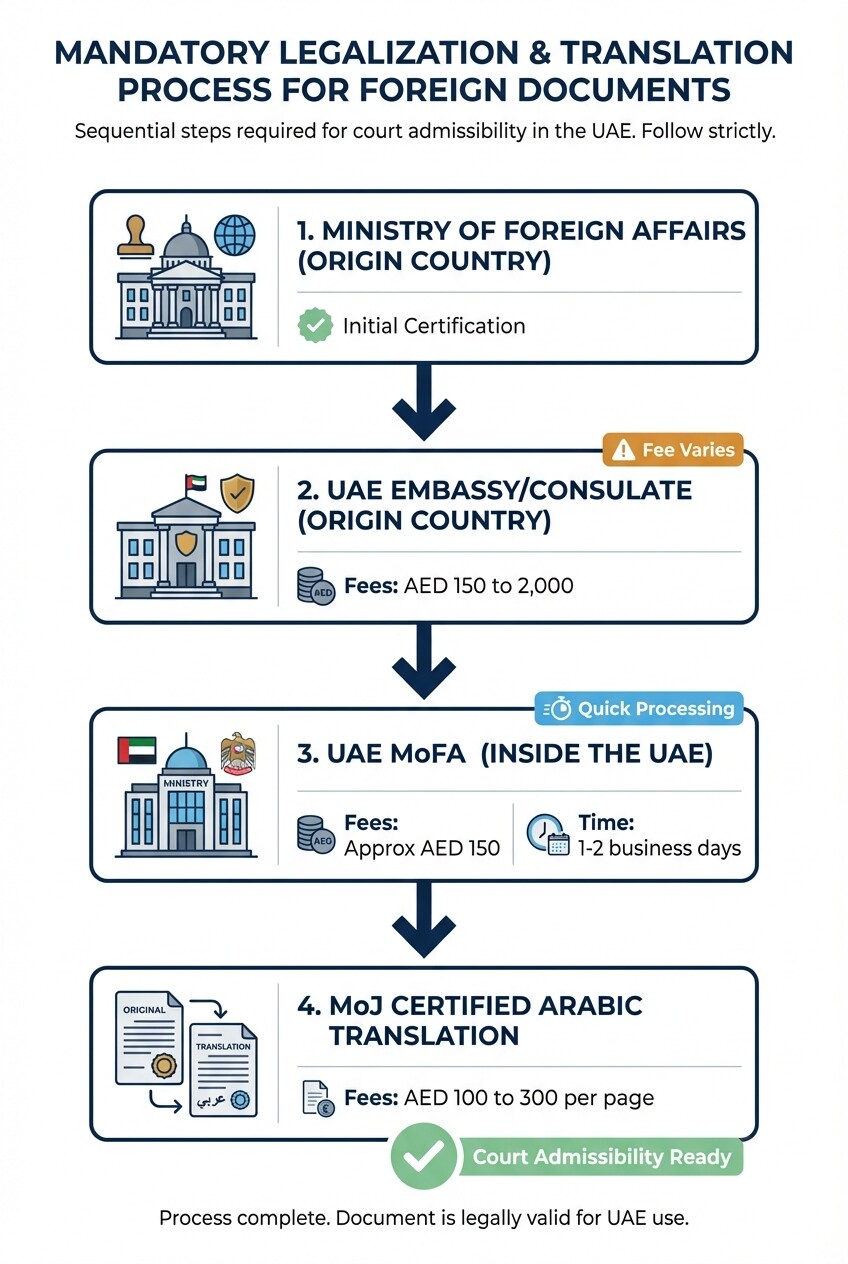
The UAE onshore courts operate exclusively in Arabic and strictly require all foreign legal documents to pass through a multi-tier legalization process before they are admissible. Failure to properly attest or translate a judgment will result in the immediate rejection of the enforcement petition.
The legalization process begins in the judgment's home country and concludes in the UAE. Following the international attestation steps, the documents must be translated into Arabic. This translation cannot be done by just any agency; it must be completed by a translator officially registered and licensed by the UAE authorities.
Be prepared for the following typical costs and timelines during this phase:
- UAE Embassy Legalization: Fees vary by origin country but generally range from AED 150 to AED 2,000 for commercial documents.
- UAE MoFA Attestation: Approximately AED 150 per document, usually completed within 1-2 business days online or at customer happiness centers.
- Certified Translation: Ranges from AED 100 to AED 300 per page, depending on the complexity of the legal text and the turnaround time required.
Using the DIFC Courts as a Conduit Jurisdiction
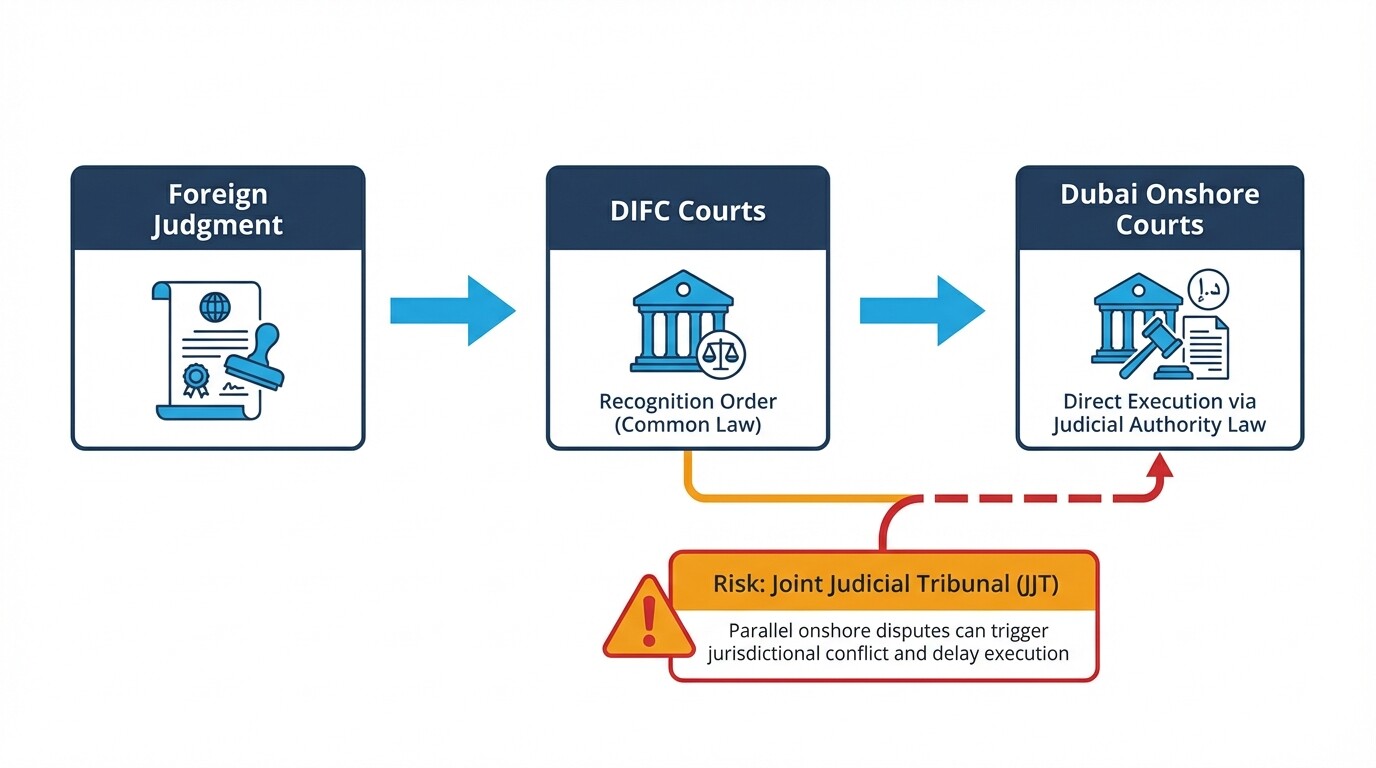
The Dubai International Financial Centre (DIFC) Courts operate under an English-language, common law framework and are frequently used as a strategic "conduit" to enforce foreign judgments against UAE onshore assets. Creditors bring their foreign judgment to the DIFC Courts for recognition, then utilize the reciprocal execution mechanism between the DIFC and Dubai onshore courts.
The DIFC Courts are generally more receptive to recognizing foreign judgments and arbitral awards than onshore courts, particularly from other common law jurisdictions. Once the DIFC Court issues a recognition order, it functions as a local Dubai judgment. Under the Judicial Authority Law, Dubai onshore courts are obligated to execute DIFC judgments without reviewing the merits.
However, creditors should employ this strategy carefully. If a parallel dispute exists in the onshore courts, the Joint Judicial Tribunal (JJT) may be convened to resolve the conflict of jurisdiction, which can delay execution and potentially block the conduit route if onshore courts claim exclusive jurisdiction. You can review the procedural framework directly via the official DIFC Courts portal.
Public Policy Exceptions for Refusing Enforcement
Even if a foreign judgment meets all procedural and reciprocity requirements, UAE courts retain the right to refuse enforcement if the order violates the State's public policy or Sharia law principles. Public policy in the UAE is interpreted broadly and encompasses rules relating to personal status, freedom of trade, and fundamental legal sovereignty.
Common examples of public policy violations include judgments awarding usurious interest (which violates Islamic finance principles), orders relating to illegal substances, or gambling debts. The courts will sever the offending portions of the judgment if possible-for example, enforcing the principal debt while declining to enforce an illegal interest rate component.
Additionally, UAE courts will deny enforcement if the underlying dispute falls under their exclusive original jurisdiction. For instance, disputes involving real estate located within the UAE or commercial agency agreements registered locally are exclusively reserved for UAE onshore courts. A foreign judgment ruling on these matters will be rejected outright.
Common Misconceptions About UAE Enforcement
International creditors often make costly strategic errors when approaching UAE litigation due to outdated information or misunderstandings of the dual-court system. Correcting these misconceptions early prevents wasted legal spend and delayed recoveries.
- Misconception: You must retry the whole case in Arabic. While this was true a decade ago, current Executive Regulations allow for direct enforcement through an execution judge without relitigating the commercial merits of the original dispute.
- Misconception: The DIFC conduit route is always guaranteed. While highly effective, the DIFC conduit strategy is not bulletproof. Defending debtors can sometimes frustrate the process by filing preemptive parallel cases onshore, triggering jurisdictional disputes.
- Misconception: Arbitral awards face the same hurdles as court judgments. Foreign arbitral awards are governed by the New York Convention, which the UAE ratified in 2006. They generally face a lower threshold for enforcement than foreign court judgments, as reciprocity is guaranteed by the Convention.
Frequently Asked Questions
How long does it take to enforce a foreign judgment in the UAE?
Under Article 85, the execution judge is mandated to issue an order within three days of filing the petition. However, factoring in document attestation, translation, and potential appeals from the debtor, the practical timeline typically ranges from two to six months.
Can a foreign judgment be enforced against a company in a UAE Free Zone?
Yes. If the debtor's assets are located within a specific Free Zone (such as JAFZA or ADGM), the execution process will involve the onshore execution judge directing the respective Free Zone authority to freeze or liquidate the assets.
Are foreign default judgments enforceable in the UAE?
Yes, default judgments can be enforced, provided the creditor can conclusively prove that the defendant was properly summoned and notified of the foreign proceedings in accordance with the issuing country's laws.
What happens if the foreign judgment includes compound interest?
UAE courts view compound interest as contrary to public policy and Sharia principles. The judge will typically enforce the principal judgment amount but strike down the sections awarding compound interest.
When to Hire a Commercial Litigation Lawyer
Navigating the cross-border complexities of UAE enforcement requires specialized legal counsel to avoid procedural rejection. You should engage a qualified UAE litigator the moment you obtain a favorable judgment abroad if the debtor holds significant assets within the Emirates.
Legal representation is mandatory for filing an execution petition in the UAE onshore courts. A commercial lawyer will handle the intricate legalization process, manage the certified translations, and determine whether the DIFC conduit or the direct onshore Article 85 route is the most viable strategy for your specific case. For complex asset tracing or debt recovery, finding the right counsel is critical; you can explore qualified commercial litigation lawyers in the United Arab Emirates through the Lawzana directory.
Next Steps for Creditors
If you hold a foreign judgment against a UAE-based entity, your immediate priority is to secure and certify your documentation. Begin by ordering fresh, sealed copies of the final judgment and the certificate of non-appeal from the issuing court.
Next, initiate the foreign affairs and embassy attestation process in your home country, as this administrative phase can take several weeks. Simultaneously, instruct your UAE legal counsel to begin asset tracing to ensure the debtor has executable capital or property within the jurisdiction before you incur the costs of local translation and court filing fees.