


- The UK uses a "no-fault" divorce system, meaning you no longer need to prove adultery, desertion, or unreasonable behavior to end a marriage.
- A minimum of 26 weeks is required to complete a divorce, which includes a mandatory 20-week "cooling-off" period.
- Divorce only ends the legal marriage; a separate "Financial Order" is necessary to legally sever financial ties and prevent future claims.
- Mediation (MIAM) is generally a legal requirement before you can ask a court to intervene in financial or child-related disputes.
- The "welfare of the child" is the court's paramount consideration in all matters involving children, overriding the preferences of the parents.
How long does it take to get a divorce in the UK?
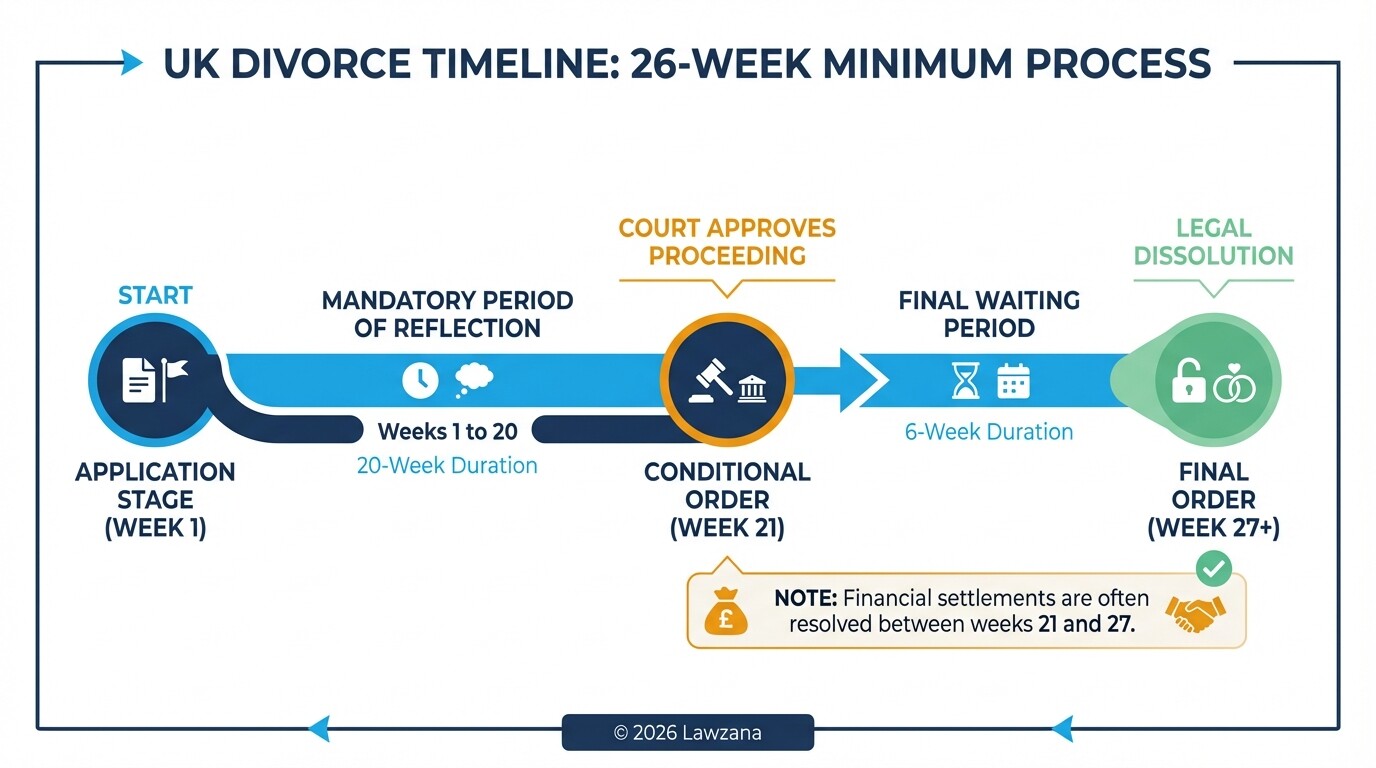
A divorce in the United Kingdom takes a minimum of six months (26 weeks) from the date the application is issued to the date the Final Order is granted. This timeline is a legal requirement designed to give couples a "period of reflection" to ensure they truly wish to proceed with the dissolution of the marriage.
The timeline is strictly regulated by the following stages:
- Application Stage (Week 1): One spouse (sole applicant) or both spouses (joint applicants) submit the divorce application to the court.
- Period of Reflection (Weeks 1 to 20): Once the application is issued, a mandatory 20-week waiting period begins. You cannot move to the next stage until this time has elapsed.
- Conditional Order Stage (Week 21): After the 20-week period, the applicant can apply for a Conditional Order. This confirms the court sees no reason why the divorce cannot proceed.
- Final Waiting Period (Weeks 21 to 26): You must wait an additional six weeks and one day after the Conditional Order is granted before you can apply for the Final Order.
- Final Order (Week 27+): Once granted, the Final Order legally ends the marriage.
While the legal minimum is 26 weeks, many divorces take longer if there are complex financial assets or child custody disputes to resolve simultaneously.
What is the difference between a Conditional Order and a Final Order?
The Conditional Order is an interim document that confirms the legal requirements for divorce have been met, while the Final Order is the legal decree that officially terminates the marriage. You remain legally married during the interval between these two orders, which allows time for the court to review and approve financial settlements.
The Conditional Order
Previously known as the Decree Nisi, the Conditional Order is the "middle point" of the process. It does not end the marriage, but it allows the court to make legally binding financial orders. If you and your spouse have agreed on how to split assets, the judge will usually approve your "Consent Order" only after the Conditional Order has been issued.
The Final Order
Formerly called the Decree Absolute, the Final Order is the final legal step. Once this is issued:
- The marriage is legally dissolved.
- Both parties are free to remarry.
- Certain pension rights and inheritance rights may change or cease.
Lawyers often advise clients to delay applying for the Final Order until a financial settlement has been formally approved by the court to protect their interest in assets like pensions.
How does the court determine a fair financial settlement?
The UK court determines financial settlements based on the principle of "fairness" rather than an automatic 50/50 split of assets. Under Section 25 of the Matrimonial Causes Act 1973, judges have broad discretion to redistribute property, savings, and pensions to ensure the future needs of both parties and any children are met.
The court evaluates several factors to reach a decision:
| Factor | Description |
|---|---|
| Welfare of Children | The first priority is always the housing and financial needs of any children under 18. |
| Financial Needs | The court assesses the future housing and income requirements of each spouse. |
| Earning Capacity | Judges consider the current and future ability of each person to earn a living. |
| Standard of Living | The court attempts to maintain the lifestyle enjoyed during the marriage, if possible. |
| Contributions | This includes both financial contributions and non-financial ones, such as being a primary caregiver. |
| Duration of Marriage | Longer marriages generally lean closer to an equal split of "matrimonial assets." |
It is important to understand that assets brought into the marriage or inherited may be treated differently than assets built up during the union, though they can still be used to meet a spouse's needs if required.
What is a MIAM and is it required for everyone?
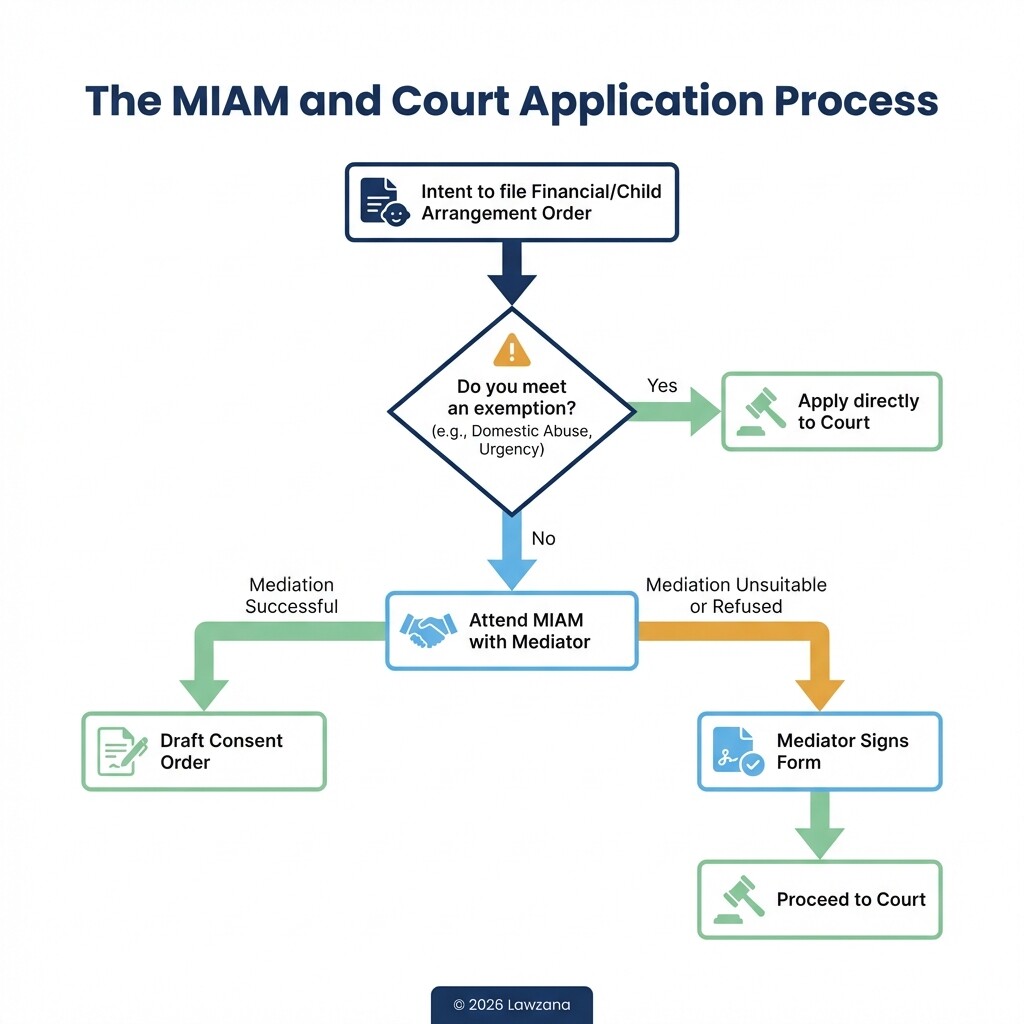
A Mediation Information and Assessment Meeting (MIAM) is a short meeting where an authorized mediator explains the mediation process and assesses whether it is a suitable way to resolve your dispute. In the UK, it is a legal requirement to attend a MIAM before filing an application to the court for financial or child arrangement orders.
The goal of the MIAM is to keep families out of the courtroom, which is often more expensive and adversarial. However, you do not have to attend a MIAM if you meet specific exemptions:
- Domestic Abuse: If there is evidence of domestic violence within the relationship.
- Urgency: If the matter requires immediate court intervention (e.g., a child is at risk of being taken abroad).
- Child Protection: If Social Services are already involved due to safety concerns.
- Distance: If there are no authorized mediators within 15 miles of your home.
If mediation is deemed suitable and both parties agree, you can continue with mediation to reach an agreement. If one party refuses or mediation fails, the mediator will provide a signed form that allows you to proceed to court.
How are child arrangement orders and parental responsibility decided?
Child arrangement orders are decided based on the "Welfare Checklist," a statutory set of criteria that ensures the child's best interests are the primary focus. The court does not view "parental rights" as the priority; instead, it focuses on the child's right to have a safe and meaningful relationship with both parents, provided it is safe to do so.
When a court creates a Child Arrangement Order, it specifies:
- Where the child lives: This can be with one parent or shared between both.
- When the child spends time with each parent: This includes weekends, holidays, and special occasions.
Parental Responsibility
Parental responsibility refers to the legal rights and duties a parent has toward their child, such as making decisions about education, medical treatment, and religious upbringing.
- Mothers automatically have parental responsibility.
- Fathers have it if they were married to the mother at the time of birth or are named on the birth certificate (for births registered after December 1, 2003, in England and Wales).
- Divorce does not remove parental responsibility; both parents must still consult each other on major life decisions for the child.
Common Misconceptions in UK Divorce Law
Many people enter the divorce process with outdated or incorrect assumptions about how the legal system operates in England and Wales.
"Cheating means I get more of the assets"
Since the introduction of no-fault divorce, the reasons for the breakdown of the marriage are almost never relevant to the financial settlement. Conduct is only considered by the court in extreme circumstances, such as if one spouse attempted to murder the other or significantly dissipated assets through gambling.
"We have a common law marriage"
There is no such thing as a "common law" husband or wife in UK law, regardless of how many years you have lived together. Cohabiting couples do not have the same legal protections or automatic rights to assets and pensions as married couples. If you are not married, you must rely on complex property laws to claim a share of a partner's assets.
"I can get a quickie divorce in a few weeks"
The term "quickie divorce" is a media myth. While the administrative part of the application is now digital and faster, the 26-week mandatory waiting period applies to everyone, including celebrities and high-net-worth individuals. There is no legal way to bypass these statutory timelines.
Practical Steps and Costs
Navigating a divorce requires careful financial planning and adherence to procedural steps.
Step-by-Step Process
- Gather Documents: You will need your original marriage certificate (or a certified copy) and a translation if it is not in English.
- File the Application: Use the GOV.UK divorce portal to submit your application.
- Pay the Fee: The standard court fee for a divorce application is currently £593.
- Disclose Finances: Both parties must complete a "Form E," which is a comprehensive breakdown of all assets, debts, and income.
- Draft a Consent Order: If you agree on finances, have a lawyer draft a Consent Order to make the agreement legally binding.
Cost Breakdown
- Court Fee: £593 (fixed).
- Mediation (MIAM): £100 to £200 per person.
- Legal Fees: These vary significantly. An uncontested divorce with a simple financial order may cost between £1,500 and £3,000, while contested cases involving multiple court hearings can exceed £10,000 to £20,000.
Frequently Asked Questions
Can I get a divorce if my spouse refuses?
Yes. Under the no-fault system, one spouse can apply for divorce unilaterally. The other spouse cannot contest the divorce itself, except on very limited technical grounds such as the validity of the marriage or the jurisdiction of the court.
Do I have to go to court in person?
Most divorces in the UK are handled entirely online or via post. Unless there is a significant dispute over finances or children that cannot be resolved through mediation or solicitor negotiation, you will likely never need to step foot in a courtroom.
What happens to our house during a divorce?
The home is treated as a matrimonial asset. The court can order it to be sold and the proceeds split, or it can order one spouse to buy out the other's interest. If there are children, the court may allow the primary caregiver to remain in the house until the youngest child turns 18 (a Mesher Order).
Are pensions included in the financial settlement?
Yes, pensions are often one of the most valuable assets in a marriage. The court can issue a "Pension Sharing Order," which transfers a percentage of one spouse's pension pot into a new pension account for the other spouse.
When to Hire a Lawyer
While you can technically file for divorce yourself using the government portal, professional legal advice is essential if your case involves any complexity. You should consult a lawyer if:
- You and your spouse cannot agree on how to split your property or savings.
- One spouse has a significantly higher income or a large pension pot.
- There are international assets or businesses involved.
- You are concerned about your spouse hiding assets.
- There is a dispute regarding where the children will live.
A lawyer ensures that your financial settlement is "full and final," protecting you from your ex-spouse making a claim against your future earnings or inheritance years after the divorce is over.
Next Steps
- Check Eligibility: Ensure you have been married for at least one year and that the UK courts have jurisdiction to hear your case.
- Locate Your Marriage Certificate: You cannot start the process without it. If lost, order a replacement from the General Register Office.
- Consult a Mediator: Book a MIAM to explore whether you can reach an agreement outside of court.
- Organize Your Finances: Start listing all bank accounts, debts, pension statements, and property valuations to prepare for financial disclosure.
- Seek Initial Legal Advice: Many family law firms offer a fixed-fee initial consultation to help you understand your rights and the likely outcome of your settlement.