



Outsourcing Legal Work: How to Scale Without Overhiring
As a managing partner or solo practitioner, you are likely familiar with the most frustrating paradox in the legal industry: the penalty for success is exhaustion. You have built a stellar reputation, navigated a highly competitive market, and are finally attracting the high-value cases you want. But as the work piles up, your current team is stretched to the breaking point.
The traditional solution, hiring another full-time W-2 associate, adds massive fixed overhead, requires non-billable weeks of onboarding, and creates significant financial risk if your caseload suddenly dips. Yet, simply turning away lucrative matters stifles your firm’s growth, disrupts your client acquisition and retention efforts, and sends prospective clients straight to your competitors.

Variable scaling allows your firm's overhead to accurately mirror your revenue, eliminating the financial risk of sudden case settlements.
|
Quick Summary: The Business Value of This Article
Firm growth should never mandate a compromise between your profit margins and your personal lawyer well-being. By treating legal talent as a strategic, on-demand resource rather than a fixed liability, you can build an agile practice designed for modern business demands. |
In this article, we provide a comprehensive, actionable framework for navigating legal outsourcing. We will explore exactly how to delegate efficiently, protect client trust, and eliminate the scaling dilemma once and for all.
Variable Workloads vs. Fixed Costs
The legal industry is inherently unpredictable. Despite your best efforts to forecast revenue, high-value cases do not arrive on a predictable schedule. They arrive in waves.
When a massive piece of litigation lands on your desk or a sudden influx of corporate mergers demands your immediate attention, your firm’s operational capacity is instantly put to the test. In these moments, managing partners usually face a difficult choice: take on the financial risk of traditional hiring, or turn the work away entirely.
The True Burden of Traditional Expansion
The default reaction to an overflowing caseload is usually to post a job listing for a new associate. However, committing to a full-time, W-2 employee is one of the heaviest financial burdens a boutique firm can take on.
When you hire a full-time attorney, you are taking on costs that extend far beyond their base salary. The true financial commitment includes:
-
Overhead and Administration: Health insurance, 401(k) matching, and payroll taxes.
-
Operational Expenses: Additional malpractice insurance premiums, continuing legal education (CLE) stipends, and bar association dues.
-
Technology and Infrastructure: Expensive annual licenses for legal research tools, practice management software, and document storage.
-
Lost Billable Time: The weeks (or months) of non-billable time partners must spend training and onboarding the new hire before they become profitable.
Consider a common scenario: A boutique litigation firm lands a lucrative, document-heavy class-action lawsuit. To handle the volume, they quickly hire a mid-level W-2 associate. But what happens when that massive case unexpectedly settles out of court six months later? The revenue stream stops, but the fixed salary and overhead remain. The firm's utilization rate plummets, and the very case that was supposed to drive record profits ends up compressing the firm’s margins for the rest of the year.
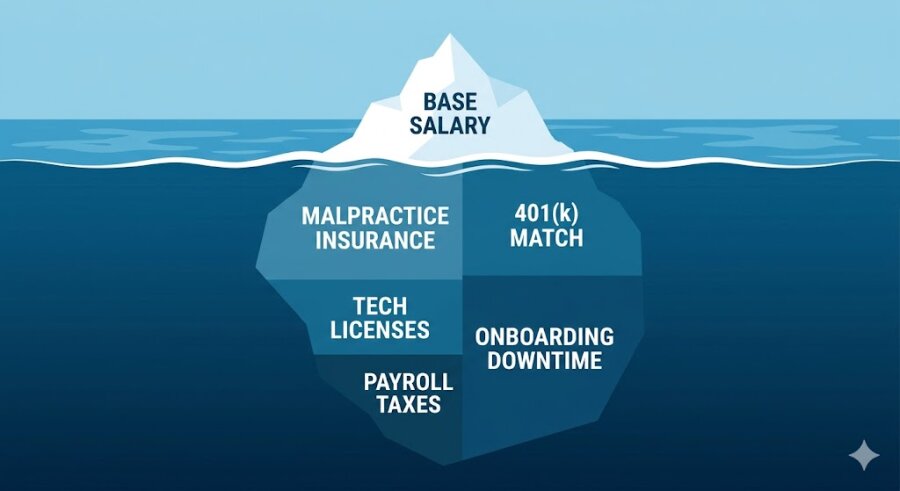
The base salary of a new W-2 associate is only the tip of the iceberg; hidden administrative overhead rapidly compresses boutique firm profit margins.
The Hidden Cost of Turning Away Revenue
To avoid the W-2 trap, some conservative firms choose the opposite route: they simply decline the work. "We are at capacity," they tell the prospective client.
While this protects your firm from immediate overhead, it introduces a much more insidious threat to your business. Rejecting a lucrative case does not just cost you that single retainer. It actively damages your ability to build long-term client relationships and costs you the lifetime value of that client.
When you turn away a corporate client or a high-net-worth individual, you force them to find a solution elsewhere. They will take their business, and their entire future network of referrals, directly to your competitors. Over time, this artificially caps your firm's revenue and limits your market presence.
| Lawzana Pro Tip: When you need to scale up for a sudden influx of cases, the traditional hiring process is simply too slow. A premier global platform allows you to rapidly connect with specialized legal professionals who are ready to step in on a contract basis. By utilizing a robust two-sided marketplace, you bypass months of W-2 recruiting and instantly expand your firm's bandwidth to capture high-value revenue without the long-term liability. |
To break past this growth plateau, law firms must move away from the rigid "all-or-nothing" approach to capacity. The most profitable modern practices treat legal talent as an agile, on-demand resource, allowing them to scale their output perfectly in sync with their incoming revenue.
What Can (and Should) You Outsource?
What is Legal Outsourcing?
Legal outsourcing is the practice of a law firm delegating specific legal or administrative tasks to external contract attorneys, paralegals, or specialized agencies. This strategy allows firms to scale their capacity, handle case overflow, and access specialized expertise without the overhead of hiring full-time employees.
To scale effectively, managing partners must audit their daily operations. You cannot outsource high-level legal strategy, client relationship management, or final court appearances. However, you can, and should, delegate the time-consuming groundwork that drains your billable hours.
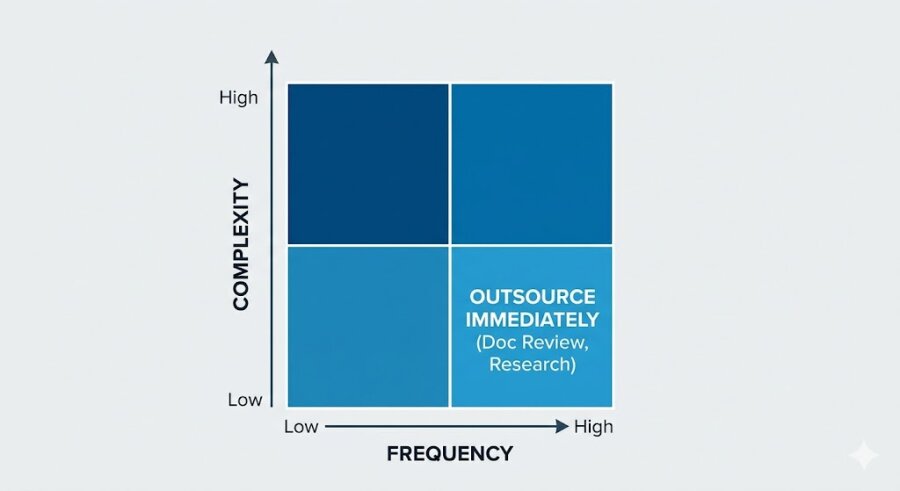
The Delegation Matrix: High-frequency, low-complexity tasks should be immediately outsourced to protect partner billable hours.
When applied strategically, outsourcing falls into three highly profitable categories.
1. High-Volume, Low-Complexity Tasks
The most immediate relief for an overworked firm comes from offloading routine, labor-intensive work. When your senior associates spend their days buried in routine document review, they are not generating premium revenue.
By pushing this work to competent contract professionals, you free your internal team to focus on complex analysis.
2. Unlocking Hyper-Specialized Expertise
Outsourcing is not solely about offloading tedious administrative tasks. It is also a powerful strategic tool for expanding your firm's core capabilities.
Consider a mid-sized corporate firm that suddenly lands a lucrative merger deal, only to discover the transaction involves a highly tangled, international intellectual property portfolio. Traditionally, the firm might refer the entire IP portion of the deal to an outside boutique, sacrificing a significant portion of the revenue.
Through strategic outsourcing, you can instead partner with a freelance, highly specialized IP attorney specifically for that single matter. This approach, for which the market has grown in recent years, allows your firm to maintain complete control of the primary client relationship, confidently manage the niche complexities of the deal, and capture the revenue, all without the expense of staffing a full-time IP department year-round.
| Lawzana Pro Tip: Sourcing reliable, hyper-specialized talent for a time-sensitive case can feel like finding a needle in a haystack. A premier global platform completely streamlines this search. Instead of relying on fragmented local networks, you can leverage a two-sided marketplace to instantly connect with vetted contract attorneys who possess the exact niche expertise your current caseload demands. |
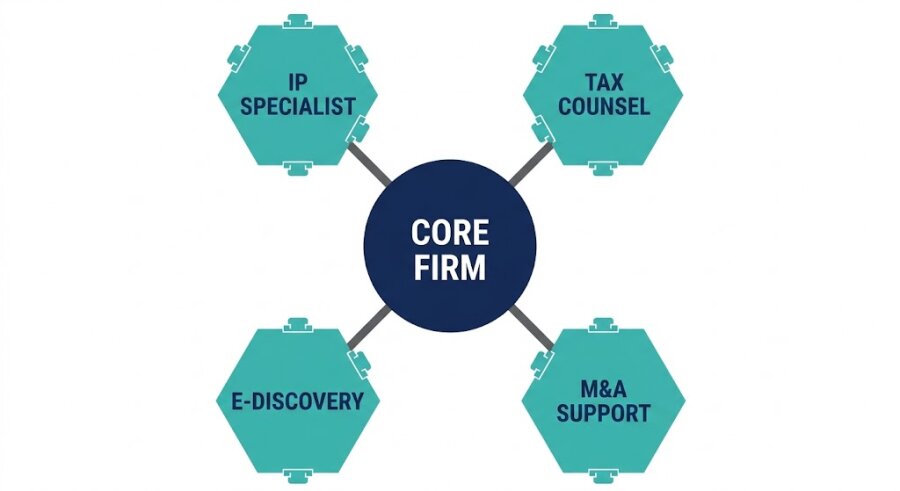
The "plug-and-play" firm: Outsourcing allows a boutique practice to operate as a full-service powerhouse by bolting on niche expertise only when needed.
3. Administrative and Paralegal Support
Your highly paid attorneys should be actively practicing law, not managing administrative bottlenecks. Leveraging contract paralegals provides immense operational relief for growing firms.
Virtual paralegals can seamlessly manage contract lifecycles, format and organize massive trial exhibits, and draft routine client correspondence. By shifting these essential but non-billable operational burdens to freelance support, your core legal team recovers hundreds of hours each month.
Top 5 Legal Tasks for Outsourcing:
-
Document Review & E-Discovery: Sifting through thousands of pages of discovery to identify privileged, relevant, or responsive information.
-
Routine Legal Research: Compiling foundational case law, statutory interpretations, or multijurisdictional compliance summaries.
-
Contract Abstraction: Extracting and summarizing key dates, liability clauses, and deliverables from massive corporate agreements.
-
Drafting Standard Pleadings: Preparing the initial, foundational drafts of complaints, answers, and standard procedural motions.
-
Deposition Summaries: Condensing hours of lengthy transcripts into actionable, easily scannable overviews.
Compliance and Client Trust
Outsourcing legal work is a brilliant business strategy, but it is not without risk. Unlike a standard corporate business outsourcing its IT department, law firms are bound by stringent ethical obligations.
When you delegate work to a contract attorney or an external paralegal, you remain the attorney of record. You cannot outsource your fiduciary duty. To scale your practice safely, you must build impenetrable guardrails that protect both your law license and your clients' trust.
Ensuring Strict Confidentiality
The foundation of the legal profession is attorney-client privilege. Introducing an external contractor into your workflow creates a potential vulnerability if not managed with precision.
To maintain strict confidentiality when utilizing freelance talent, implement these mandatory operational protocols:
-
Siloed Information Access: Never give a contract attorney blanket access to your firm’s entire cloud server. Create secure, temporary folders that contain only the specific documents required for their assigned task.
-
Ironclad NDAs: Require every external professional to sign a comprehensive Non-Disclosure Agreement before they see a single case file.
-
Rigorous Conflict Checks: Treat freelance attorneys exactly as you would a new lateral hire. Before assigning a matter, you must run a thorough conflict check against their past clients and concurrent contract work.
| Lawzana Pro Tip: Vetting individual freelance attorneys for ethical compliance and conflict history is a massive drain on your non-billable time. Utilizing a premier global platform instantly mitigates this friction. A robust two-sided marketplace ensures that the specialized legal professionals you connect with are already verified and operating to a high international standard, allowing you to confidently build your external team without the administrative headache. |
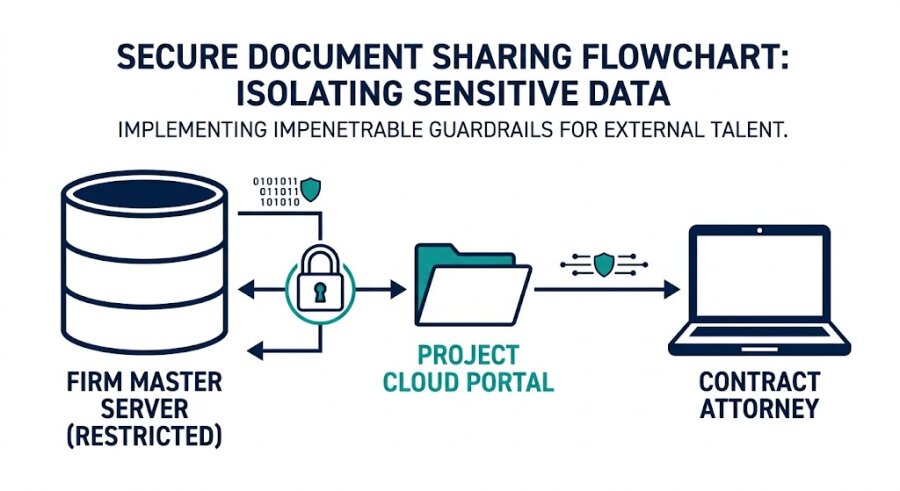
Ethical data compartmentalization: Never grant external talent access to your master server. Utilize isolated project portals to maintain attorney-client privilege.
Understanding Billing and Client Disclosure
A common hesitation among managing partners is the fear of how clients will react to outsourced work. Will they feel neglected? Will they refuse to pay?
In reality, modern corporate clients and savvy individuals appreciate cost-effective efficiency, provided you are entirely transparent. Secretly marking up outsourced work or hiding the use of contract attorneys is a fast track to disciplinary action.
To navigate billing and disclosure ethically, follow these best practices:
-
The ABA Standard: Familiarize yourself with American Bar Association (ABA) Formal Opinion 08-451. The ABA explicitly supports outsourcing, provided the delegating lawyer ensures the contractor's competence, maintains direct supervision, and protects client confidences.
-
Update Your Retainer Agreements: Eliminate surprises by embedding clear language in your standard engagement letters. State plainly that your firm may utilize specialized contract attorneys or paralegals to handle matters efficiently, under your direct supervision.
-
Transparent Invoicing: When billing for a freelancer’s time, you generally have two ethical options. You can bill the client for the exact cost of the contractor as an administrative expense, or you can bill the contractor's time at a reasonable market rate for their level of expertise, provided this fee structure was agreed upon in the retainer.
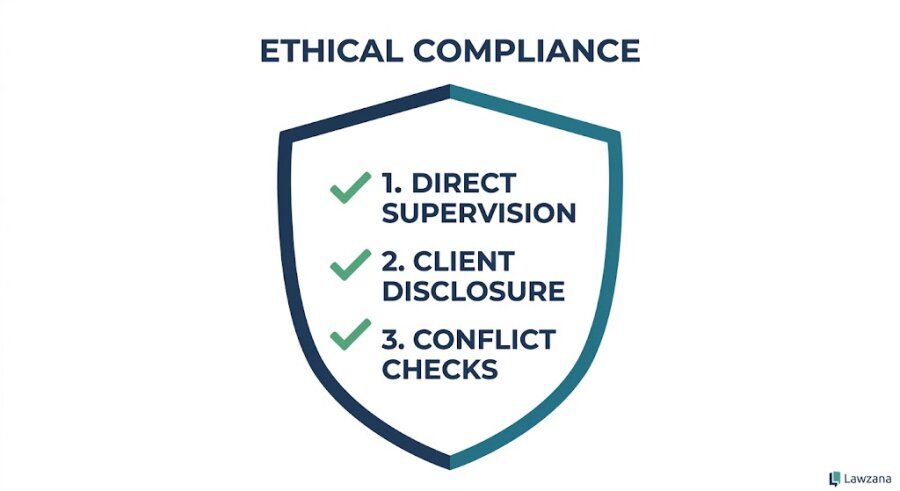
The three non-negotiable pillars of ethical legal outsourcing, aligning with ABA Formal Opinion 08-451.
Integrating Freelance Talent
The difference between a stressful outsourcing experience and a highly profitable one comes down to execution. You cannot simply hand over a massive case file to a contract attorney, provide a vague deadline, and hope for the best.
To turn freelance talent into a seamless extension of your firm, you must treat their onboarding with the same operational rigor you apply to your in-house staff. Successful integration relies on crystal-clear communication, secure technology, and uncompromising quality control.
Defining Clear Scopes of Work (SOW)
Ambiguity is the enemy of outsourced efficiency. If you provide a contract attorney with unclear instructions, you will likely receive off-target work that requires hours of your own time to fix, completely defeating the purpose of delegation.
Before any billable work begins, you must draft a precise Scope of Work (SOW). A foolproof SOW should clearly define:
-
The Exact Deliverable: Are you asking for a raw list of case citations, a fully formatted internal memo, or a final draft ready for court filing?
-
Firm Deadlines and Milestones: For large projects, establish midway check-ins to ensure the contractor is on the right track before they exhaust the allocated hours.
-
Formatting Requirements: Provide your firm’s style guide or templates so the final document perfectly matches your internal branding and formatting standards.
-
Communication Protocols: Specify how and when the freelancer should contact you with questions to avoid constant interruptions during your protected deep-work hours.
| Lawzana Pro Tip: Managing the initial logistics of hiring, like negotiating terms, verifying expertise, and establishing project parameters, can easily eat into the time you are trying to save. By utilizing a premier global platform, you establish a direct, professional line of communication with specialized talent. A two-sided marketplace streamlines the initial engagement, allowing you to clearly define scopes of work and expectations within a structured, business-focused environment. |
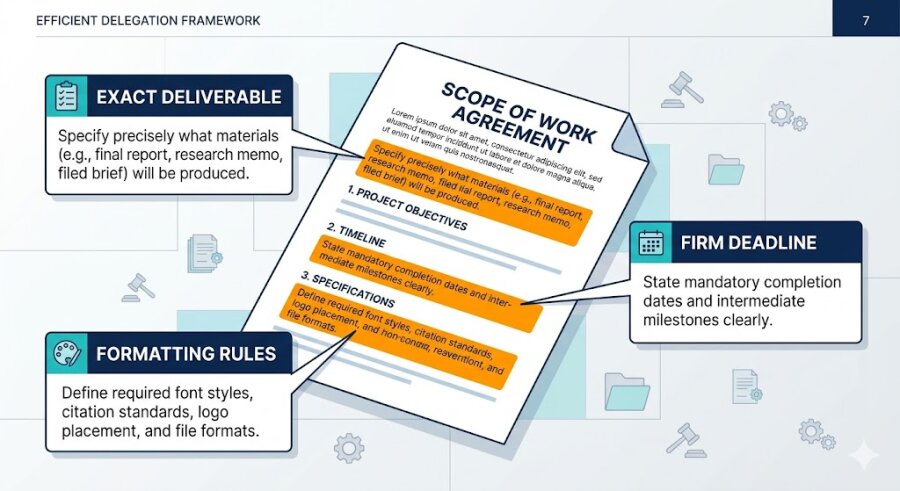
Ambiguity destroys outsourcing ROI. A highly profitable Scope of Work must explicitly define deliverables, milestones, and formatting rules upfront.
Centralizing Case Management
Emailing sensitive, multi-gigabyte document files back and forth is incredibly inefficient and highly insecure. To integrate external talent smoothly, your firm must utilize a centralized, cloud-based practice management system like Lawzana Flow.
Your technology stack should allow you to create secure, project-specific portals. This enables the contract attorney to log in, access only the specific case files they need, and upload their completed drafts directly into your firm's workflow. This eliminates version control issues, where multiple attorneys are editing different versions of the same Word document, and keeps your operations moving efficiently.
Maintaining Rigorous Quality Control
When you hire an external professional, you are buying their time and initial analysis, but you are not transferring your liability. The partner of record must take ultimate ownership of the final work product before it ever reaches the client or the judge.
Build dedicated review time into every outsourced project. By the time a brief reaches your desk from a trusted contract attorney, 90% of the heavy lifting should be complete. Your job is to apply the final 10%, the strategic nuance, the firm’s unique voice, and the final factual verification. This ensures that every document leaving your firm reflects your exact standard of excellence, regardless of who drafted the initial paragraphs.
Building a Scalable, Future-Proof Practice
Scaling a law firm successfully no longer means leasing more office space and stacking fixed salaries. True growth requires operational agility. By treating legal talent as an on-demand resource rather than a rigid liability, your firm can confidently weather economic shifts, capture sudden influxes of high-value cases, and protect your profit margins.
Before you launch your new growth strategy, review these common questions to ensure your firm is fully prepared.
Frequently Asked Questions About Legal Outsourcing
-
Is it ethical for a law firm to outsource legal work?
Yes. Under guidelines like ABA Formal Opinion 08-451, outsourcing is entirely ethical provided the delegating attorney ensures the contractor's competence, protects client confidentiality, and maintains direct supervision over the final work product.
-
Do I need to disclose the use of a contract attorney to my client?
Transparency is the best policy. It is highly recommended to include a clear clause in your standard retainer agreements stating that your firm may utilize external legal professionals to handle matters cost-effectively under your supervision.
-
How much does legal outsourcing typically cost?
Costs vary significantly based on the complexity of the task and the freelancer's expertise. However, because you only pay for actual hours worked, eliminating benefits, taxes, and software licenses, the overall expense is drastically lower than hiring a full-time W-2 employee.
-
Can a solo practitioner use legal process outsourcing?
Absolutely. Outsourcing is the ultimate equalizer for solo practitioners, allowing them to handle massive caseloads and compete directly with mid-sized firms without taking on crippling administrative overhead.
-
Who is liable for mistakes made by a freelance lawyer?
You are. The hiring partner or attorney of record retains ultimate fiduciary responsibility. This is why rigorous quality control and final reviews are mandatory before submitting any outsourced work to a client or the court.
Turn Your Expanded Capacity into Revenue with Lawzana
You now have the framework to handle case overflow, access niche expertise on demand, and scale your firm profitably. But expanded capacity is only half the equation. To truly grow, you need a reliable pipeline of high-intent clients to fill that newfound bandwidth.
As a premier global platform and two-sided marketplace, becoming a Lawzana member is designed to bridge the gap between your world-class expertise and the high-value clients actively searching for it. We handle the heavy lifting of digital visibility so you can focus entirely on practicing law.