



A legal practice might generate twenty million dollars annually yet still struggle to cover basic overhead. High top-line revenue frequently masks deep operational inefficiencies.
Many partners continue managing their operations using vanity numbers like total hours billed and gross originations. These specific figures measure sheer activity rather than actual financial health. Relying on them provides a false sense of security. Meanwhile, underlying profit margins quietly erode.
Building a resilient business requires leadership to look much deeper into the data. In this article, we break down the exact law firm profitability metrics partners must track. You will learn how to identify hidden revenue leakage. The following sections also detail methods for optimizing resources and increasing the true valuation of your organization.
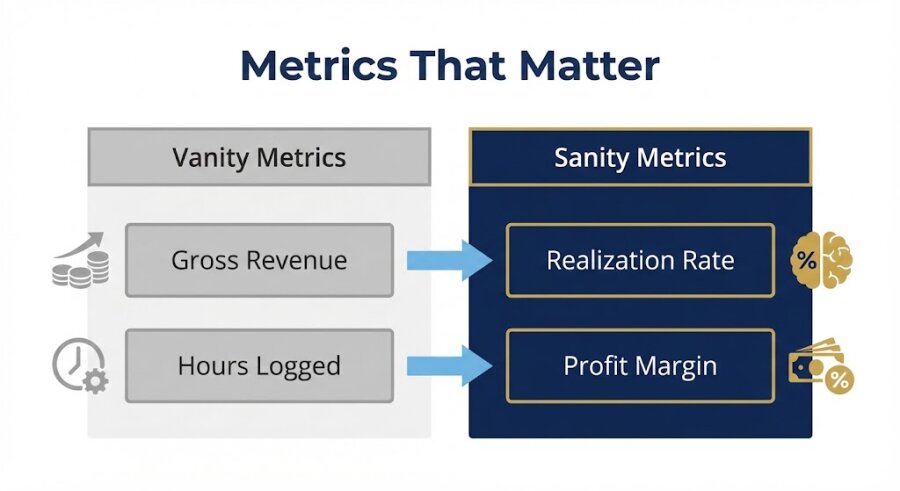
Top-line revenue is a vanity metric. True financial resilience is built on tracking the numbers that actually dictate your margins.
How to Measure Firm Profitability: Tracking the Utilization Rate
Human capital represents your single largest expense. Measuring how effectively your firm deploys that expensive talent is absolutely critical. The utilization rate tracks this exact dynamic. It reveals the stark difference between potential capacity and actual output.

The utilization gap: Uncover exactly where your most expensive human capital is losing billable time to administrative friction.
What Are the Best KPIs for Law Firms Measuring Capacity?
You calculate this specific metric using a straightforward mathematical formula. Simply divide the total billable hours logged by the total available working hours in a given period.
A shockingly low percentage frequently alarms managing partners during their initial financial audits. This number exposes a harsh operational reality. Your associates are likely buried under mountains of non-billable work. They might spend a massive portion of their week on administrative duties. Internal meetings drain productivity. Unstructured business development activities also consume highly valuable time.
We would advise executive committees to view this KPI as a diagnostic tool rather than a weapon. Poor utilization rarely indicates a lack of a lawyer's work ethic. It almost always highlights broken internal processes.
What Is a Good Target Metric for Attorney Utilization?
Expectations absolutely must align with reality. Setting targets too high creates incredibly dangerous incentives.
Lawyers facing impossible billing quotas will eventually begin padding their timesheets just to survive. Others simply burn out. They quit without warning. Talent turnover destroys profitability faster than almost any other operational failure.
Industry standards vary considerably based on the specific role of the practitioner within your organization.
-
Associates typically target much higher percentages since their primary function centers strictly on execution.
-
Partners naturally record significantly lower utilization rates.
-
Senior leadership must dedicate substantial portions of their week to firm management alongside client acquisition.
What Is a Good Profit Margin for a Law Firm Practice Area?
Not all revenue carries the same weight. Different departments within your organization operate with vastly different financial realities. Sometimes, one highly lucrative team secretly subsidizes several underperforming groups.
You must uncover the true costs associated with every single service you provide. Massive cash flow frequently comes from high-volume commodity work. Yet, notably thin final profits often result from those exact same matters.
How to Calculate True Overhead Costs by Department
Finding an accurate margin requires precise math. You cannot simply look at the gross fees collected by a specific team. Leadership has to allocate direct expenses directly to the responsible group. Furthermore, a realistic portion of general firm overhead must be assigned there too.
-
Rent for the square footage that the department occupies.
-
Software licenses are necessary for daily operations.
-
The salaries paid to dedicated paralegal staff.
Failing to distribute these burdens correctly paints a highly distorted picture. You might assume a specific litigation team is your biggest earner. A deeper financial dive could expose something else entirely. Their actual profitability might be completely erased by excessive discovery costs.
How Do KPIs Influence Strategic Resource Allocation?
Hard data should dictate every hiring decision. Your entire marketing budget needs to rely on these figures too. Suppose the numbers clearly show that complex cross-border transactions deliver the highest net returns. The firm should immediately pivot resources toward that exact specialty.

Data-driven strategy means ruthlessly pivoting your firm's resources toward high-yield, high-margin practice areas.
Leadership might decide to aggressively expand their roster of investment and business structuring lawyers. Capitalizing on a proven profitability trend accelerates growth exponentially.
At Lawzana, we are aware that elite firms make these calculated pivots daily. They abandon low-yield practice areas without hesitation. Our platform helps them attract the precise clientele required for feeding those highly lucrative departments. You cannot scale effectively if you continue funding starved sectors of your business.
Understanding the Leverage Ratio as a KPI for Law Firms
A brilliant legal strategy requires proper execution. How your organization balances senior expertise with junior effort dictates your financial ceiling. This dynamic is commonly known as the leverage ratio.
Many organizations struggle with this specific balance. As a digital platform connecting high-tier clients with appropriate counsel, at Lawzana, we do sometimes notice structural inefficiencies. Firms often pitch a massive team of seasoned experts to win a bid. Yet deploying partners for every minor task destroys your margins rapidly.
How to Measure Firm Profitability Using Partner-to-Associate Balance
You must clearly define the exact ratio of equity owners to subordinate attorneys. A top-heavy pyramid creates immediate operational friction.
Imagine a scenario where too few associates exist within a department. The partners inevitably end up handling mid-level work. They attempt to bill this time at absolute premium rates. Clients eventually notice these exorbitant fees for standard document review. Frustration builds quickly. Realization rates plummet. Partners are forced to discount their own invoices just to appease angry corporate boards.
Consider the severe structural risks involved:
-
Highly compensated equity owners waste hours on routine administrative tasks.
-
Junior talent lacks adequate mentorship.
-
Leadership is too busy grinding through basic filings to teach the next generation.
-
Succession planning fails completely without a wide base of upcoming talent.
What Is the Best Metric to Optimize the Firm Pyramid?
Finding the structural sweet spot is incredibly lucrative. The ideal pyramid allows partners to focus almost entirely on high-level strategy. Client origination should consume their remaining schedule. Associates then drive the actual execution engine of the business.
Data must guide your hiring trajectory moving forward. If your most senior people are constantly drowning in paperwork, you need more leverage. Bringing in capable mid-level talent allows the partners to delegate effectively. Revenue grows exponentially when the highest earners concentrate solely on business development. We see the most profitable firms master this delegation perfectly. They build a wide base of capable associates to support a very focused group of rainmakers.
What Is the Best Metric to Measure Profitability vs. Cash Flow?
Cash flow is the literal oxygen of your business. Profit existing only on a spreadsheet means absolutely nothing if the money remains trapped. Your financial health depends entirely on liquidity.
How to Measure Firm Profitability Using the WIP-to-Fee Ratio
Work in Progress represents all unbilled time. This specific metric exposes a massive vulnerability within many practices. When leadership delays invoicing, the firm is effectively granting clients an unsecured loan. You charge zero interest on this borrowed money.
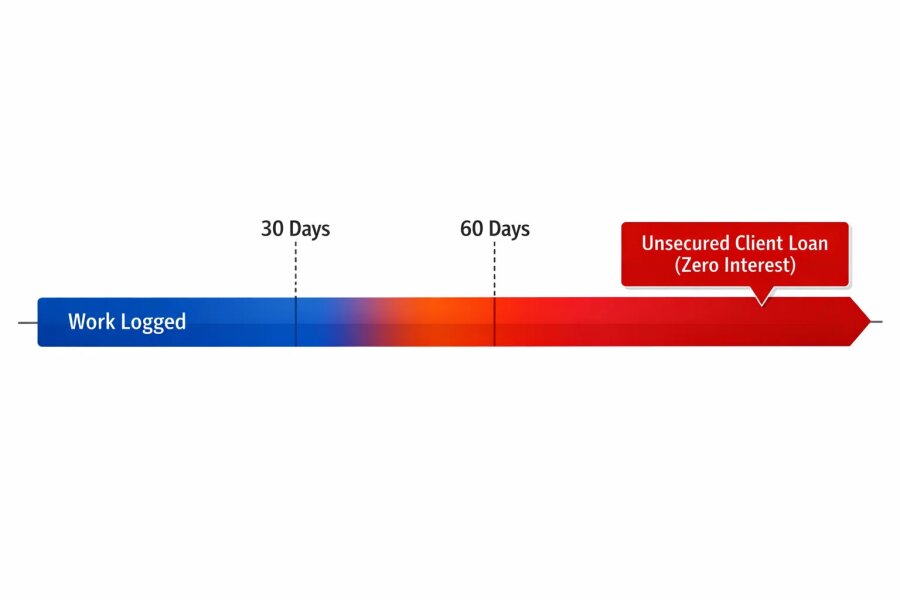
Unbilled Work in Progress is simply an unsecured loan to your clients. Tighten your billing cycles to protect your firm's liquidity.
Implementing strict billing cycles is absolutely non-negotiable. You must convert that pending work into actual fees on a rigid schedule.
What Are KPIs for Law Firms Regarding AR Aging?
Accounts Receivable Aging tracks exactly how long your invoices sit unpaid. You calculate this using Days Sales Outstanding. DSO measures the precise delay between sending a bill and receiving the cash.

Cash flow is the oxygen of your business. Monitor your Days Sales Outstanding (DSO) strictly to prevent capital from getting trapped.
A healthy practice keeps this number as low as possible. If your DSO routinely stretches beyond sixty days, your organization is acting as a bank.
Combating this requires immediate operational changes:
-
Implement automated payment reminders through your management software.
-
Start accepting credit cards to remove client payment friction.
-
Require substantial upfront retainers for historically high-risk matters.
You cannot invest in new marketing initiatives or hire top talent if your capital is locked inside unpaid invoices. True profitability requires actual cash in the bank.
Building a Data-Driven Culture: The Best Metric Is Adoption
Knowing the right numbers provides zero value if the leadership team ignores them. Information requires action.
Many brilliant attorneys naturally focus entirely on securing favorable outcomes or closing complex mergers for their clients. Financial analysis understandably falls lower on their daily priority list. They are dedicated professionals who excel at practicing law. Therefore, shifting the firm toward a business-first mindset requires the right tools and proper incentives.
Modern management software bridges this gap beautifully. It transforms raw data into accessible visual dashboards. Partners no longer need to spend hours deciphering dense accounting spreadsheets. Real-time metrics appear instantly on their screens.
Transitioning a traditional practice toward full financial transparency takes time and patience. You must encourage collaboration rather than forcing compliance. The most effective method involves aligning compensation models directly with these modern profitability indicators. Gross originations should not be the only path to a larger distribution check.
Consider adjusting your incentive structures to reflect actual financial health:
-
Reward high realization rates instead of just praising total hours billed.
-
Provide bonuses for efficient delegation to junior associates.
-
Recognize partners who maintain exceptionally low outstanding client balances.
At Lawzana, we connect high-net-worth individuals and corporate entities with elite legal talent globally. We constantly observe a shared operational trait among the most successful organizations on our platform. Embracing data enthusiastically gives these teams a significant advantage. Operational clarity allows them to accept sophisticated matters with total confidence. The managing partners understand exactly how to staff incoming cases for maximum efficiency and ultimate client satisfaction.
Securing Your Future Growth
Tracking these specific law firm profitability metrics transforms an organization completely. A legal practice elevates from merely surviving to actively thriving. Growth always requires absolute precision. Hard data provides leadership with the immense confidence needed to make highly strategic business decisions.
Consider the operational freedom this level of insight brings to a growing practice:
-
Leadership can confidently pivot away from low-margin service areas.
-
The executive committee can graciously decline engagements that historically drain vital administrative resources.
-
Partners gain the ability to accurately forecast annual revenue benchmarks.
Building a sustainable legal enterprise remains a deeply complex endeavor. The most successful legal professionals understand that their time is incredibly valuable. They refuse to operate in the dark regarding their own financial health. We highly recommend taking one immediate step today. Audit your current collection realization rate this week. This single diagnostic action reveals incredible insights into your baseline operational stability.
Once your internal metrics are fully optimized, a new, exciting challenge emerges. You must acquire the exact caliber of clientele required to feed your highly efficient machine. This is exactly where our platform provides unmatched value to the legal community. Elite practitioners across the globe utilize our network to secure premium international engagements. Highly specialized investment lawyers constantly leverage Lawzana to seamlessly connect with corporate entities and high-net-worth prospects. Join our growing platform today. Attract the perfect clients to fuel your future expansion.