Registering an Australian Subsidiary: Regulatory FAQ for Tech Firms
- Regulatory Body: Foreign tech companies must register their subsidiary with the Australian Securities and Investments Commission (ASIC), typically as a Proprietary Limited (Pty Ltd) company.
- Local Representation: Australian corporate law requires at least one company director and a Public Officer to be ordinarily resident in Australia.
- Identification Rules: All directors, including foreign nationals, must obtain a Director Identification Number (Director ID), which requires notarized and apostilled proof of identity.
- Setup Costs: Expect to pay between $3,000 and $10,000 AUD in combined legal fees, ASIC registration charges, and professional services to establish the entity.
- Timelines: The end-to-end process from document preparation to obtaining an Australian Business Number (ABN) and opening a local bank account generally takes four to eight weeks.
ASIC Registration Framework for Foreign Tech Firms
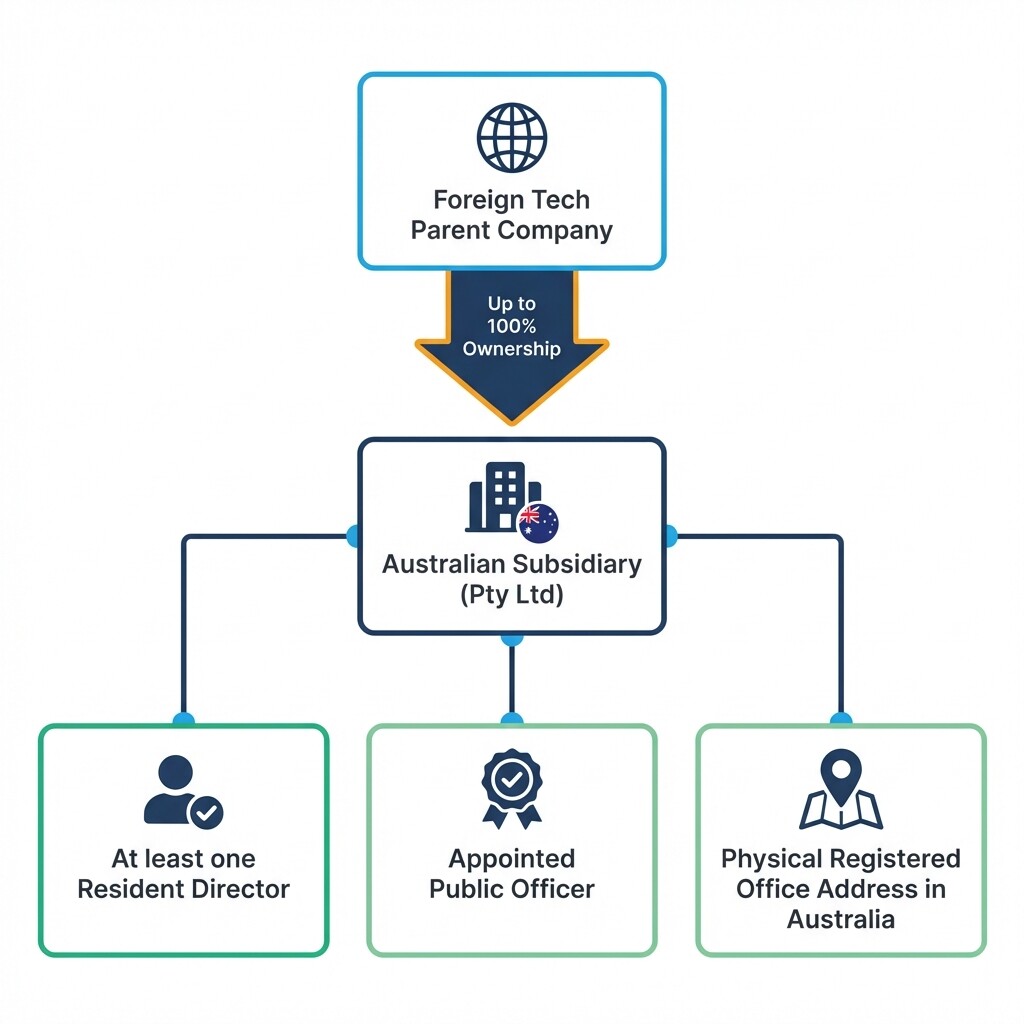
Foreign technology companies must register their Australian subsidiary with the Australian Securities and Investments Commission (ASIC). A proprietary limited company (Pty Ltd) is the most common and practical structure, requiring at least one resident director and a physical registered office address in Australia.
Operating as a subsidiary allows a foreign tech parent company to ring-fence its liability while establishing a distinct local presence. According to the Corporations Act 2001, a foreign entity can either register as a foreign company branch or incorporate a new local subsidiary. Tech firms overwhelmingly prefer incorporating a local Pty Ltd subsidiary because it streamlines the process of signing local customer contracts, accessing Australian government tech and R&D grants, and hiring domestic employees. When incorporating, you must submit an application detailing the company name, share structure, registered office address, and director details to register the company with ASIC. Once approved, ASIC issues an Australian Company Number (ACN), which acts as the entity's primary legal identifier.
Cost Breakdown for Registering an Australian Subsidiary
Registering an Australian subsidiary typically costs between $3,000 and $10,000 AUD in initial legal setup fees and government charges. Ongoing compliance, tax lodgment, and resident director services will add an estimated $5,000 to $15,000 AUD annually, depending on the complexity of your operations.
Foreign firms should budget for both direct government filing fees and mandatory professional services. Because tax structures and cross-border IP licensing agreements are highly scrutinized in Australia, retaining legal and financial advisors is a necessary cost of doing business.
| Registration/Setup Expense | Estimated Cost (AUD) | Frequency | | : | : | : | | ASIC Company Registration Fee | $576 | One-time | | Legal Setup & Corporate Structuring | $2,500 - $8,000 | One-time | | Registered Office Address Service | $500 - $1,200 | Annual | | Resident Director Service (if needed) | $5,000 - $12,000+ | Annual | | Tax Registration (ABN/TFN/GST) | $500 - $1,500 | One-time | | Annual ASIC Review Fee | $310 | Annual |
Mandatory Director Identification and Documentation
All company directors, including foreign nationals residing overseas, must apply for a Director Identification Number (Director ID) before they can be officially appointed to an Australian company. The paper application process for foreign residents requires providing notarized and apostilled identification documents to verify identity and background.
Administered by the Australian Business Registry Services (ABRS), the Director ID is a unique identifier designed to prevent the use of false director identities. Because foreign directors cannot use the Australian digital myGovID system, they must complete a manual paper application. The primary challenge for foreign tech founders is the strict document certification standard. You must provide:
- A certified copy of your primary identity document (typically a valid passport).
- A certified copy of a secondary identity document (such as a driver's license or birth certificate).
- Proof of your current residential address.
Crucially, if you are certifying these documents outside of Australia, they must be certified by a Notary Public and, in almost all jurisdictions, authenticated via an Apostille stamp. Failure to correctly certify these documents is the leading cause of registration delays.
Australian Tax Registration Steps
Once the subsidiary is registered with ASIC, the company must apply to the Australian Taxation Office (ATO) for a Tax File Number (TFN) and an Australian Business Number (ABN). Technology firms must also register for Goods and Services Tax (GST) if their projected annual Australian turnover exceeds $75,000 AUD.
Obtaining an ABN is critical for trading in Australia; without it, other Australian businesses must withhold tax at the highest marginal rate on payments made to your subsidiary. The process for applying for an ABN involves detailing the company's business activities, associates, and physical locations. To complete this tax registration, the subsidiary must formally appoint a Public Officer within one month of incorporation. The Public Officer serves as the ATO's primary point of contact for the company and is legally responsible for the company's tax obligations. By law, the Public Officer must be at least 18 years old and ordinarily reside in Australia.
Expected Timeline for Subsidiary Registration
Establishing an Australian subsidiary usually takes four to eight weeks from initial document collection to final tax registration. Delays most commonly occur during the notarization of foreign director documents and the manual review of tax registrations by the ATO.
To manage expectations, foreign tech firms should anticipate a multi-stage timeline:
- Document Preparation and Director IDs (2-4 weeks): The longest phase. Foreign directors must secure notarized and apostilled identification and mail the physical documents to the ABRS.
- ASIC Incorporation (1-3 days): Once all signed consents and structures are finalized, the actual electronic ASIC registration is nearly instantaneous, usually returning an ACN within 48 hours.
- Tax Registration (1-4 weeks): Applying for an ABN and TFN triggers a manual review by the ATO for foreign-owned entities. This review period can take up to 28 days.
- Corporate Bank Account Setup (2-6 weeks): Australian banks enforce strict Anti-Money Laundering and Know Your Customer (AML/KYC) regulations. Opening an account requires comprehensive verification of the foreign parent company's ultimate beneficial owners (UBOs).
Common Misconceptions About Establishing an Australian Subsidiary
Many foreign tech companies underestimate Australia's strict local residency requirements and assume they can operate a subsidiary without any domestic personnel. Other common myths involve tax registration timelines and banking conveniences.
- Myth: You can establish a company with an entirely foreign board. Reality: An Australian Pty Ltd must have at least one director who ordinarily resides in Australia. If you do not have local staff, you will need to hire a professional nominee resident director.
- Myth: You will receive your ABN immediately upon ASIC registration. Reality: While domestic founders often receive an ABN instantly, applications involving foreign parent companies or foreign directors are flagged for manual integrity checks by the ATO, delaying issuance by up to a month.
- Myth: Opening an Australian corporate bank account is a fast, digital process. Reality: Due to rigorous KYC laws, foreign-owned entities cannot simply open an account online. The process requires extensive documentation of the global corporate tree and often requires wet-ink signatures or specific verification calls.
Frequently Asked Questions
Do I need to physically travel to Australia to set up a subsidiary?
No, the entire incorporation process can be managed remotely. Legal and accounting representatives in Australia can handle the ASIC filings, tax registrations, and act as your resident director and public officer if necessary.
Can a foreign parent company act as the sole shareholder?
Yes, an Australian proprietary limited company (Pty Ltd) can be 100% foreign-owned. A single foreign corporate entity can hold all the shares in the Australian subsidiary.
What is the corporate tax rate for tech subsidiaries in Australia?
The standard corporate tax rate in Australia is 30%. However, if your subsidiary qualifies as a "base rate entity" (an aggregated turnover of less than $50 million AUD and meeting passive income tests), it may be eligible for a reduced corporate tax rate of 25%.
Do I need an Australian bank account to register the company?
You do not need an Australian bank account to complete the ASIC registration or obtain an ABN. However, you will need a local bank account to efficiently process local transactions, pay Australian employees, and remit local taxes.
When to Hire a Business Registration Lawyer
You should hire an Australian corporate lawyer before finalizing your corporate structure or executing any cross-border intercompany agreements. Legal counsel ensures your subsidiary complies with the Corporations Act and prevents costly structuring mistakes regarding intellectual property and transfer pricing.
Drafting a custom company constitution that aligns with your foreign parent company's bylaws requires local expertise. Attempting to use generic, off-the-shelf company templates often leads to governance conflicts between the Australian subsidiary and the international parent. You can consult Australian business registration lawyers to structure your entity correctly from day one.
Next Steps
Begin the registration process by confirming your corporate structure and identifying who will serve as the Australian resident director and Public Officer. Gathering the required identification documents early will significantly speed up your overall timeline.
- Verify Corporate Name Availability: Check the ASIC registers to ensure your desired subsidiary name is available in Australia.
- Apply for Director IDs: Have all foreign directors begin the process of notarizing and apostilling their identification documents immediately.
- Engage Local Professionals: Retain an Australian law firm or accounting practice to handle the ASIC lodgment, provide a registered office address, and act as your local agent.
- Draft Intercompany Agreements: Work with your legal team to prepare software licensing, data sharing, and management services agreements between the parent company and the new Australian subsidiary.