

- You must submit unfair dismissal claims to the Fair Work Commission within 21 days of your termination date.
- Employees have a legal right to request flexible or remote work arrangements after 12 months of service if they meet specific eligibility criteria.
- Redundancy pay is calculated based on your length of continuous service and typically ranges from 4 to 16 weeks of base pay.
- Employers can only refuse a flexible work request on "reasonable business grounds" and must provide a written explanation within 21 days.
- To qualify for unfair dismissal protections, you must earn below the high-income threshold or be covered by a modern award or enterprise agreement.
What are the criteria for filing an unfair dismissal claim in 2026?
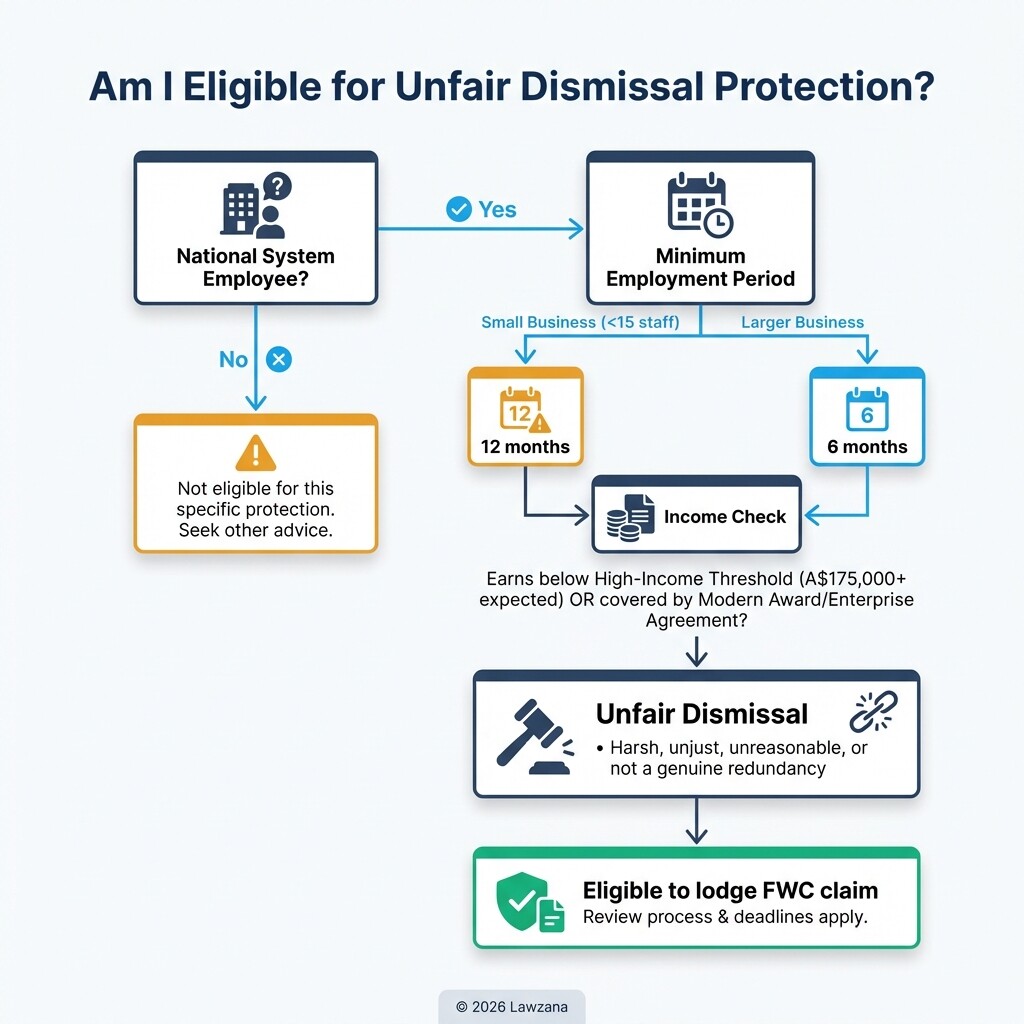
To file an unfair dismissal claim in Australia, you must be a national system employee who has completed the minimum employment period and meets specific income or award coverage requirements. The Fair Work Commission (FWC) defines a dismissal as "unfair" if it is harsh, unjust, or unreasonable, or if it was not a case of genuine redundancy.
As we look toward 2026, the following criteria remain the pillars of eligibility:
- Minimum Employment Period: You must have worked for your employer for at least six months. If you work for a small business (fewer than 15 employees), this period extends to 12 months.
- Income Threshold: If you are not covered by a modern award or enterprise agreement, your annual earnings must be below the high-income threshold. This figure is indexed annually on July 1; for the 2025 to 2026 period, it is expected to exceed $175,000 AUD.
- Definition of Dismissal: You must show that you were terminated at the employer's initiative or that you were forced to resign because of the employer's conduct (constructive dismissal).
- The Small Business Fair Dismissal Code: For employees of small businesses, the FWC will check if the employer followed this specific code. If they did, the dismissal is generally deemed fair.
What are the legal protections for requesting flexible work arrangements?
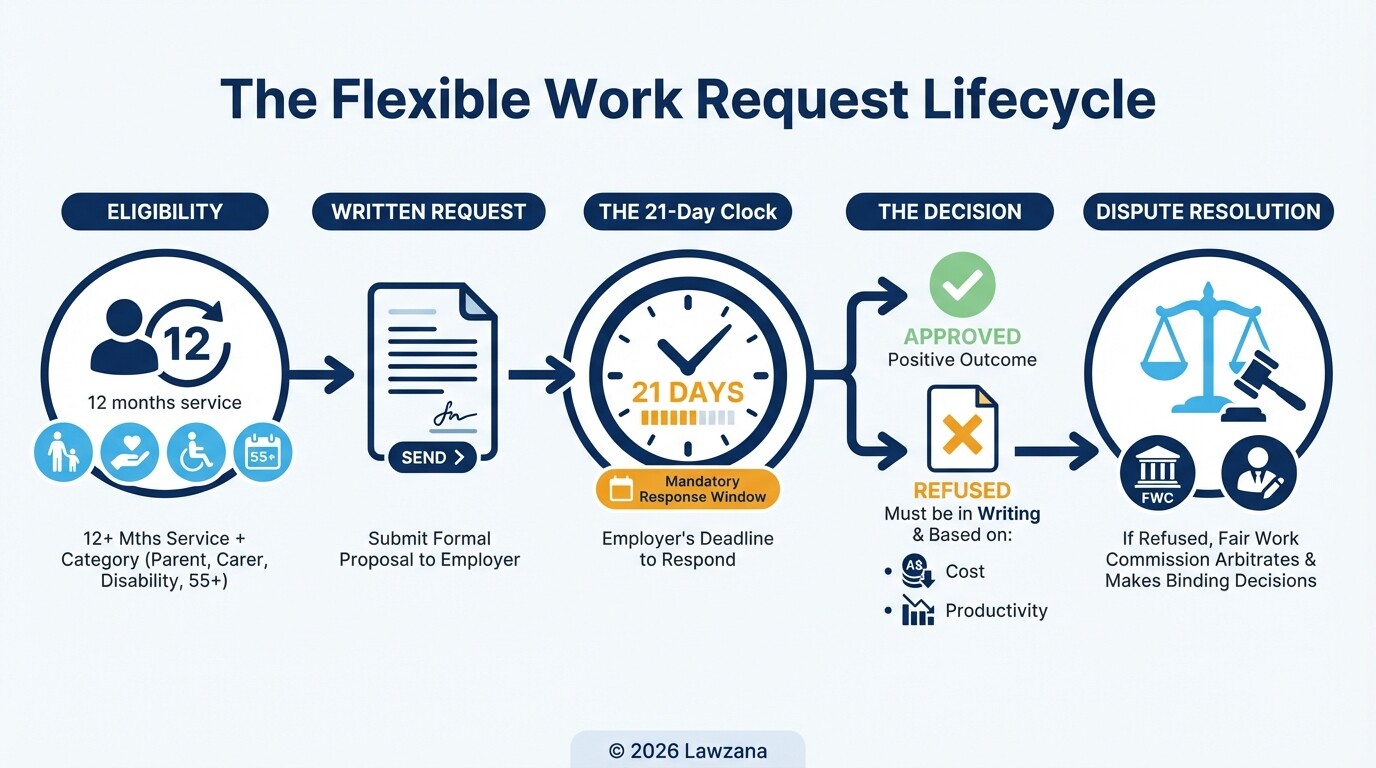
Australian law grants eligible employees the right to request flexible work arrangements, including remote work, under the National Employment Standards (NES). Employers are legally obligated to consider these requests seriously and can only refuse them based on clearly defined "reasonable business grounds."
To make a formal request, you must have completed at least 12 months of continuous service. You must also fall into one of the following categories:
- You are a parent or have responsibility for the care of a child who is school-aged or younger.
- You are a carer (under the Carer Recognition Act 2010).
- You have a disability.
- You are 55 years of age or older.
- You are experiencing family and domestic violence or are caring for a family member experiencing it.
The Employer's Responsibility: Once you submit a written request, your employer must respond in writing within 21 days. If they refuse, they must outline the specific business grounds for the refusal, such as excessive cost, loss of productivity, or significant negative impact on customer service. Since recent legislative updates, if a dispute arises over a flexible work request, the Fair Work Commission has the power to arbitrate and make a binding decision.
How do you calculate severance pay and notice periods correctly?
Severance pay, often called redundancy pay, is calculated based on your period of continuous service with the employer at the time of dismissal. Notice periods are separate and represent the time between being told your job will end and your last day of work.
The following table outlines the minimum redundancy pay requirements under the Fair Work Act 2009:
| Period of Continuous Service | Redundancy Pay Period |
|---|---|
| At least 1 year but less than 2 years | 4 weeks |
| At least 2 years but less than 3 years | 6 weeks |
| At least 3 years but less than 4 years | 7 weeks |
| At least 4 years but less than 5 years | 8 weeks |
| At least 6 years but less than 7 years | 11 weeks |
| At least 9 years but less than 10 years | 16 weeks |
| 10 years or more | 12 weeks* |
Note: The amount drops to 12 weeks after 10 years because employees become eligible for Long Service Leave in most states.
Notice Periods: Notice periods generally range from one week (for less than a year of service) to four weeks (for more than five years of service). If you are over 45 years old and have completed at least two years of service, you are entitled to an additional week of notice.
How should you document workplace disputes for the Fair Work Commission?
Documentation is the most critical factor in winning a dispute at the Fair Work Commission. Because the FWC relies on evidence to determine "procedural fairness," you must maintain a chronological record of all interactions related to your performance, conduct, or flexible work requests.
Follow these steps to build a robust evidence file:
- Save Written Communications: Export and save all emails, Slack messages, or Microsoft Teams chats regarding your performance or remote work status. Do not rely on your work computer, as you may lose access immediately upon dismissal.
- Keep a Contemporary Diary: Record the dates, times, and details of verbal conversations. Write these notes as soon as possible after the event to ensure accuracy.
- Request Meeting Minutes: If you are called into a disciplinary meeting, take your own notes and ask for a copy of the employer's notes.
- Document the "Why": If you are requesting flexible work, document how your role can be performed remotely to preemptively counter "reasonable business grounds" for refusal.
- Collect Performance Reviews: Keep copies of past positive performance reviews to counter claims of poor performance.
What is the timeline for submitting an unfair dismissal claim?
The timeline for submitting an unfair dismissal claim in Australia is exceptionally strict: you have exactly 21 days from the date your dismissal took effect. This 21-day window includes weekends and public holidays, starting from the day after your final day of employment.
The Fair Work Commission rarely grants extensions. To receive one, you must prove "exceptional circumstances," which are defined very narrowly. Examples of exceptional circumstances might include a serious medical emergency or a natural disaster. Forgetting the date or being unaware of the law is almost never accepted as a valid reason for a late filing.
If you are nearing the deadline and do not have all your evidence ready, it is better to lodge an incomplete application to "stop the clock" and provide further details later than to miss the 21-day cutoff.
Common Misconceptions about Employment Rights
Myth 1: "I can be fired for any reason during my probation period." While the minimum employment period (6 or 12 months) protects employers from unfair dismissal claims, it does not give them a "free pass." You are still protected by General Protections laws from day one. You cannot be fired for discriminatory reasons, such as pregnancy, race, religion, or because you exercised a workplace right.
Myth 2: "If I work from home, my employer can't monitor my activity." In Australia, employers generally have the right to monitor work-related activity on company-owned devices, provided they have a clear policy in place. Remote work does not exempt you from surveillance or productivity expectations, provided the monitoring is lawful and reasonable.
Myth 3: "A redundancy is always genuine if the company is struggling." A redundancy is only "genuine" if the employer no longer requires your job to be performed by anyone and they have followed consultation requirements in your award or agreement. If they hire someone else to do the exact same job two weeks later, it may not be a genuine redundancy.
What is the Right to Disconnect in Australia?
Introduced recently, the Right to Disconnect allows employees to refuse to monitor, read, or respond to contact from their employer outside of working hours, unless that refusal is unreasonable. This is particularly relevant for remote workers where the lines between home and office are blurred.
Can I be fired for requesting to work from home?
No. Requesting a flexible work arrangement is a "workplace right." Under the General Protections provisions of the Fair Work Act, it is illegal for an employer to take adverse action against you (including firing you) because you exercised that right.
What is the maximum compensation for unfair dismissal?
Compensation is capped at the lesser of either six months of your pay or half of the high-income threshold. In 2026, this cap is expected to be approximately $87,500 AUD, though the primary remedy the FWC considers is reinstatement to your job.
When to Hire a Lawyer
While many people represent themselves at the Fair Work Commission, you should consult an employment lawyer if:
- Your income is near or above the high-income threshold and you need to argue award coverage.
- You believe your dismissal was due to discrimination or "adverse action" (General Protections).
- Your employer is a large corporation with a dedicated legal team.
- You are negotiating a complex deed of release or a high-value settlement.
- You have missed the 21-day deadline and need to argue for an extension based on exceptional circumstances.
Next Steps
- Check the Calendar: Calculate exactly how many days have passed since your dismissal to ensure you are within the 21-day window.
- Gather Your Contract: Review your employment contract and any relevant modern awards to determine your notice and severance entitlements.
- Submit Your Request: If you are seeking flexible work, draft a formal written request citing the Fair Work Act and detailing your proposed schedule.
- Lodge an Application: If you have been dismissed, visit the Fair Work Commission website to begin the Form F2 application process for unfair dismissal.
- Seek Expert Advice: Contact a legal professional or your union representative to review your evidence before your conciliation hearing.