


- Australia recognizes "International Wills" under the UNIDROIT Convention, simplifying the probate process for assets held in multiple countries.
- Australians living abroad may need separate wills for different jurisdictions to avoid probate delays and conflicting legal requirements.
- Foreign-executed wills are generally valid in Australian states if they meet the formal requirements of the place where they were signed or the testator's domicile.
- Tax implications, particularly Capital Gains Tax (CGT) on Australian real estate, vary significantly depending on whether the beneficiary is an Australian tax resident.
- An Australian Power of Attorney often lacks legal standing in foreign jurisdictions, requiring expats to draft local documents for their country of residence.
Cross-Border Estate Planning Checklist for Expats
An Australian living abroad must account for two or more legal systems simultaneously. This checklist ensures your assets are protected and your wishes are enforceable across borders.
| Action Item | Description | Priority |
|---|---|---|
| Asset Audit | List all global assets, including real estate, bank accounts, and digital assets. | High |
| Jurisdictional Review | Determine if your host country uses Common Law or Civil Law (e.g., "forced heirship" rules). | High |
| Document Coordination | Decide between one "International Will" or multiple "Situs Wills" for specific countries. | Medium |
| Tax Residency Check | Consult an accountant regarding your status and how it affects CGT on Australian property. | High |
| Executor Appointment | Choose executors in both Australia and your country of residence for logistical ease. | Medium |
| POA Updates | Draft a Power of Attorney and Enduring Guardianship for both jurisdictions. | High |
| Digital Vault | Store login credentials and instructions for international accounts in a secure location. | Low |
Sample International Will Clause
When drafting a will intended to cover assets in multiple countries, specific language can help clarify your intent and ensure the document is recognized under the UNIDROIT Convention.
Clause: Choice of Law and Jurisdiction "I declare that it is my intention that this Will shall be construed and take effect according to the laws of the State of [Insert Australian State, e.g., New South Wales], Australia. Furthermore, I intend for this document to constitute an 'International Will' as defined in the Annex to the Convention providing a Uniform Law on the Form of an International Will 1973."
Clause: Limited Revocation "I hereby revoke all former wills and testamentary dispositions previously made by me, except for any will or codicil made by me that specifically deals with my immovable property located in [Foreign Country Name]. It is my intention to maintain separate testamentary documents for my assets in Australia and [Foreign Country Name]."
Validity of Foreign-Executed Wills in Australian States
Wills executed outside of Australia are generally recognized as valid across all Australian states and territories provided they comply with specific formal requirements. These requirements are governed by state-based legislation, such as the Succession Act 2006 (NSW) or the Wills Act 1997 (VIC), which typically adhere to the Hague Convention on the Conflict of Laws.
For a foreign will to be valid in Australia, it must usually meet the legal standards of the place where it was executed, the place where the testator was domiciled at the time of execution, or the place where the testator was a national. If you are an Australian expat, using the "International Will" format-which requires an authorized witness (such as a local lawyer or notary public) to sign a certificate-provides the highest level of certainty that your will will be accepted by an Australian court without the need for extensive proof of foreign law.
Documentation Required for Assets in Multiple Jurisdictions
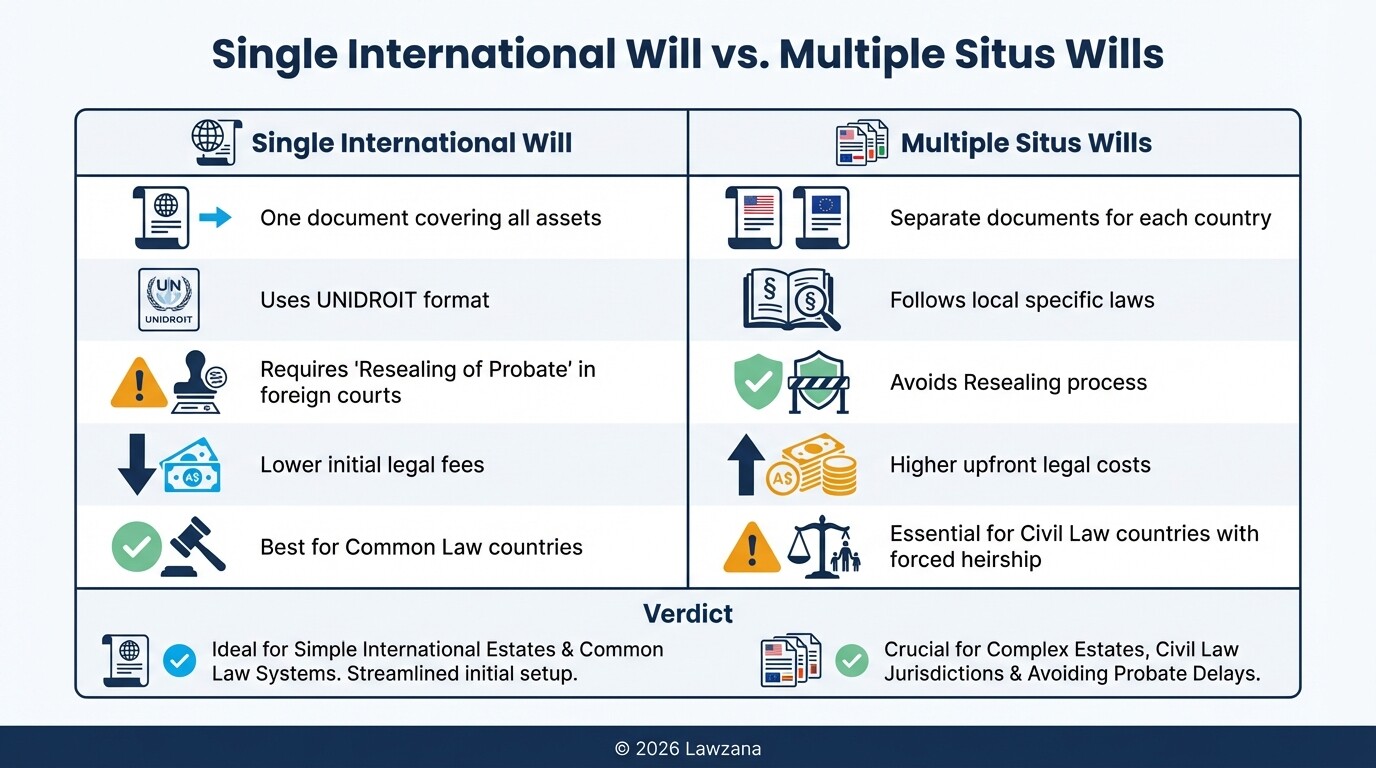
Managing assets in multiple jurisdictions requires a dual-track documentation strategy to ensure executors can access funds and transfer titles without multi-year legal battles. Expats must maintain a comprehensive "Asset Register" that details the location, account numbers, and legal titles of all holdings in Australia and abroad.
If you choose to have a single will, you will likely need to go through a process called "Resealing of Probate." This is where a court in one country (e.g., Australia) recognizes the grant of probate issued by a court in another country (e.g., the UK). However, many countries, particularly those with Civil Law systems like France or Thailand, do not recognize the concept of "Resealing." In these cases, you must have a "Situs Will"-a separate legal document drafted according to local laws specifically for assets in that country.
Tax Implications of International Inheritance for Beneficiaries
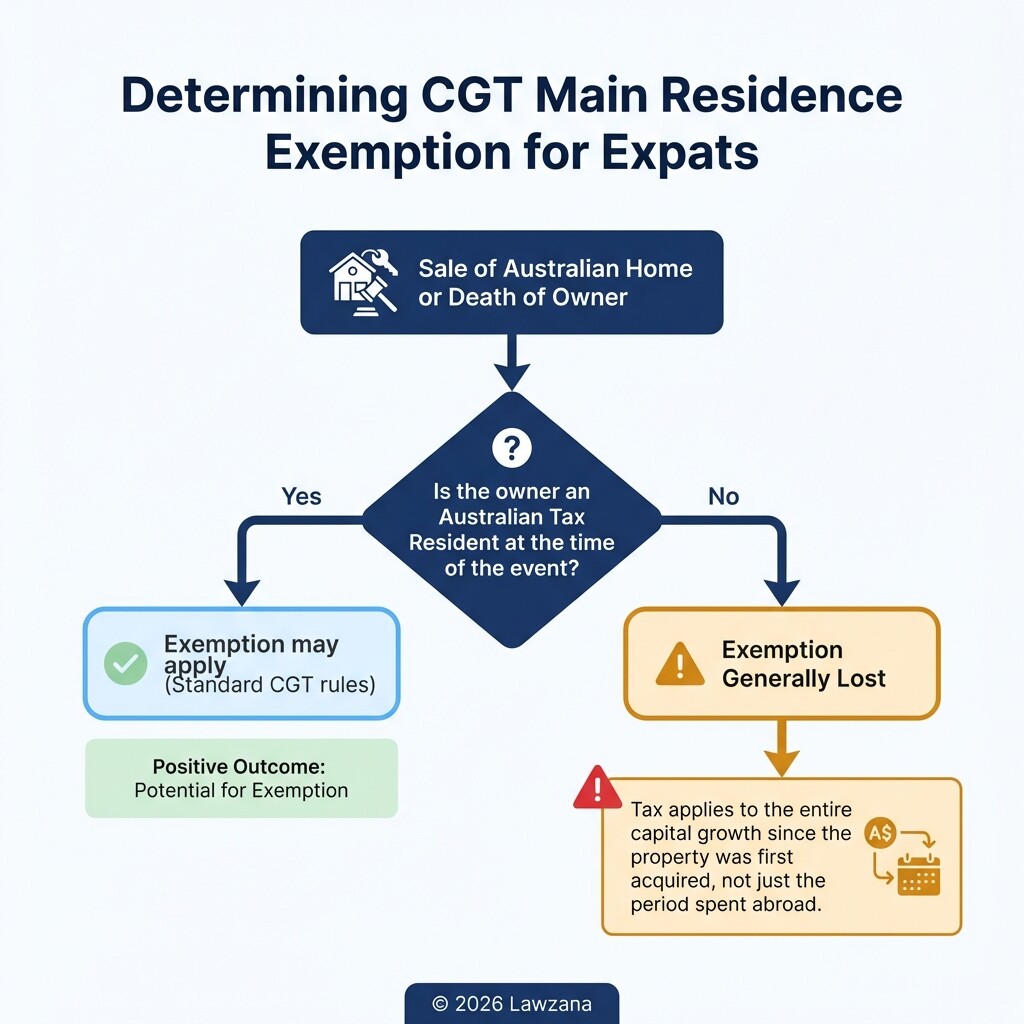
Australia does not impose a "death tax" or inheritance tax, but the tax implications for beneficiaries can still be severe due to Capital Gains Tax (CGT) and the loss of specific exemptions. When an Australian expat passes away, their residency status for tax purposes at the time of death determines how assets are treated.
The most critical tax trap involves the "Main Residence Exemption." Recent changes to Australian tax law mean that many non-residents are no longer entitled to the CGT exemption on their former Australian home. If you leave an Australian property to a beneficiary while you are a foreign tax resident, the estate may be hit with a significant tax bill based on the capital growth since the property was first acquired, not just since you moved abroad. Additionally, if you leave assets to a foreign resident beneficiary, specific "CGT Event K3" rules may trigger an immediate tax liability for the estate.
Common Mistakes in Drafting Powers of Attorney for Expats
A common misconception among Australians living abroad is that their Australian Enduring Power of Attorney (EPOA) will allow a family member to manage their affairs in their new country of residence. In reality, most foreign financial institutions and healthcare providers will refuse to recognize an Australian EPOA because it does not meet local statutory requirements.
Another frequent error is failing to appoint a "local" attorney for Australian affairs. If an expat appoints another expat as their attorney, and both are living in London while trying to sell a property in Brisbane, the logistical hurdles-such as certifying documents at the Australian Consulate-can cause significant delays. It is often more efficient to appoint a trusted friend, family member, or professional based in Australia to handle Australian-specific matters, while having a separate local document for your country of residence.
Steps for Periodic Review of International Estate Plans
International estate plans are not "set and forget" documents; they require review every two to three years or whenever a significant life or legal event occurs. Changes in tax treaties between Australia and your host country can suddenly make your existing plan inefficient or even invalid.
- Monitor Residency Status: Review your tax residency yearly, as this dictates your CGT obligations.
- Audit Legislative Changes: Australian states and foreign jurisdictions frequently update succession laws (e.g., changes to the European Succession Regulation).
- Update Executor Details: Ensure your executors are still willing and able to act across time zones and international borders.
- Verify Asset Ownership: If you move assets between countries or close foreign bank accounts, update your asset register and will references accordingly.
- Re-evaluate Life Changes: Marriage, divorce, or the birth of children may automatically revoke parts of your will depending on the jurisdiction.
Common Misconceptions
"My Australian will covers everything I own globally." While an Australian will can technically include a clause for "all property worldwide," it may be practically useless in a foreign country that requires specific local formalities. Without a local will or an "International Will" certificate, your foreign assets could be frozen for years during probate.
"Australia has no inheritance tax, so my beneficiaries are safe." While there is no specific "inheritance tax," the Australian government uses Capital Gains Tax (CGT) to capture value from estates. If you are a non-resident for tax purposes at the time of death, the tax consequences for your beneficiaries can be as high as 45% on certain assets.
"A Power of Attorney is the same as a Will." A Power of Attorney loses all legal force the moment you pass away. It is only for managing your affairs while you are alive but incapacitated. You must have a valid will to manage what happens after death.
FAQ
Can I have two different wills for two different countries?
Yes, this is often the most efficient strategy. These are called "Situs Wills." However, you must ensure that one will does not accidentally "revoke" the other. Each document must be carefully drafted to state that it only applies to assets within a specific jurisdiction.
What is the UNIDROIT Convention?
The UNIDROIT Convention is an international treaty that created a standardized format for an "International Will." Australia is a party to this convention. A will made in this format is recognized as valid in any other country that has also signed the treaty, regardless of where it was signed.
Do I need to pay Australian tax on my foreign inheritance?
Generally, no. Australia does not tax the receipt of an inheritance. However, if the inherited asset produces income (like a rental property) or if you later sell the asset, you may be liable for Australian income tax or Capital Gains Tax.
When to Hire a Lawyer
Cross-border estate planning involves navigating the intersection of two different legal systems, which is beyond the scope of DIY will kits. You should consult a lawyer if:
- You own real estate in more than one country.
- You are unsure of your tax residency status or its impact on your estate.
- You live in a country with "forced heirship" laws (common in Civil Law jurisdictions like Europe and the Middle East).
- Your estate includes complex structures like Australian family trusts or foreign corporations.
- You want to ensure your Power of Attorney is legally enforceable in both Australia and your current home.
Next Steps
- Catalog Your Assets: Create a list of all Australian and foreign assets, including bank accounts, real estate, and pensions (Superannuation).
- Determine Your Residency: Confirm your tax status with an international tax specialist to understand potential CGT liabilities.
- Draft Local Documents: If you do not have a local will in your country of residence, contact a local attorney to draft one that complements your Australian will.
- Consult an Australian Specialist: Speak with an Australian lawyer experienced in international succession to review your documents for cross-border compatibility.