


Key Takeaways
The Australian Competition and Consumer Commission (ACCC) aggressively pursues multinational technology companies for anti-competitive behavior, operating with broad investigatory powers. When your firm faces an antitrust inquiry in Australia, immediate and strategic action is required to manage immense data burdens and mitigate severe financial exposure.
- Analyze the Notice: Most ACCC inquiries begin with a Section 155 notice, a statutory demand for documents and evidence carrying criminal penalties for non-compliance.
- Implement Legal Holds: Halting auto-delete functions across all communication platforms is your first mandatory step to prevent accidental evidence destruction.
- Negotiate Scope: Do not blindly produce data. Engage early with the ACCC to narrow search terms and negotiate rolling production schedules.
- Prepare for High Costs: Defending an Australian antitrust inquiry easily costs millions in AUD, driven largely by forensic e-discovery and expert economic witnesses.
- Consider Early Resolution: Enforceable undertakings (Section 87B) allow firms to settle investigations early, often avoiding crippling litigation and reputational damage.
Analyzing the Initial ACCC Statutory Notice
A statutory notice from the ACCC-typically issued under Section 155 of the Competition and Consumer Act 2010-compels your company to provide information, produce documents, or give sworn evidence. Failing to comply, providing false information, or destroying requested documents is a criminal offense, making an immediate analysis of the notice's scope critical.
Upon receiving the notice, your legal and compliance teams must dissect the document to understand the exact nature of the allegations. The ACCC uses these notices to investigate suspected breaches such as the misuse of market power, anti-competitive algorithms, or cartel behavior. You must immediately identify the specific timeframe under investigation, the precise divisions or products targeted, and the legal deadlines for compliance. Understanding these parameters dictates the scale of your internal investigation and forms the foundation of your defense strategy.
ACCC Inquiry Response Checklist: Legal Holds and Discovery
Executing a comprehensive legal hold prevents the accidental deletion of requested documents and establishes your company's good-faith cooperation with the Australian regulator. Because multinational tech firms generate massive volumes of electronic discovery, you must immediately isolate internal communications, algorithm changes, and pricing documentation.
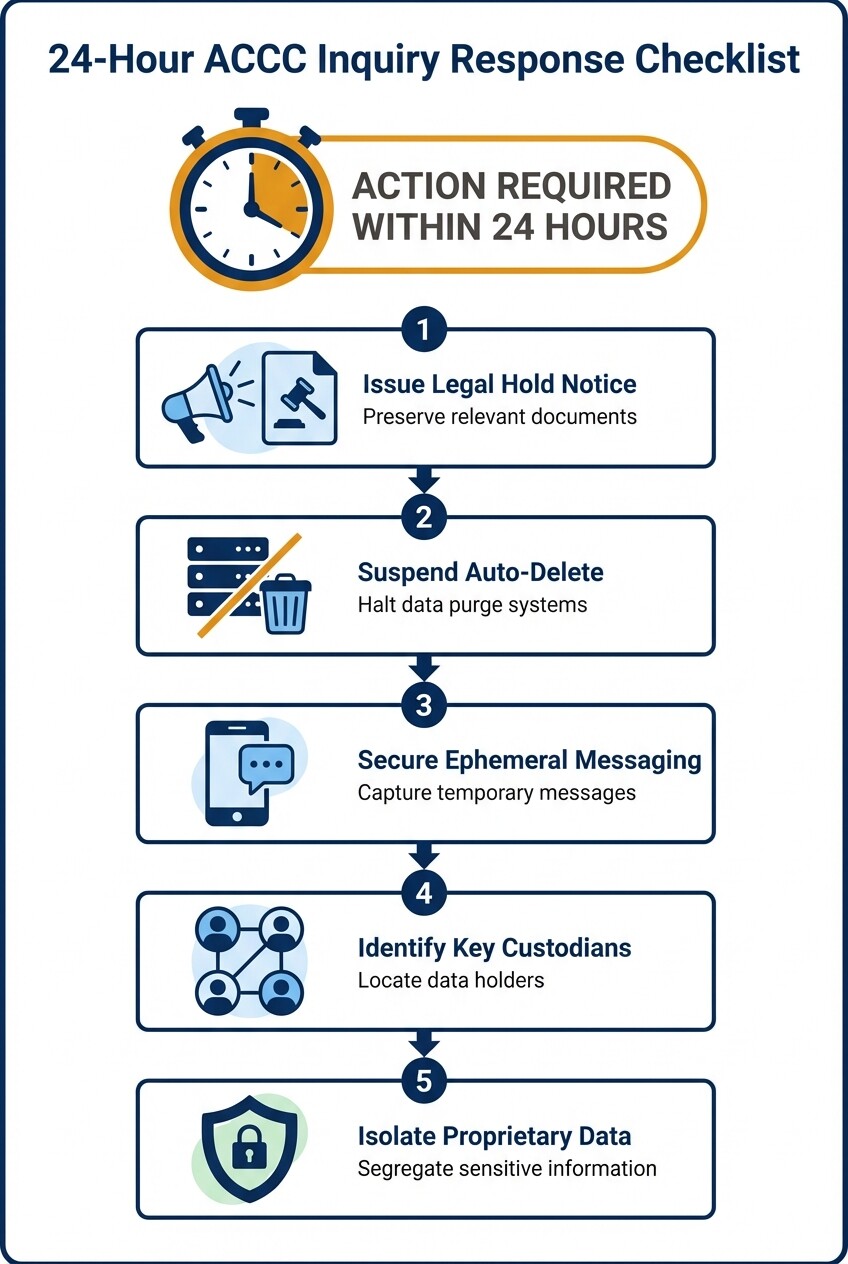
Deploy this checklist within 24 hours of receiving an ACCC inquiry to secure your data:
- Issue a Company-Wide Legal Hold Notice: Distribute clear, mandatory instructions to all relevant employees to preserve records, specifically naming the products or regions involved.
- Suspend Auto-Delete Protocols: Work with IT to immediately halt routine data destruction across email servers, internal wikis, and cloud storage environments.
- Secure Ephemeral Messaging: Capture data from casual or encrypted communication platforms commonly used in tech, including Slack, Microsoft Teams, and WhatsApp.
- Identify Key Custodians: Map out the executives, engineers, and product managers most likely to hold relevant information regarding the ACCC's specific concerns.
- Isolate Proprietary Data: Secure historical versions of pricing algorithms, API access logs, and competitive market analyses that the regulator is likely to scrutinize.
Formulating a Structured Response Strategy
A structured response strategy limits your operational burden by actively negotiating the scope and deadlines of the ACCC's document requests. Rather than blindly producing terabytes of unreviewed data, your legal team should engage early with the agency to narrow search parameters and agree on manageable, rolling productions.
The ACCC often issues extremely broad initial demands to ensure nothing is missed. Your Australian counsel should initiate dialogue with the regulator to refine search strings, exclude irrelevant business units, and agree on appropriate technology-assisted review (TAR) protocols. By proactively identifying and logging legally privileged documents, and supplying data in structured batches rather than a single massive dump, your firm maintains operational continuity while fully satisfying its legal obligations.
Anticipating the Costs of Antitrust Litigation Defense
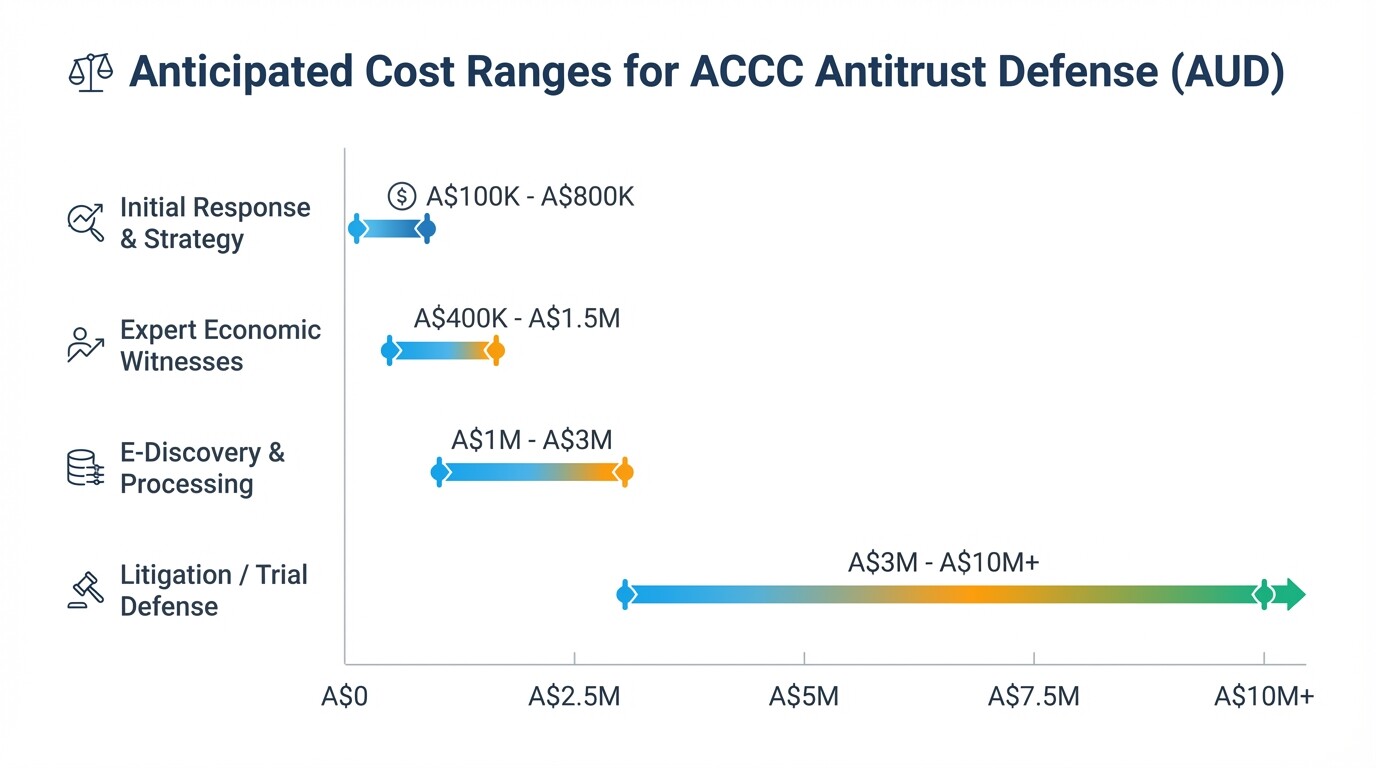
Defending an ACCC antitrust inquiry requires a substantial budget, often exceeding $2 million to $5 million AUD for complex investigations before a trial even begins. Foreign tech firms must anticipate heavy expenses tied to forensic data collection, top-tier legal counsel, and the procurement of expert economic witnesses.
Understanding these costs early helps corporate counsel secure appropriate internal budgets.
| Phase of Investigation | Estimated Cost Range (AUD) | Cost Drivers |
|---|---|---|
| Initial Response & Strategy | $150,000 - $300,000 | Legal analysis, risk assessment, ACCC scoping negotiations. |
| E-Discovery & Processing | $500,000 - $2,500,000+ | Vendor hosting fees, technology-assisted review, privilege logging. |
| Expert Economic Witnesses | $200,000 - $800,000 | Market definition analysis, algorithmic impact modeling. |
| Litigation / Trial Defense | $3,000,000 - $10,000,000+ | Barrister fees, prolonged court hearings, extensive preparation. |
Exploring Early Dispute Resolution and Enforceable Undertakings
Resolving an investigation early through an enforceable undertaking under Section 87B allows your firm to avoid drawn-out litigation, unpredictable court fines, and severe reputational damage. This legally binding settlement requires your company to commit to specific behavioral changes or structural remedies in exchange for the ACCC concluding its investigation.
Foreign tech firms often utilize Section 87B undertakings to resolve concerns regarding data sharing, platform access, or algorithmic bias without formally admitting legal liability. If the ACCC accepts the undertaking, it becomes enforceable in the Federal Court of Australia. This approach provides certainty to shareholders, heavily reduces legal defense costs, and demonstrates to the Australian public that your firm takes its regulatory obligations seriously.
Common Misconceptions About ACCC Investigations
Multinational tech firms often misunderstand the ACCC's jurisdictional reach and investigatory aggression, leading to misaligned defense strategies. Recognizing these misconceptions early prevents critical missteps during the initial weeks of the inquiry.
- "Our servers are overseas, so the ACCC cannot reach our data." The ACCC routinely pursues foreign corporations carrying on business in Australia. If your services affect Australian consumers or markets, the regulator expects full compliance regardless of where your physical servers or parent company are located.
- "We can ignore the deadline and ask for an extension later." Statutory deadlines under Section 155 are rigid. While the ACCC may grant extensions, they must be negotiated well in advance with substantial justification. Ignoring a deadline triggers severe penalties.
- "Providing partial information is enough to appease them." The ACCC conducts rigorous cross-referencing and frequently compels testimony from executives. Omitting unfavorable data will likely be discovered and viewed as obstruction, severely escalating the regulatory response.
Frequently Asked Questions
What is a Section 155 Notice?
A Section 155 notice is a statutory tool used by the ACCC to compel individuals or corporations to provide information, produce documents, or appear for questioning under oath during an investigation.
Can foreign executives be compelled to testify in Australia?
Yes. If a foreign executive's actions relate to an Australian market or consumer base, the ACCC can issue a notice compelling them to attend an examination, often accommodating remote attendance for overseas individuals.
What are the penalties for breaching Australian antitrust laws?
For corporations, penalties for anti-competitive conduct can be the greater of $50 million AUD, three times the value of the benefit obtained, or 30% of the company's adjusted turnover during the breach period.
Will our proprietary algorithms be made public?
Not necessarily. While you must produce them to the ACCC, your legal team can claim confidentiality to ensure trade secrets and proprietary source code are protected from public disclosure or competitors.
When to Hire an Antitrust Lawyer
You must engage specialized antitrust counsel the moment you suspect an impending ACCC investigation or within 24 hours of receiving a statutory notice. Delays in legal representation can result in missed negotiation windows, poorly scoped data preservation, and the accidental destruction of critical evidence. Because Australia's competition laws feature unique provisions, retaining experienced antitrust litigation lawyers in Australia is non-negotiable for foreign firms.
Next Steps for Tech Firms
If your technology firm is targeted by the ACCC, immediately assemble an internal crisis management team comprising legal, IT, and executive leadership. Issue your company-wide legal holds to secure all relevant data and communications. Finally, appoint local Australian counsel to formally contact the ACCC, signal your cooperation, and begin negotiating the scope of the statutory notice.