Key Takeaways
Setting up an Australian subsidiary requires strict compliance with local corporate law, particularly directorship mandates and tax registrations. Planning your corporate governance structure early prevents compliance failures and market entry delays.
- Resident Director Mandate: Australian private companies (Pty Ltd) must appoint at least one director who ordinarily resides in Australia.
- Registration Timelines: Registering the company with the Australian Securities and Investments Commission (ASIC) is fast, but securing an Australian Business Number (ABN) takes up to 28 days for foreign-owned entities.
- Parent Company Liability: The corporate veil can be pierced in Australia. Foreign parent companies are liable if the subsidiary trades while insolvent.
- 2026 ESG Rules: Mandatory climate-related financial disclosures apply to many subsidiaries by 2026, requiring alignment with global parent company reporting.
- Structural Alternatives: Foreign companies can bypass the subsidiary structure by registering as a foreign branch or forming a joint venture.
Resident Director Requirements and Alternatives
Australian proprietary limited companies (Pty Ltd) must have at least one director who ordinarily resides in Australia. If a foreign parent company cannot fulfill this requirement with internal staff, they must hire a professional nominee director or choose an alternative corporate structure.
The resident director carries the same legal duties and liabilities as any other director under the Corporations Act 2001. They are accountable for financial compliance, solvency, and tax obligations.
Foreign companies have several alternatives if appointing an internal resident director is unworkable:
- Appoint a Nominee Director: You can contract a local professional (often an accountant or lawyer) to act as your resident director. This requires a deed of indemnity and strong internal controls to satisfy the nominee's risk requirements.
- Register a Foreign Branch: Instead of creating a new subsidiary, you can register your existing foreign company with ASIC. This establishes a branch office in Australia, allowing legal operation without a local director. You must still appoint a local agent for compliance.
- Use an Employer of Record (EOR): If the immediate goal is to hire Australian staff rather than conduct local B2B trade, an EOR can employ staff on your behalf, bypassing the need for corporate registration.
ASIC Registration and Setup Checklist
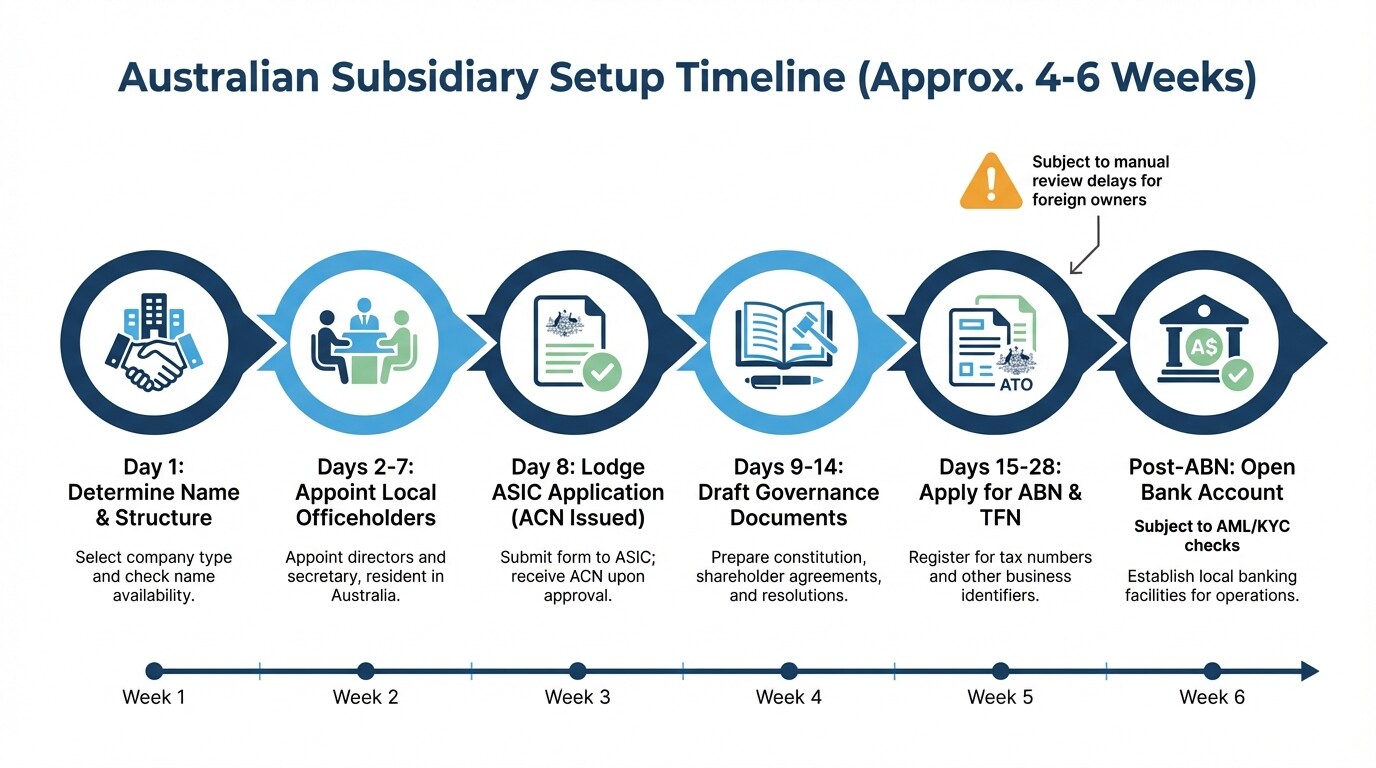
Registering an Australian subsidiary generally takes two to four weeks. The process involves securing a corporate structure with ASIC followed by obtaining tax identities from the Australian Business Register.
The timeline depends heavily on the tax registration phase. Foreign directors require manual identity verification by the Australian Taxation Office (ATO). Follow this setup checklist:
- Determine Name and Structure (Day 1): Ensure your desired company name is available and does not infringe on existing Australian trademarks.
- Appoint Local Officeholders (Days 2-7): Secure written consent from your resident director and public officer. Include the company secretary if applicable.
- Lodge ASIC Application (Day 8): Submit Form 201 to ASIC to register the company. If using a corporate service provider, the Australian Company Number (ACN) and certificate of registration are usually issued within 24 to 48 hours.
- Draft Governance Documents (Days 9-14): Adopt a company constitution. Execute the initial circulating resolutions of directors to issue shares to the foreign parent company.
- Apply for an ABN and TFN (Days 15-28): Submit applications for an Australian Business Number (ABN) and Tax File Number (TFN). Because foreign parent companies and non-resident directors are involved, the application is typically flagged for manual review. This takes up to 28 days to finalize.
- Open a Bank Account (Post-ABN): Australian banks require strict Anti-Money Laundering (AML) and Know Your Customer (KYC) checks. This adds two to four weeks to the timeline.
Governance FAQ
While a subsidiary is a separate legal entity, Australian courts hold foreign parent companies liable for their subsidiary's debts and actions under specific circumstances.
Can the corporate veil be pierced in Australia?
Yes. Under Section 588V of the Corporations Act 2001, a holding company is liable for the debts of its subsidiary if the subsidiary engages in insolvent trading. If the parent company knew or had reasonable grounds to suspect the subsidiary was insolvent, they must cover the local debts.
Do parent company executives face personal liability?
Generally, no. This changes if those foreign executives are also appointed as directors of the Australian subsidiary. Directors of the Australian subsidiary (including the resident director) are personally liable for unpaid employee superannuation (pension) and Pay As You Go (PAYG) withholding taxes.
Are parent companies liable for workplace violations?
Usually no. However, accessorial liability provisions in the Fair Work Act 2009 allow courts to penalize any person or corporate entity knowingly involved in a workplace breach. If the parent company's human resources department dictates illegal underpayment policies in Australia, the parent entity faces prosecution.
Do I need to visit Australia to set up the subsidiary?
No. The entire process of registering a company and applying for tax numbers is handled remotely. You must provide certified copies of your identification documents to your local corporate service provider.
What is a Public Officer in Australia?
Every company carrying on a business in Australia must appoint a Public Officer within three months of generating income. This person is the official point of contact for the Australian Taxation Office. They ensure the company complies with local tax laws and must reside in Australia.
Can a foreign company own 100% of an Australian Pty Ltd?
Yes. There are no restrictions on foreign entities holding 100% of the shares in an Australian private company. The company must comply with the resident director requirement and secure any relevant Foreign Investment Review Board (FIRB) approvals if acquiring certain local assets.
2026 ESG Reporting and Continuous Disclosure Rules
Beginning in phased rollouts leading up to 2026, many Australian subsidiaries face mandatory climate-related financial disclosures under the new Australian Sustainability Reporting Standards (ASRS). Foreign parent companies must integrate these localized environmental, social, and governance (ESG) metrics into their corporate governance frameworks to avoid regulatory penalties.
The Australian government requires companies to disclose their climate-related risks, opportunities, and greenhouse gas emissions across their supply chains (Scope 1, 2, and 3 emissions).
To prepare for 2026 compliance, foreign subsidiaries must implement the following governance steps:
- Audit Current Reporting Thresholds: Determine if the Australian subsidiary meets the size thresholds for mandatory reporting independent of the parent company.
- Integrate Global Data: Ensure the parent company's global ESG reporting software isolates data specific to Australian operations for local auditors.
- Establish a Local Risk Committee: Create a subsidiary governance committee tasked with continuous disclosure obligations and monitoring local regulatory shifts regarding greenwashing.
Practical Alternatives to Wholly-Owned Subsidiaries
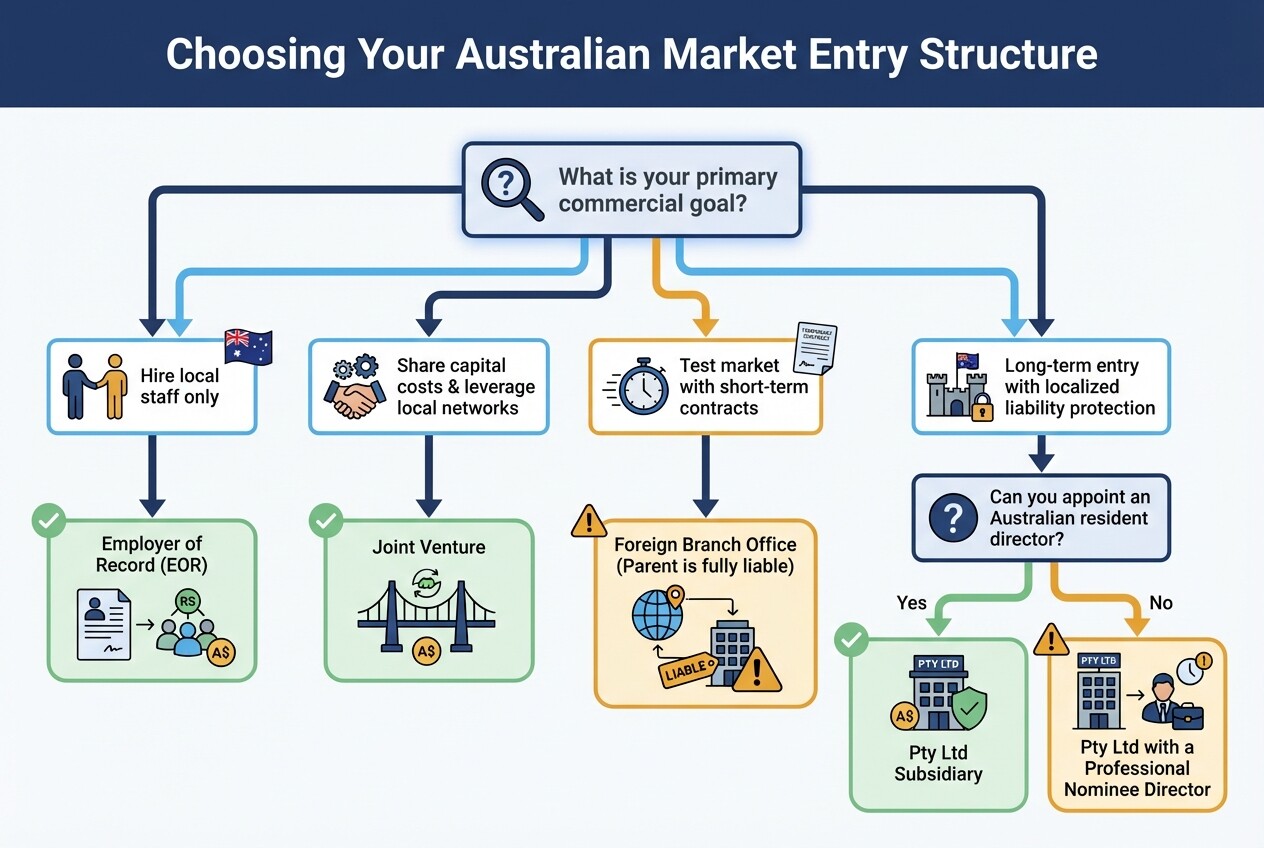
A wholly-owned subsidiary is not the only way to enter the Australian market. Foreign entities can utilize joint ventures or register a branch office based on their risk tolerance and capital commitment.
Selecting the right vehicle depends on whether you need localized liability protection or immediate operational capacity.
| Corporate Structure | Level of Local Liability | Key Governance Requirement | Best Used For |
|---|---|---|---|
| Pty Ltd Subsidiary | Contained to the subsidiary | Requires one Australian resident director | Long-term market entry, local hiring, and B2B contracting. |
| Foreign Branch Office | Parent company is fully liable | Requires a local agent | Testing the market, short-term contracts, avoiding director fees. |
| Joint Venture | Shared with the local partner | Shareholder agreement | Leveraging local networks, sharing capital costs and market risks. |
Consult with corporate governance lawyers in Australia before choosing an alternative. Tax treatments and intellectual property protections vary between structures.
Common Misconceptions
Multinational companies often underestimate the compliance differences between their home jurisdiction and Australia. Assuming that standard global governance policies perfectly align with Australian law creates structural and financial risks.
- Sole director residency: Many foreign investors believe they can register an Australian company from abroad and act as the sole director. Australian law requires at least one director to be an ordinary resident.
- Branch office tax avoidance: Operating a branch office does not exempt you from Australian taxation. Income sourced within Australia is subject to local corporate tax rates. The ATO aggressively enforces transfer pricing rules.
- Immediate ABN issuance: While ASIC registration (ACN) is fast, the ABN is managed by a different government body. Manual identity checks for foreign owners mean the ABN takes several weeks, delaying your ability to issue valid local invoices.
Corporate Setup Cost Estimates
Establishing a subsidiary involves predictable government fees alongside variable professional costs. Budgeting between AUD 3,500 and AUD 12,000 for the first year is typical for standard setup, legal review, and tax registration.
- ASIC Registration Fee: AUD 576 (current government fee to register a standard proprietary company).
- Legal and Incorporation Fees: AUD 1,500 to AUD 3,000 for drafting the company constitution, shareholder resolutions, and processing registrations.
- Resident Nominee Director Fees: AUD 3,000 to AUD 10,000+ per year, depending on the risk profile of your industry and active management requirements.
- Registered Office Services: AUD 300 to AUD 800 per year to use a local firm's address for official government correspondence.
Next Steps
Engaging local legal counsel early prevents costly restructuring. An Australian corporate governance lawyer ensures your shareholder agreements, directorship structures, and data privacy policies comply with federal law.
Outline your commercial goals in Australia and gather your international corporate documents. Determine whether you plan to hire local staff, secure local contracts, or physically warehouse inventory. Legal counsel can then confirm whether a subsidiary, branch, or joint venture is the safest route for your business.