- International skilled workers in Australia are entitled to the same minimum wage and National Employment Standards (NES) as Australian citizens, regardless of their visa subclass.
- Reporting workplace exploitation to the Fair Work Ombudsman generally protects your visa from cancellation under the "Assurance Protocol" with the Department of Home Affairs.
- The Fair Work Commission enforces a strict 21-day deadline from the date of dismissal for filing unfair dismissal or general protections claims.
- In 2026, skilled visa holders have expanded rights to switch employers, often having up to 180 days to find new sponsorship after leaving a role.
- Legal costs for employment disputes can range from a small filing fee ($87.20 in 2026) for self-represented claims to several thousand dollars for specialized legal representation.
Skilled Worker Employment Contract Checklist
Employment contracts for international professionals must comply with both the Fair Work Act 2009 and the specific requirements of your visa (such as Subclass 482 or 494). Use this checklist to ensure your agreement meets Australian legal standards and protects your status.
| Item to Verify | Requirement for Skilled Workers | Status |
|---|---|---|
| National Employment Standards (NES) | Must meet all 11 minimum standards (leave, hours, notice). | [ ] |
| Minimum Salary | Must meet or exceed the Temporary Skilled Migration Income Threshold (TSMIT). | [ ] |
| Work Hours | Maximum 38 hours per week plus "reasonable" additional hours. | [ ] |
| Superannuation | Employer must pay at least 11.5% (2026 rate) into your pension fund. | [ ] |
| Notice Period | Clearly defined period for termination (usually 1-4 weeks based on tenure). | [ ] |
| Role Description | Must match the ANZSCO code listed on your visa nomination. | [ ] |
| Visa Compliance Clause | Explicitly states the employer will comply with sponsorship obligations. | [ ] |
| Deductions | No "hidden" fees for visa processing or recruitment costs deducted from pay. | [ ] |
Minimum Wage and Fair Work Standards for Visa Holders in 2026
International skilled workers in Australia are legally entitled to the same pay and conditions as local employees under the Fair Work Act. In 2026, these rights are anchored by the National Employment Standards (NES) and the specific Modern Award or Enterprise Agreement that covers your industry.
The Australian government sets a National Minimum Wage, which is reviewed annually, but most skilled workers are covered by "Awards" that set higher pay rates for specific professions. For 2026, the Temporary Skilled Migration Income Threshold (TSMIT) ensures that sponsored workers receive a salary that allows for a professional standard of living. It is illegal for an employer to pay you less than the rate specified in your visa nomination, even if you agree to a lower amount in writing.
Your core entitlements include:
- Paid Leave: Four weeks of annual leave and ten days of personal/carer's leave per year.
- Public Holidays: Right to be absent on public holidays with pay, unless a request to work is reasonable.
- Information Statements: Employers must provide you with the Fair Work Information Statement and the Fixed Term Contract Information Statement (if applicable) when you start.
Legal Steps for Addressing Workplace Discrimination or Unfair Dismissal
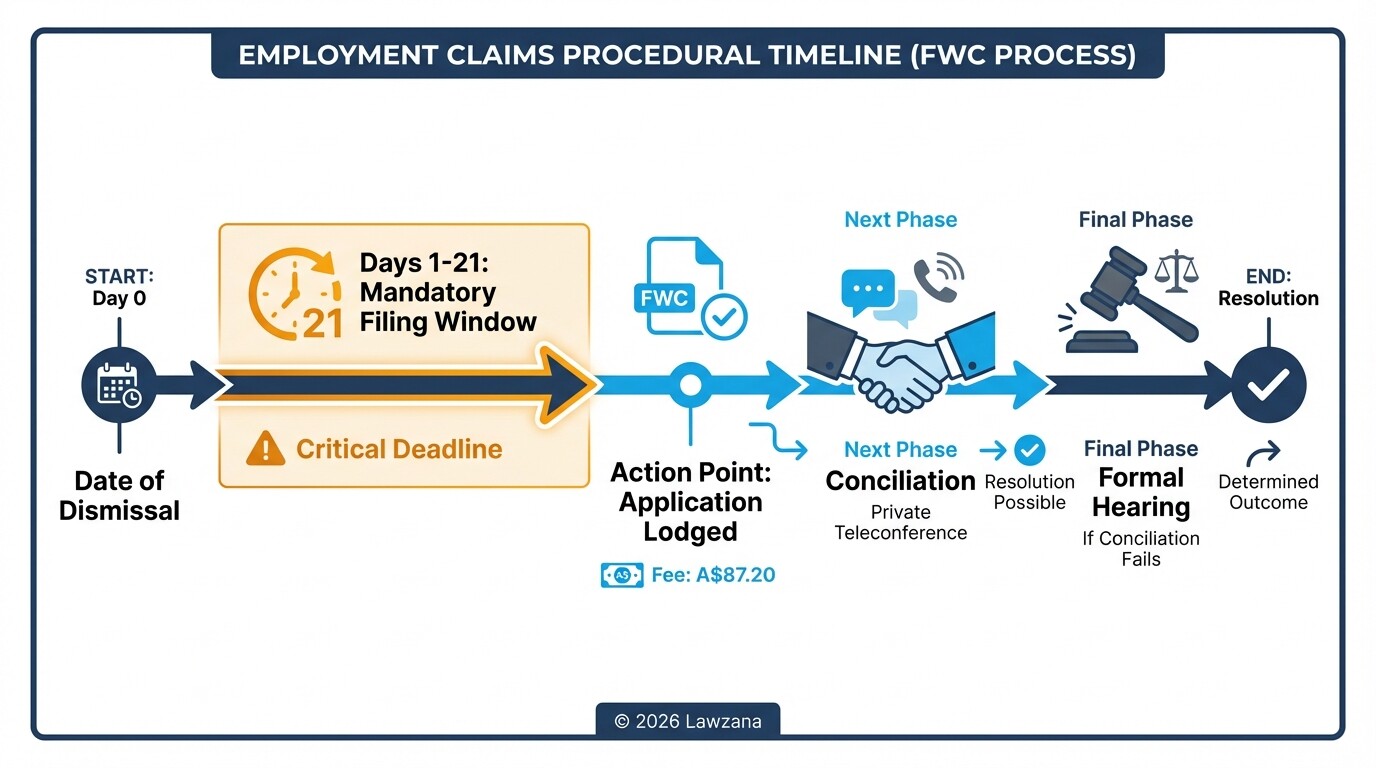
If you are terminated without a valid reason or treated unfairly based on protected attributes, you can seek a legal remedy through the Fair Work Commission (FWC). Australia provides robust protections against "adverse action," which includes firing an employee or demoting them because they exercised a workplace right or because of their race, religion, or nationality.
The process for seeking justice involves several formal steps:
- Assess Eligibility: You must have worked for at least six months (or 12 months for small businesses) to claim unfair dismissal. There is no minimum service period for discrimination (General Protections) claims.
- Observe the 21-Day Rule: You must lodge your application with the FWC within 21 calendar days of your dismissal taking effect. Extensions are rarely granted.
- Conciliation: Most cases are referred to a teleconference where a Fair Work official helps both parties reach a settlement without a formal hearing.
- Formal Hearing: If conciliation fails, the matter may proceed to a public hearing where a Commission member makes a binding decision on compensation or reinstatement.
Cost Estimates for Pursuing Employment Claims
The cost of pursuing a claim in the Fair Work Commission is designed to be accessible for individual workers, though legal representation can increase expenses significantly. For most workers, the initial barrier to entry is low, focused primarily on the application fee.
As of 2026, the filing fee for an unfair dismissal or general protections claim is approximately $87.20 AUD. This fee can be waived if you can demonstrate that paying it would cause serious financial hardship. If you choose to hire a private employment lawyer, costs typically follow these structures:
- Fixed Fee Consultations: $300 - $600 AUD for an initial assessment of your contract and rights.
- No Win, No Fee: Some firms take a percentage (usually 25%-33%) of the final settlement, though this is more common for high-value discrimination cases.
- Hourly Rates: Specialized employment lawyers charge between $400 and $800 AUD per hour depending on seniority.
- Self-Representation: Many workers successfully represent themselves in conciliation at no cost beyond the filing fee.
Alternatives to Litigation: Negotiating Deed of Release Settlements
A Deed of Release is a formal legal contract used to settle workplace disputes privately, avoiding the stress and public nature of a court or Commission hearing. It allows an employer and a skilled worker to end the relationship on agreed terms, usually involving a lump-sum payment in exchange for the worker waiving their right to future legal claims.
For international workers, a Deed of Release is often the preferred path because it can include "neutral references" that help secure future sponsorship.
Comparison: Litigation vs. Deed of Release
| Feature | Fair Work Commission Hearing | Deed of Release (Settlement) |
|---|---|---|
| Speed | 3-6 months | 1-2 weeks |
| Privacy | Public record/Decision published | Strictly confidential |
| Outcome | Reinstatement or capped pay | Flexible (references, pay, tax-free components) |
| Costs | High if using lawyers | Moderate legal review fees |
Sample Clause: Mutual Non-Disparagement
"Each party agrees that they will not, directly or indirectly, make any written or oral statements that are disparaging, derogatory, or defamatory regarding the other party or its officers and employees."
Visa Implications When Changing Employers or Reporting Exploitation
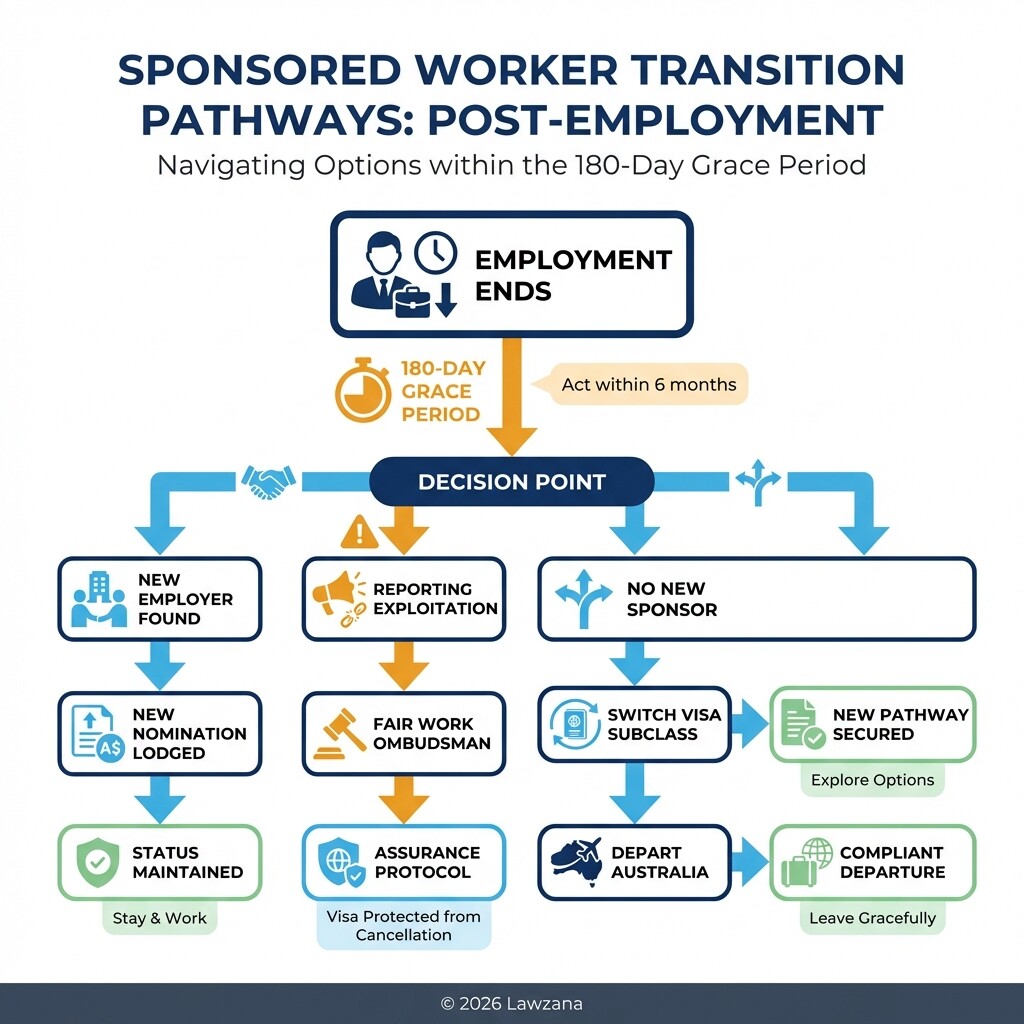
One of the greatest fears for skilled migrants is that losing their job or reporting a boss will lead to immediate deportation. Under the 2026 Australian migration framework, protections are significantly stronger than in previous years, specifically to prevent "wage theft" and bonded labor.
If you are on a sponsored visa (like the 482) and your employment ends:
- Grace Period: You generally have 180 days to find a new sponsor, depart Australia, or apply for a different visa. During this time, you may have work rights depending on your specific visa conditions.
- The Assurance Protocol: If you report your employer for exploitation to the Fair Work Ombudsman, the Department of Home Affairs generally agrees not to cancel your visa, provided you commit to abiding by your visa conditions in the future.
- New Sponsorship: Your new employer must lodge a new nomination. In 2026, many of these processes are streamlined to allow workers to transition between employers with minimal downtime.
Common Misconceptions About Skilled Worker Rights
Myth 1: "My employer paid for my visa, so I am not allowed to quit." In Australia, forced labor or "debt bondage" is illegal. While an employer can contractually require you to pay back legitimate relocation costs if you leave early, they cannot prevent you from resigning, and they cannot "own" your visa status.
Myth 2: "If I complain about my pay, my boss can have me deported." Only the Department of Home Affairs has the power to cancel a visa, not your employer. If an employer threatens your visa status because you are asking for your legal entitlements, they are committing a serious offense under the Fair Work Act.
Myth 3: "Casual workers don't have rights." Even if you are working as a casual skilled professional, you are entitled to a "casual loading" (usually 25% extra pay) to compensate for the lack of paid leave. You are still protected from discrimination and unfair dismissal after a qualifying period.
FAQ
Can my employer deduct the cost of my visa nomination from my salary?
No. Under Australian law, employers are responsible for the costs associated with becoming a sponsor and nominating a position. It is illegal to pass these specific "Skilling Australians Fund" (SAF) levies or nomination fees onto the worker through salary deductions.
What happens to my visa if my employer goes bankrupt?
If your sponsoring company enters liquidation, your employment is effectively terminated. You will typically be granted the standard 180-day grace period to find a new sponsor or transition to another visa subclass without being in breach of your visa conditions.
Can I work a second job on a sponsored visa?
Generally, no. Most skilled sponsored visas (like the 482) are "condition-linked" to the specific employer and occupation that nominated you. Working for another employer without a new nomination is a breach of Visa Condition 8107.
When to Hire a Lawyer
While many employment issues can be resolved via the Fair Work Ombudsman, you should consult an Australian employment lawyer if:
- You have been terminated and have less than 10 days remaining on the 21-day filing deadline.
- Your employer is demanding you pay back thousands of dollars in "visa costs" as a condition of leaving.
- You are being asked to sign a Deed of Release that you do not fully understand.
- Your employer is threatening to contact Home Affairs to "cancel your visa" as a intimidation tactic.
Next Steps
- Audit Your Pay: Compare your current payslip against the 2026 Fair Work Award rates for your specific ANZSCO occupation code.
- Document Everything: Keep a private log of hours worked, emails, and any verbal threats regarding your visa status.
- Check Your Visa Status: Use the VEVO system to confirm your current visa conditions and expiry date.
- Seek Early Advice: If you suspect you are being underpaid or treated unfairly, contact the Fair Work Ombudsman or a qualified legal professional immediately to protect your rights before deadlines pass.