Going through a family separation is emotionally taxing, and navigating the process across international borders adds a heavy layer of complexity. For expats and foreign nationals in Colombia, dissolving a marriage involves interacting with local family courts, understanding international treaties, and protecting your assets and parental rights across different jurisdictions.
- Jurisdiction matters: Colombian courts can handle your divorce if your last shared marital home was in Colombia or if the defending spouse currently lives there.
- Foreign marriages require local registration: You cannot file for divorce in Colombia until your foreign marriage is officially registered with the Colombian government.
- Mutual agreement saves years: Uncontested divorces can be resolved through a notary in one to two months, while contested lawsuits in family court often take several years.
- Child relocation is strictly governed: Taking a child out of Colombia without the other parent's permission is illegal and triggers international restitution protocols under the Hague Convention.
When Does Colombia Have Jurisdiction Over Your Divorce?
Colombian family courts generally have jurisdiction if your last shared marital home was in Colombia or if the spouse being filed against currently lives in the country. If neither of you lives in Colombia anymore, you will likely need to file in your new country of residence.
Under Colombian law, jurisdiction is tied to domicile rather than citizenship. This means foreign nationals living in Colombia are fully subject to local family laws. If your spouse has already left the country, but you remain in the home you shared together, you can initiate proceedings in Colombia.
A critical requirement is that your marriage must be legally recognized in Colombia. If you were married in another country, you must register the marriage at a Colombian notary or consulate before a local court or notary will process a divorce or asset division.
International Divorce Preparation Checklist
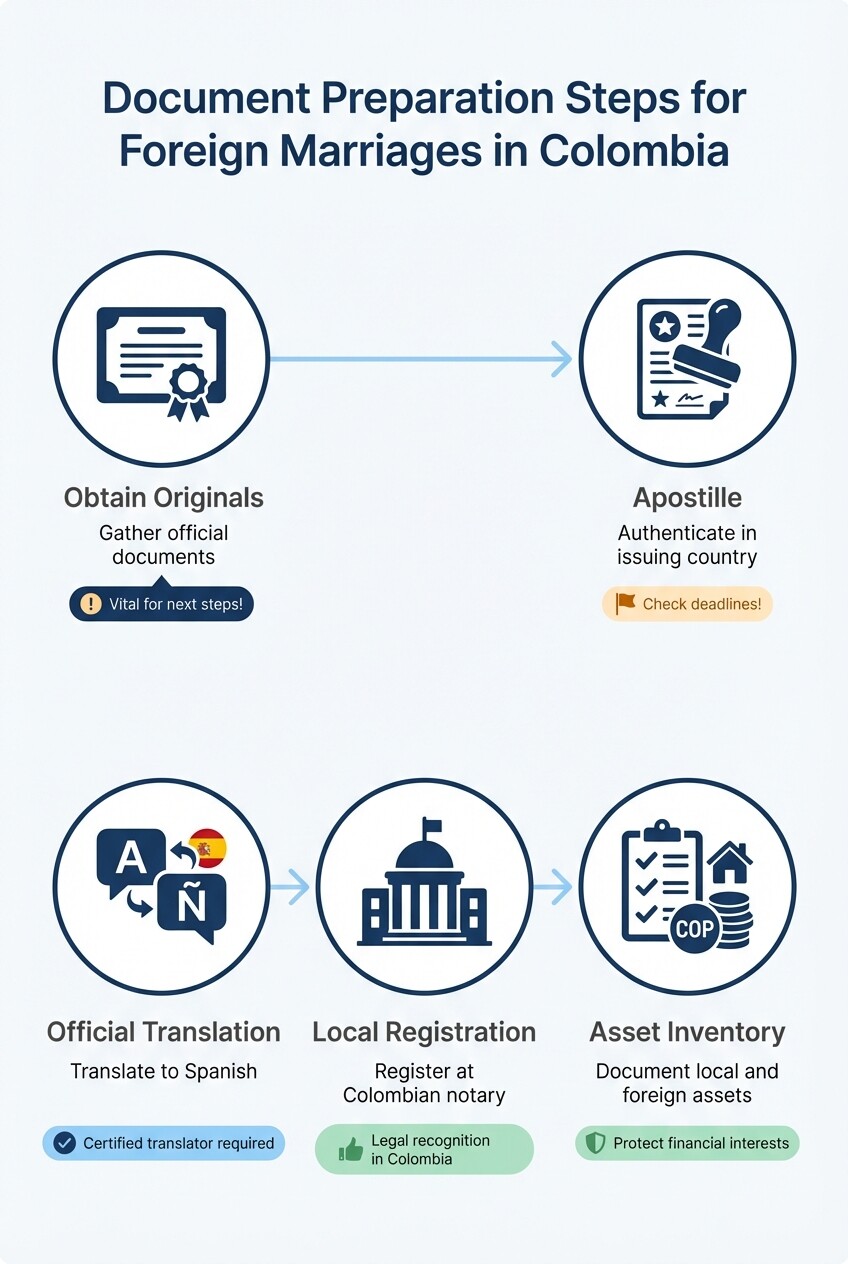
Before you can file for divorce in Colombia, you must gather, authenticate, and translate your legal documents. The most critical step is ensuring foreign civil status documents are properly recognized by the Colombian government.
Use this checklist to prepare your initial documentation:
- Obtain original certificates: Secure original copies of your marriage certificate and the birth certificates of any children.
- Apostille foreign documents: Documents issued outside of Colombia must receive an Apostille stamp from the issuing country to be valid locally. You can review the official rules for this process on the Colombian Ministry of Foreign Affairs Apostille portal.
- Translate to Spanish: All foreign documents must be translated into Spanish by an official translator certified by the Colombian government.
- Register the marriage locally: Take the apostilled and translated marriage certificate to a Colombian notary to register it in the national civil registry.
- Draft an inventory of assets: Compile a list of all bank accounts, real estate, and investments acquired during the marriage, noting which are located in Colombia and which are abroad.
Timelines and Costs for Colombian Divorces
The cost and duration of a divorce in Colombia depend entirely on whether both parties agree to the terms. Mutual consent divorces are fast and relatively inexpensive, while contested lawsuits can drag on for years and drain financial resources.
When spouses agree on asset division, alimony, and child custody, they can use a "Divorcio Express" process before a Notary Public. If they disagree on any of these points, the case must go before a Family Judge in a contested lawsuit.
| Process Type | Estimated Timeline | Average Notary/Court Costs (COP) | Estimated Legal Fees (COP) |
|---|---|---|---|
| Mutual Consent (Notary) | 1 to 2 months | 500,000 to 1,500,000 | 2,000,000 to 5,000,000 |
| Contested (Family Court) | 1.5 to 3 years | Minimal (Court is public) | 10,000,000 to 30,000,000+ |
Legal fees vary widely based on the complexity of the estate and the seniority of the lawyer. In contested cases involving high-value international assets, lawyers often charge a percentage of the assets recovered in addition to their base retainer.
Protecting Children and Handling International Custody
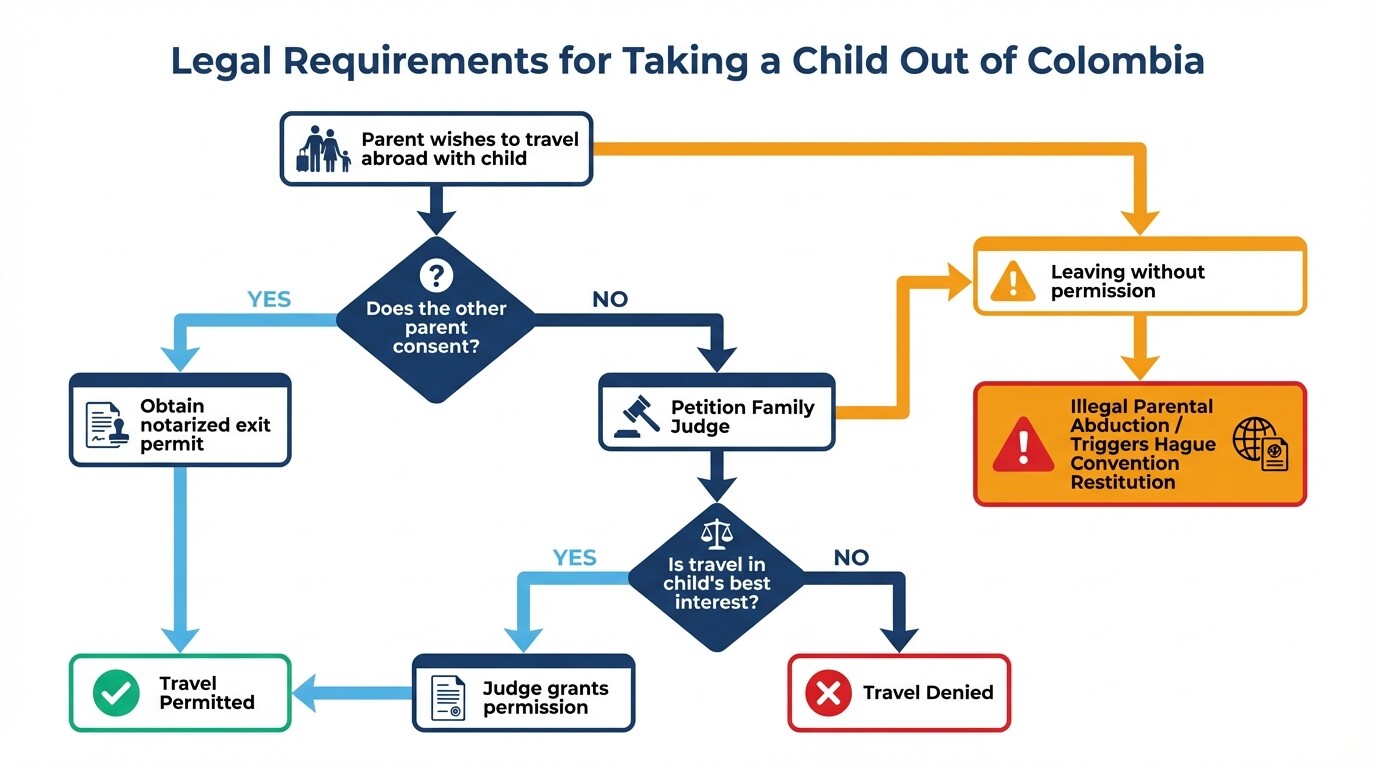
Under Colombian law and the Hague Convention, neither parent can permanently relocate a child outside of Colombia without the explicit consent of the other parent or a family judge. The Colombian Institute of Family Welfare handles cross-border child abduction cases and strictly enforces international restitution.
If one parent wants to travel abroad with a child, they must obtain a formal exit permit signed by the other parent and authenticated by a notary. If the other parent refuses, the traveling parent must petition a family judge for permission, which is only granted if the judge determines the travel is in the child's best interest.
When a parent removes a child from Colombia without consent, it is considered international parental child abduction. Colombia is a signatory to the Hague Convention on the Civil Aspects of International Child Abduction. The government acts swiftly to locate the child and mandate their return to their habitual residence so custody can be properly decided by local courts.
Dividing Foreign Assets and International Real Estate
Colombian family courts will divide all marital assets acquired during the marriage, regardless of where those assets are located. However, enforcing a Colombian court order on foreign bank accounts or real estate usually requires recognizing the judgment in that specific country.
Colombia operates under a community property regime called the marital partnership. Assets and debts acquired from the date of the marriage to the date of separation are generally split equally. This includes pensions, foreign bank accounts, and international real estate. Inheritances and gifts received individually are usually excluded from this division.
While a Colombian judge can order a spouse to transfer half the value of a foreign asset, the court has no direct power to seize property in another country. If a spouse refuses to comply, you will need to take the Colombian judgment to the country where the asset is located and file a legal recognition process to enforce the seizure or sale.
Common Misconceptions About International Divorces in Colombia
Navigating two legal systems often leads to dangerous assumptions about how family law works. Believing these myths can jeopardize your assets and custody rights.
- Marrying abroad means you are not married in Colombia: Many expats believe that if they wed outside Colombia, they do not need a formal divorce locally. If you live in Colombia, you are legally bound by local family laws and must process a divorce to protect your future income and assets from your ex-spouse.
- Primary custody grants total travel freedom: Having physical custody of your child does not erase the other parent's rights. You still need the non-custodial parent's notarized permission to take the child across Colombian borders.
- Foreign assets are hidden from Colombian courts: Hiding international assets is a severe offense. Colombian courts have mechanisms to penalize spouses who conceal property, often awarding the hidden asset entirely to the defrauded spouse.
Frequently Asked Questions
Can I get a divorce in Colombia if my spouse refuses?
Yes. You can file a contested divorce lawsuit before a family judge. However, under Colombian law, you must prove specific legal grounds for a contested divorce, such as infidelity, severe mistreatment, or unjustified separation for more than two years.
How are child support payments calculated?
Colombian judges calculate child support based on the child's needs and the financial capacity of both parents. Support covers housing, education, health, clothing, and recreation, and payments are generally capped at fifty percent of the paying parent's total income.
Do I have to appear in court if I leave the country?
You do not necessarily have to be physically present in Colombia. You can grant a special power of attorney to a Colombian lawyer to represent you in court hearings or to sign notary documents on your behalf.
What happens to my Colombian visa after a divorce?
If your residency or visa status is tied to your marriage to a Colombian national, a divorce will invalidate the foundation of your visa. You will need to apply for a new visa category, such as a work or investment visa, to legally remain in the country.
When to Hire a Lawyer
You should consult a family lawyer immediately if your spouse threatens to take your children out of the country or if there are substantial international assets at stake. Early legal intervention is vital to secure exit restrictions for children and freeze marital assets before they can be hidden or sold. If you and your spouse agree on all terms, a lawyer is still required to draft the settlement agreement and process the mutual consent divorce through the notary.
Next Steps
Gather your marriage and birth certificates and begin the apostille and translation process as soon as possible, as this can take several weeks. Outline your financial assets and debts, separating what you owned prior to the marriage from what you acquired together. Once your documents are organized, find experienced family lawyers in Colombia who specialize in cross-border disputes and the Hague Convention to advise you on your specific jurisdictional rights.