- The mutual recognition framework allows Hong Kong liquidators to apply for judicial assistance to manage distressed assets in Mainland China.
- The process relies on the 2021 Record of Meeting between the Supreme People's Court and the Hong Kong Government.
- Recognition is currently restricted to three designated pilot areas: Shanghai, Xiamen, and Shenzhen.
- Liquidators must file formal applications with Intermediate People's Courts and prove the debtor's Center of Main Interests (COMI) has been in Hong Kong for at least six months.
- Proactive coordination is essential to protect international creditors and resolve competing winding-up petitions between the two jurisdictions.
What is the Record of Meeting Framework?
The Record of Meeting framework is a mutual recognition mechanism established in 2021 that allows liquidators in Hong Kong and bankruptcy administrators in Mainland China to request judicial assistance across borders. This agreement streamlines the process of managing distressed assets, restructuring debt, and protecting creditors in both jurisdictions.
Prior to this formalized framework, cross-border insolvency recognition relied on unpredictable common law principles and ad hoc cooperation. The Supreme People's Court and the Government of the Hong Kong Special Administrative Region created this mechanism to provide legal certainty for multinational businesses. The framework establishes a clear protocol for courts to recognize insolvency representatives, stay parallel legal proceedings, and prevent the unauthorized dissipation of a debtor's assets.
To qualify for assistance under this framework, the debtor's Center of Main Interests must be located in the requesting jurisdiction. For Hong Kong liquidators seeking recognition in the Mainland, the debtor's COMI must have been continuously in Hong Kong for at least six months prior to the application. Courts evaluate COMI based on the place of incorporation, the principal place of business, and the location of core administrative functions.
Eligible Pilot Areas for Hong Kong Liquidators
Hong Kong liquidators can currently apply for mutual recognition and assistance only in three designated pilot areas in Mainland China: Shanghai, Xiamen, and Shenzhen. The Supreme People's Court selected these specific cities due to their strong commercial ties with Hong Kong and their established, sophisticated judicial infrastructure.
For an application to be accepted, the Mainland debtor must have its principal assets, a place of business, or a representative office located within one of these three municipalities.
| Pilot Area | Strategic Importance for Debt Recovery |
|---|---|
| Shanghai | Serves as the primary financial hub and corporate headquarters for many multinational entities operating in Mainland China. |
| Shenzhen | Acts as a major technology and manufacturing center with immediate geographic and economic proximity to Hong Kong. |
| Xiamen | Functions as a vital cross-border trade zone with heavy foreign direct investment and complex shipping operations. |
If a debtor's assets are located entirely outside these three areas, the Hong Kong liquidator cannot currently utilize the Record of Meeting framework. In such cases, creditors must rely on traditional, more cumbersome methods of offshore debt recovery and local Mainland litigation.
Application Checklist: Filing with Intermediate People's Courts
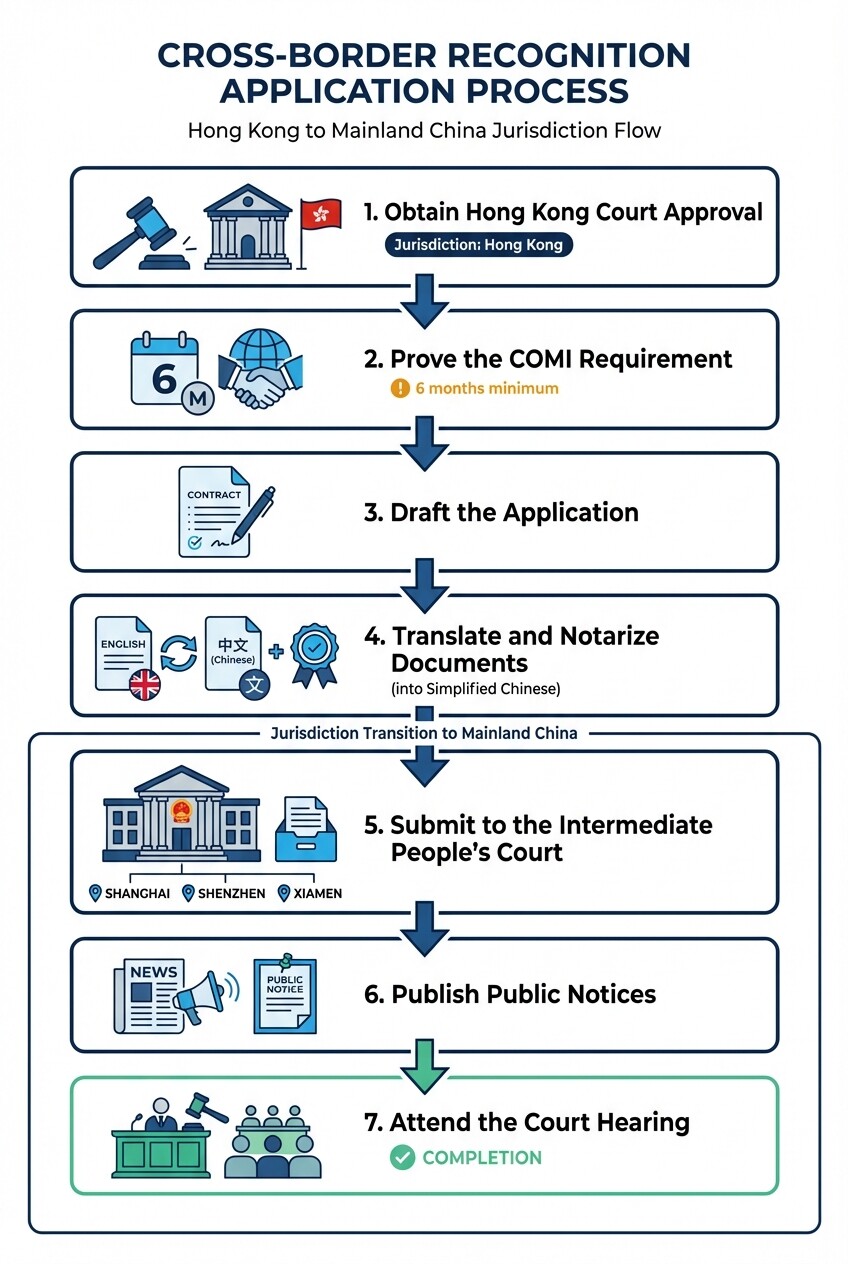
To secure control over mainland assets, Hong Kong liquidators must submit a formal application to the relevant Intermediate People's Court in the designated pilot area. The court will review the application to ensure it meets the criteria outlined in the Supreme People's Court guidelines before granting recognition.
The application process requires strict adherence to procedural rules in both jurisdictions. Follow this checklist to navigate the filing successfully:
- Obtain Hong Kong Court Approval: Apply to the High Court of Hong Kong for a formal letter of request addressed to the relevant Mainland court.
- Prove the COMI Requirement: Gather evidentiary documents showing the debtor's center of main interests has been anchored in Hong Kong for six continuous months.
- Draft the Application: Prepare a detailed application letter outlining the scope of recognition and specific assistance required to secure the assets.
- Translate and Notarize Documents: Translate all Hong Kong winding-up orders, liquidator appointment certificates, and supporting evidence into simplified Chinese. Have these documents officially notarized and attested.
- Submit to the Intermediate People's Court: File the complete application package with the Intermediate People's Court in Shanghai, Shenzhen, or Xiamen.
- Publish Public Notices: Following court instructions, publish a notice of the application to alert local creditors.
- Attend the Court Hearing: Present the case before the Mainland judges, proving that recognition does not violate basic principles of Mainland law or public policy.
How to Protect International Creditor Rights During Restructuring
International creditors can protect their rights by actively participating in the recognized Hong Kong restructuring process and ensuring their claims are registered before mainland assets are dissipated. The mutual recognition framework prevents individual mainland creditors from seizing assets independently, centralizing the distribution under the recognized liquidator.
To maximize recovery, international creditors must monitor onshore asset transfers closely. Mainland Chinese insolvency law enforces specific priority rules for debt repayment that may differ from Hong Kong regulations. Under Mainland law, employee wages, social security premiums, and outstanding tax liabilities are paid out before unsecured corporate debt.
Creditors should work closely with the appointed liquidator to ensure all cross-border asset valuations are accurate. By leveraging the framework, the liquidator can request the Intermediate People's Court to freeze mainland bank accounts, seize real estate, and halt pending litigation against the debtor in the Mainland. This judicial assistance preserves the total asset pool, ensuring a fairer distribution for international stakeholders based on the approved restructuring plan.
Managing Jurisdictional Conflicts and Competing Petitions
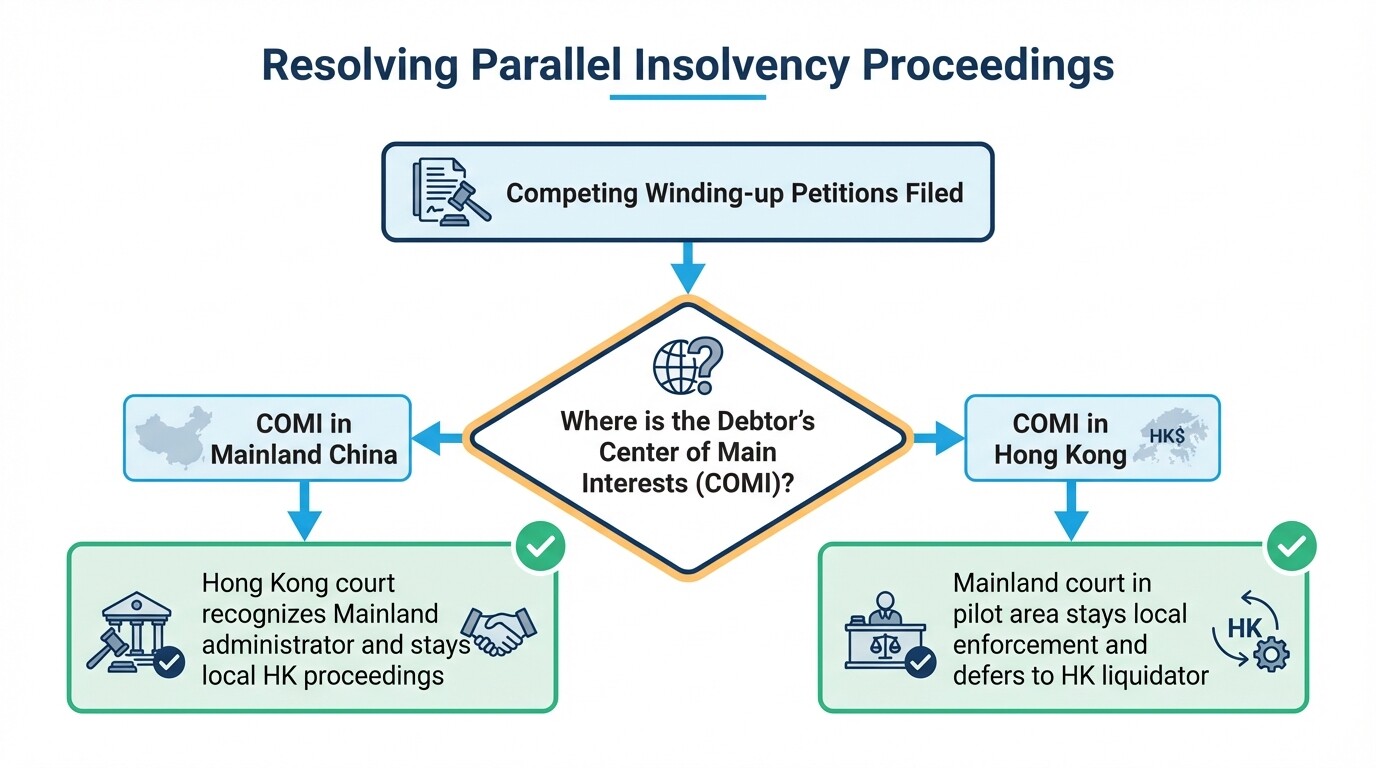
Resolving jurisdictional conflicts requires identifying the debtor's center of main interests and coordinating parallel proceedings to prevent asset stripping. When competing winding-up petitions are filed in both Hong Kong and Mainland China, courts now favor cooperation to maximize creditor returns.
Conflicts typically arise when offshore creditors file a winding-up petition in Hong Kong, while onshore creditors initiate bankruptcy proceedings in a Mainland court. The Record of Meeting framework provides a mechanism to handle these parallel proceedings. If the debtor's COMI is clearly in the Mainland, the Hong Kong court will generally recognize the Mainland bankruptcy administrator and stay local proceedings to avoid duplicating efforts.
Conversely, if the COMI is in Hong Kong, the Mainland court in a pilot area can stay local enforcement actions and defer to the Hong Kong liquidator. Effective management of these conflicts relies heavily on proactive communication between the insolvency practitioners and the respective courts. Attempting to hide assets or rush judgments in one jurisdiction will generally trigger immediate injunctions from the coordinating court.
Common Misconceptions About HK-Mainland Insolvency
Many businesses misunderstand the mutual recognition framework, assuming it guarantees automatic and unrestricted asset recovery across all of Mainland China. In reality, the process is highly localized and subject to strict jurisdictional limitations.
Misconception 1: Recognition is automatic. Filing a winding-up order in Hong Kong does not grant automatic control over Mainland assets. Liquidators must apply for recognition, and Mainland courts will reject the application if it unfairly prejudices Mainland creditors or violates public interest.
Misconception 2: The framework covers all of Mainland China. Currently, Hong Kong liquidators can only seek assistance from courts in Shanghai, Xiamen, and Shenzhen. Assets held in Beijing, Guangzhou, or other non-pilot areas remain outside the scope of the streamlined recognition protocol.
Misconception 3: Hong Kong priority rules will apply to Mainland assets. Even when a Hong Kong liquidator takes control of Mainland assets, the distribution of those specific assets must often satisfy Mainland preferential claims, such as local employee wages and taxes, before funds can be remitted offshore to satisfy international creditors.
Frequently Asked Questions
What defines a Center of Main Interests (COMI)?
A debtor's COMI is the location where it conducts the administration of its interests on a regular basis. Courts look at the place of incorporation, the location of the primary executive office, the location of main assets, and where creditors perceive the business to be managed.
How long does it take to get recognition in a pilot area?
The timeline varies based on case complexity and creditor objections. Once a complete application is filed with the Intermediate People's Court, the review and hearing process generally takes several months to conclude before formal recognition is granted.
Can mainland bankruptcy administrators apply for recognition in Hong Kong?
Yes. The framework is mutual. Mainland bankruptcy administrators appointed by courts in the pilot areas can apply to the High Court of Hong Kong for recognition and assistance to recover assets located in Hong Kong.
When to Hire a Restructuring Lawyer
Engage a restructuring lawyer the moment a debtor with cross-border operations defaults on significant obligations or when competing winding-up petitions are threatened. Navigating the Record of Meeting framework requires specialized legal counsel licensed to coordinate actions in both jurisdictions.
Because strict deadlines and public policy tests govern these applications, early legal intervention prevents the unauthorized transfer of mainland assets. You can find experienced professionals to handle these complex cases through a directory of restructuring and insolvency lawyers in Hong Kong. Engaging a firm with dual-qualified practitioners ensures compliance with both Hong Kong High Court procedures and Mainland Intermediate People's Court requirements.
Next Steps
Taking immediate action preserves asset value and prevents unauthorized transfers during cross-border insolvency events. Waiting to initiate recovery efforts often results in depleted onshore bank accounts and transferred property.
Begin by assessing the geographic footprint of the debtor's primary assets to confirm if they fall within Shanghai, Shenzhen, or Xiamen. Next, gather documentation to establish the debtor's center of main interests over the past six months. Finally, consult with restructuring and insolvency lawyers to draft the necessary letters of request and initiate the mutual recognition process.