


- Corporate insolvency in Iceland is primarily governed by the Act on Bankruptcy etc., No. 21/1991, which outlines both liquidation and restructuring paths.
- A company must prove objective insolvency, meaning it cannot pay debts as they fall due and the situation is not temporary, to initiate formal proceedings.
- The timeline from filing a petition to the court appointing a liquidator is rapid, generally taking only two to four weeks.
- International creditors have the exact same priority rights and standing as domestic creditors under Icelandic insolvency law.
- Court filing fees are low, but petitioning creditors or debtors must provide an upfront security deposit of 250,000 to 500,000 ISK to cover initial administrative costs.
Conditions for Initiating Insolvency or Restructuring Proceedings in Iceland
To initiate insolvency or restructuring in Iceland, a company must demonstrate objective insolvency, meaning it cannot fulfill its financial obligations as they become due, and this inability is not temporary. Both creditors and the debtor's board of directors have the legal right to file a petition with the relevant district court (Héraðsdómur).
The framework for these procedures is established in the Act on Bankruptcy etc., No. 21/1991, which sets strict thresholds for court intervention. When a creditor files the petition, they must provide clear evidence of a defaulted, legally enforceable claim. If the company itself files, the board of directors must submit a detailed financial statement proving the insolvency.
For formal restructuring, known locally as a composition with creditors (nauðasamningur), the conditions are slightly different. The company must prove that its underlying business model is viable. The court will only grant permission for restructuring if there is a realistic probability that the company can return to solvency through debt forgiveness or extended payment terms, and a certified accountant or lawyer must endorse the proposed restructuring plan.
Strategies for Debt Negotiation and Avoiding Mandatory Liquidation

Avoiding mandatory liquidation requires proactive debt negotiation through informal workouts or formal composition agreements with creditors before insolvency is declared. The most effective strategy involves presenting a transparent financial recovery plan to major creditors early in the distress cycle.
Companies operating in Iceland have several legal and strategic options to restructure their debt without immediately surrendering control to a liquidator:
- Suspension of Payments (Greiðslustöðvun): A company can apply to the District Court for a temporary moratorium on payments. This provides a legal shield from creditor actions and halts asset seizures for up to six months. During this period, the company works with a court-appointed assistant to negotiate with creditors.
- Informal Workouts: Before involving the courts, companies can negotiate privately with their largest creditors, such as Icelandic commercial banks. This often involves extending loan maturities, securing bridge financing, or executing debt-for-equity swaps.
- Formal Composition Agreement: If an informal workout fails, a debtor can propose a legally binding composition agreement. If accepted by a qualified majority of creditors and confirmed by the court, it forces dissenting minority creditors to accept the restructuring terms, effectively avoiding liquidation.
Regulatory Timelines From Filing to Appointment of a Liquidator
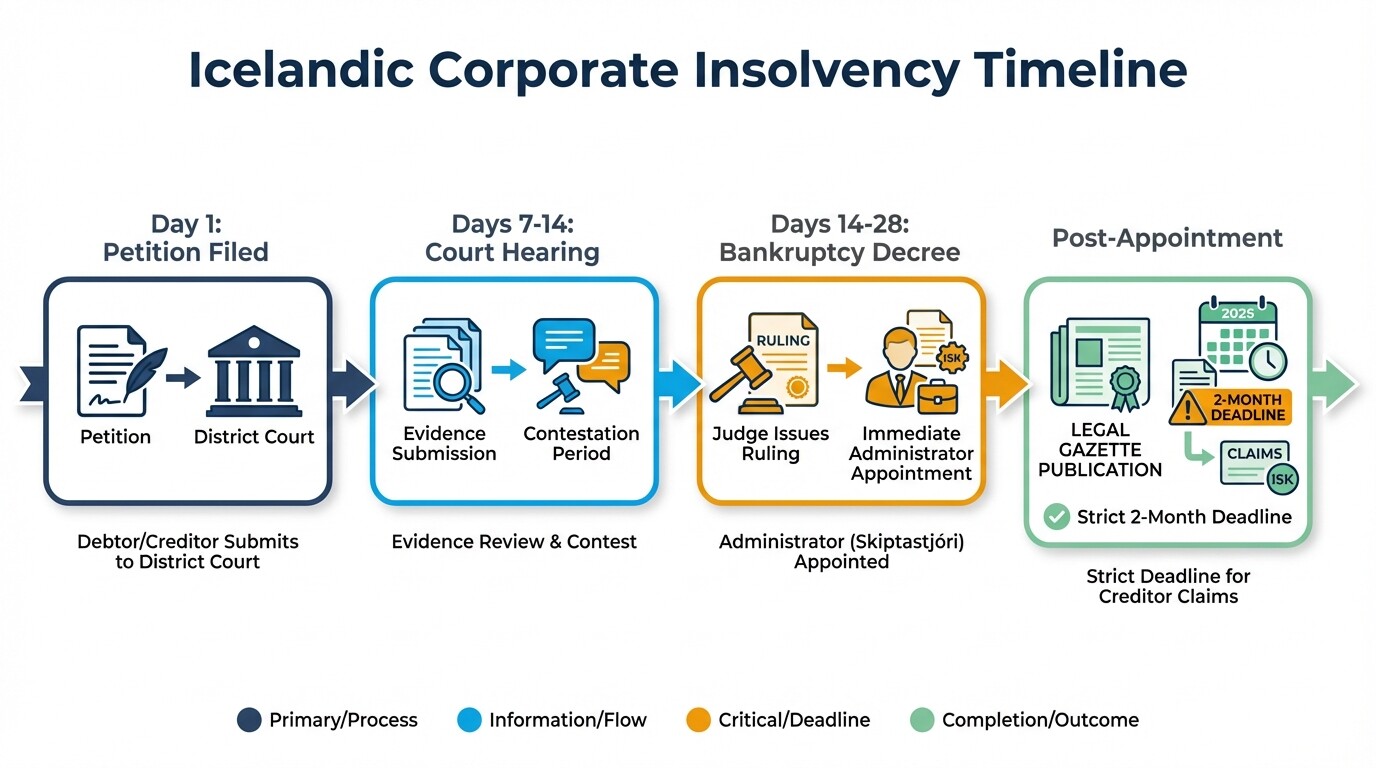
The timeline from filing an insolvency petition to the appointment of a liquidator typically ranges from two to four weeks in Iceland. Once the District Court issues the bankruptcy decree, it immediately appoints a certified administrator to take control of the company's assets.
The statutory process follows a predictable schedule under Icelandic law:
- Day 1: The debtor or creditor submits a formal bankruptcy petition to the District Court.
- Days 7 to 14: The court summons the debtor and petitioning creditor for a hearing. If the debtor contests the petition, the court allows a brief period for evidence submission.
- Days 14 to 28: The judge issues a ruling. If insolvency is proven, the court immediately declares the company bankrupt and appoints an administrator (skiptastjóri), usually a certified attorney.
- Post-Appointment: Within days of the appointment, the administrator publishes a formal notice in the Legal Gazette (Lögbirtingablaðið), inviting all creditors to submit their claims within a strict two-month deadline.
Estimated Legal Fees and Court Costs for Corporate Bankruptcy
Initiating corporate bankruptcy in Iceland requires paying a standard court filing fee of approximately 25,000 to 30,000 ISK, alongside an upfront security deposit for the liquidator's initial costs, which usually ranges from 250,000 to 500,000 ISK. Total legal and administrative fees depend heavily on the estate's complexity and are paid out of the estate's assets.
Understanding the financial burden of filing is critical for both distressed companies and petitioning creditors. If there are insufficient assets in the estate to cover the liquidation costs, the party that filed the petition may lose their security deposit.
| Cost Category | Estimated Amount (ISK) | Payment Responsibility |
|---|---|---|
| Court Filing Fee | 25,000 to 30,000 ISK | Paid by the petitioner at filing |
| Security Deposit | 250,000 to 500,000 ISK | Paid by the petitioner (refunded if estate has funds) |
| Liquidator Hourly Fees | 25,000 to 45,000 ISK/hour | Paid from the bankruptcy estate's assets |
| Legal Counsel (Advisory) | Varies by firm complexity | Paid by the hiring party |
Regulatory Protection Mechanisms for International Creditors
International creditors are protected by the principle of equal treatment under Icelandic insolvency law, ensuring they hold the same priority rights as domestic creditors. They are permitted to file claims, attend creditor meetings, and challenge the administrator's decisions in court.
Iceland is part of the European Economic Area (EEA) and adheres to international cross-border insolvency frameworks. This provides robust protection for foreign entities caught in an Icelandic bankruptcy scenario:
- Equal Standing: Nationality does not dictate the priority of claims. A foreign supplier's unsecured claim carries the exact same weight as an Icelandic supplier's unsecured claim.
- Notice Requirements: While the formal call for claims is published in the Icelandic Legal Gazette, known international creditors must be directly notified by the administrator.
- Claim Submission: International creditors have two months from the publication date to submit their claims. The submission must clearly state the principal amount, interest, and any asserted security or priority rights, supported by adequate documentation.
Common Misconceptions About Icelandic Restructuring
Many business leaders mistakenly believe that filing for restructuring guarantees a debt write-off or that foreign creditors are secondary to local entities. Understanding the reality of Icelandic bankruptcy law prevents costly strategic errors.
- Restructuring means total control: Directors often believe they maintain absolute control during a suspension of payments. In reality, the court appoints an assistant who must approve all major financial decisions and transactions.
- Insolvency is a fast exit: Many assume a bankrupt company is wound up in a matter of months. In practice, liquidating corporate assets, resolving disputed claims, and distributing funds often takes anywhere from one to three years in Iceland.
- Shareholders retain value: Corporate founders frequently think they will retain some equity after a formal restructuring. Under Icelandic law, debt takes priority over equity, and shareholders almost always lose their entire investment unless all creditors are paid in full.
Frequently Asked Questions
What is the role of the liquidator in Icelandic insolvency?
The liquidator, appointed by the District Court, assumes full control of the bankrupt company. Their duties include securing and selling the company's assets, assessing the validity of creditor claims, investigating potential voidable transactions, and distributing the proceeds to creditors according to legal priority.
Can a company continue trading during bankruptcy?
A company cannot continue standard operations after a bankruptcy decree is issued unless the liquidator explicitly determines that continuing operations temporarily will maximize the value of the estate's assets for the creditors.
What is the deadline for submitting a claim in Iceland?
Creditors must submit their claims within two months of the bankruptcy notice being published in the Icelandic Legal Gazette. Failing to submit a claim within this window usually results in the claim being entirely dismissed from the bankruptcy estate.
When to Hire a Lawyer and Next Steps
You should hire a restructuring lawyer the moment your company projects a cash flow deficit that will prevent it from meeting upcoming debt obligations. Early legal intervention is critical to securing a moratorium on payments before creditors force a mandatory liquidation.
If your business is facing distress, or if you are a creditor seeking to recover funds from an Icelandic entity, take the following steps:
- Compile a complete and accurate ledger of all current assets, outstanding liabilities, and upcoming maturities.
- Assess whether the financial difficulties are temporary liquidity issues or fundamental insolvency.
- Consult with restructuring and insolvency lawyers in Iceland to determine whether an informal workout, a suspension of payments, or a formal bankruptcy petition is your most viable legal option.