


Drafting a Will and Inheritance Regulations in Iceland
- Strict forced heirship: Icelandic law reserves two-thirds of your estate for your spouse and children. You can only distribute the remaining one-third through a will.
- Habitual residency: If you permanently reside in Iceland when you pass away, local inheritance laws apply to your worldwide estate.
- Spousal tax exemption: Surviving spouses pay no inheritance tax. Other beneficiaries pay a flat 10% rate.
- District Commissioner: The Sýslumaður handles all probate and estate settlement processes in the country.
- Cross-border tax: Foreign residents should align their Icelandic will with their home country's tax regulations to prevent double taxation.
Estate Planning for Foreign Residents in Iceland
Moving to Iceland requires updating your financial and legal affairs. Drafting a legally compliant will ensures your assets are distributed according to your wishes while staying within local legal boundaries. A proper estate plan minimizes administrative delays and tax liabilities for your family.
Iceland's Forced Heirship Rules
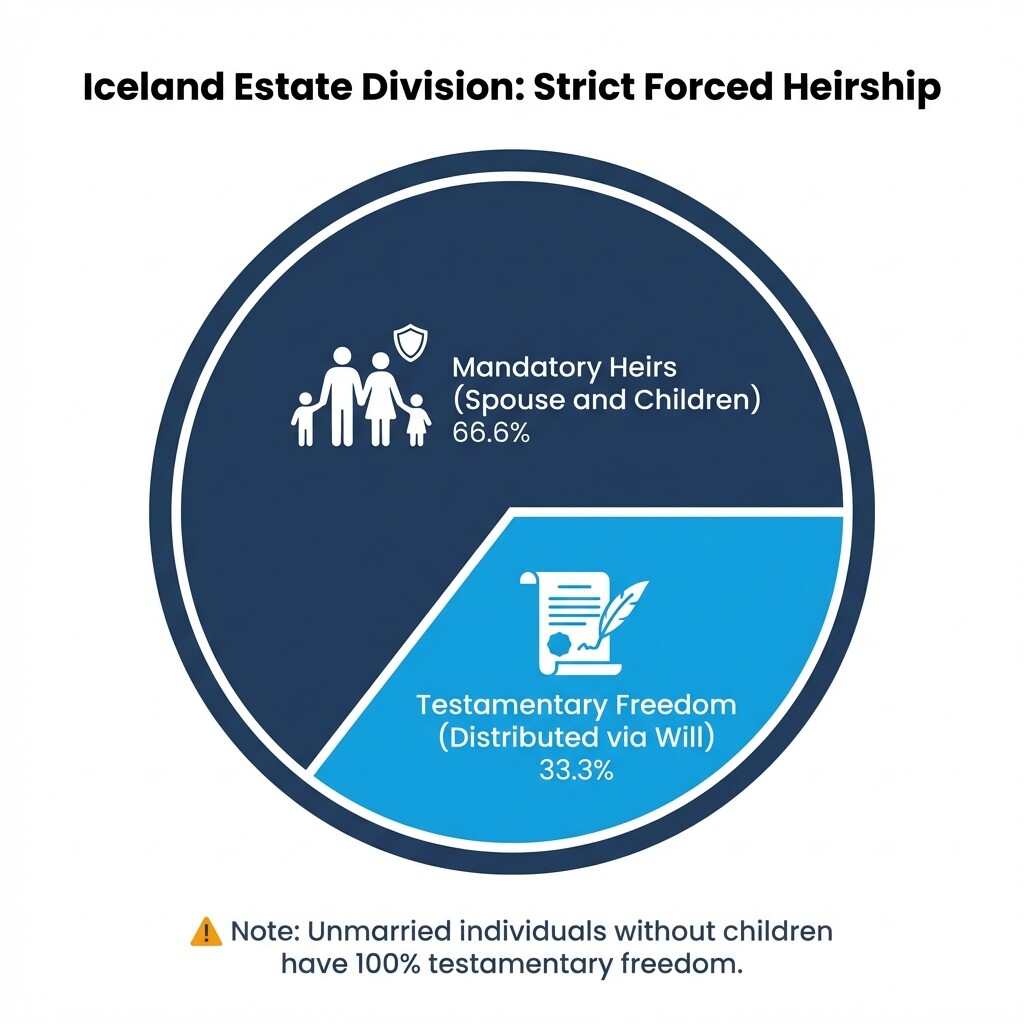
Iceland enforces strict forced heirship rules. If you have a surviving spouse or children, you cannot freely distribute your entire estate. For foreign residents whose habitual residence is Iceland, these rules apply to worldwide assets. The law reserves two-thirds of the estate for your immediate family.
When drafting a will, consider the following rules:
- Spouses and descendants: A spouse and children are legally entitled to two-thirds of your estate. Your will can only dictate the distribution of the remaining one-third.
- No direct descendants: Unmarried individuals without children have full testamentary freedom. You can leave your entire estate to anyone, including charities or friends.
- Habitual residence: Foreigners living permanently in Iceland are subject to local rules regardless of nationality. However, EU citizens can invoke the EU Succession Regulation (Brussels IV) to apply the law of their home country and bypass Icelandic forced heirship.
Estimated Legal Costs for Drafting a Will
Drafting a legally compliant will in Iceland costs between 50,000 ISK and 150,000 ISK. Standard wills for simple local estates fall on the lower end. Documents for international estates with cross-border tax considerations incur higher fees.
| Estate Planning Service | Estimated Cost (ISK) | Description |
|---|---|---|
| Basic Will Drafting | 50,000 - 80,000 | Standard will for local assets and straightforward family structures. |
| Complex Will | 90,000 - 150,000+ | Tailored for residents with overseas assets or blended families. |
| Notary Fee | 2,000 - 3,000 | Fee paid to the District Commissioner to formally witness the will. |
| Estate Consultation | 25,000 - 40,000 / hr | Hourly rate for advice on cross-border tax and heirship laws. |
Estate Planning Checklist for Foreign Residents
Follow this checklist to formalize your estate in Iceland and prevent administrative delays.
- Inventory global assets: List all bank accounts, real estate, investments, and pensions in Iceland and abroad.
- Determine habitual residence: Assess whether Icelandic law or your home country's law applies based on where you permanently live.
- Draft the will: The official document should be drafted in Icelandic by a legal professional. You can request a translated copy for your records.
- Include standard clauses: Clearly identify your heirs, specify the distribution of your one-third free estate (if applicable), and name an executor.
- Sign before a notary: Execute the will at the District Commissioner's office or before two legally competent witnesses who are not beneficiaries.
- Store securely: File a copy with your lawyer or register it so the authorities can locate the document during probate.
The Role of the District Commissioner
The District Commissioner (Sýslumaður) oversees estate settlements and probate procedures in Iceland. This office issues the official certificate of estate administration, processes inheritance tax returns, and guides heirs through estate division.
When a resident passes away, the hospital or relevant authority notifies the District Commissioner, who then contacts the legal heirs to begin the probate process. The Commissioner handles several regulatory steps:
- Issuing the death certificate: Formalizes the passing and freezes the deceased's bank accounts.
- Authorizing private division: Grants heirs permission to divide the estate privately (einkaskipti) if they agree on the distribution and assume responsibility for the deceased's debts.
- Appointing an administrator: If heirs disagree or the estate is bankrupt, the Commissioner assigns a lawyer to execute a court-administered division (opinber skipti).
Probate Process Timelines
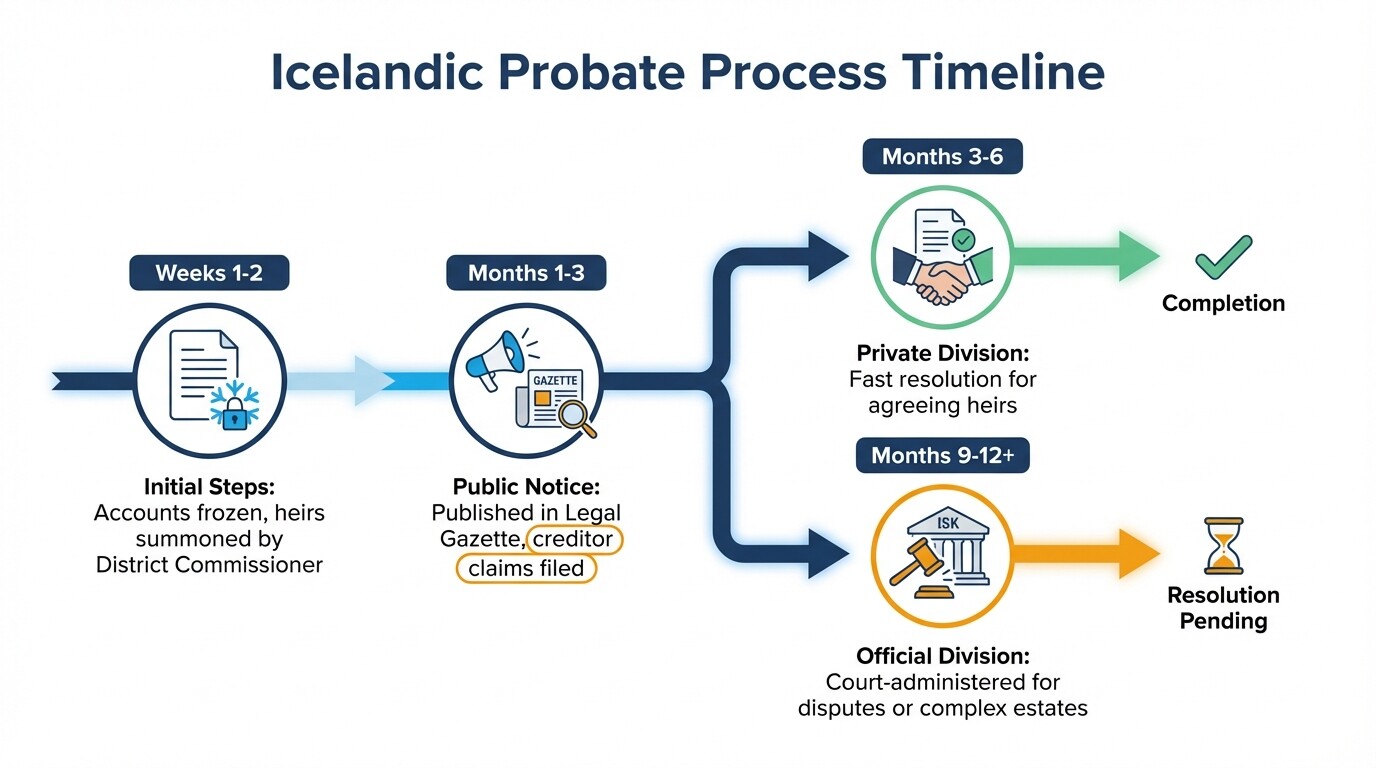
The probate process in Iceland takes between three and twelve months. The timeline depends heavily on whether the heirs choose a private settlement or require official court administration. Private divisions are relatively fast. Disputed estates or complex international assets take significantly longer.
The general timeline proceeds as follows:
- Weeks 1-2: The District Commissioner is notified, accounts are frozen, and heirs are summoned for an initial meeting.
- Months 1-3: A formal notice is published in the Legal Gazette (Lögbirtingablaðið). Creditors have two to three months to file claims against the estate.
- Months 3-6 (Private division): Once debts are cleared and inheritance tax is paid, agreeing heirs can distribute the assets privately.
- Months 9-12+ (Official division): If the estate involves disputes, complex asset liquidation, or court intervention, the process easily extends beyond a year.
Cross-Border Tax Regulations
Iceland levies a flat inheritance tax rate of 10% on estates. Navigating cross-border inheritance may trigger additional tax liabilities in your country of citizenship. Double taxation treaties and local tax residency rules determine whether your beneficiaries owe taxes to multiple jurisdictions.
- Icelandic tax rates: Surviving spouses pay 0% inheritance tax. All other beneficiaries (children, friends, siblings) pay a flat 10% on the net value of the estate above a statutory threshold.
- Double taxation: If you leave assets in your home country, your heirs might face inheritance taxes there. Iceland has double taxation treaties with several nations to prevent heirs from being taxed twice on the same assets.
- Asset valuation: Foreign real estate and international investment portfolios are valued according to Icelandic tax standards if the deceased was an Icelandic tax resident.
Frequently Asked Questions
Do I need to register my will in Iceland?
While not strictly mandatory, you should sign your will before a notary at the District Commissioner's office. This ensures the document is officially recorded and discoverable by authorities when probate begins.
What happens if I die without a will in Iceland?
If you die intestate, Icelandic law dictates the distribution. Your spouse receives one-third of the estate, and your children share the remaining two-thirds. If you have no children, your spouse inherits everything.
Can I disinherit my children in Iceland?
No. Under forced heirship laws, your descendants are entitled to share two-thirds of your estate with your spouse. You cannot entirely disinherit a legal heir.
Can I leave my entire estate to a charity?
You can only leave your entire estate to a charity if you do not have a surviving spouse or children. Otherwise, forced heirship rules limit your charitable donations to one-third of the estate.
Does my foreign will cover my property in Iceland?
A foreign will may be legally valid, but executing it in Iceland often requires costly translations, legalizations, and court approvals. Local lawyers recommend drafting a separate Icelandic will for assets held within the country.
Are foreign residents subject to the same inheritance taxes?
Yes. If you are a habitual resident of Iceland when you pass away, your beneficiaries pay the standard 10% inheritance tax rate regardless of your nationality.
When to Hire a Lawyer
Hire a lawyer to draft your will if you own property in multiple countries, have a blended family, or wish to utilize international treaties to bypass forced heirship laws. A legal professional ensures your will is drafted accurately in Icelandic, complies with local statutes, and minimizes the tax burden on your family.
Next Steps
Start by cataloging your global assets and determining your habitual residency status. Consult with a legal expert specializing in Icelandic estate law to discuss how forced heirship applies to your family structure. To find vetted, English-speaking legal counsel, explore our directory of lawyers in Iceland to draft your estate plan.