


- Iceland aligns its export control and sanctions framework directly with the European Union and the United Nations, enforcing strict rules on dual-use goods and targeted international trade restrictions.
- Securing an export license from the Icelandic Ministry for Foreign Affairs (MFA) generally requires 30 to 60 days, necessitating proactive supply chain planning.
- Implementing an Internal Compliance Program (ICP) for an Icelandic business typically costs between 2.8 million and 7.0 million ISK in the first year, covering legal setup, screening software, and staff training.
- Violating sanctions carries severe consequences under Icelandic law, including limitless corporate fines and up to four years of imprisonment for responsible individuals.
- Shipping and logistics companies bear heavy regulatory reporting duties, requiring real-time screening of manifests, vessels, and end-users before clearing Icelandic customs.
Export Controls and Sanctions Compliance Checklist
An effective internal compliance program requires systematic verification of goods, partners, and destinations. Use this practical checklist to audit your current export protocols before engaging in cross-border trade from Iceland.
- Classify Your Items: Determine if your product, software, or technology falls under dual-use categories and identify its specific Export Control Classification Number (ECCN).
- Screen All Counterparties: Run all buyers, intermediaries, end-users, and financial institutions against Icelandic, UN, and EU consolidated sanctions lists.
- Verify the End-Use: Obtain and authenticate a signed End-User Certificate (EUC) confirming the items will not be diverted to military, nuclear, or sanctioned activities.
- Check Destination Controls: Confirm whether the destination country is subject to comprehensive embargoes or targeted sector-specific sanctions.
- Identify Red Flags: Train sales and logistics teams to spot abnormal transaction behaviors, such as cash payments for large orders or obscure shipping routes.
- Document the Transaction: Retain all compliance screening records, communications, and shipping documents for a minimum of five years.
2026 Regulations on Dual-Use Goods and Export Controls
Iceland's 2026 export control framework strictly regulates the transfer of dual-use goods, software, and technology that can be utilized for both civilian and military purposes. Through its European Economic Area (EEA) membership, Iceland continuously aligns its domestic policies with the European Union's evolving export control regime.
The legal foundation for these controls is the Act on the Control of Services and Items that may have Strategic Significance (Act No. 58/2010). Under the 2026 regulatory environment, the Ministry for Foreign Affairs places heightened scrutiny on emerging technologies, including artificial intelligence applications, advanced semiconductors, and cyber-surveillance systems. Businesses exporting these technologies must demonstrate robust internal controls and prove that their products will not facilitate human rights violations or unauthorized military development abroad. Failure to properly classify goods before export is the leading cause of regulatory enforcement actions in the current trade climate.
Timeline for Securing Export Licenses from Icelandic Authorities
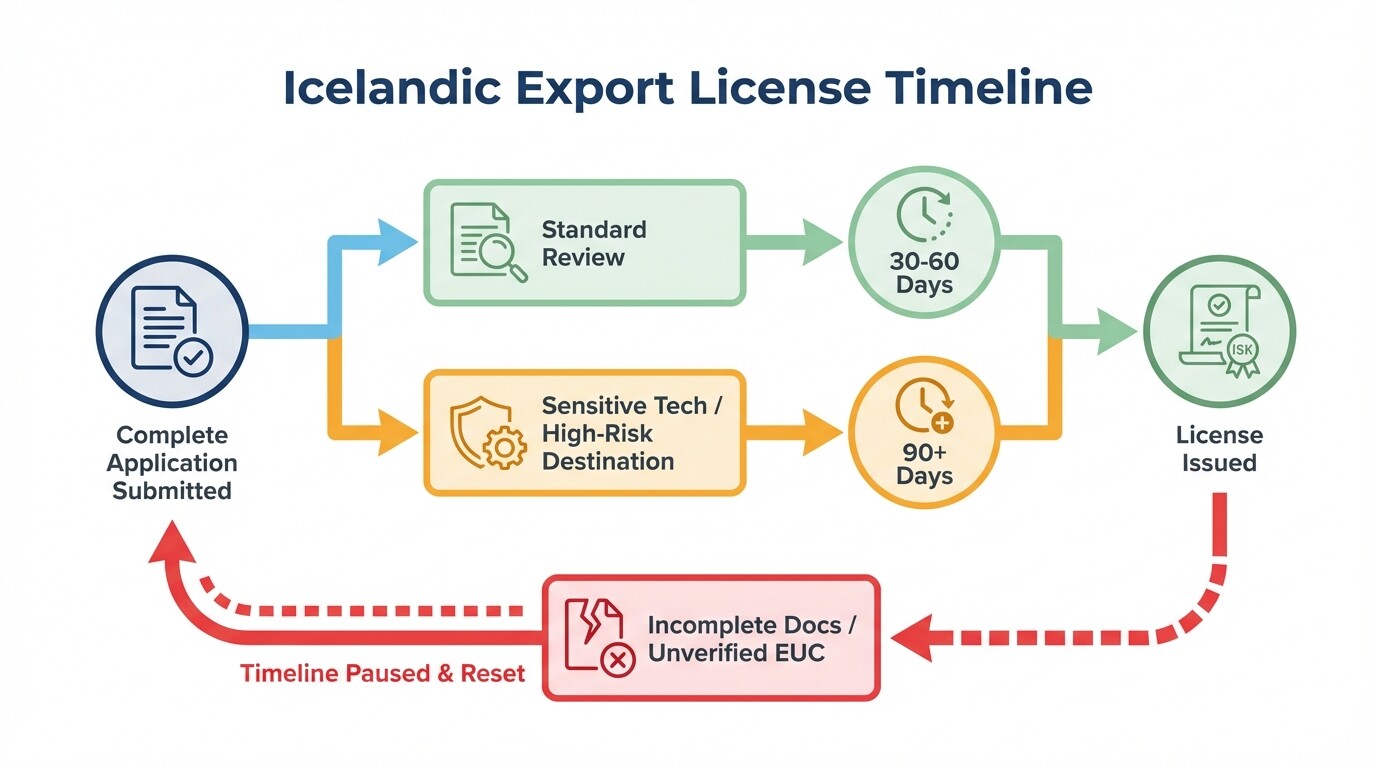
Securing a standard export license from the Icelandic Ministry for Foreign Affairs takes between 30 and 60 days from the date of a complete application. Applications involving sensitive dual-use technology or high-risk destinations can extend the review process to 90 days or more.
The licensing timeline depends entirely on the accuracy and completeness of the documentation provided by the exporter. When an application is submitted, the Ministry evaluates the technical specifications of the goods, the credibility of the end-user, and the geopolitical risks associated with the destination. If the application lacks a verified End-User Certificate or clear technical data, the Ministry will pause the review, effectively resetting the timeline. Companies should apply for licenses well in advance of their target shipping dates to prevent costly delays at Icelandic ports.
Estimated Costs for an Internal Legal Compliance Program
A comprehensive Internal Compliance Program (ICP) in Iceland typically costs between 2,800,000 ISK and 7,000,000 ISK for initial setup and first-year operations. These costs encompass legal structuring, restricted party screening software, and mandatory employee training.
Building an effective compliance infrastructure is an upfront investment that prevents catastrophic legal and financial penalties later. Small-to-medium enterprises can sometimes streamline costs by outsourcing screening functions, but larger exporters and shipping companies require dedicated internal resources. Below is an estimated breakdown of the costs associated with establishing a robust sanctions compliance program in Iceland:
| Compliance Expense Category | Estimated Annual Cost (ISK) | Description of Services | | | | | | Legal & Strategic Setup | 1,500,000 - 3,500,000 | Drafting compliance manuals, risk assessments, and internal protocols. | | Screening Software | 500,000 - 1,500,000 | Licensing for automated software that checks global sanctions lists. | | Training & Auditing | 800,000 - 2,000,000 | Annual staff workshops and third-party compliance audits. | | Total First-Year Estimate | 2,800,000 - 7,000,000 | Comprehensive cost for initial implementation and tools. |
Regulatory Penalties for Violating International Trade Sanctions
Violating international trade sanctions in Iceland carries severe administrative and criminal penalties, including fines reaching hundreds of millions of krónur and up to four years of imprisonment. Corporate directors and compliance officers can also face personal liability for systemic failures within their organizations.
Iceland enforces its international commitments under the Act on the Implementation of International Sanctions (Act No. 93/2008). If a company is found guilty of bypassing export controls or conducting business with sanctioned entities, the government has the authority to seize the illicit goods and confiscate all financial proceeds from the transaction. Furthermore, businesses penalized for sanctions evasion suffer immense reputational damage and are typically blacklisted by international financial institutions, effectively cutting them off from global banking networks.
Reporting Duties for Cross-Border Trade and Shipping Companies
Cross-border trade and shipping companies must submit detailed transaction records, end-user certificates, and customs declarations for all controlled items leaving Iceland. These reports must be filed with the Directorate of Customs and the Ministry for Foreign Affairs prior to shipment.
Logistics providers and freight forwarders bear a heavy burden under Icelandic law to ensure they do not facilitate the transport of illicit or unsanctioned goods. They are legally required to perform real-time screening of cargo manifests against international watchlists. If a shipping company suspects that a consignment involves restricted dual-use goods without a valid license, or is secretly destined for a sanctioned territory, they have a mandatory duty to halt the shipment and report the irregularity to Icelandic authorities immediately.
Common Misconceptions About Icelandic Export Sanctions
Operating under incorrect assumptions about international trade laws can inadvertently expose a business to criminal liability. Clearing up these misunderstandings is crucial for maintaining a compliant supply chain.
- "Iceland is independent, so EU sanctions do not apply to us." While Iceland is not an EU member state, its membership in the European Economic Area (EEA) and the Schengen zone means it closely mirrors and enforces EU sanctions regimes and dual-use export controls to maintain seamless trade relations.
- "Export controls only apply to weapons and military hardware." The vast majority of export control violations involve "dual-use" civilian items. Everyday technology like encrypted software, telecommunications equipment, and certain industrial chemicals require strict licensing if they have potential secondary military applications.
- "We rely on our freight forwarder to handle all sanctions compliance." While logistics partners play a role in reporting, the legal liability for sanctions violations ultimately rests with the exporter of record. You cannot contract away your legal duty to know your end-user.
FAQ
What are dual-use goods?
Dual-use goods are products, software, or technologies primarily designed for civilian commercial use but possess technical capabilities that allow them to be used for military applications or the development of weapons of mass destruction.
Which Icelandic authority issues export licenses?
The Icelandic Ministry for Foreign Affairs is the primary governing body responsible for reviewing applications and issuing export licenses for dual-use items and controlled technologies.
Do I need to screen domestic transactions within Iceland?
Yes. While domestic trade poses a lower risk, companies must still ensure they are not doing business with individuals or entities that have been designated on UN or domestic sanctions lists, as asset-freezing rules apply globally and locally.
What should I do if I discover a sanctions violation in my company?
If a violation is discovered, you must immediately halt the related transactions, secure all relevant documentation, and consult with legal counsel to voluntarily self-disclose the breach to the Ministry for Foreign Affairs and relevant authorities.
When to Hire a Lawyer and Next Steps
Navigating the complexities of international trade requires proactive legal oversight, especially when updating internal policies to meet 2026 regulations. You should engage legal counsel when classifying complex technologies, responding to inquiries from the Ministry for Foreign Affairs, or structuring a new Internal Compliance Program. A lawyer will help ensure your risk assessments are comprehensive and your screening tools meet statutory requirements.
As your next step, audit your current client base and product catalog against the latest consolidated sanctions lists. If you identify overlapping technologies or high-risk jurisdictions in your supply chain, connect with experienced sanctions and export controls lawyers in Iceland to develop a compliant, secure framework for your global operations.