


Explainer: Antitrust Regulations and Joint Ventures in Iceland
- The Icelandic Competition Authority treats "full-function" joint ventures as mergers, requiring mandatory notification if specific turnover thresholds are met.
- Joint venture reviews take 25 working days for Phase I and can extend up to an additional 90 working days for a complex Phase II investigation.
- Total costs for clearing a joint venture range from ISK 2,500,000 for straightforward approvals to over ISK 10,000,000 for deals requiring extensive economic defense.
- Icelandic antitrust law heavily mirrors European Economic Area (EEA) regulations, penalizing price-fixing and market dominance abuse with fines up to 10% of a company's global turnover.
- Foreign businesses must implement strict "clean team" protocols to prevent illegal information exchange before a joint venture is formally approved.
Overview of Iceland's Antitrust Framework
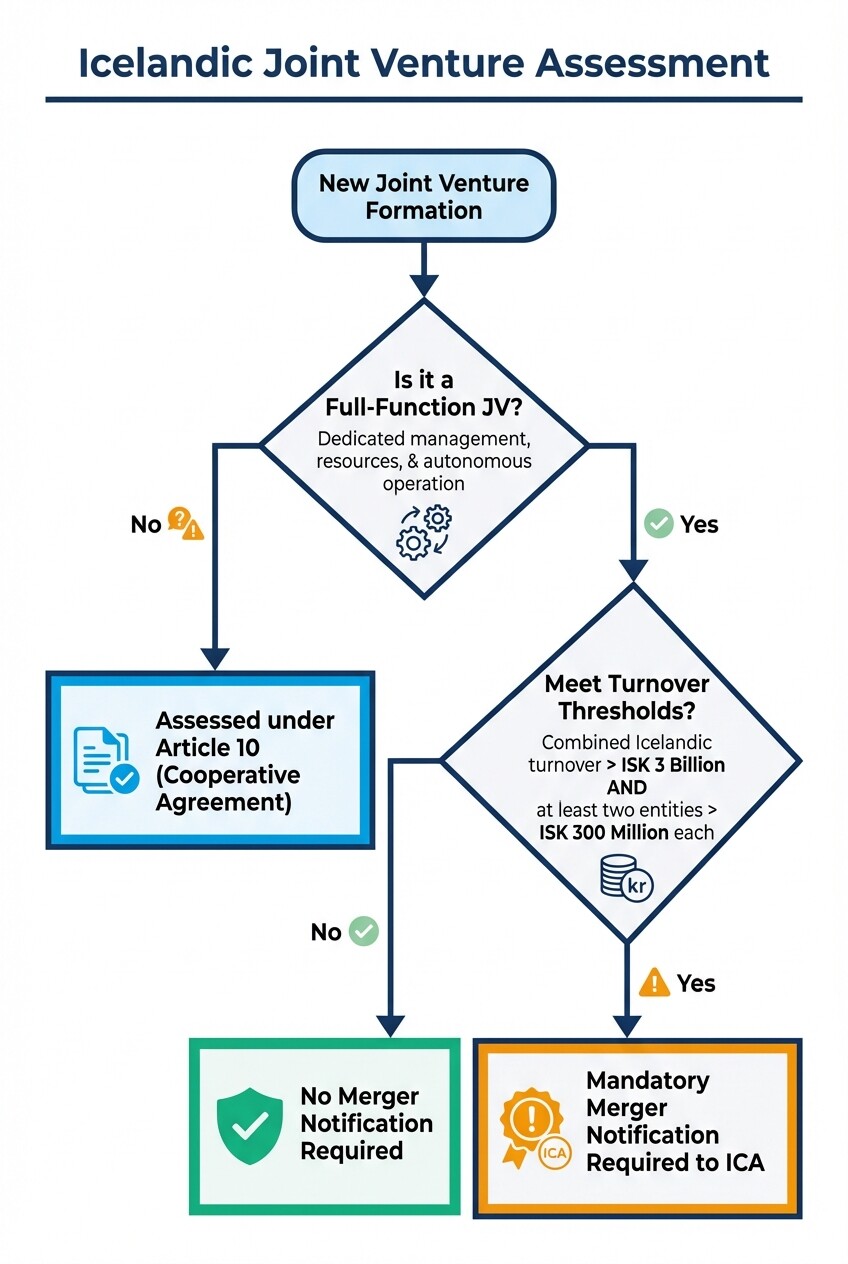
Iceland's antitrust framework is governed by the Competition Act No. 44/2005 and enforced by the Icelandic Competition Authority (Samkeppniseftirlitið). The regime heavily mirrors European Economic Area (EEA) competition rules, prohibiting anti-competitive agreements, cartels, and the abuse of dominant market positions.
Under Icelandic law, joint ventures are scrutinized through two distinct lenses depending on their structure. If a joint venture performs all the functions of an autonomous economic entity on a lasting basis, it is classified as a "full-function" joint venture and must undergo formal merger control. If the joint venture is non-full-function and operates merely as a cooperative agreement between competitors, it is assessed under Article 10 of the Competition Act, which governs anti-competitive agreements. The primary goal of the authority is to ensure that collaborative corporate efforts do not substantially lessen competition or harm Icelandic consumers.
Timelines for Mandatory Joint Venture Notifications
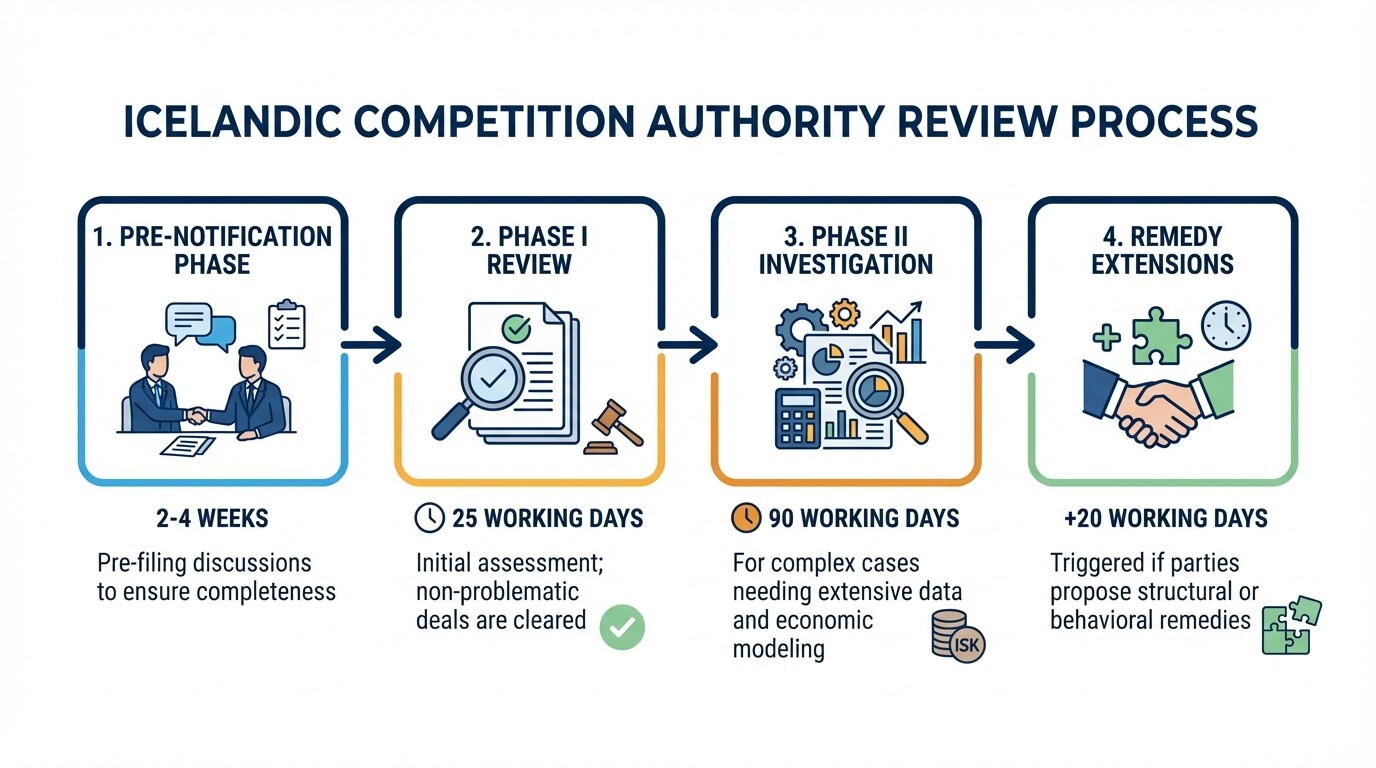
A mandatory joint venture notification in Iceland takes 25 working days for a Phase I review and up to 115 working days if the review advances to an in-depth Phase II investigation. These formal statutory timelines only begin after the Icelandic Competition Authority confirms the notification filing is complete.
The review process typically follows a phased structure:
- Pre-notification Phase (Variable): Before formally filing, parties often engage in pre-notification discussions with the authority. This takes 2 to 4 weeks and helps ensure the formal filing is accepted as complete on day one.
- Phase I Review (25 Working Days): The authority assesses whether the joint venture raises any initial competition concerns. Most non-problematic joint ventures are cleared at the end of this phase.
- Phase II Investigation (90 Working Days): If the authority identifies potential negative market impacts, it launches a Phase II investigation. This phase involves extensive data requests, economic modeling, and market testing.
- Extensions: The Phase II timeline can be extended by up to 20 additional working days if the merging parties propose structural or behavioral remedies (such as divesting assets) to address the authority's concerns.
Estimated Costs for a Competition Authority Review
Navigating a competition review for an Icelandic joint venture involves mandatory filing fees alongside legal and economic advisory costs that typically range from ISK 2,500,000 to ISK 10,000,000. Straightforward Phase I approvals cost significantly less than complex Phase II investigations that require structural remedies.
Corporate entities must budget for both administrative fees and external counsel. Legal fees vary based on the volume of data requested by the authority and whether complex economic models are required to prove market efficiencies.
| Expense Category | Estimated Cost Range (ISK) | Description |
|---|---|---|
| ICA Filing Fee | ISK 500,000 | Mandatory administrative fee paid to the Icelandic Competition Authority upon submitting a merger notification. |
| Phase I Legal Counsel | ISK 2,000,000 - ISK 4,000,000 | Drafting the notification, defining relevant markets, and managing standard Phase I correspondence. |
| Phase II Legal Counsel | ISK 5,000,000 - ISK 10,000,000+ | Responding to extensive requests for information, negotiating remedies, and representing the JV in hearings. |
| Economic Advisory | ISK 3,000,000 - ISK 8,000,000+ | Hiring external economists to model market impacts, primarily needed only for deals with high market concentration. |
Market Dominance and Price-Fixing Regulations for 2026
In 2026, Iceland strictly enforces prohibitions against price-fixing and the abuse of market dominance under Articles 10 and 11 of the Competition Act. The regulatory landscape places aggressive scrutiny on algorithmic pricing models, sustainability agreements, and data-sharing mechanisms within joint ventures.
Article 10 of the Competition Act explicitly bans horizontal agreements that fix purchase or selling prices, limit production, or share markets. For joint ventures, this means parent companies cannot use the venture as a conduit to align their broader pricing strategies. Article 11 prohibits businesses holding a dominant position (generally presumed at a market share of 40% or higher) from abusing their power through exclusionary pricing, tying arrangements, or refusing to supply competitors. Penalties for violating these provisions are severe, including administrative fines of up to 10% of the total global turnover of the participating business groups.
Joint Venture Antitrust Compliance Checklist
Foreign businesses entering Icelandic joint ventures must proactively structure their agreements to avoid horizontal collusion and illegal market sharing. Implementing a structured antitrust compliance protocol prevents costly investigations, heavy fines, and blocked transactions.
Use the following operational steps to ensure your joint venture complies with Icelandic antitrust regulations before executing final agreements:
- Calculate Turnover Thresholds: Confirm if the parent companies meet the Icelandic merger control thresholds. Notification is required if the combined turnover in Iceland exceeds ISK 3 billion, and at least two participating entities each have an Icelandic turnover exceeding ISK 300 million.
- Assess Full-Functionality: Determine if the joint venture will have its own management, access to sufficient resources, and operate independently from its parents on a lasting basis. If yes, prepare for formal merger control filings.
- Establish a Clean Team Protocol: Ensure that commercially sensitive information (such as future pricing, strategic plans, or customer lists) is only shared among a designated "clean team" of external advisors or non-commercial staff during the negotiation phase.
- Evaluate Ancillary Restraints: Review any non-compete clauses or supply agreements between the parent companies and the joint venture. Ensure these restraints are strictly necessary and directly related to the successful implementation of the joint venture.
- Draft a Firewall Policy: Create strict information barriers for post-closing operations to ensure the joint venture does not become a channel for the parent companies to coordinate their competitive behavior in outside markets.
Common Misconceptions About Icelandic Antitrust Law
Many businesses misunderstand how Icelandic competition law applies to foreign entities and the scope of permissible collaboration. Clarifying these misconceptions prevents severe financial penalties and delayed joint venture launches.
- Foreign headquarters exempts a company from Icelandic review: Turnover thresholds are based on revenue generated within Iceland. Two foreign entities forming a joint venture outside of Iceland must still notify the Icelandic Competition Authority if their Icelandic sales meet the statutory thresholds.
- Non-compete clauses are always legal in joint ventures: While non-compete agreements are common to protect the investment in a joint venture, they are only legal if they are limited in geographic scope, duration (typically a maximum of three years), and subject matter. Overly broad non-competes are treated as illegal market sharing.
- Small market shares guarantee automatic clearance: Even if the parent companies hold relatively low market shares, the authority may still intervene if the joint venture creates coordinated effects, eliminates a unique potential competitor, or establishes a dangerous precedent in highly concentrated local markets.
Frequently Asked Questions
What is a full-function joint venture under Icelandic law?
A full-function joint venture is a corporate entity that performs all the functions of an autonomous economic business on a lasting basis. It has dedicated management, its own resources, and access to a market beyond merely selling back to its parent companies.
When must a joint venture notify the Icelandic Competition Authority?
Notification is mandatory before the joint venture is implemented if the combined Icelandic turnover of the participating companies is at least ISK 3 billion, and at least two of the companies each have an Icelandic turnover of at least ISK 300 million.
Can the Icelandic Competition Authority block a joint venture?
Yes. The authority has the power to prohibit a joint venture entirely if it determines the transaction will substantially impede effective competition. Alternatively, they may approve it subject to strict behavioral or structural conditions.
Are there penalties for implementing a joint venture before approval?
Yes. "Gun-jumping" or implementing a notifiable joint venture before receiving official clearance from the Icelandic Competition Authority can result in administrative fines amounting to a significant percentage of the parent companies' global turnover.
When to Hire an Antitrust Lawyer in Iceland
You should hire an antitrust lawyer immediately upon deciding to form a joint venture or collaborate with a competitor in Iceland. Early legal intervention is critical to structure the transaction securely, determine whether mandatory merger thresholds are met, and set up safe information-sharing protocols during negotiations. If you wait until the deal is signed to consult counsel, you risk drafting agreements with illegal ancillary restraints or triggering severe gun-jumping penalties. Partnering with top-tier antitrust lawyers in Iceland ensures your venture remains compliant with the complex, evolving standards of the Icelandic Competition Authority.
Next Steps
If you are planning a joint venture or major commercial agreement impacting the Icelandic market, your first step is to compile the global and Iceland-specific revenue figures for all participating entities. Next, outline the exact operational scope of the proposed joint venture, detailing what resources it will hold and which markets it will target. Finally, retain local Icelandic legal counsel to formally assess these metrics against the Competition Act thresholds. They will guide you on whether a formal merger notification is required or if the collaboration can proceed under standard commercial guidelines.