


FAQ: Buying a Business in Iceland as a Foreign Investor
Key Takeaways
Foreign investors looking to acquire a business in Iceland must navigate specific regulatory thresholds, sector restrictions, and a unique corporate landscape. Preparing for these local requirements ensures a smoother transaction and protects your investment.
- Investors outside the European Economic Area (EEA) face sector-specific ownership restrictions and typically require government approval.
- A standard M&A due diligence process in Iceland takes between three and six months.
- Legal and advisory costs generally range from 2% to 5% of the total transaction value.
- Mandatory filings with the Icelandic Competition Authority are required if combined turnover exceeds 3 billion ISK.
- Structuring the acquisition as a share deal rather than an asset deal often provides significant tax advantages under Icelandic corporate law.
What Are the Foreign Ownership Restrictions in Iceland?
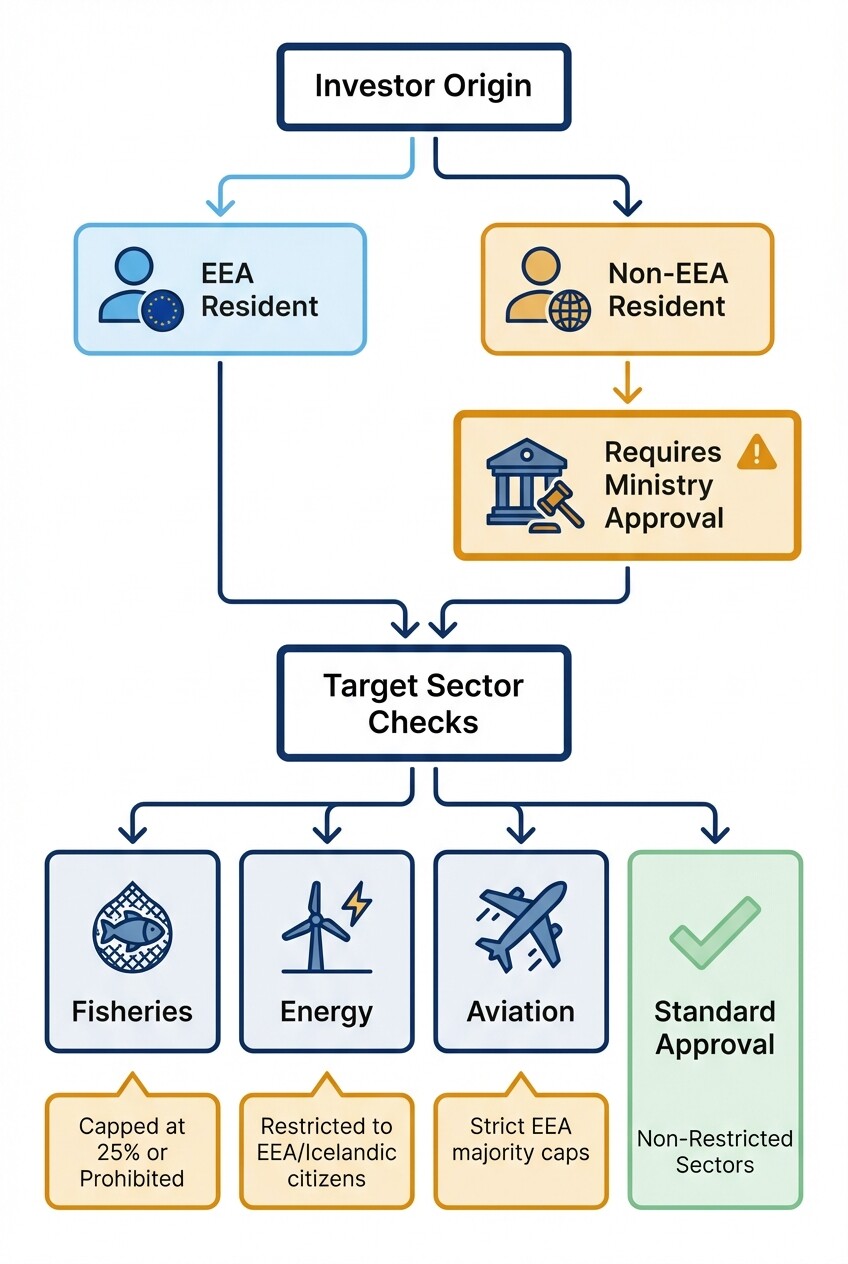
Foreign investors from outside the European Economic Area (EEA) face specific restrictions when buying an Icelandic business, particularly in heavily protected sectors like fisheries, energy, and aviation. EEA residents generally enjoy the same investment rights as Icelandic citizens under the terms of the EEA Agreement.
The legal framework governing this is primarily outlined in the Act on Investment by Non-residents in Business Enterprises. If you are a non-EEA resident, you must formally apply for permission from the Ministry of Culture and Business Affairs before executing an acquisition. The processing time for this permission typically takes a few weeks, provided all beneficial ownership documentation is clear.
Certain sectors are completely prohibited or strictly limited for all foreign investors, regardless of EEA status:
- Fisheries: Foreign ownership in companies engaged in fishing or fish processing is strictly prohibited to protect national quotas. Indirect foreign ownership is capped at 25% (or up to 33% under specific, rare circumstances).
- Energy: The right to harness hydroelectric and geothermal energy is restricted to Icelandic citizens and EEA residents.
- Aviation: Airlines operating out of Iceland are subject to strict European and domestic ownership caps, generally requiring majority EEA ownership.
For detailed official guidance on application procedures, investors should review the guidelines provided by the Government of Iceland's Ministry of Culture and Business Affairs.
How Long Does the M&A Due Diligence Timeline Take?
The typical M&A due diligence process in Iceland takes between three and six months from the signing of a letter of intent to the final closing. Complex transactions involving heavy regulatory scrutiny, real estate assets, or cross-border financing can push this timeline closer to nine months.
Icelandic corporate due diligence follows international standards but requires careful attention to local labor laws and environmental regulations. The timeline generally breaks down into the following phases:
- Preparation and Letter of Intent (Weeks 1-3): Both parties sign a Non-Disclosure Agreement (NDA), negotiate the preliminary valuation, and sign a binding or non-binding Term Sheet.
- Financial and Legal Due Diligence (Weeks 4-12): Buyers audit financial statements, corporate tax histories, and commercial contracts. Special attention is given to employment contracts, as Iceland enforces strict employee transfer protections.
- Regulatory Review and Filings (Weeks 10-18): If the transaction hits certain financial thresholds, filings must be prepared for the Competition Authority. Non-EEA investors also file for Ministry approval during this window.
- Contract Drafting and Closing (Weeks 16-24): Finalizing the Share Purchase Agreement (SPA) or Asset Purchase Agreement (APA), establishing escrow accounts, and executing the transfer of shares at the local Company Registry (Skatturinn).
Estimated Legal Fees and Advisory Costs for Acquisitions
Total legal and advisory costs for cross-border acquisitions in Iceland generally range from 2% to 5% of the transaction value. These costs cover corporate due diligence, contract drafting, tax structuring, and mandatory regulatory filings.
Corporate lawyers and financial advisors in Reykjavik typically bill by the hour, with M&A partners charging between 40,000 ISK and 65,000 ISK per hour. Standardizing a budget early in the process prevents unexpected financial strain as due diligence expands.
| Advisory Service | Estimated Cost (Small Deals < 500M ISK) | Estimated Cost (Large Deals > 1B ISK) |
|---|---|---|
| Legal Due Diligence & SPA Drafting | 3,000,000 ISK - 6,000,000 ISK | 8,000,000 ISK - 20,000,000+ ISK |
| Financial & Tax Due Diligence | 2,000,000 ISK - 4,000,000 ISK | 5,000,000 ISK - 15,000,000+ ISK |
| Competition Authority Filing | 1,500,000 ISK - 2,500,000 ISK | 3,000,000 ISK - 6,000,000 ISK |
| Notary & Registration Fees | 100,000 ISK - 300,000 ISK | 300,000 ISK - 800,000 ISK |
Navigating Icelandic Competition Authority Approvals
Mergers and acquisitions must be reported to the Icelandic Competition Authority (Samkeppniseftirlitið) if the combined turnover of the merging enterprises exceeds 3 billion ISK, and at least two of the enterprises have a minimum turnover of 300 million ISK each. Mandatory filings must occur before the transaction is formally implemented.
Failing to notify the Authority or implementing a merger before approval (gun-jumping) can result in severe administrative fines and the forced unwinding of the transaction. The timeline for approval depends on the complexity of the market overlap:
- Phase I Investigation: Once a complete notification is submitted, the Authority has up to 25 working days to approve the merger or open a deeper investigation.
- Phase II Investigation: If competitive concerns are identified, a Phase II investigation is launched, granting the Authority an additional 90 working days.
- Fast-Track Notification: Transactions with minimal market impact may qualify for a simplified notification process, heavily reducing legal costs and waiting periods.
Investors can review the exact notification thresholds and filing procedures directly through the Icelandic Competition Authority.
Structuring an Acquisition Contract to Minimize Tax Liabilities
Structuring your acquisition under Icelandic corporate law requires choosing between a share deal and an asset deal, each carrying distinct tax implications. Share deals generally offer more favorable capital gains treatments, while asset deals allow buyers to step up the tax basis of the acquired assets for future depreciation.
Foreign buyers often set up an Icelandic holding company, either a Private Limited Company (ehf.) or a Public Limited Company (hf.), to act as the purchasing vehicle. This structure allows investors to utilize Iceland's participation exemption system, which can exempt dividend income and capital gains from corporate income tax (currently set at 21%).
Key structural provisions to include in your acquisition contract:
- Purchase Price Adjustments: Use clear net working capital (NWC) targets pegged to the exact closing date to prevent the seller from extracting value before handover.
- Warranties and Indemnities: Tailor warranties to cover historic tax liabilities and employee benefits. Icelandic courts strictly interpret commercial contracts, so vague indemnity clauses will not protect the buyer.
- Tax Withholding Clauses: Ensure the contract clearly designates which party is responsible for withholding taxes on the transfer, particularly if the seller is leaving the Icelandic tax jurisdiction.
Common Misconceptions About Buying an Icelandic Business
Foreign investors often make costly assumptions about Iceland's regulatory landscape and business culture. Understanding local legal nuances is essential to avoid delayed closings and post-acquisition disputes.
- Misconception: Employment contracts can be easily terminated post-merger. Under Icelandic law, acquiring a business via an asset deal triggers employee transfer protections. Employees automatically transfer to the new owner with their existing rights, wages, and seniority intact. Dismissing staff solely because of the acquisition is generally unlawful.
- Misconception: English contracts are insufficient for local enforcement. While the official language is Icelandic, business transactions and corporate contracts are routinely drafted and executed in English. Icelandic courts fully recognize and enforce English-language commercial agreements.
Frequently Asked Questions
Can a foreign investor own 100% of an Icelandic limited liability company?
Yes, foreign investors can own 100% of an Icelandic limited liability company (ehf. or hf.), provided the business does not operate in a restricted sector such as fisheries or energy. Non-EEA residents will need formal approval from the Ministry of Culture and Business Affairs.
Do I need an Icelandic bank account to buy a business in Iceland?
While you can fund an acquisition from a foreign account, you will eventually need a domestic bank account to operate the business, pay local employees, and remit taxes to the Icelandic Revenue and Customs. Opening a corporate bank account in Iceland requires passing strict anti-money laundering (AML) checks.
Are there local director requirements for Icelandic companies?
Yes, the majority of the board of directors and the managing director (CEO) of an Icelandic company must be residents of Iceland or another EEA member state. If you cannot meet this requirement, you must apply for an exemption from the Ministry.
Are there stamp duties on corporate acquisitions in Iceland?
Iceland does not levy stamp duties on the transfer of corporate shares. However, if the transaction involves the direct transfer of real estate via an asset deal, a stamp duty of 0.8% applies to the official property valuation.
When to Hire a Lawyer and Next Steps
You should engage local legal counsel before signing a Letter of Intent or Term Sheet to ensure confidentiality and structural alignment. Early legal intervention allows you to structure the acquisition in a tax-efficient manner and prevents you from agreeing to unworkable legal precedents.
If you are ready to move forward with a corporate acquisition in Iceland, your next steps should be:
- Draft a Non-Disclosure Agreement: Protect all financial disclosures before viewing internal company data.
- Define Your Investment Vehicle: Decide whether you will purchase directly or establish an Icelandic holding company.
- Engage Local Counsel: Partner with experienced M&A lawyers in Iceland to manage the due diligence process, draft the Share Purchase Agreement, and handle all regulatory filings with the Competition Authority.