


Drafting Commercial Contracts in Iceland: Compliance Guide
Key Takeaways
The process of drafting commercial agreements in Iceland requires navigating local statutory law while aligning with European Economic Area (EEA) standards. Foreign entities must prioritize clear jurisdictional terms and precise currency mechanisms to protect their commercial interests.
- EEA Alignment: Icelandic contract law operates under the framework of the European Economic Area, meaning most EU commercial directives apply locally.
- Currency Volatility: Payment terms must account for fluctuations in the Icelandic Króna (ISK) and local inflation rates to preserve deal value.
- Written Supremacy: Although verbal agreements are technically valid in Iceland, B2B contracts must explicitly require written amendments to prevent evidentiary disputes.
- Choice of Forum: Contracts must definitively state whether disputes will be resolved in Icelandic courts or through international arbitration.
Commercial Contract Compliance Checklist
Drafting a valid and enforceable cross-border contract in Iceland requires verifying corporate authority, defining payment structures, and establishing dispute resolution mechanisms. This checklist ensures your B2B agreement meets Icelandic legal and commercial standards.
- Corporate Authority Verification: Obtain an updated extract from the relevant national business registry (e.g., the Icelandic Enterprise Registry) to confirm the signatory's legal capacity.
- Choice of Law Designation: Explicitly state which country's substantive law governs the agreement to avoid reliance on default private international law rules.
- Jurisdiction and Venue: Specify whether disputes will be settled in the District Court of Reykjavík or through a specific arbitration body (e.g., Nordic Arbitration Centre).
- Currency and Exchange Rate Pegging: Define the payment currency (ISK, EUR, USD) and specify the reference bank for exchange rates on the date of invoice or payment.
- Entire Agreement Clause: Include a provision stating the written contract supersedes all prior negotiations, term sheets, or verbal discussions.
- No Oral Modification (NOM) Clause: Require all future amendments to be executed in writing and signed by authorized representatives of both parties.
The Role of the Icelandic Contract Act and EEA Regulations
The Icelandic Contract Act (Act No. 39/1936) serves as the foundational law governing the formation, validity, and agency of contracts in Iceland. Because Iceland is a member of the European Economic Area (EEA), this local legislation directly intersects with and implements broad European commercial regulations.
Iceland operates on the principle of freedom of contract, allowing B2B parties immense flexibility to negotiate terms. However, local courts interpret contracts through the lens of reasonableness and good faith. Under the Icelandic Contract Act, courts possess the authority to modify or set aside contract provisions if they are deemed highly unreasonable or exploitative. Furthermore, EEA membership ensures that EU directives regarding late B2B payments, commercial agency rules, and cross-border trade standards are fully integrated into Icelandic law. Foreign businesses must draft agreements that harmonize their standard corporate templates with these localized European protections.
Mitigating Mistakes in Jurisdiction and Choice of Law Clauses
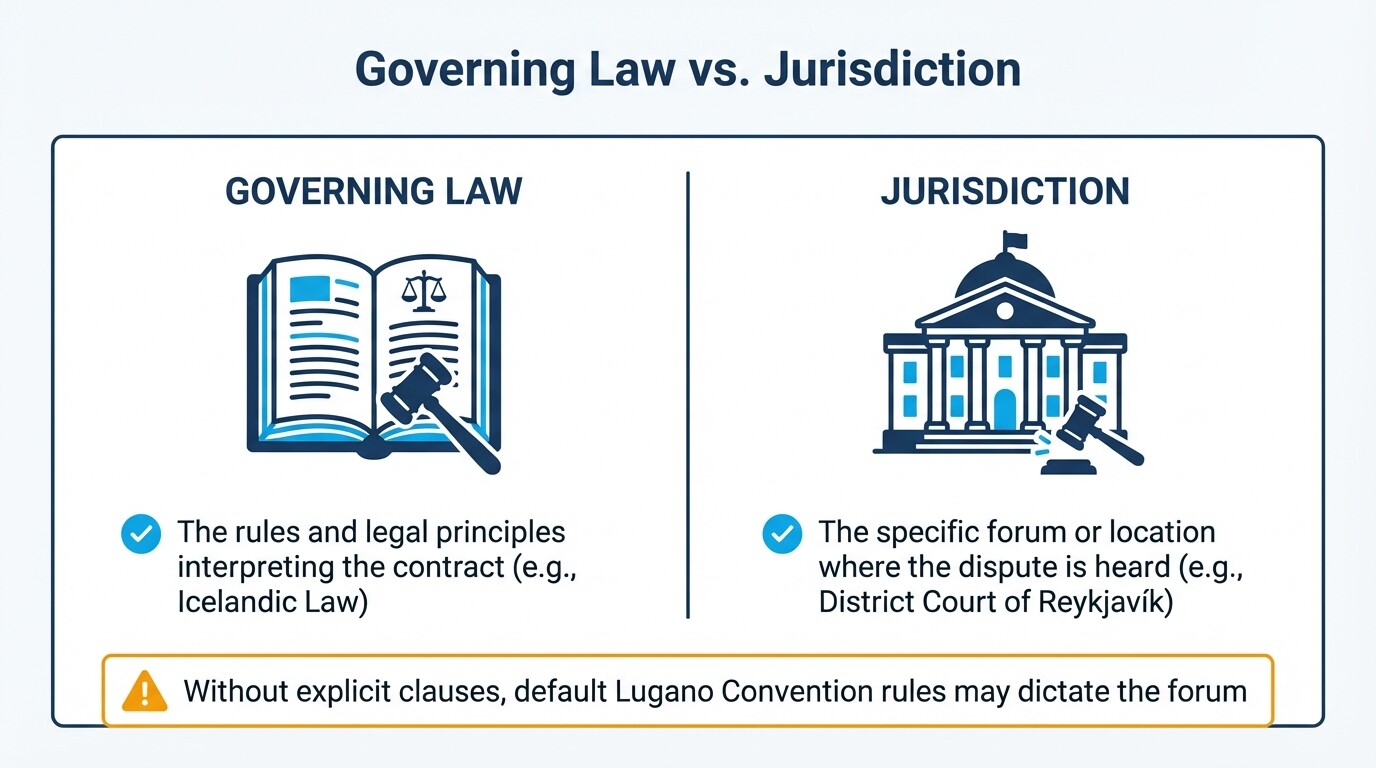
Foreign businesses frequently fail to explicitly define jurisdiction and choice of law in their B2B agreements, leading to complex and expensive procedural disputes. A poorly drafted clause can force a company to litigate in an unfavorable forum or under unfamiliar legal standards.
When dealing with cross-border contracts involving Iceland, you must separate the governing law (the rules interpreting the contract) from the jurisdiction (where the dispute is heard). Iceland is a party to the Lugano Convention, which governs jurisdiction and the enforcement of judgments across the EU and EFTA states. If your contract remains silent, default Lugano rules may dictate that you must sue the Icelandic company in Iceland.
Sample Choice of Law and Jurisdiction Clause
To ensure absolute clarity, foreign entities should integrate a definitive dispute resolution provision. Use the following sample language as a baseline for your agreements:
"This Agreement, and any dispute or claim arising out of or in connection with it, shall be governed by and construed in accordance with the laws of Iceland, excluding its conflict of law principles. The Parties irrevocably agree that the District Court of Reykjavík (Héraðsdómur Reykjavíkur) shall have exclusive jurisdiction to settle any dispute or claim arising out of this Agreement."
Essential Documentation for Cross-Border Corporate Partnerships

Validating a cross-border partnership requires formal proof that both entities exist legally and that their representatives possess the authority to bind the company. Failing to secure these documents can render a commercial agreement void or unenforceable.
Before signing any high-value commercial contract in Iceland, foreign entities must conduct proper due diligence on their local counterparts. The required documentation establishes corporate reality and financial standing.
- Company Registry Extract: You must obtain an official certificate from the Icelandic Register of Enterprises (Fyrirtækjaskrá). This proves the company is active and lists the registered board members.
- Articles of Association: Reviewing this document ensures the company's stated purpose aligns with the nature of your contract and verifies who holds signing authority (prókúra).
- Certificate of Good Standing: For the foreign entity, an equivalent document from their home jurisdiction, often apostilled, must be provided to the Icelandic partner to prove corporate legitimacy.
- Power of Attorney (PoA): If the individual signing the contract is not a registered board member with automatic signing rights, a formal written PoA must be attached as an appendix to the main contract.
Structuring Payment Terms to Prevent Currency and Inflation Disputes
Contracts must clearly define currency mechanisms and inflation protections to shield cross-border deals from the historical volatility of the Icelandic Króna (ISK). Ambiguous payment terms frequently lead to significant financial losses when exchange rates fluctuate between the invoice date and the payment date.
Icelandic law permits B2B contracts to be denominated in foreign currencies, such as Euros (EUR) or US Dollars (USD). When contracting in ISK, businesses often utilize indexation (verðtrygging), linking the contract value to the Icelandic Consumer Price Index (CPI) to protect against local inflation. To prevent disputes, contracts should establish exact payment parameters.
- Select a Primary Currency: Clearly state the currency of payment. If invoicing in EUR but accepting ISK, specify the exact conversion mechanism.
- Define the Exchange Rate Source: State that conversions will be calculated using the official mid-rate published by the Central Bank of Iceland (Seðlabanki Íslands) on the exact date of payment.
- Implement Late Payment Penalties: Utilize standard EEA late payment interest rates or negotiate a specific default interest rate to disincentivize delayed cross-border transfers.
Emphasizing Written Amendments Over Verbal Agreements
While verbal contracts are legally binding in Iceland, relying on them in cross-border B2B settings invites severe evidentiary challenges and costly litigation. Commercial agreements must explicitly demand that all modifications be executed in writing to maintain operational predictability.
Under Icelandic law, a contract can be formed orally, and verbal amendments to written contracts are theoretically valid. However, proving the existence and exact terms of a verbal modification in an Icelandic court is incredibly difficult and relies heavily on witness testimony and circumstantial email evidence. To eliminate this risk, foreign businesses must mandate written formalities.
- Include an Entire Agreement Clause: This legally nullifies any prior verbal promises, email negotiations, or preliminary term sheets not explicitly included in the final signed document.
- Enforce a No Oral Modification (NOM) Clause: State clearly that no amendment, waiver, or variation of the contract is valid unless it is in writing and signed by authorized representatives of both parties.
- Establish Notice Protocols: Define exactly how formal communications and contract changes must be delivered (e.g., registered mail, specific corporate email addresses) to be considered legally effective.
Common Misconceptions About Icelandic Contracts
Misunderstandings regarding Icelandic contract law frequently cause foreign businesses to adopt overly complex or non-compliant negotiation strategies. Clearing up these myths ensures a smoother drafting process.
- Misconception: Contracts must be drafted in Icelandic to be valid. English is widely accepted as a standard language for B2B commercial contracts in Iceland. An agreement drafted entirely in English is fully valid, binding, and enforceable in Icelandic courts.
- Misconception: A physical presence in Iceland is required to sign a contract. Foreign entities do not need a registered branch or subsidiary in Iceland to enter into a valid commercial agreement with an Icelandic company. Cross-border contracts are standard and routinely enforced.
- Misconception: Courts will always enforce the literal text of the contract. While freedom of contract is strong, Icelandic courts apply a mandatory doctrine of good faith. A court may intervene if a clause is deemed highly oppressive or if the literal interpretation creates a commercially absurd result.
Frequently Asked Questions
Can electronic signatures be used for commercial contracts in Iceland?
Yes, Iceland complies with the EU eIDAS regulation. Qualified electronic signatures (such as those using local Icelandic electronic IDs or international equivalents like DocuSign) are legally binding and hold the same weight as physical wet-ink signatures for commercial contracts.
Are non-compete clauses enforceable in Icelandic B2B agreements?
Yes, non-compete clauses are enforceable between businesses, provided they are reasonable in scope, geographical area, and duration. Overly broad restrictions that unjustly limit trade may be scaled back or voided by Icelandic courts under the Contract Act.
How long is the statute of limitations for a breach of contract in Iceland?
The general statute of limitations for bringing a claim for breach of contract in Iceland is four years from the date the breach occurred or the date the payment was due, according to the Icelandic Act on the Limitation Period for Claims.
Do I need to notarize a commercial contract in Iceland?
Standard commercial contracts do not require notarization to be legally binding in Iceland. However, notarization or apostille certification may be necessary for supporting documents, such as foreign Powers of Attorney or real estate transfer deeds.
When to Hire a Lawyer
Engaging legal counsel is crucial when establishing long-term corporate partnerships, navigating complex regulatory frameworks, or structuring high-value financial transactions in Iceland. A lawyer should review your agreements before execution to ensure jurisdiction clauses, currency mechanisms, and EEA compliance provisions are securely drafted to protect your assets. If you are entering the Icelandic market or need to localize your standard commercial templates, you can easily connect with experienced contract lawyers in Iceland through the Lawzana directory to secure precise, localized legal guidance.
Next Steps
- Audit Standard Templates: Review your current corporate agreements to ensure they contain explicit choice of law and jurisdiction clauses suitable for the EEA framework.
- Establish Currency Protocols: Update your standard payment terms to account for ISK exchange rate mechanisms and specific late payment interest rules.
- Gather Corporate Documents: Proactively acquire your own company's Certificates of Good Standing and necessary Powers of Attorney to prevent delays during the contract execution phase.