


Cross-border vendor agreements in Singapore require precise clauses to mitigate supply chain risks and ensure regulatory compliance. Using a structured legal checklist helps international companies align with local laws, navigate dispute resolution efficiently, and adapt to evolving tax rules.
Key Takeaways
Understanding the core requirements of a Singapore vendor agreement protects your business from costly international disputes. Keep these fundamental principles in mind before drafting or signing your contract:
- Determine jurisdiction: Explicitly state that Singapore law governs the contract to avoid complex, cross-border jurisdictional battles.
- Plan for disputes: Incorporate the SIAC model clause to ensure disagreements are handled through private, efficient arbitration.
- Protect personal data: Include specific data transfer provisions to comply with Singapore's Personal Data Protection Act (PDPA).
- Mitigate supply risks: Draft force majeure clauses that specifically address regional port closures and Southeast Asian supply chain disruptions.
- Anticipate tax changes: Update your payment and liability terms to account for Singapore's tightening Goods and Services Tax (GST) rules on imported services.
Legal Checklist for Cross-Border Vendor Agreements in Singapore
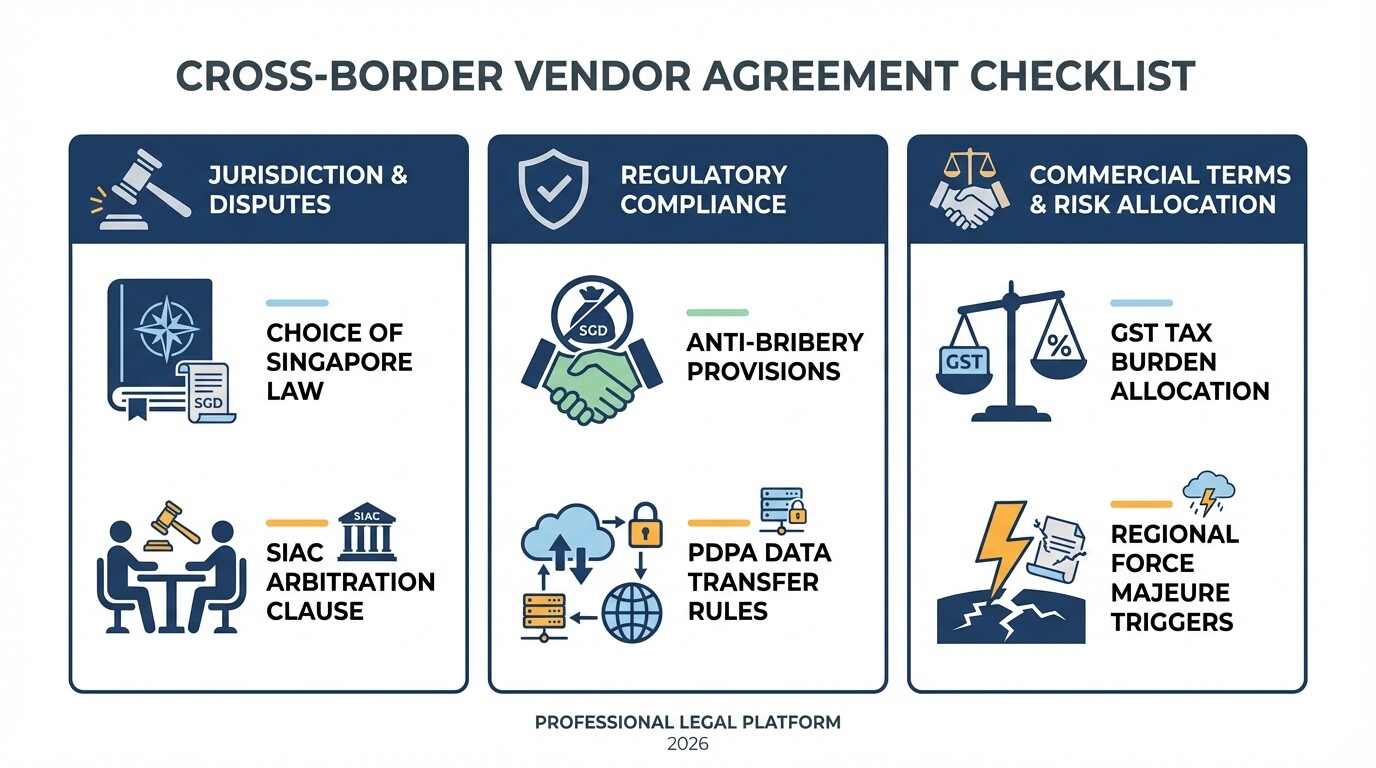
A comprehensive checklist ensures your international business leaves no regulatory gaps when engaging a vendor based in Singapore. Use this actionable framework to verify your contract covers all necessary jurisdictional, tax, and operational requirements.
Jurisdiction & Dispute Resolution
- Ensure a clear Choice of Law clause selects Singapore law.
- Specify the exclusive or non-exclusive jurisdiction of Singapore courts, or opt for arbitration.
- Insert the standard SIAC Model Clause if arbitration is the preferred dispute resolution method.
Regulatory Compliance
- Include standard compliance clauses for Singapore's anti-bribery laws (Prevention of Corruption Act).
- Verify that cross-border data transfer mechanisms comply with the PDPA.
- Include specific obligations for the vendor to notify you immediately of any data breaches.
Commercial Terms & Risk Allocation
- Update tax clauses to clarify who bears the burden of Singapore's GST, accounting for updates to imported digital services.
- Detail payment terms in the exact currency (e.g., SGD or USD) and define the exchange rate mechanism if applicable.
- Explicitly define force majeure triggers, specifically naming regional supply chain and logistics disruptions.
Specifying the Choice of Law Clause
A clear choice of law clause explicitly dictates that Singapore law governs the interpretation and enforcement of the contract. Without this, disputes can easily spiral into complex jurisdictional battles over which country's legal system applies to the vendor relationship.
Singapore commercial law is rooted in English common law, making it highly predictable and business-friendly for international parties. When drafting this clause, you must clearly distinguish between the governing law of the contract and the jurisdiction where disputes will be heard.
Sample Choice of Law Clause:
"This Agreement and any dispute or claim arising out of or in connection with it or its subject matter or formation shall be governed by and construed in accordance with the laws of the Republic of Singapore."
Incorporating the SIAC Model Arbitration Clause
The Singapore International Arbitration Centre (SIAC) provides a globally recognized framework for resolving cross-border commercial disputes privately and efficiently. Including the SIAC model clause ensures any disagreements are handled by a neutral, expert tribunal rather than public foreign courts.
Arbitration is generally preferred in cross-border B2B agreements because arbitral awards are enforceable in over 170 countries under the New York Convention. To ensure the clause is valid, businesses should rely on the exact phrasing provided by official arbitration bodies.
Standard SIAC Model Clause:
"Any dispute arising out of or in connection with this contract, including any question regarding its existence, validity or termination, shall be referred to and finally resolved by arbitration administered by the Singapore International Arbitration Centre in accordance with the Arbitration Rules of the Singapore International Arbitration Centre for the time being in force, which rules are deemed to be incorporated by reference in this clause."
You should also specify the seat of arbitration (e.g., Singapore), the number of arbitrators (typically one or three), and the language of the arbitration (e.g., English) immediately following the model clause. You can verify current rules directly through the SIAC official guidelines.
PDPA Data Transfer Clause Compliance
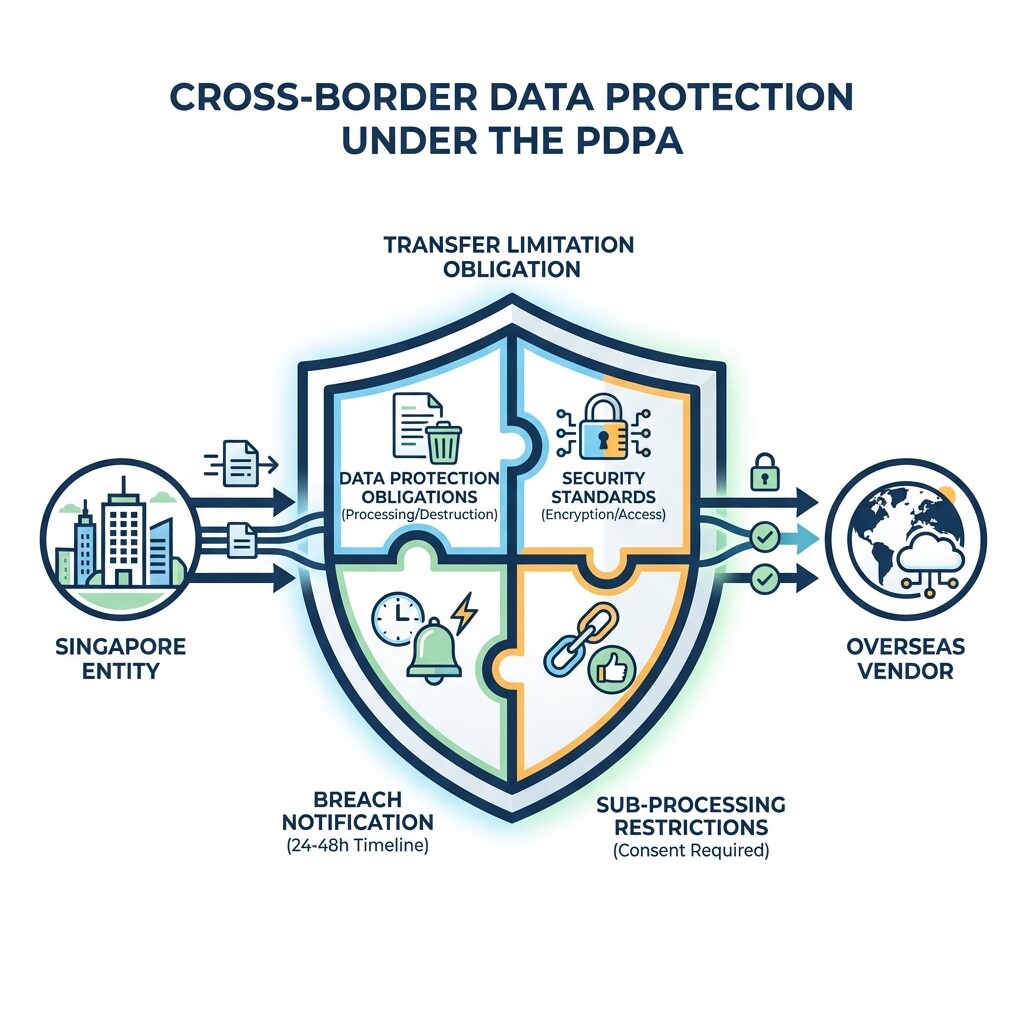
The Personal Data Protection Act (PDPA) legally requires companies to protect personal data when transferring it outside of Singapore. Failing to include specific data transfer clauses exposes your business to severe financial penalties and regulatory audits.
If your vendor agreement involves sharing customer, employee, or user data across borders, the contract must legally bind the receiving party to a standard of protection comparable to the PDPA. This is known as the Transfer Limitation Obligation.
To remain compliant under the Personal Data Protection Act 2012, your vendor agreement must include:
- Data Protection Obligations: Clear directives on how the vendor processes, stores, and eventually destroys the data.
- Security Standards: Technical requirements for encryption and access control.
- Breach Notification: A strict timeline (usually 24 to 48 hours) for the vendor to report any suspected data leaks.
- Sub-processing Restrictions: Limitations preventing the vendor from sharing data with third-party sub-contractors without your prior written consent.
Drafting Force Majeure for Regional Supply Chains
A properly drafted force majeure clause relieves parties from liability when unavoidable external events disrupt performance. For companies operating in or through Singapore, this clause must specifically address regional supply chain disruptions, port closures, and geopolitical shifts.
Standard boilerplates that only mention "acts of God" or "war" are insufficient for modern logistics hubs. Because Singapore relies heavily on maritime and air freight from neighboring countries, your clause must be tailored to regional realities.
Ensure your force majeure clause explicitly covers:
- Unplanned closures of major transshipment ports or straits.
- Regional maritime blockades or sudden customs embargoes.
- Widespread manufacturing shutdowns in neighboring countries that directly impact the Singapore vendor's deliverables.
- Strict mitigation requirements, compelling the vendor to seek alternative supply routes before declaring a force majeure event.
Adapting to the 2026 GST Updates
Singapore regularly updates its Goods and Services Tax (GST) rules, with stringent frameworks governing imported digital services and low-value goods. Your vendor agreements must explicitly assign tax liabilities to prevent unexpected cost overruns when engaging foreign or local digital vendors.
Under Singapore's Overseas Vendor Registration (OVR) and reverse charge mechanisms, the burden of GST can shift depending on whether the services are B2B or B2C, and where the vendor is registered. Contracts extending into or beyond 2026 must be future-proofed against tightening tax compliance frameworks.
When drafting payment terms:
- State all prices clearly as either "inclusive of GST" or "exclusive of GST."
- Include a "Change in Law" provision that allows for the automatic adjustment of contract prices if Singapore's Inland Revenue Authority alters the prevailing GST rate or scope of taxable imported services.
- Require the vendor to provide valid tax invoices that comply with Singapore accounting standards to ensure you can claim input tax credits where applicable.
Common Misconceptions About Singapore Vendor Contracts
International businesses often make critical assumptions about Singapore contract law based on their home jurisdiction's rules. Clearing up these misconceptions prevents fundamental drafting errors that could invalidate key provisions.
- Misconception: Standard U.S. or UK templates work perfectly without changes. While Singapore law is based on English common law, local statutes like the Contracts (Rights of Third Parties) Act and specific PDPA requirements mean foreign templates often fail to provide adequate protection.
- Misconception: B2B contracts are exempt from data protection laws. The PDPA applies strictly to B2B relationships. Even if you are only sharing corporate contact details of your employees with a vendor, data transfer and protection obligations still apply.
- Misconception: Penalties are purely punitive and always enforceable. Under Singapore law, penalty clauses designed solely to punish a party for a breach are generally unenforceable. Liquidated damages clauses must represent a genuine pre-estimate of actual commercial loss.
Frequently Asked Questions
Review these common questions to better understand the legal and operational nuances of structuring cross-border vendor agreements in Singapore.
Can we choose a foreign law to govern a Singapore vendor contract?
Yes, parties are generally free to choose the governing law of their contract, such as New York or English law. However, doing so can increase legal costs and complexity if you need to enforce the contract against a vendor's assets located in Singapore.
Is the SIAC arbitration clause mandatory?
No, using SIAC is entirely optional. However, it is highly recommended for cross-border contracts because it offers a neutral forum and its arbitral awards are vastly easier to enforce internationally compared to standard court judgments.
What happens if we do not include a force majeure clause?
If you omit a force majeure clause, the strict common law doctrine of "frustration" applies. This doctrine is notoriously difficult to prove and only discharges the contract if an event makes performance completely impossible, leaving you highly vulnerable to supply chain delays.
When to Hire a Lawyer
Engaging a legal professional is critical when structuring high-value, long-term, or operationally complex cross-border agreements. An experienced contract lawyer ensures your agreements comply with Singapore's evolving regulatory landscape while aggressively protecting your commercial interests.
You should consult contract lawyers in Singapore if your vendor agreement involves transferring sensitive personal data, dealing with proprietary intellectual property, or if the contract value represents a significant portion of your operational budget. A local lawyer can also advise on the precise phrasing needed for enforceable liquidated damages and liability caps under Singapore law.
Next Steps for Securing Your Vendor Contracts
Taking proactive steps to formalize your vendor agreements minimizes financial risk and establishes a strong foundation for your international operations. Follow a systematic approach to execute and manage your contracts effectively.
- Audit existing templates: Review your current international vendor templates to ensure they contain Singapore-specific choice of law and SIAC arbitration clauses.
- Verify PDPA compliance: Map the flow of data between your company and the vendor to ensure all cross-border transfer requirements are documented in the agreement.
- Review pricing and tax terms: Update financial clauses to explicitly address GST responsibilities and currency fluctuation mechanisms.
- Engage legal counsel: Have a qualified Singapore legal professional review the finalized draft to identify any enforceability risks before signing.