Drafting Enforceable Cross-Border Vendor Agreements in Nigeria
- Choosing international arbitration over domestic litigation is critical for protecting foreign business interests from procedural delays in Nigerian courts.
- Explicit governing law and jurisdiction clauses prevent local courts from automatically applying Nigerian domestic law to foreign vendor agreements.
- Payment clauses must account for Central Bank of Nigeria (CBN) foreign exchange controls to ensure seamless repatriation of funds.
- Electronic signatures and email correspondences are fully admissible in Nigerian commercial courts for proving breach of contract.
- Mandating pre-dispute mediation in your agreement saves time, preserves business relationships, and reduces adversarial friction.
Key Clauses for Enforcing Foreign-Drafted Contracts
To enforce a foreign-drafted commercial contract in Nigeria, the agreement must explicitly define the governing law, dispute resolution mechanism, and specific performance obligations. Without these localized clauses, Nigerian courts may assume jurisdiction or apply domestic laws that inadvertently disadvantage foreign vendors.
Drafting these provisions clearly prevents local partners from exploiting ambiguities to delay payments or avoid liability. Below are essential sample clauses adapted for cross-border enforcement in Nigeria.
Sample Governing Law Clause "This Agreement, and any non-contractual obligations arising out of or in connection with it, shall be governed by, and construed in accordance with, the laws of [Insert Jurisdiction, e.g., England and Wales], without regard to its conflict of laws principles."
Sample Dispute Resolution (Arbitration) Clause "Any dispute, controversy, or claim arising out of or relating to this Agreement, including its breach, termination, or invalidity, shall be finally settled by arbitration in accordance with the Arbitration Rules of the United Nations Commission on International Trade Law (UNCITRAL). The seat of arbitration shall be [Insert Neutral Location, e.g., London, UK]. The language of the arbitration shall be English."
Sample Foreign Exchange and Payment Clause "All payments due to the Vendor under this Agreement shall be made in [Insert Currency, e.g., United States Dollars]. The Purchaser bears the sole responsibility and risk of sourcing foreign exchange and securing any regulatory approvals necessary to remit funds outside of Nigeria. Payment obligations are not discharged until the full amount in the agreed currency clears the Vendor's designated bank account."
Navigating Foreign Exchange Controls and Payment Repatriation
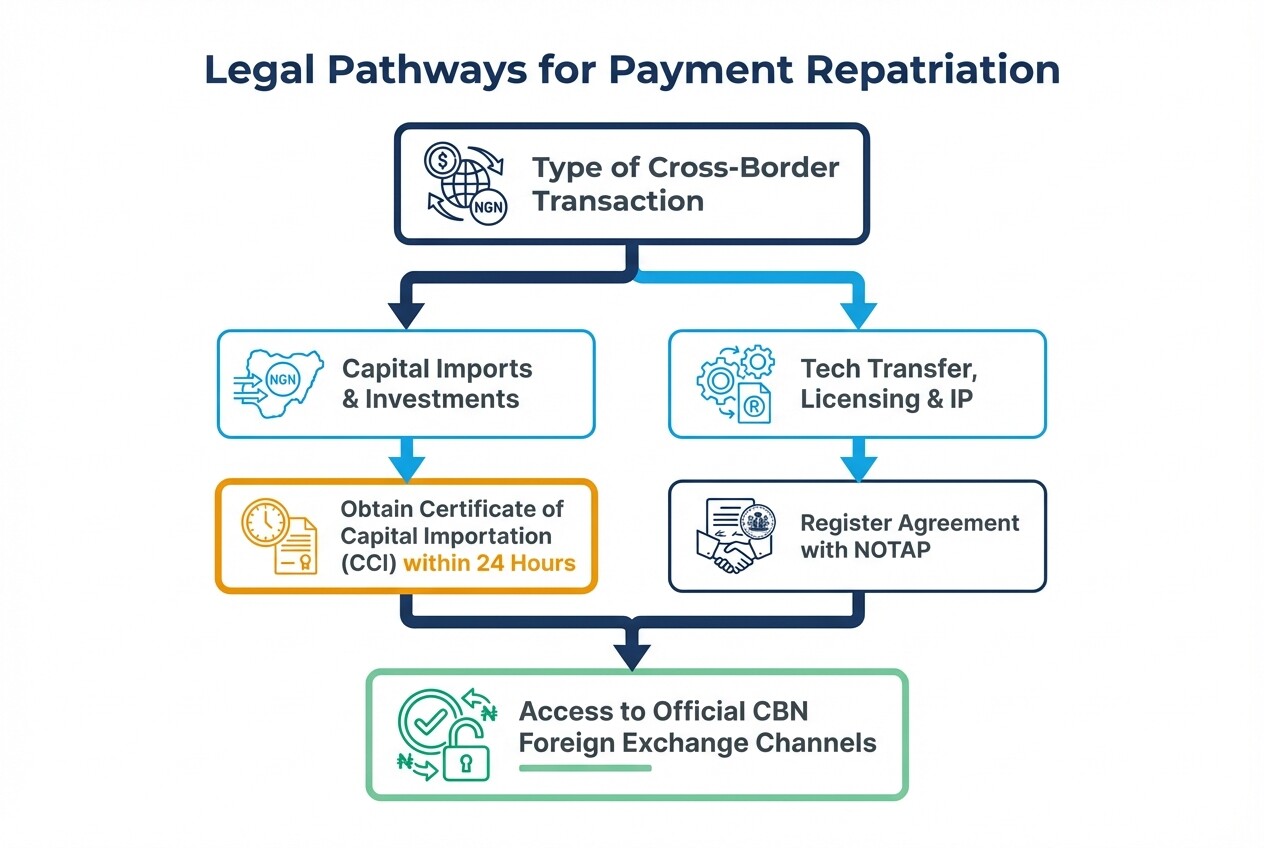
Moving funds out of Nigeria requires strict compliance with the Central Bank of Nigeria (CBN) regulations regarding foreign exchange allocation. Repatriation clauses must account for foreign exchange liquidity issues and outline acceptable payment currencies to protect foreign vendors.
Many foreign B2B investors encounter severe bottlenecks when local vendors cannot source US Dollars or Euros at official rates. To mitigate this, cross-border contracts must clearly state that the local partner absorbs the currency fluctuation risk. For large-scale foreign investments and capital imports, foreign companies must ensure their local partners obtain a Certificate of Capital Importation (CCI) within 24 hours of capital inflow. A valid CCI is the legally recognized document that guarantees an investor's right to repatriate dividends and capital through official CBN channels at prevailing market rates.
If your agreement involves the transfer of technology, licensing, or intellectual property to a Nigerian entity, the agreement must be registered with the National Office for Technology Acquisition and Promotion (NOTAP). Unregistered technology transfer agreements cannot legally legally trigger foreign exchange remittances through official banking channels.
Domestic Litigation vs. International Arbitration
International arbitration is heavily preferred over domestic litigation for cross-border disputes in Nigeria due to its speed, neutrality, and global enforceability under the New York Convention. Nigerian commercial courts, while improving, still suffer from severe procedural backlogs and frequent adjournments that can stall debt recovery for years.
Foreign investors must weigh the upfront costs of arbitration against the operational paralysis of local litigation. Below is a comparison to help structure your dispute resolution strategy.
| Feature | Domestic Litigation (Nigerian Courts) | International Arbitration |
|---|---|---|
| Time to Resolve | 3 to 7+ years (including appeals) | 1 to 2 years |
| Enforceability | Subject to complex reciprocal enforcement laws | Highly enforceable via the New York Convention |
| Confidentiality | Public record | Strictly private and confidential |
| Costs | Lower upfront filing fees, high long-term costs | High upfront tribunal fees, lower long-term costs |
| Expertise | Judges handle generalized dockets | Parties select arbitrators with specific industry expertise |
Proving Breach of Contract in Nigerian Courts
Proving a breach of contract in a Nigerian commercial court requires a well-maintained paper trail demonstrating the existence of the agreement, clear terms, failure to perform, and resulting damages. While Nigerian law recognizes oral contracts, they are notoriously difficult to enforce in cross-border B2B disputes where the burden of proof rests entirely on the claimant.
To successfully litigate or arbitrate a breach in Nigeria, foreign vendors must compile specific evidentiary documents. Ensure your legal team has immediate access to the following checklist.
Evidence Gathering Checklist:
- Fully executed vendor agreement with verifiable signatures (electronic signatures are valid under the Nigerian Evidence Act).
- Approved purchase orders or work orders tied to the master agreement.
- Detailed invoices showing payment terms, due dates, and the specific currency required.
- Delivery notes, bills of lading, or completion certificates signed by the Nigerian partner acknowledging receipt of goods or services.
- Chronological record of written communications (emails, formal default notices, and WhatsApp messages) demonstrating the breach and your attempts to demand performance.
Alternatives to Litigation: Effective Pre-Dispute Mediation Strategies
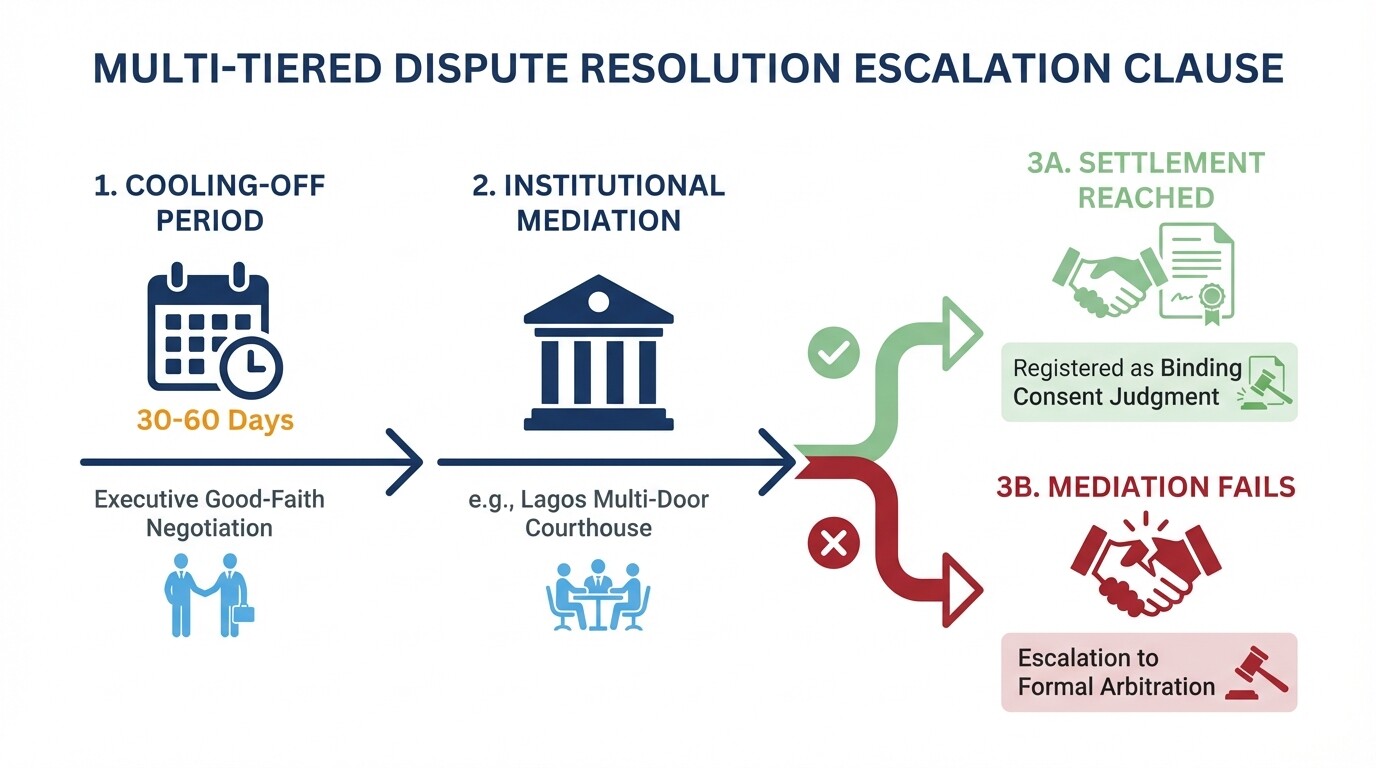
Embedding a multi-tiered dispute resolution clause that mandates mediation before arbitration can save foreign vendors significant time and legal fees. Mediation preserves ongoing B2B relationships and avoids the adversarial friction and public exposure of formal litigation in Nigeria.
The most effective cross-border agreements include a "cooling-off" period. This requires executives from both companies to attempt good-faith negotiations for 30 to 60 days before any formal legal claims are filed. If executive negotiation fails, the parties proceed to institutional mediation. Facilities like the Lagos Multi-Door Courthouse (LMDC) offer structured, court-connected alternative dispute resolution (ADR) that provides neutral ground for local and foreign entities. If a settlement is reached, the terms are registered as a consent judgment, making it legally binding and immediately enforceable in Nigeria without a trial.
Common Misconceptions About Nigerian Contracts
Foreign businesses often enter the Nigerian market with assumptions based on their home jurisdictions, leading to costly enforcement errors. Understanding the local legal reality prevents structural flaws in your vendor agreements.
- Foreign judgments are automatically enforceable: Many vendors mistakenly believe a default judgment from a US or UK court can be instantly executed in Nigeria. In reality, foreign judgments must go through a formal registration and recognition process in a Nigerian High Court, which the local defendant can heavily contest.
- Paying in USD guarantees getting paid in USD: Specifying USD in a contract does not magically create foreign exchange liquidity. If the local partner cannot source dollars from the CBN, payment will stall unless the contract forces the partner to utilize parallel market rates or alternative offshore accounts.
- Notarization equals validity: Foreign vendors often assume a contract must be notarized or sealed to be legally binding. Under Nigerian law, standard commercial contracts simply require clear offer, acceptance, consideration, and intention to create legal relations; formal notarization is only required for specific documents like power of attorney or real estate transfers.
Frequently Asked Questions
Can a Nigerian commercial contract be governed by US or UK law?
Yes. Nigerian courts generally respect the freedom of contract. If two corporate entities explicitly agree that the laws of New York or England govern their agreement, Nigerian courts will uphold that choice of law, provided it does not violate Nigerian public policy.
What is the statute of limitations for contract breach in Nigeria?
The statute of limitations for a breach of a simple contract in Nigeria is generally six years from the date the breach occurred. For contracts executed under seal (deeds), the limitation period extends to twelve years.
Are electronic signatures legally valid in Nigeria?
Yes. Under the Nigerian Evidence Act, electronic signatures and digitally executed contracts are legally valid and fully admissible as evidence in commercial disputes.
Can a foreign company sue a Nigerian company without having a local office?
Yes. A foreign entity not registered to do business in Nigeria can still initiate legal proceedings or arbitration against a Nigerian company to enforce a contract or recover a debt.
When to Hire a Lawyer & Next Steps
You should hire a Nigerian legal practitioner before finalizing any cross-border vendor agreement to ensure compliance with local regulatory, tax, and foreign exchange frameworks. Attempting to enforce a poorly localized contract after a payment default or breach occurs is significantly more expensive and statistically less likely to succeed.
If you are currently drafting a vendor agreement or facing a B2B dispute, your next step is to have a local attorney review your governing law, dispute resolution, and payment repatriation clauses. Connecting with experienced contract lawyers in Nigeria ensures your agreements are structurally sound and legally enforceable within the jurisdiction, protecting your bottom line from predictable local risks.