


Key Takeaways
Organizations operating internationally must comply with strict post-Brexit regulations when moving UK residents' personal data across borders. Failing to implement legally binding safeguards exposes businesses to severe regulatory fines and operational disruptions.
- Restricted Transfers: Moving personal data from the UK to a country without an adequacy decision requires specific authorized transfer mechanisms.
- Mechanism Options: Companies must utilize the UK International Data Transfer Agreement (IDTA), the UK Addendum to the EU Standard Contractual Clauses (SCCs), or Binding Corporate Rules (BCRs).
- Mandatory Risk Assessments: A Transfer Risk Assessment (TRA) must be completed and documented before executing any international data transfer agreement.
- Contract Repapering: Legacy data processing agreements must be updated to incorporate post-Brexit UK GDPR requirements.
- Financial Penalties: Non-compliance can trigger fines from the Information Commissioner's Office (ICO) up to £17.5 million or 4% of global annual turnover, whichever is higher.
Regulatory Updates: Transferring UK Data to Non-Adequate Jurisdictions
Following Brexit, the United Kingdom operates under its own UK GDPR, meaning international data transfers to countries without an official "adequacy decision" require targeted legal safeguards. The Information Commissioner's Office (ICO) actively enforces these rules under the Data Protection Act 2018, mandating that global firms use authorized transfer mechanisms.
An adequacy decision is a formal recognition by the UK government that a foreign country's legal framework offers data protection equivalent to UK standards. Countries within the European Economic Area (EEA), alongside nations like Japan and New Zealand, currently hold adequacy status, allowing data to flow freely. However, transferring data to non-adequate jurisdictions-such as India or the United States (outside of the UK-US Data Bridge framework)-requires organizations to implement specific contractual and technical safeguards.
To comply, global firms must embed regulatory requirements directly into their vendor and intra-group contracts. This primarily involves executing specialized data transfer agreements and conducting thorough risk assessments to guarantee that foreign governments cannot unlawfully access UK citizens' data.
UK IDTA vs. EU SCC Addendum: Which Should You Use?
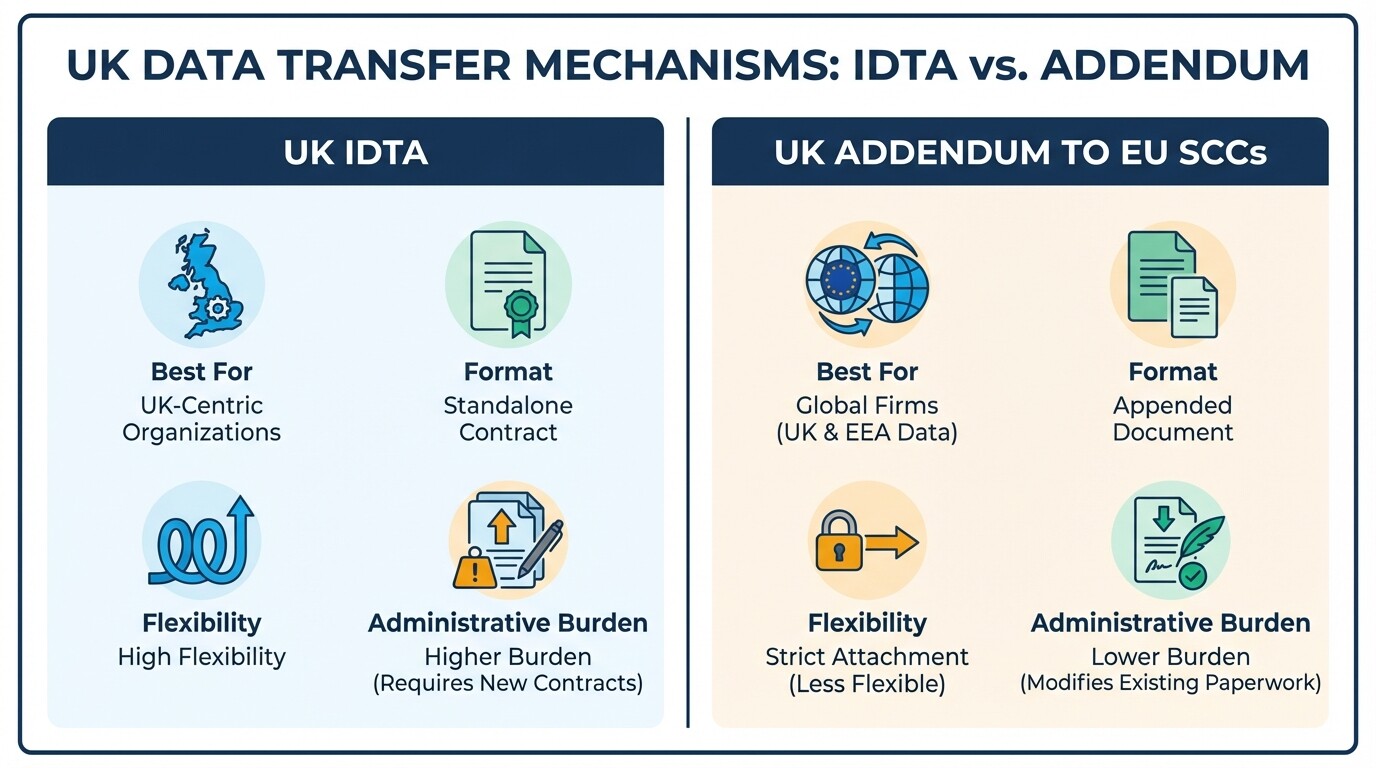
Global firms must choose between the standalone UK International Data Transfer Agreement (IDTA) or the UK Addendum to the EU Standard Contractual Clauses (SCCs) to legalize restricted transfers. The Addendum is typically the most efficient route for companies processing both UK and EU data, while the IDTA is designed specifically for UK-only data flows.
Multinational corporations often struggle to decide which framework best aligns with their existing compliance infrastructure. The choice heavily depends on your organizational footprint and your vendors' locations.
| Feature | UK IDTA | UK Addendum to EU SCCs |
|---|---|---|
| Best For | UK-centric organizations with no European Economic Area (EEA) operations. | Global firms processing both UK and EEA personal data simultaneously. |
| Format | A standalone commercial contract drafted specifically by the ICO. | A short document appended to existing, executed EU SCCs. |
| Flexibility | Highly flexible. Can be linked to any master service agreement or data processing agreement. | Less flexible. Must be strictly attached to the unamended EU SCC framework. |
| Administrative Burden | Requires negotiating and signing a completely new contract with vendors. | Lower burden. Simply modifies existing EU compliance paperwork to include the UK. |
Step-by-Step Checklist: Conducting Transfer Risk Assessments (TRAs)
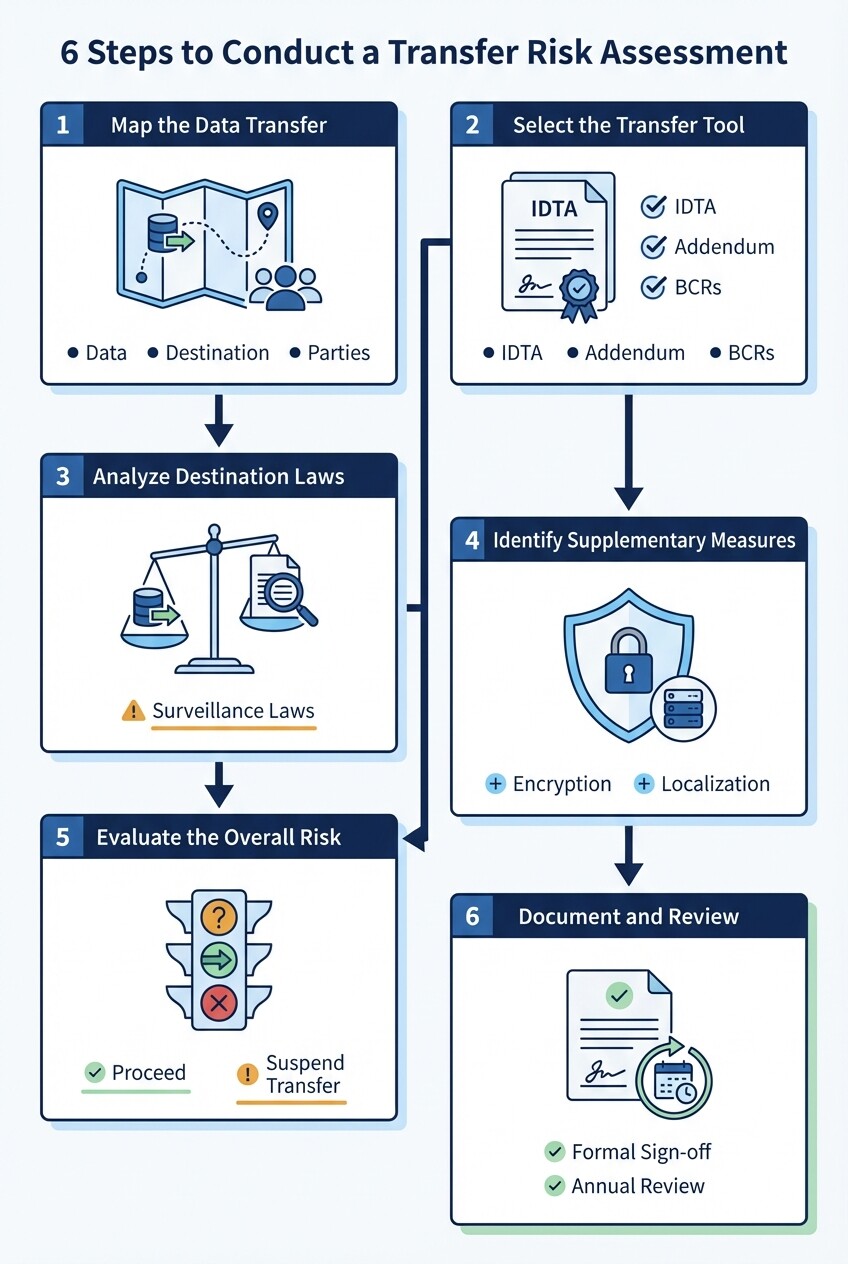
A Transfer Risk Assessment (TRA) evaluates whether the destination country's legal framework provides data protection equivalent to the UK GDPR. You must complete and document a TRA before executing an IDTA or SCC Addendum to transfer personal data to a non-adequate jurisdiction.
- Map the Data Transfer: Document exactly what personal data is being transferred, the categories of data subjects, the destination country, and the specific third parties accessing the data.
- Select the Transfer Tool: Confirm whether you are utilizing the UK IDTA, the UK Addendum, or Binding Corporate Rules to govern the transaction legally.
- Analyze Destination Laws: Assess the legal framework of the importing country. Specifically, investigate whether local surveillance laws allow government agencies disproportionate access to the transferred data.
- Identify Supplementary Measures: If the destination country's laws fall short of UK standards, implement technical safeguards like end-to-end encryption, strict pseudonymization, or localized data routing.
- Evaluate the Overall Risk: Determine if the transfer tool and supplementary measures sufficiently protect the data subjects' rights. If the risk remains high, the transfer must be suspended.
- Document and Review: Record all findings in a formal TRA document signed by your compliance officer. Review this assessment annually or whenever destination country laws change.
Sample Data Processing Agreement (DPA) Transfer Clause
A compliant Data Processing Agreement (DPA) must explicitly address how international transfers are handled under UK GDPR Article 46. The following sample clause illustrates how to legally integrate the UK Addendum into your B2B vendor agreements to ensure lawful cross-border data flows.
Cross-Border Data Transfers (UK Addendum Incorporation)
In the event that the processing of Personal Data involves a Restricted Transfer from the United Kingdom to a jurisdiction that has not received an adequacy decision from the UK Government, the Parties agree that such transfer shall be governed by the UK Addendum to the EU Standard Contractual Clauses (the "UK Addendum"), issued by the Information Commissioner's Office.
The UK Addendum is hereby incorporated into this DPA by reference and deemed executed by the Parties. For the purposes of the UK Addendum, the Parties agree to the following: 1. The EU SCCs, as appended to this DPA, shall apply with the modifications set out in Part 2 of the UK Addendum. 2. The "Exporter" shall be the Data Controller, and the "Importer" shall be the Data Processor. 3. The governing law shall be the laws of England and Wales, and the competent courts shall be the courts of London, England. 4. In the event of any conflict between the terms of this DPA and the UK Addendum, the provisions of the UK Addendum shall prevail regarding the Restricted Transfer.
Binding Corporate Rules (BCRs) for Multinational Groups
Binding Corporate Rules (BCRs) are internal data protection policies designed for large multinational corporate groups transferring data continuously across borders. They offer a comprehensive, group-wide alternative to signing individual IDTAs or SCC Addendums for every single intra-group data transfer.
Securing UK BCRs requires a formal application and approval process directly through the ICO, which can take several months to over a year to complete. The application must demonstrate that the corporate group enforces legally binding privacy policies on all its global subsidiaries, employees, and subcontractors.
Once approved, BCRs provide immense operational freedom. Human resources, IT, and centralized compliance teams can share UK data globally across the corporate network without needing to repaper contracts for every new internal project. This mechanism is best suited for enterprise-level organizations where the high upfront cost of ICO approval is offset by long-term administrative savings.
Common Misconceptions About UK Data Transfers
Many global businesses face heavy compliance fines due to fundamental misunderstandings about post-Brexit data laws. Avoiding these common traps ensures your compliance framework holds up under regulatory scrutiny and avoids operational disruptions.
- Misconception: EU SCCs cover UK data automatically. Following Brexit, standard EU SCCs are no longer legally valid for transferring UK data on their own. Businesses must attach the ICO's specific UK Addendum to their EU SCCs, or use the standalone UK IDTA.
- Misconception: Transfer Risk Assessments are optional. Executing the correct contract is only half the legal requirement. Relying on an IDTA without conducting and documenting a TRA renders the transfer mechanism invalid and exposes the firm to immediate regulatory action.
- Misconception: US transfers are strictly banned. While the US as a whole does not have a blanket adequacy decision, data can flow legally via the UK-US Data Bridge if the US recipient is certified under the framework. If they are not certified, you can still transfer data using an IDTA and a robust TRA.
Frequently Asked Questions
What qualifies as a restricted transfer under UK GDPR?
A restricted transfer occurs when personal data subject to the UK GDPR is sent or made accessible to a legally distinct receiver located outside the UK. This includes scenarios where a foreign vendor remotely accesses a server located inside the United Kingdom.
Can we continue using legacy EU Standard Contractual Clauses?
No. The ICO set a strict deadline of March 21, 2024, for businesses to update all legacy EU SCCs governing UK data. Any organization still relying on pre-2021 EU SCCs for UK transfers is currently operating unlawfully and must repaper immediately.
Who is liable if a foreign vendor breaches the UK IDTA?
Under UK GDPR, the data controller (the exporting company) retains ultimate accountability for the data. If a foreign vendor (the data processor) breaches the agreement and misuses the data, the UK exporter can face severe ICO fines and civil claims from affected data subjects.
How much does it cost to implement these data transfer agreements?
While the IDTA and UK Addendum templates are free to download from the ICO, legal costs for mapping data flows, conducting TRAs, and negotiating DPAs typically range from £2,000 to £10,000+ depending on the complexity and volume of the multinational's vendor network.
When to Hire a Data Privacy Lawyer
Navigating UK GDPR cross-border transfer requirements requires technical legal precision to avoid multimillion-pound regulatory enforcement. You should hire a specialized data privacy lawyer when restructuring global data flows, facing complex negotiations with international enterprise vendors, or applying for Binding Corporate Rules.
Attempting to manage international data flows internally without specialized counsel often leads to invalid risk assessments and non-compliant vendor contracts. An experienced legal professional will accurately map your data, draft customized transfer clauses, and serve as an authoritative representative if your firm faces an ICO audit. You can find vetted professionals by consulting contract lawyers in the United Kingdom who specialize in post-Brexit privacy compliance.
Next Steps for Global Firms
Securing your international data flows starts with a comprehensive audit of your current vendors, software providers, and existing transfer mechanisms. Take immediate action to map your data and update legacy contracts to prevent regulatory exposure.
- Conduct a Data Mapping Exercise: Identify every piece of UK personal data that crosses borders, including remote server access by foreign IT support teams.
- Audit Existing Contracts: Review all active DPAs to ensure legacy EU SCCs have been replaced with the UK IDTA or the UK Addendum.
- Execute TRAs: For every restricted transfer identified, systematically complete and document a Transfer Risk Assessment.
- Update Privacy Notices: Ensure your external-facing privacy policies accurately disclose your international data transfer mechanisms to consumers in plain language.