


Resolving Cross-Border Commercial Disputes in the United Kingdom
- Post-Brexit, the UK relies primarily on the Hague Convention 2005 to enforce exclusive jurisdiction clauses and recognize foreign judgments.
- English courts strongly encourage Alternative Dispute Resolution (ADR), and unreasonably refusing mediation can result in severe cost penalties.
- The UK offers powerful interim relief tools, including Worldwide Freezing Orders, to prevent asset dissipation while a dispute is ongoing.
- The English legal system operates on a "loser pays" principle, meaning the unsuccessful party typically covers 60 to 80 percent of the winner's legal costs.
- Properly drafted exclusive jurisdiction clauses are vital for commercial contracts to ensure predictable enforcement across international borders.
Enforcing Choice of Law and Jurisdiction Clauses in Post-Brexit Contracts
English courts highly respect and reliably enforce choice of law and jurisdiction clauses written into commercial contracts. Following the UK's departure from the European Union, ensuring these clauses are explicitly drafted as "exclusive" is critical to guarantee seamless enforcement under international conventions.
For contracts drafted for 2026 and beyond, businesses must be precise. The UK has retained the Rome I and Rome II Regulations in domestic law, meaning English courts will continue to apply the governing law chosen by the parties for contractual and non-contractual obligations. However, jurisdiction and the enforcement of judgments now rely heavily on the Hague Convention rather than previous EU frameworks.
Sample Exclusive Jurisdiction Clause
To ensure your commercial agreements are protected under the Hague Convention 2005, use clear, exclusive language. Below is a standard sample clause for a UK-focused international contract:
Governing Law: This Agreement and any dispute or claim arising out of or in connection with it or its subject matter or formation shall be governed by and construed in accordance with the law of England and Wales.
Jurisdiction: Each party irrevocably agrees that the courts of England and Wales shall have exclusive jurisdiction to settle any dispute or claim arising out of or in connection with this Agreement, its subject matter, or formation.
Impact of the Hague Convention on Foreign Judgments
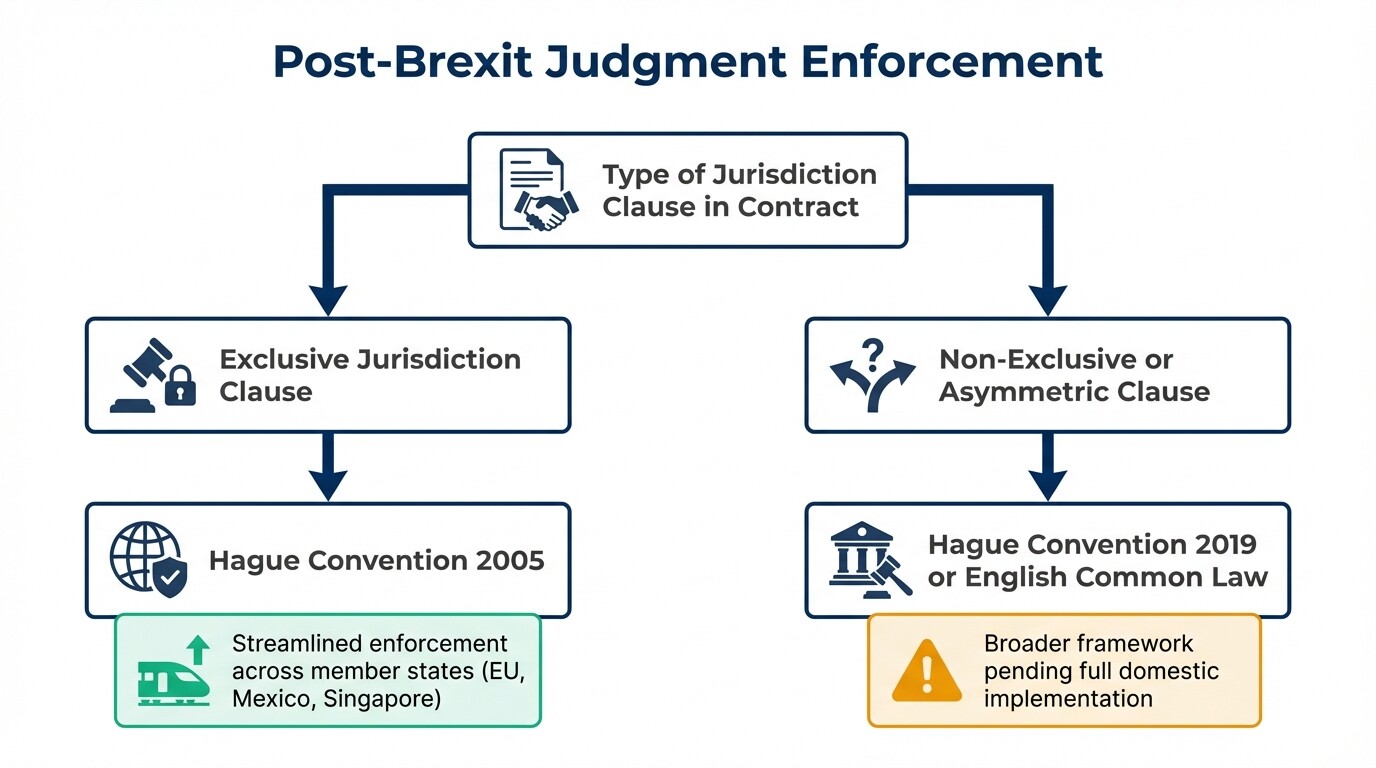
The Hague Convention on Choice of Court Agreements 2005 is currently the primary international framework the UK uses to recognize and enforce foreign judgments. It ensures that judgments issued by courts designated in exclusive jurisdiction agreements are recognized and enforced across all member states, which includes the EU, Mexico, and Singapore.
If a contract features an asymmetric or non-exclusive jurisdiction clause, the 2005 Convention does not apply. To bridge this gap, the UK signed the Hague Judgments Convention 2019, which provides a broader framework for the recognition and enforcement of civil and commercial judgments globally. Once fully implemented into UK domestic law, this newer convention will significantly streamline the enforcement of judgments stemming from non-exclusive jurisdiction clauses across participating nations.
Alternative Dispute Resolution (ADR) Trends in London
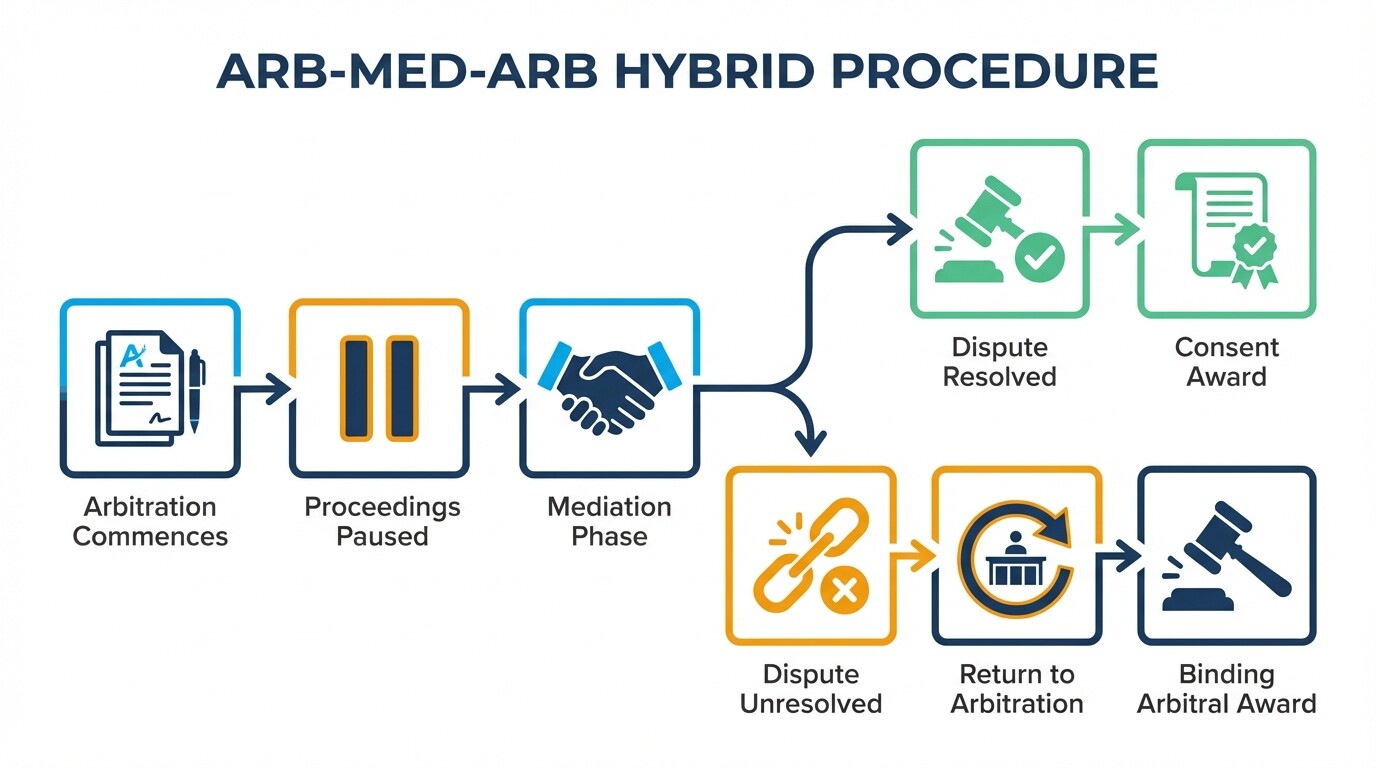
London commercial courts now expect and often require parties to attempt Alternative Dispute Resolution, such as mediation or arbitration, before proceeding to a full trial. Recent developments in English civil procedure have cemented the court's authority to pause proceedings and compel parties to engage in ADR, provided it does not impair their right to a fair trial.
International businesses favor London as an arbitration hub due to the presence of institutions like the London Court of International Arbitration (LCIA) and the robust support provided by the Arbitration Act 1996. The current trends in UK commercial ADR include:
- Cost Penalties for Refusal: Under the Civil Procedure Rules, judges routinely impose heavy financial penalties on victorious parties who unreasonably refused to mediate prior to trial.
- Hybrid Procedures: There is a rise in "Arb-Med-Arb" clauses, where disputes commence as arbitration, pause for mediation, and if unresolved, return to arbitration for a binding award.
- Technology Disputes: Specialized ADR centers are seeing a massive influx of cross-border data privacy, software licensing, and cryptocurrency disputes, favoring expert determination over traditional litigation.
Securing Interim Relief and Injunctions
The English legal system provides exceptionally robust mechanisms for securing interim relief, allowing businesses to freeze assets or halt harmful activities before a final trial judgment is reached. Applications for these injunctions are typically made to the Commercial Court or the Chancery Division of the High Court.
Securing an injunction requires demonstrating a "good arguable case" and proving that damages alone would not be an adequate remedy. The most common forms of interim relief in UK cross-border disputes include:
- Worldwide Freezing Orders: Previously known as Mareva injunctions, these prevent a defendant from dissipating assets globally, ensuring funds remain available to satisfy a future judgment.
- Search Orders: Also called Anton Piller orders, these permit a claimant's representatives to enter the defendant's premises to search for and seize vital evidence that might otherwise be destroyed.
- Anti-Suit Injunctions: English courts can order a party to stop pursuing legal proceedings in a foreign court if those proceedings breach an exclusive English jurisdiction or arbitration clause.
Timeline and Cost Expectations for London Commercial Litigation
Resolving a cross-border commercial dispute in the UK generally takes between 12 to 24 months from issuing the claim to the final trial, with costs scaling based on the complexity of the case. Under the English "loser pays" rule, the unsuccessful party is normally ordered to cover the majority of the winning party's legal expenses.
Understanding the financial and temporal commitment is essential for businesses assessing litigation risk. Below is an estimated breakdown of a standard High Court commercial dispute.
| Litigation Phase | Estimated Timeline | Typical Cost Range (GBP) |
|---|---|---|
| Pre-Action Protocol & Investigation | 1 to 3 months | £15,000 to £50,000 |
| Issuing Claim & Statements of Case | 2 to 4 months | £30,000 to £80,000 |
| Disclosure of Documents | 3 to 6 months | £50,000 to £150,000+ |
| Witness Statements & Expert Reports | 3 to 5 months | £40,000 to £100,000+ |
| Trial Preparation and Trial | 3 to 6 months | £100,000 to £300,000+ |
Common Misconceptions About UK Cross-Border Litigation
Many international business leaders misunderstand how recent political and legal shifts have impacted the English legal system. Clarifying these myths is vital for corporate risk management.
- Misconception: Post-Brexit, EU judgments are impossible to enforce in the UK. While the automatic enforcement under the Brussels Recast Regulation has ended, EU judgments remain highly enforceable in the UK through the Hague Convention (for exclusive clauses) or under English common law rules for suing on a foreign judgment debt.
- Misconception: You must have a physical UK presence to litigate in London. Foreign corporations can freely bring claims or be sued in the English courts. You simply need to instruct UK-qualified legal counsel to represent your entity.
- Misconception: Commercial litigation costs are entirely unrecoverable. Unlike the default system in the United States, the UK operates on a cost-shifting model. A successful litigant can typically recover 60 to 80 percent of their reasonably incurred legal costs from the opposing party.
Frequently Asked Questions
How long do I have to bring a breach of contract claim in the UK?
Under the Limitation Act 1980, you generally have six years from the date the breach of contract occurred to initiate legal proceedings in England and Wales.
Can I serve legal proceedings on a defendant outside the UK?
Yes. Under the Civil Procedure Rules, you can serve legal proceedings outside the jurisdiction. If your contract contains an exclusive English jurisdiction clause, you usually do not need the court's permission to serve a foreign defendant.
What is the Commercial Court in London?
The Commercial Court is a highly specialized subdivision of the King's Bench Division of the High Court. It handles complex national and international business disputes and is staffed by judges with extensive commercial law backgrounds.
Will my foreign legal counsel be able to represent me in a UK court?
Foreign lawyers cannot typically speak or advocate directly in English and Welsh courts unless they cross-qualify. You will need to instruct locally qualified solicitors and barristers to handle the formal litigation process.
When to Hire a Commercial Litigation Lawyer & Next Steps
You should engage a commercial litigation lawyer the moment a cross-border dispute surfaces or as soon as you receive a formal pre-action letter. Early legal intervention is critical for preserving electronic evidence, securing asset-freezing injunctions before funds disappear, and exploring mediation options before legal costs escalate.
If you are facing a potential cross-border dispute, your immediate next steps should be to gather all relevant contracts, isolate any choice of law or jurisdiction clauses, and suspend all internal document destruction policies. You can then search for specialized commercial litigation lawyers in the United Kingdom to evaluate your legal standing and outline a strategic recovery plan. Taking decisive action early puts your business in the strongest possible negotiating position.