Navigating Commercial Arbitration in Nigeria's Emerging Tech Sector
- Nigeria's Arbitration and Mediation Act 2023 introduces progressive rules, including third-party funding and emergency arbitration, making it highly attractive for tech dispute resolution.
- Drafting clear arbitration clauses in SaaS and fintech agreements prevents costly jurisdictional battles and keeps IP disputes confidential.
- The Lagos Court of Arbitration (LCA) offers a cost-effective, regionally savvy alternative to international venues like London or Paris for mid-market tech disputes.
- Foreign arbitral awards are readily enforceable in Nigeria under the New York Convention, provided specific statutory procedures are followed at the Federal High Court.
- Emergency arbitrator applications require precise documentation to prove immediate financial or operational risk to your tech enterprise.
Advantages of the 2023 Arbitration and Mediation Act for Tech Disputes
The Arbitration and Mediation Act 2023 completely modernizes Nigeria's commercial dispute framework to support rapid, tech-driven business environments. It directly benefits international tech firms by legalizing third-party funding, codifying the enforcement of emergency interim measures, and limiting court interference. For SaaS and fintech companies drafting contracts that may face disputes in 2026 and beyond, this legislation guarantees a globally competitive and predictable resolution process.
The specific advantages for technology companies include:
- Third-Party Funding: Tech startups and international investors can now legally secure external funding for arbitration costs. This ensures that well-funded corporations cannot use high legal fees to outlast smaller tech innovators during IP or breach of contract disputes.
- Award Review Tribunal: The Act introduces an optional, expedited appellate mechanism within the arbitration framework. This allows parties to challenge an award on specific grounds before a second arbitral tribunal rather than dragging the dispute into the congested Nigerian court system.
- Enforcement of Interim Measures: The legislation grants arbitral tribunals the power to issue binding preliminary orders, such as injunctions to stop the unauthorized use of proprietary software or the transfer of contested domain names while the arbitration is ongoing.
- Statute of Limitations Clarity: The Act explicitly stops the limitation period clock once arbitral proceedings commence, removing a common procedural loophole previously used to derail commercial claims.
Sample Arbitration Clause for SaaS and Fintech Contracts
A precisely drafted arbitration clause is the primary defense against unexpected litigation risks in international tech transactions. Below is a specialized template designed for technology contracts operating within the Nigerian market, ensuring enforceability and confidentiality.
Standard Tech-Optimized Arbitration Clause Template:
"Any dispute, controversy, or claim arising out of or relating to this Agreement, including its breach, termination, intellectual property ownership, or invalidity thereof, shall be settled by mandatory and binding arbitration. The arbitration shall be administered by the Lagos Court of Arbitration (LCA) in accordance with its Arbitration Rules currently in force.
- The number of arbitrators shall be [Select: one or three].
- The seat, or legal place, of arbitration shall be Lagos, Nigeria.
- The language to be used in the arbitral proceedings shall be English.
- The tribunal shall have the authority to grant interim measures, including immediate injunctive relief regarding data breaches, software licensing violations, and intellectual property infringement.
- All arbitral proceedings, including the existence of the dispute and any awards, shall be strictly confidential."
Note: For high-value international transactions, ensure that the chosen rules align with the specific procedural laws of the seat. Consult ADR Mediation & Arbitration Lawyers in Nigeria to tailor this clause to your specific data processing or fintech regulatory requirements.
Selecting Seats: Lagos Court of Arbitration vs. International Venues
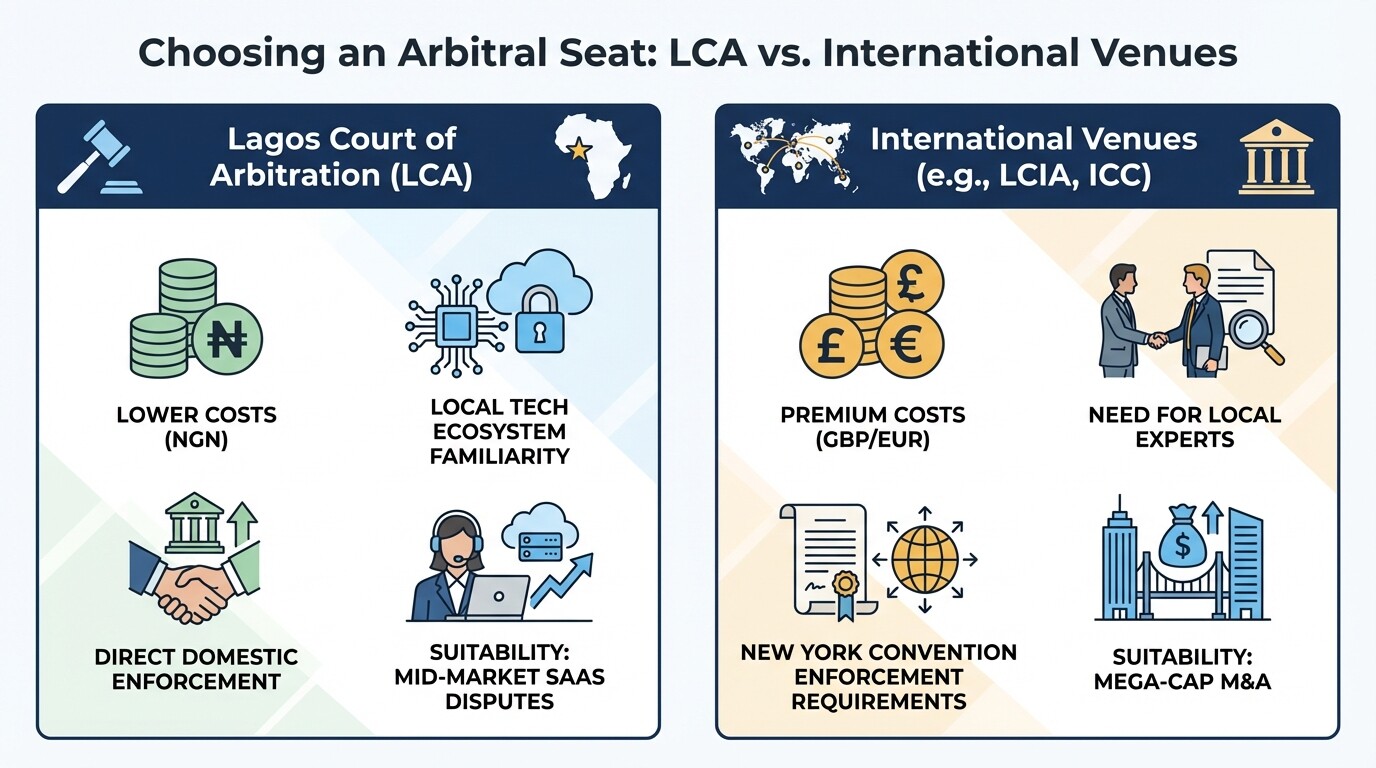
Choosing the right arbitral seat dictates the procedural laws governing your dispute and the level of court support available. For companies operating in Nigeria's tech sector, the choice typically comes down to a domestic institution like the Lagos Court of Arbitration (LCA) or established international venues like the London Court of International Arbitration (LCIA).
| Decision Factor | Lagos Court of Arbitration (LCA) | International Venues (e.g., LCIA, ICC) |
|---|---|---|
| Costs | Highly cost-effective. Administrative fees and arbitrator rates are often lower and payable in Naira or lower USD brackets. | Extremely expensive. Premium administrative fees and hourly rates billed in GBP or Euros. |
| Local Tech Context | High familiarity with Nigerian fintech regulations, local payment gateways, and the domestic startup ecosystem. | Limited direct knowledge of localized Nigerian commercial realities without hiring expensive expert witnesses. |
| Enforceability | Domestic awards are enforced directly as judgments of the Federal High Court. | Foreign awards require recognition under the New York Convention before enforcement in Nigeria. |
| Best Used For | Mid-market SaaS disputes, local vendor agreements, and regional fintech partnerships. | Mega-cap M&A, massive infrastructure tech deployments, and multi-jurisdictional investor-state disputes. |
Enforcing International Arbitration Awards in Nigerian Courts
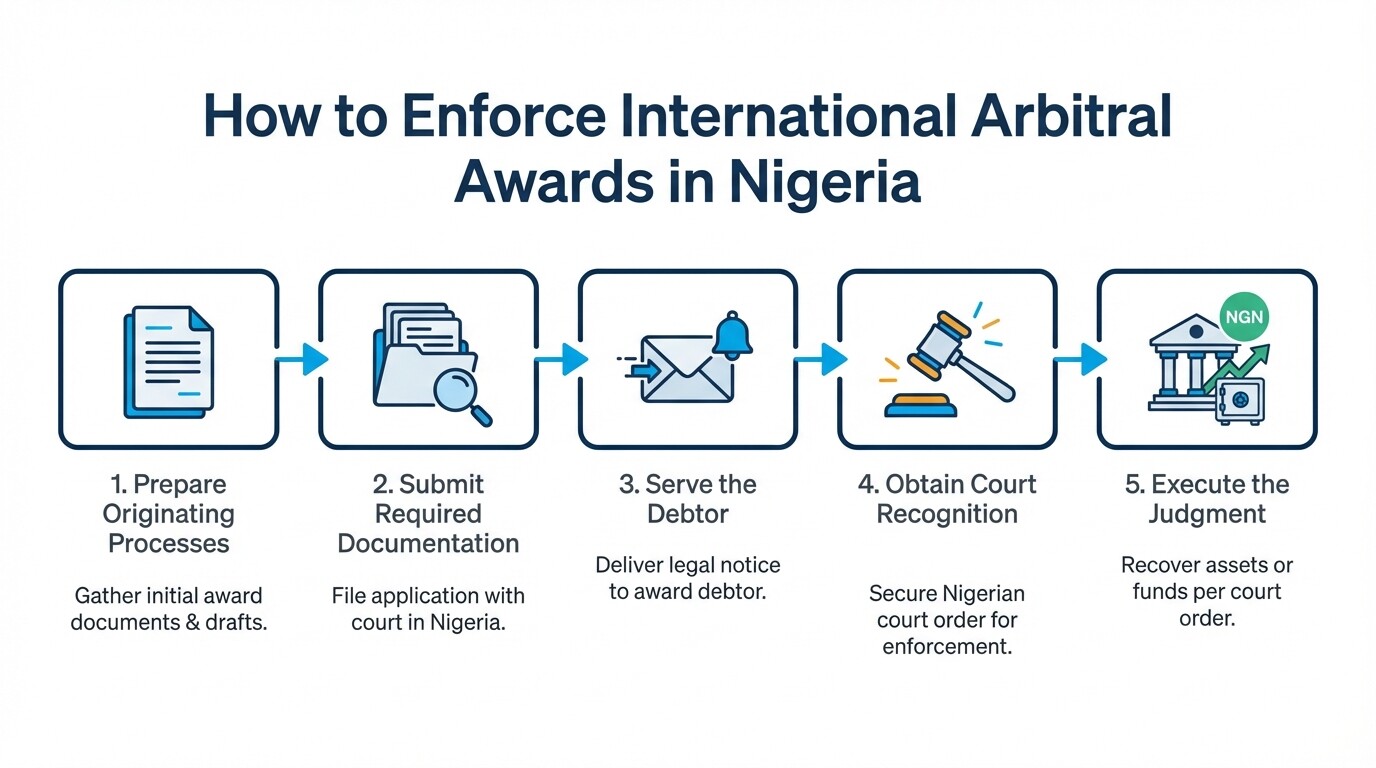
Enforcing an international arbitration award in Nigeria requires initiating formal recognition proceedings at the Federal High Court. Because Nigeria is a signatory to the New York Convention, courts generally respect and enforce foreign arbitral awards without re-examining the underlying merits of the tech dispute.
To enforce an award, tech companies must follow these specific steps:
- Prepare Originating Processes: File an originating motion at the Federal High Court of Nigeria. The application must clearly state the relief sought and the statutory grounds for enforcement.
- Submit Required Documentation: Attach the duly authenticated original award (or a certified copy) and the original arbitration agreement. If the award is not in English, a certified translation must be provided.
- Serve the Debtor: The opposing party must be formally served with the court processes, giving them a limited window to raise any of the narrow statutory defenses against enforcement (such as lack of due process or invalidity of the arbitration agreement).
- Obtain Court Recognition: Once recognized, the court registers the arbitral award as a judgment of the Federal High Court.
- Execute the Judgment: Proceed with standard debt recovery mechanisms, such as garnishee proceedings to freeze the debtor's bank accounts or writ of attachment against corporate assets.
For official guidance on corporate dispute and investment protections, companies can review frameworks detailed by the Nigerian Investment Promotion Commission (NIPC).
Documentation Needed for Emergency Arbitrator Applications
Emergency arbitration provides immediate, temporary relief before a full tribunal is constituted, which is critical when source code is stolen or a major data breach occurs. To secure an emergency order under Nigerian law, your application must provide overwhelming documentary evidence of imminent, irreparable harm.
Emergency Arbitrator Application Checklist:
- Notice of Arbitration: A formal document outlining the core dispute, the parties involved, and the primary relief sought.
- Application for Emergency Relief: A detailed legal brief explaining exactly what interim measures are needed (e.g., an order blocking the launch of a competing software product).
- Proof of Irreparable Harm: Financial models, traffic logs, or operational reports demonstrating that waiting for a standard tribunal will cause damage that monetary compensation cannot fix.
- Evidence of Urgency: Timelines and correspondence proving the threat is immediate and ongoing.
- Copy of the Arbitration Agreement: The signed contract containing the arbitration clause to establish jurisdiction.
- Payment Receipt: Proof of payment for the emergency arbitrator institution fees.
Common Misconceptions About Nigerian Arbitration
Business leaders entering the Nigerian tech market often hold outdated views about the local dispute resolution landscape. These misunderstandings can lead to poorly drafted contracts and missed opportunities for efficient conflict resolution.
- Arbitration is just as slow as local litigation: This is false. While the Nigerian court system can face severe backlogs, commercial arbitration operates entirely outside this system. Tribunals set their own expedited timelines, often resolving complex tech disputes in months rather than years.
- Nigerian courts constantly interfere with arbitral awards: This is a myth. The 2023 Act strictly limits judicial intervention. Courts are legally mandated to stay court proceedings in favor of arbitration and can only set aside awards on extremely narrow, internationally recognized grounds.
- You cannot enforce intellectual property disputes through arbitration: This is incorrect. While the raw registration of patents or trademarks is a state function, disputes over IP licensing, software development breaches, and copyright infringement are fully arbitrable under Nigerian commercial law.
Frequently Asked Questions
Can foreign tech companies use the Lagos Court of Arbitration?
Yes. The LCA is an international dispute resolution center. Foreign companies can freely select the LCA to administer their disputes, even if neither party is registered in Nigeria, provided they agree to it in their contract.
How much does commercial arbitration cost in Nigeria?
Costs vary based on the dispute value and the institution. The LCA provides a transparent fee schedule on its platform. Generally, domestic arbitration is significantly more affordable than utilizing European or North American venues, with fees scaling proportionately to the claim amount.
Can I appeal an arbitral award in Nigeria?
Standard arbitral awards are final and binding. They cannot be appealed on the merits of the case. They can only be challenged or set aside by a court for severe procedural violations, such as fraud, arbitrator bias, or acting outside the scope of the arbitration agreement.
How long does an emergency arbitration take?
Under most modern institutional rules operating in Nigeria, an emergency arbitrator is appointed within two to three days, and a decision on interim relief is typically issued within 14 to 21 days from the application date.
When to Hire an Arbitration Lawyer
You should engage an arbitration specialist the moment a critical commercial relationship begins to deteriorate, well before formal notices are filed. Early legal intervention is vital in the tech sector, where delayed action can result in the irreversible loss of intellectual property or user data. An experienced lawyer will help you evaluate whether to trigger emergency arbitration, negotiate settlements under the shadow of arbitration, and ensure all pre-arbitration contractual steps are strictly followed.
Next Steps
If you are drafting new commercial contracts or facing an imminent dispute, start by auditing your current arbitration clauses to ensure they comply with the 2023 Act. Gather all related project documentation, correspondence, and technical logs to build a preliminary case file. From there, connect with specialized lawyers in Nigeria to formally assess your jurisdictional options and begin mapping out an aggressive dispute resolution strategy.