- Non-Resident Indians (NRIs) can legally inherit both commercial property and agricultural land in India under the Foreign Exchange Management Act (FEMA).
- Mediation and arbitration offer a confidential, cost-effective alternative to Indian civil courts, resolving disputes in months rather than decades.
- Gathering properly authenticated documents, such as a consularized Power of Attorney and a valid succession certificate, is mandatory for participating in ADR from abroad.
- Embedding an arbitration clause into a Family Settlement Deed ensures the agreement remains legally binding and enforceable without returning to traditional litigation.
- Inherited assets can be repatriated out of India up to a limit of $1 million USD per financial year, provided all tax clearances and FEMA guidelines are met.
The Legal Framework for NRI Inheritance in India
Non-Resident Indians (NRIs) and Persons of Indian Origin (PIOs) have the legal right to inherit any immovable property in India, including commercial real estate, residential homes, and ancestral agricultural land. The process of succession is governed by the personal religious laws of the deceased, such as the Hindu Succession Act, 1956, or the Indian Succession Act, 1925, for secular or other religious applications.
While FEMA strictly prohibits NRIs from purchasing agricultural land, plantation property, or farmhouses in India, inheriting these specific types of properties is entirely permitted. However, complications often arise when multiple heirs, both resident and non-resident, hold joint claims to an undivided ancestral estate. If an NRI wishes to liquidate inherited agricultural land, they are legally restricted to selling it only to a resident Indian citizen. Commercial and residential properties offer more flexibility and can be sold to other NRIs or resident Indians. Understanding these distinct property categories is the first step in formulating a realistic settlement strategy before entering any mediation room.
Why Mediation Beats Civil Litigation for Family Property
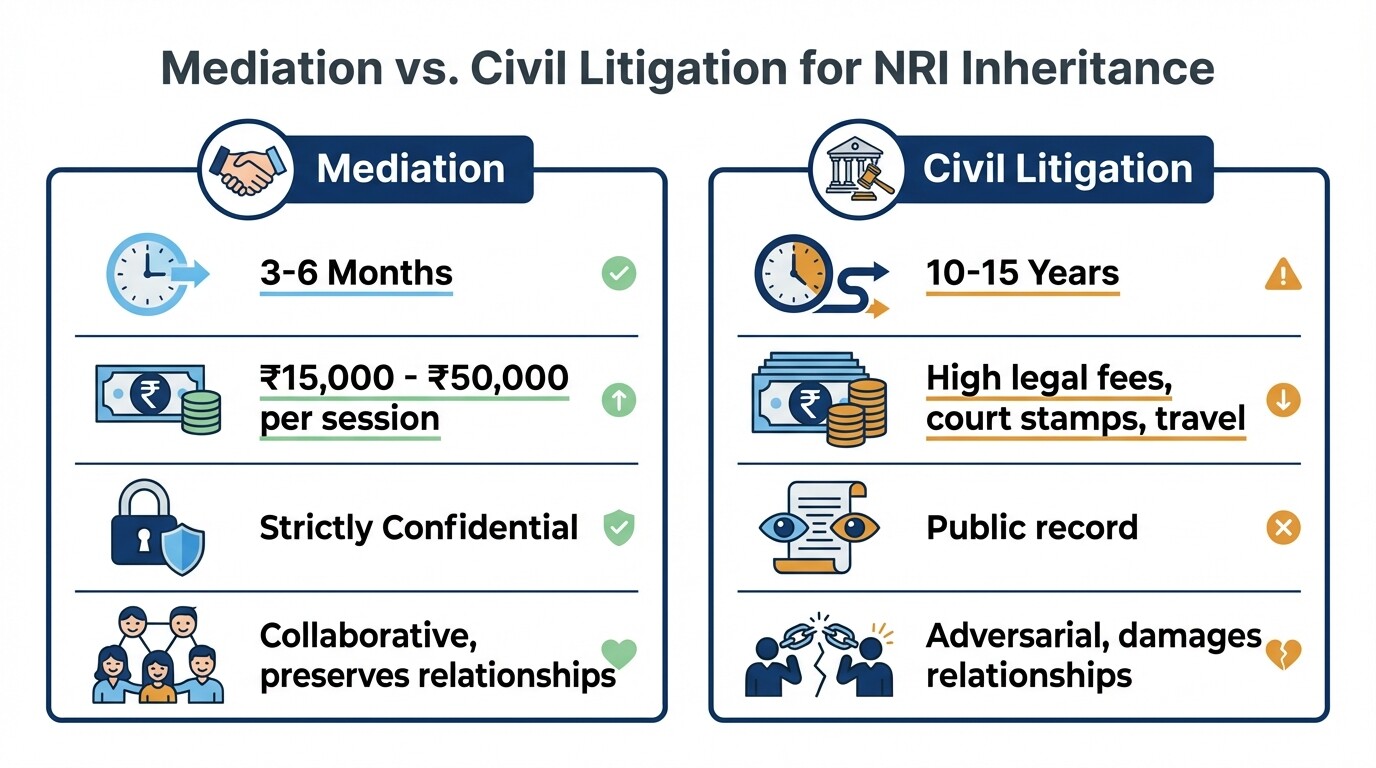
Mediation is a collaborative dispute resolution process that is vastly faster, cheaper, and more private than litigating a property partition suit in India's heavily backlogged civil courts. Instead of spending 10 to 15 years battling family members before a judge, mediation allows parties to negotiate a customized, mutually beneficial agreement in a matter of months.
In a traditional Indian court case, legal fees, court stamps, and travel costs can quickly consume a significant portion of the estate's value. Conversely, certified mediators typically charge between ₹15,000 and ₹50,000 per session, depending on the complexity of the estate. Because mediation is non-adversarial, it preserves fragile family relationships that would otherwise be destroyed by public cross-examinations. Furthermore, mediation proceedings are strictly confidential, protecting your family's private financial matters and asset details from the public record.
Essential Documentation Checklist for NRI Inheritance
Successfully resolving an inheritance dispute requires a clear, authenticated paper trail proving your legal right to the estate. Gathering the right succession certificates, translated wills, and a valid power of attorney ensures your legal representative can effectively mediate and bind agreements on your behalf in India.
Prepare the following documents before initiating alternative dispute resolution:
- Registered Will or Testamentary Document: If a will exists, ensure it is available. If the will was drafted in a foreign language, it must be officially translated and notarized. Wills executed outside India may require probate in an Indian court to be actionable.
- Death Certificate: The original death certificate of the deceased property owner, issued by the local municipal authority in India or the respective foreign authority (properly apostilled).
- Succession Certificate or Legal Heir Certificate: Required in the absence of a will. A Legal Heir Certificate is used for transferring local names on utility bills and taxes, while a Succession Certificate (issued by a civil court) is mandatory for transferring bank accounts and securities.
- Special Power of Attorney (SPOA): If you cannot travel to India, you must execute an SPOA authorizing a trusted resident or lawyer to mediate and sign documents for you. This must be attested by the Indian Embassy or Consulate in your country of residence.
- Property Title Deeds: Original sale deeds, allotment letters, and latest encumbrance certificates (EC) proving the deceased's clear title to the disputed property.
- Updated Khata or Mutation Extracts: Revenue records demonstrating that the property is registered in the deceased's name in local municipal or village council (Panchayat) records.
Structuring Binding Arbitration Agreements for Family Settlements
A successful mediation culminates in a Family Settlement Deed, which can be made internationally enforceable by incorporating a binding arbitration clause. This structural safeguard ensures that if any family member breaches the agreed-upon partition or payout terms, you can enforce the agreement under the Indian Arbitration and Conciliation Act without starting a new, lengthy civil lawsuit.
When drafting the Family Settlement Deed with your legal counsel, you must clearly define the dispute resolution mechanism. Below is sample language that can be adapted for a settlement contract to ensure future disagreements are handled outside the court system.
Sample Arbitration Clause for a Family Settlement Deed:
"Any dispute, claim, or controversy arising out of or relating to this Family Settlement Deed, including the breach, termination, enforcement, interpretation, or validity thereof, shall be determined by final and binding arbitration. The arbitration shall be conducted by a sole arbitrator mutually appointed by the Parties in accordance with the provisions of the Arbitration and Conciliation Act, 1996 (as amended). The seat and venue of the arbitration shall be [e.g., New Delhi, India]. The language of the arbitration shall be English. The award rendered by the arbitrator shall be final, binding, and enforceable in any court of competent jurisdiction."
Repatriating Inherited Funds Under FEMA
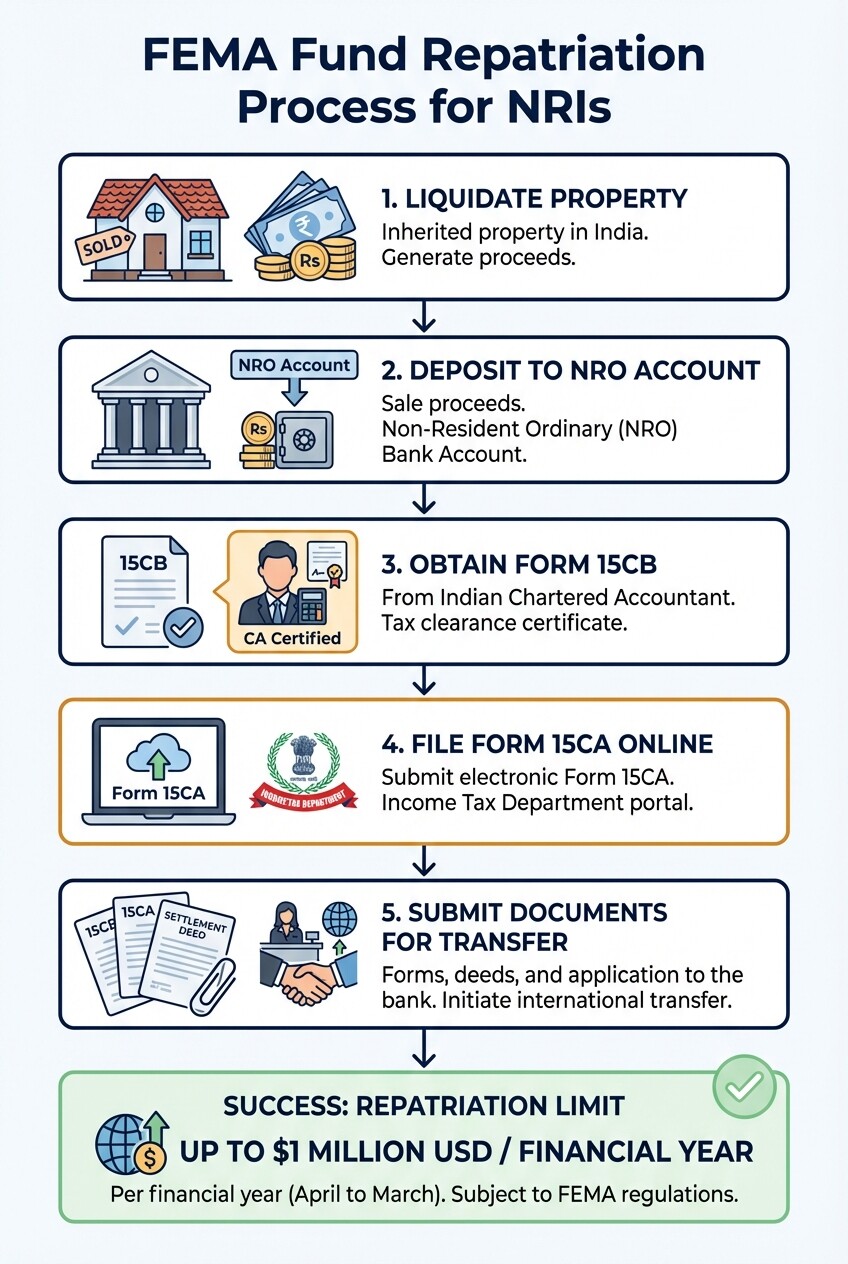
Once a family dispute is settled and inherited property is liquidated, NRIs must comply strictly with FEMA regulations to transfer the funds out of India. The Reserve Bank of India (RBI) permits NRIs to repatriate up to $1 million USD per financial year from their Non-Resident Ordinary (NRO) bank account, provided all taxes are paid.
To execute this transfer, you must first deposit the sale proceeds of the inherited property into your NRO account. You cannot transfer these funds directly to a foreign bank account or an NRE (Non-Resident External) account without fulfilling documentation requirements. You will need to hire an Indian Chartered Accountant (CA) to issue a Form 15CB, which certifies that the applicable capital gains taxes have been paid. Subsequently, you must file Form 15CA online with the Indian Income Tax Department. Once the bank receives these forms along with a copy of the Family Settlement Deed and the property sale deed, they will authorize the cross-border wire transfer.
Common Misconceptions About NRI Property Disputes
Many NRIs fall into legal traps because they rely on outdated advice or common myths regarding Indian property and succession law. Understanding the reality of your rights can save you years of frustration and prevent costly financial mistakes.
- Misconception: You must be physically present in India to resolve a property dispute. Reality: Through the use of a properly consularized Special Power of Attorney (SPOA) and video-conferencing, you can participate in mediation, appoint legal counsel, and finalize settlement deeds entirely from your country of residence.
- Misconception: NRIs lose their claim to ancestral agricultural land. Reality: FEMA restrictions only prevent NRIs from purchasing new agricultural land. If you inherit farming land or a plantation from a resident Indian ancestor, your ownership rights are fully protected by law, though you may only sell it to an Indian resident.
- Misconception: A registered foreign will is automatically valid for Indian property. Reality: A will drafted and registered abroad is valid, but to execute it over immovable property in major Indian metropolitan cities (like Mumbai, Chennai, or Kolkata), it often still requires a formal probate order from a competent Indian civil court.
Frequently Asked Questions
Can an NRI challenge a will in India through arbitration?
A will itself cannot be probated or validated through arbitration in India, as probate is an exclusive right of civil courts (a right in rem). However, family members can use mediation to negotiate a mutual settlement regarding the distribution of the estate, regardless of the will's contested terms, and sign a binding settlement deed.
How long does property mediation typically take in India?
Most family inheritance disputes handled through private mediation are resolved within 3 to 6 months. This timeline depends on the willingness of all legal heirs to compromise and how quickly international documents, like powers of attorney, can be authenticated and mailed.
Do I need to pay income tax on inherited property in India?
No, there is no inheritance tax in India. You do not pay tax simply for receiving the property. However, if you sell the inherited property as part of the settlement, you will be liable for Long-Term Capital Gains (LTCG) tax on the profit, which must be cleared before repatriating the money.
What happens if one family member refuses to mediate?
Mediation is entirely voluntary. If a co-heir refuses to participate or acts in bad faith, the mediator will close the proceedings. At that point, your only legal recourse is to file a formal partition suit in the civil court having jurisdiction over the property.
When to Hire an ADR Lawyer and Next Steps
Navigating Indian property law from abroad requires a legal representative who understands both local inheritance statutes and cross-border financial regulations. You should hire an attorney when multiple heirs are contesting ownership, when you need to enforce a previously agreed family settlement, or when complex agricultural properties are involved.
A specialized lawyer can act as your proxy in India, draft foolproof settlement deeds, and ensure you do not violate FEMA rules during fund repatriation. To take the first step toward reclaiming your family assets without the burden of endless litigation, explore qualified ADR lawyers in India who have proven experience handling cross-border NRI estate disputes. Gather your preliminary documents, draft a clear outline of the disputed assets, and schedule an initial consultation to assess the viability of mediation for your specific case.