- The Digital Competition Bill introduces an ex-ante framework, regulating large digital platforms before anti-competitive behavior occurs rather than after.
- Companies designated as Systemically Significant Digital Enterprises (SSDEs) must comply with strict prohibitions on self-preferencing and unauthorized data cross-use.
- Non-compliance carries severe financial risks, with potential penalties reaching up to 10% of a company's global turnover.
- Small and Medium Enterprises (SMEs) gain new legal leverage to challenge the dominance of large platforms and ensure fair access to digital marketplaces.
- The Competition Commission of India (CCI) will gain expanded oversight, requiring firms to appoint dedicated compliance officers and submit annual reports.
What is the Digital Competition Bill and why does it matter?
The Digital Competition Bill is a proposed legislative framework designed to regulate large-scale digital platforms in India to ensure fair market competition. It shifts the regulatory focus from traditional "ex-post" enforcement (punishing bad behavior after it happens) to a proactive "ex-ante" model that sets ground rules for the most powerful players in the tech ecosystem.
This legislation is essential because India's digital economy is expanding at an unprecedented rate, creating a few "gatekeeper" platforms that control access to millions of consumers. By implementing these rules, the Indian government aims to prevent market distortion, protect consumer choice, and foster a level playing field for domestic startups and traditional businesses transitioning to digital storefronts.
What is the 'Ex-ante' approach to Indian antitrust law?
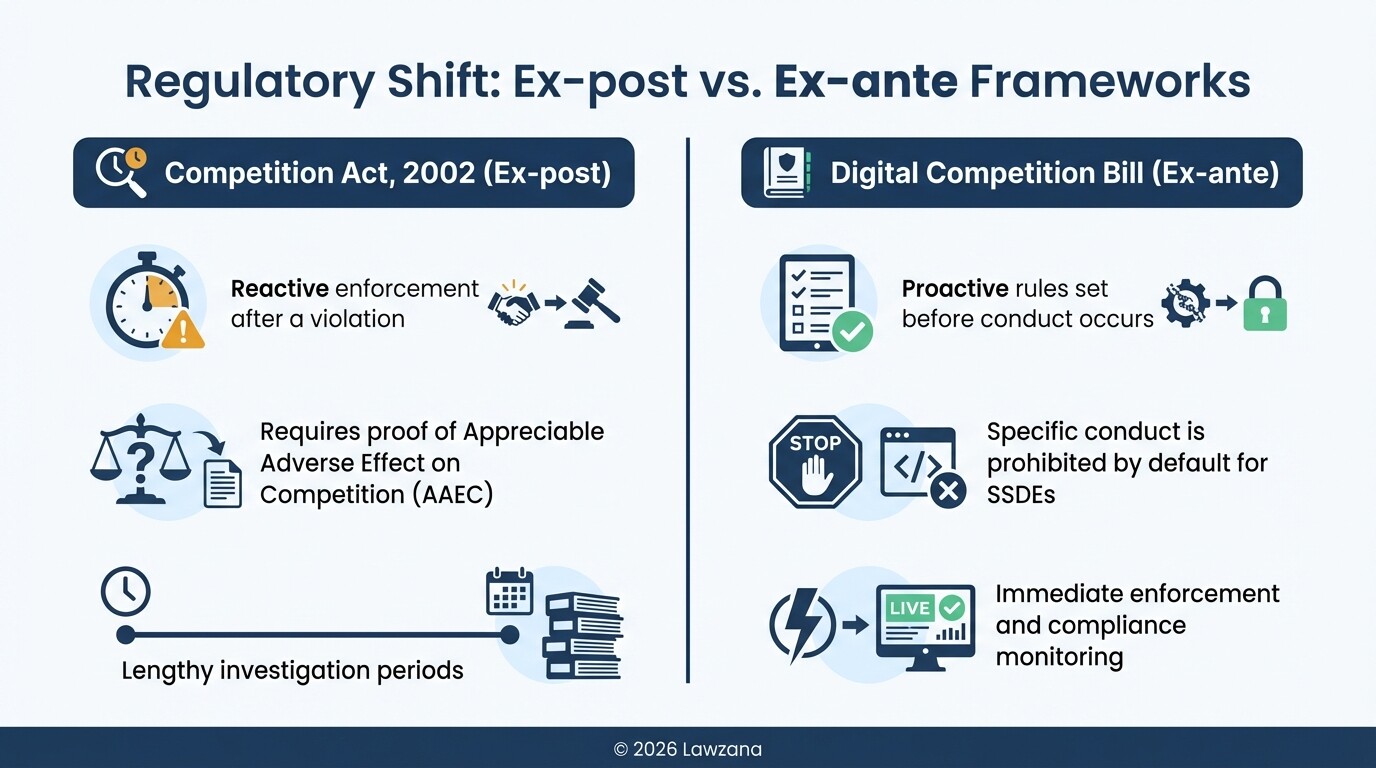
The ex-ante approach establishes a set of "do's and don'ts" for dominant digital firms before they engage in any market activities. Unlike the existing Competition Act of 2002, which requires the CCI to prove an "Appreciable Adverse Effect on Competition" (AAEC) through a long investigation, the ex-ante framework presumes that certain behaviors by massive platforms are inherently harmful and prohibits them outright.
Under this model, the CCI identifies Systemically Significant Digital Enterprises (SSDEs) based on specific financial and user-base thresholds. Once designated, these firms must follow a code of conduct that includes:
- Pre-emptive Compliance: Adhering to standards regarding transparency and fairness without waiting for a competitor to file a complaint.
- Reporting Obligations: Providing regular updates to the CCI to demonstrate that their algorithms and business practices remain competitive.
- Immediate Enforcement: Enabling the CCI to act quickly if a firm deviates from its designated obligations, significantly shortening the timeline for legal interventions.
How does the bill restrict self-preferencing and data cross-use?
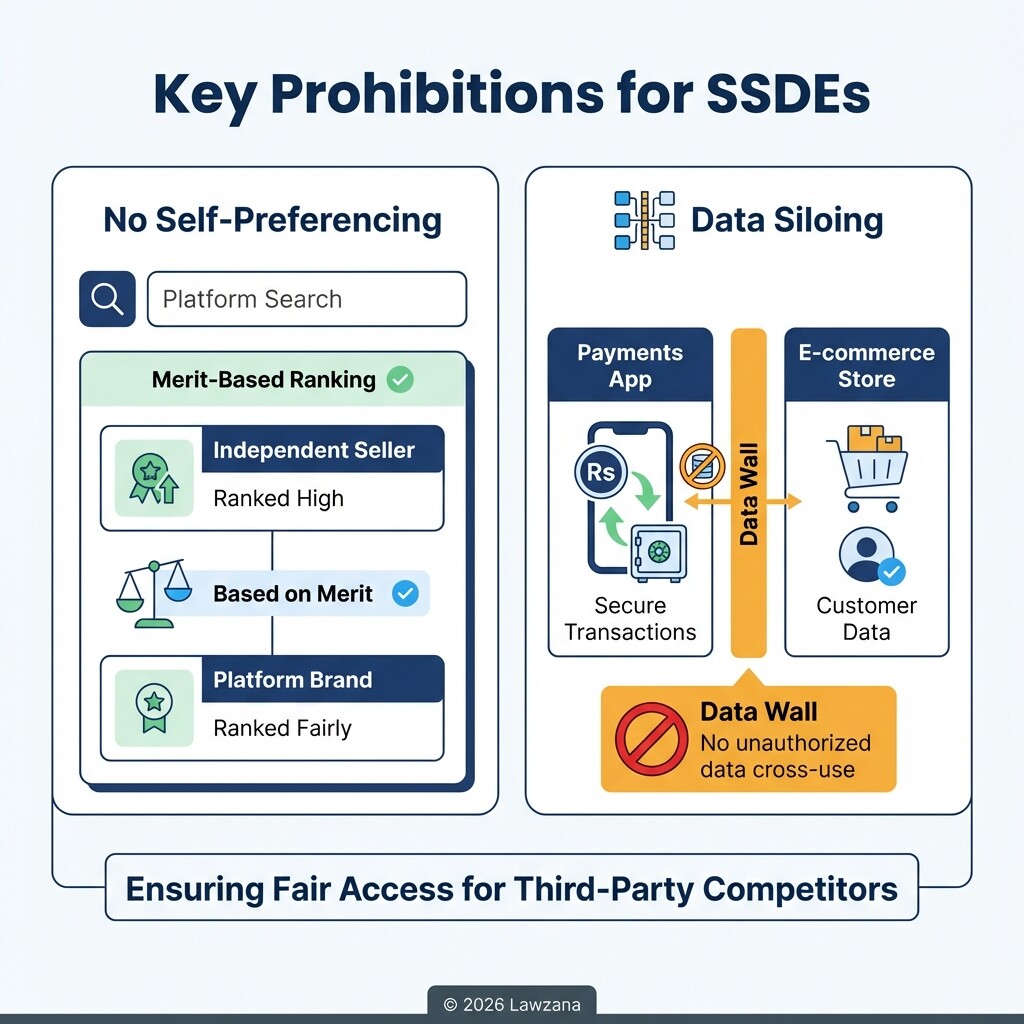
The Bill strictly prohibits SSDEs from favoring their own products or services over those of third-party competitors on their platforms. This means a marketplace platform cannot use its search algorithm to rank its private-label goods higher than those of independent sellers, ensuring that consumer choice is driven by merit rather than platform ownership.
Furthermore, the legislation addresses "data cross-use," which occurs when a large company uses personal data collected from one service (e.g., a payment app) to give its other service (e.g., an e-commerce store) an unfair advantage. The new rules mandate:
- Data Siloing: SSDEs must keep data generated by different business segments separate unless they receive explicit, informed consent from the user.
- Anti-Tying Measures: Platforms cannot force users to sign up for secondary services as a condition for using a primary service.
- Transparency in Intermediation: Platforms must disclose the parameters they use for ranking products, preventing "black box" algorithms from unfairly sidelining competitors.
What are the compliance requirements for designated digital firms?
Companies designated as SSDEs are required to overhaul their internal governance to meet strict transparency and accountability standards. This includes the mandatory appointment of a Chief Compliance Officer, a Nodal Contact Person, and a dedicated grievance redressal mechanism located within India.
These requirements ensure that the CCI has a direct line of communication with a responsible executive who can be held legally accountable for the firm's actions. The core compliance checklist includes:
| Requirement | Description |
|---|---|
| Chief Compliance Officer | A senior executive responsible for ensuring the firm follows all ex-ante rules. |
| Annual Compliance Reports | Detailed filings submitted to the CCI demonstrating adherence to fair-play rules. |
| Algorithmic Audits | Periodic reviews of search and recommendation engines to ensure no self-preferencing. |
| Data Usage Records | Documentation showing how user data is segmented and protected from cross-use. |
What are the penalties and investigative powers of the CCI?
The Competition Commission of India (CCI) is granted significant enforcement powers under the Bill, including the ability to levy fines that can be financially devastating. If an SSDE is found in violation of the ex-ante rules, the CCI can impose a penalty of up to 10% of the enterprise's global turnover from the preceding three financial years.
Beyond fines, the CCI possesses broad investigative tools to ensure the digital market remains contestable. These powers include:
- Search and Seizure: The ability to conduct "dawn raids" on corporate offices to secure digital evidence and internal communications.
- Interim Orders: The power to issue "cease and desist" orders during an ongoing investigation to prevent immediate harm to smaller competitors.
- Behavioral Remedies: The authority to force a company to change its business model, such as unbundling software or opening up its data to competitors.
- Director Liability: Holding individual directors and key managerial personnel liable for the company's anti-competitive conduct if it occurred with their knowledge or negligence.
How can SMEs leverage these new fair-play rules?
Small and Medium Enterprises (SMEs) can use the Digital Competition Bill as a shield against the aggressive market tactics of larger competitors. By codifying what constitutes "unfair behavior," the law makes it easier for smaller brands to file formal complaints and seek redress without the prohibitive costs of proving complex economic theories.
To maximize these benefits, SMEs should adopt the following legal strategies:
- Monitor Platform Rankings: Track search visibility and report sudden, unexplained drops that coincide with the launch of a platform's private-label competitor.
- Utilize the Grievance Redressal Mechanism: Use the mandatory platform-level complaint systems to resolve disputes regarding data access or unfair fees before escalating to the CCI.
- Collective Bargaining: Form industry associations to file representative complaints with the CCI, sharing the legal costs and increasing the weight of the evidence provided.
- Audit Interoperability: Ensure that your third-party tools can integrate seamlessly with major platforms, and report any "walled garden" tactics that prevent your software from functioning on an SSDE's ecosystem.
Common Misconceptions
1. The Bill only targets American Big Tech companies
While large multinational firms are the most likely to be designated as SSDEs, the thresholds are based on financial turnover and user base within India. Any entity, including large Indian conglomerates with significant digital footprints in e-commerce, social media, or search, can be designated as an SSDE and held to these standards.
2. The Digital Competition Bill replaces the Competition Act, 2002
This is incorrect. The Bill is intended to supplement the existing Act. While the 2002 Act continues to govern mergers and general "abuse of dominance" across all sectors, the Digital Competition Bill provides a specialized, faster-moving framework specifically for the unique challenges of the digital economy.
3. Ex-ante regulation will stifle innovation
Critics often argue that strict rules prevent companies from experimenting with new features. However, the Bill aims to promote "innovation by all" rather than "innovation by one." By preventing dominant firms from crushing startups, the framework ensures a more diverse and vibrant technological landscape where new ideas can compete on their merits.
FAQs
Which authority oversees the Digital Competition Bill?
The Competition Commission of India (CCI) is the primary regulatory body responsible for designating SSDEs, conducting investigations, and enforcing penalties under the Bill.
How is a company designated as an SSDE?
A company is designated as a Systemically Significant Digital Enterprise based on several factors, including its annual turnover in India, its global market capitalization, and the number of active business and end-users it serves in the country.
Can a company appeal a penalty from the CCI?
Yes, decisions and penalties issued by the CCI can be appealed before the National Company Law Appellate Tribunal (NCLAT). Further appeals can be taken to the Supreme Court of India.
Does the Bill apply to non-Indian companies?
Yes, if a digital service provider has a significant user base or generates substantial revenue in India, it can be designated as an SSDE regardless of where its global headquarters are located.
When to Hire a Lawyer
Navigating the complexities of the Digital Competition Bill requires specialized legal expertise, particularly for companies operating in the e-commerce or SaaS sectors. You should consult an antitrust lawyer if:
- Your company is approaching the financial or user-base thresholds that may lead to an SSDE designation.
- You are an SME experiencing unfair treatment, such as sudden delisting or data withholding, by a major digital platform.
- You need to structure your data sharing and search algorithms to comply with new Indian regulatory standards.
- Your business is facing an investigation or has received a notice from the Ministry of Corporate Affairs regarding competition practices.
Next Steps
- Assess Your Status: Review your India-specific turnover and user metrics to determine if your business falls within the potential SSDE designation criteria.
- Audit Internal Data Policies: Ensure that your current methods for collecting and sharing data across different business units do not violate "cross-use" prohibitions.
- Review Partner Agreements: If you are an SME, review your contracts with large platforms to identify any clauses that may now be considered anti-competitive under the new Bill.
- Prepare a Compliance Roadmap: Establish an internal team to monitor updates from the CCI and prepare for the mandatory appointment of compliance officers once the Bill is enacted.