- The Competition Commission of India (CCI) possesses broad powers to conduct "dawn raids" and seize digital evidence without prior notice.
- Filing a leniency application early is critical in cartel cases, as the first applicant can receive a penalty reduction of up to 100%.
- Non-compliance with CCI directions or the destruction of evidence can result in fines of up to ₹10 million (1 crore INR) per day.
- Appeals against CCI orders must be filed before the National Company Law Appellate Tribunal (NCLAT) within 60 days.
Response Checklist for CCI Investigations
A CCI investigation requires an immediate, disciplined response to mitigate legal exposure and prevent secondary charges of non-cooperation. Use this checklist to manage the first 48 hours of an inquiry or search operation.
| Action Item | Responsible Party | Priority |
|---|---|---|
| Verify Credentials: Check the DG's search warrant and the identity cards of all officers present. | Legal Counsel / Head of Security | Immediate |
| Establish a "Shadow" Team: Assign one employee to follow each DG officer to log every document viewed or seized. | Compliance Team | Immediate |
| Protect Privileged Mail: Identify and segregate communications between the company and its external legal counsel. | In-house Counsel | High |
| IT Freeze: Temporarily suspend auto-delete protocols on email servers and cloud storage. | IT Director | High |
| Internal Briefing: Issue a "No-Comment" policy to employees to prevent unauthorized statements to the media or DG. | PR / Legal | Medium |
| Leniency Evaluation: Assess if the investigation involves a cartel and determine if a "Marker" for leniency should be filed. | External Counsel | High |
Powers of the Director General During Dawn Raids
The Director General (DG) acts as the investigative arm of the CCI and possesses the authority to conduct unannounced searches, commonly known as dawn raids. Under Section 41 of the Competition Act, 2002, the DG has the same powers as a civil court regarding the summoning of witnesses and the examination of evidence.
During these operations, the DG can:
- Enter Premises: Access any office, factory, or warehouse belonging to the company or its executives.
- Seize Evidence: Confiscate physical documents, hard drives, laptops, and mobile phones.
- Record Statements: Conduct "on-the-spot" depositions of employees and directors under oath.
- Digital Forensic Imaging: Mirror entire servers or cloud environments to analyze communication patterns and metadata.
Rights of the Company During Search and Seizure Operations
While companies are legally obligated to cooperate with the DG, they retain fundamental rights to ensure the investigation remains within legal boundaries. Asserting these rights is not considered non-cooperation, provided it is done professionally and based on established legal principles.
Companies operating in India have the following protections:
- Right to Legal Representation: While the law does not strictly mandate that the DG wait for a lawyer to arrive, companies can request a reasonable delay. Legal counsel is generally permitted to be present during the recording of statements, though they may not be allowed to answer on behalf of the witness.
- Attorney-Client Privilege: Communications with external legal counsel are protected under the Indian Evidence Act. Documents containing legal advice should be clearly marked and kept separate to prevent accidental seizure.
- Right Against Self-Incrimination: While a witness must answer factual questions, they cannot be forced to provide an admission of guilt.
- Index of Seizure: The DG is required to provide a "Panchnama" (a formal record) and a detailed list of every item seized before leaving the premises.
Process for Filing a Leniency Application in Cartel Cases
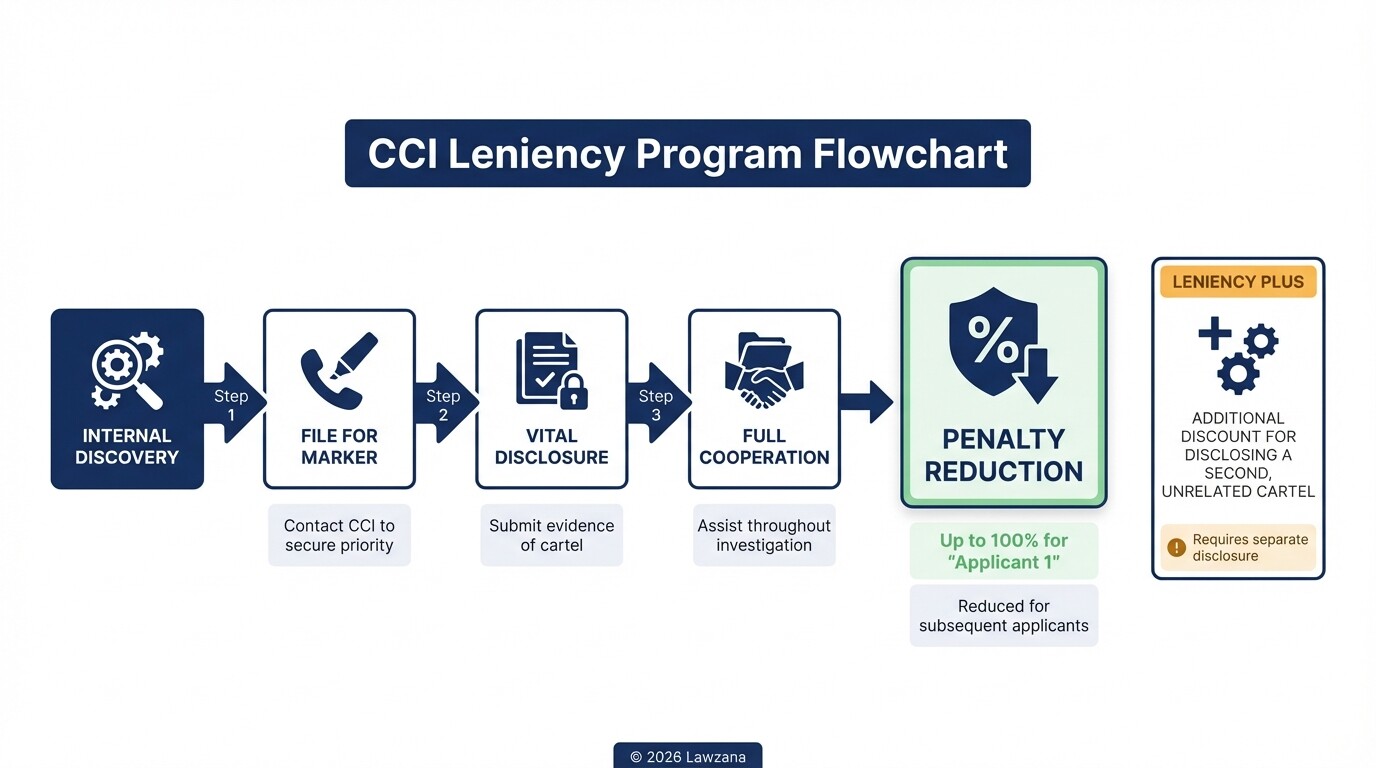
The CCI's Leniency Program, governed by the Lesser Penalty Regulations, provides a pathway for companies involved in cartels to mitigate their financial liability. By being the first to "blow the whistle" and provide vital information, a company can significantly reduce the massive penalties associated with price-fixing or bid-rigging.
The process involves these specific steps:
- Filing for a Marker: The company contacts the CCI (usually via email or a physical letter) to "mark" their place in the queue. This secures their priority status while they gather detailed evidence.
- Submitting Vital Disclosure: The applicant must provide evidence that enables the CCI to form a prima facie opinion about the existence of the cartel.
- Cooperation Throughout: The applicant must provide "continuous and true" cooperation throughout the investigation until the final order is passed.
- Leniency Plus: Under the 2023 Amendment, a company already disclosing one cartel can receive additional penalty reductions if they disclose a second, unrelated cartel ("Leniency Plus").
Timelines for Responding to Prima Facie Orders
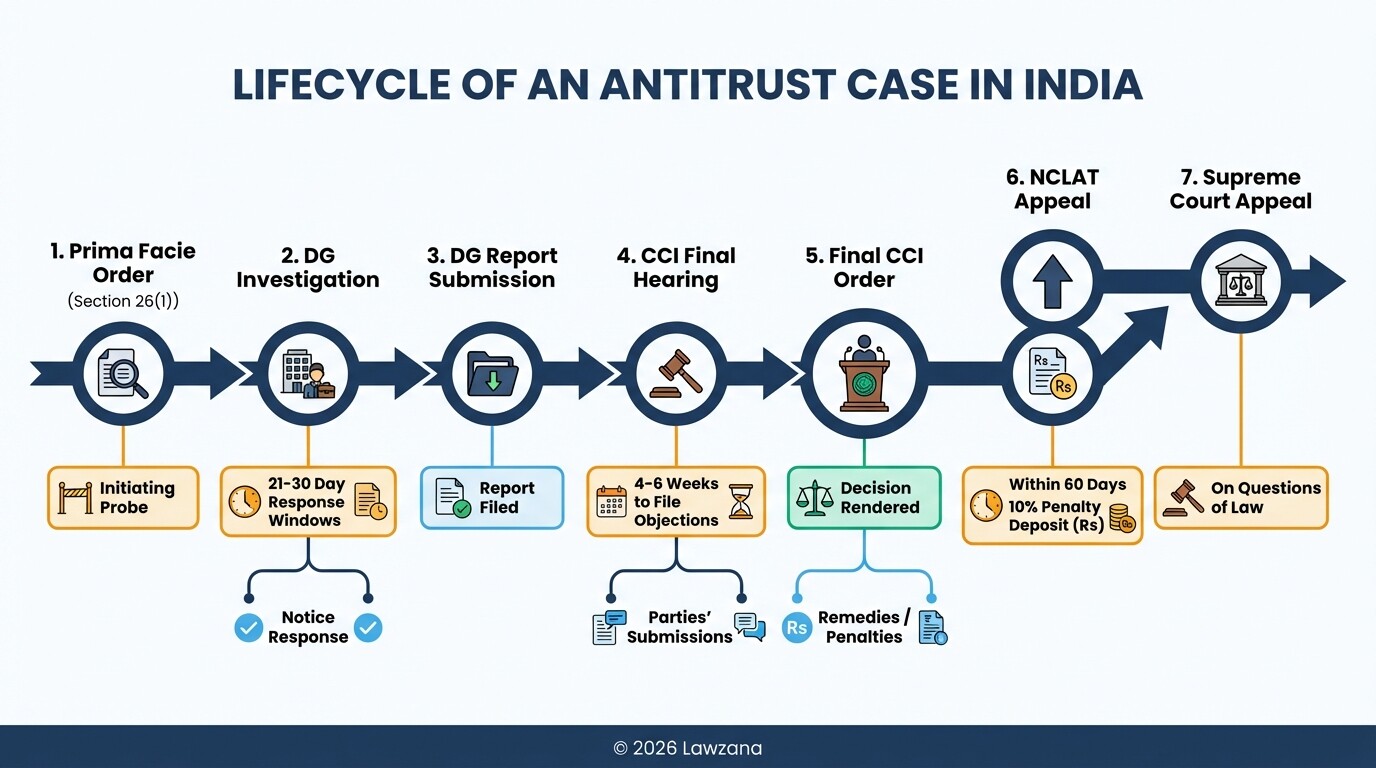
An investigation officially begins when the CCI issues a "prima facie" order under Section 26(1) of the Act, stating there is reason to believe a violation has occurred. This order is administrative and cannot be appealed, meaning the company must prepare for a long-term investigative process.
- Initial Notification: Once the DG is directed to investigate, they will issue a notice to the company to provide information.
- Submission Deadline: Companies are typically given 21 to 30 days to respond to these notices.
- Extensions: The CCI may grant extensions of 15 to 30 days if the company demonstrates that the data requested is voluminous or requires technical extraction.
- The DG Report: After completing the inquiry, the DG submits a report to the CCI. The company then receives a copy and is usually given 4 to 6 weeks to file "objections or suggestions" to the report's findings.
Appealing CCI Orders Before the NCLAT
Final orders passed by the CCI-whether they involve penalties for abuse of dominance or the dismantling of a cartel-are appealable. The National Company Law Appellate Tribunal (NCLAT) serves as the dedicated forum for these disputes.
To file a successful appeal, companies must adhere to these requirements:
- Limitation Period: The appeal must be filed within 60 days of receiving the CCI's order.
- Mandatory Penalty Deposit: The NCLAT typically requires the appellant to deposit 10% of the penalty amount imposed by the CCI as a condition for granting a "stay" on the remainder of the fine.
- Grounds for Appeal: Appeals can be based on errors of law, violations of the principles of natural justice, or incorrect appreciation of economic evidence.
- Further Appeal: If the NCLAT ruling is unfavorable, a final appeal can be made to the Supreme Court of India on substantial questions of law.
Common Misconceptions
- "Dominance is illegal in India": Holding a dominant market position is not a violation of the Competition Act. The law only prohibits the abuse of that dominance, such as predatory pricing or imposing unfair conditions on consumers.
- "The DG needs a warrant from the CCI": The DG cannot authorize its own dawn raid. They must obtain a search warrant from the Chief Metropolitan Magistrate in the relevant jurisdiction before entering a company's premises.
- "Internal emails are private": In India, there is no "expectation of privacy" for corporate emails during a regulatory investigation. Anything sent via company servers is fair game for the DG unless it is a communication with a lawyer.
FAQ
What is the maximum penalty for an antitrust violation in India?
The CCI can impose a penalty of up to 10% of the average turnover of the company for the last three preceding financial years. For cartels, the penalty can be even higher-up to three times the profit for each year of the cartel's duration.
Can individuals be sent to jail for competition law violations?
The Competition Act is primarily a civil statute, so there are no direct prison sentences for the anti-competitive act itself. However, individuals can face imprisonment for up to one year for non-compliance with CCI orders or for providing false evidence.
Does the CCI investigate foreign companies?
Yes. Under the "effects doctrine" (Section 32), the CCI has jurisdiction over any conduct that happens outside India but has an Appreciable Adverse Effect on Competition (AAEC) within the Indian market.
When to Hire a Lawyer
You should engage a specialized competition lawyer immediately if:
- Your company receives a "Notice for Information" from the DG or the CCI.
- Officers of the DG arrive at your premises for a search and seizure operation.
- You suspect that an employee has engaged in unauthorized discussions with competitors regarding pricing or market sharing.
- You are planning a merger or acquisition that exceeds the jurisdictional thresholds for notification to the CCI.
Next Steps
- Audit Your Communications: Review internal and external communication protocols to ensure they comply with competition law.
- Draft a Dawn Raid Manual: Create a clear, step-by-step guide for your front-desk and IT staff on how to handle an unannounced visit from the DG.
- Conduct Training: Organize compliance workshops for high-risk departments like Sales, Procurement, and Logistics.
- Monitor Market Position: If your company holds a high market share, conduct a dominance audit to ensure your pricing and contracting strategies are not "abusive" under Section 4.
For official guidelines and the latest regulations, visit the Competition Commission of India (CCI) and the National Company Law Appellate Tribunal (NCLAT).