- Turkey is a signatory to the New York Convention, meaning foreign arbitral awards are generally enforceable provided there is reciprocity between Turkey and the country where the award was rendered.
- The enforcement process, known as "Tenfiz," requires a formal lawsuit in a Turkish Civil Commercial Court to convert a foreign award into a locally executable judgment.
- Turkish courts are strictly prohibited from reviewing the merits of the underlying dispute (the "révision au fond" prohibition), though they can refuse enforcement based on public policy violations.
- Creditors can obtain "interim injunctions" or "precautionary attachments" to freeze a debtor's assets in Turkey while the enforcement lawsuit is pending.
- All foreign documents must be properly apostilled and translated into Turkish by a notarized translator to be admissible in court.
Does Turkey follow the New York Convention for foreign awards?
Turkey has been a party to the New York Convention on the Recognition and Enforcement of Foreign Arbitral Awards since 1991. This means Turkish courts are legally obligated to recognize and enforce arbitral awards made in other signatory states, provided the dispute is considered "commercial" under Turkish law.
The principle of reciprocity is the cornerstone of this process. Turkey applies the Convention to awards made in the territory of another contracting state. If the award was rendered in a non-contracting state, enforcement may still be possible under the International Private and Civil Procedure Law (Law No. 5718, known as MÖHUK) if there is a bilateral treaty in place or if that country provides de facto reciprocity to Turkish awards.
What are the legal requirements for recognition and enforcement in Turkey?
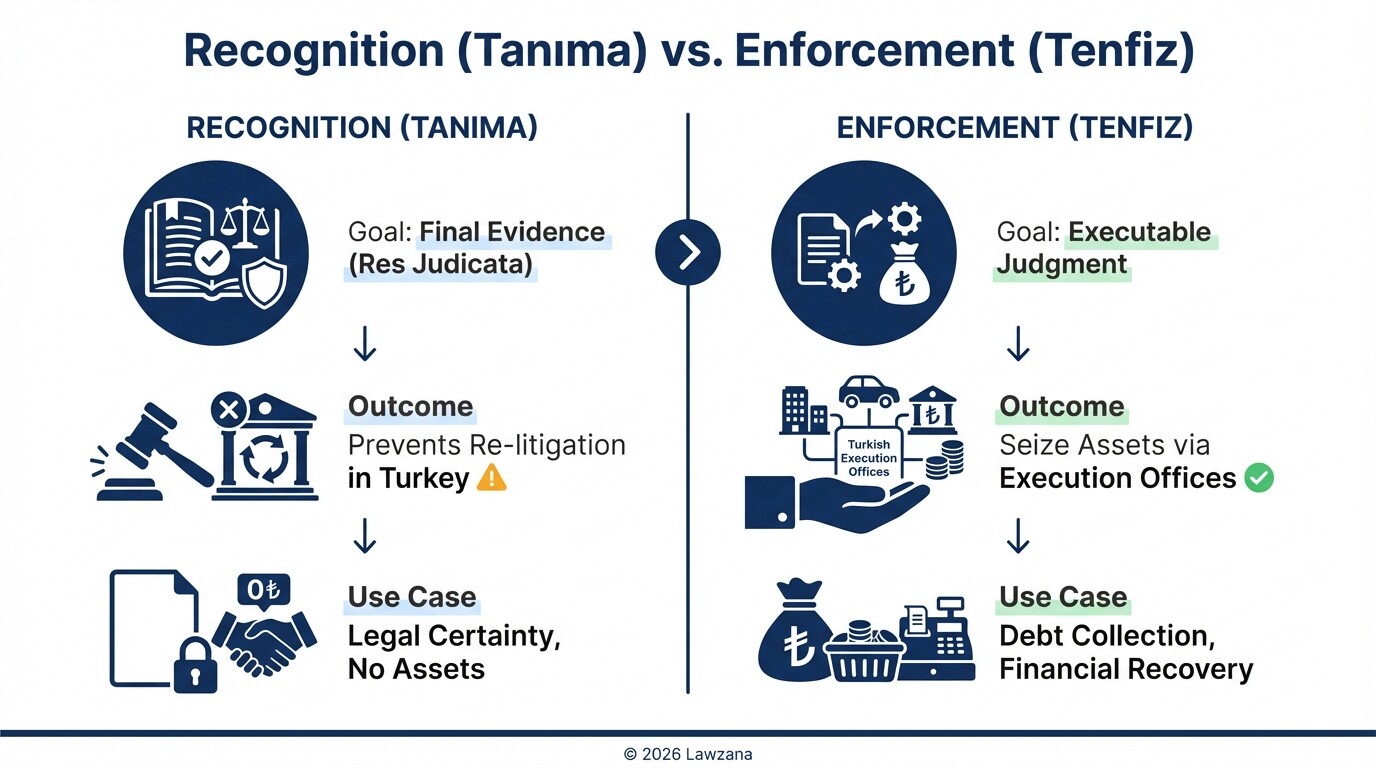
For a foreign arbitral award to be legally binding and enforceable in Turkey, it must undergo a formal procedure called "Tanıma" (Recognition) or "Tenfiz" (Enforcement). While recognition grants the award the status of "final evidence" or "res judicata," enforcement is what allows the creditor to use the Turkish debt collection offices to seize assets.
According to Articles 60 to 62 of Law No. 5718 (MÖHUK), the court will verify several conditions:
- Existence of an Arbitration Agreement: A valid, written agreement must exist between the parties.
- Finality: The award must be binding, final, and enforceable under the laws of the country where it was rendered.
- Due Process: The party against whom the award is invoked must have been properly notified of the appointment of the arbitrator and the proceedings.
- Jurisdiction: The subject matter of the dispute must be "arbitrable" under Turkish law (e.g., real estate rights in Turkey are generally not arbitrable).
How do Turkish courts define the "public policy" exception?
The most common defense used to block the enforcement of a foreign award in Turkey is the "Public Policy" (Kamu Düzeni) exception. If a Turkish court determines that the enforcement of an award would fundamentally contradict the Turkish legal order or basic notions of justice, it can refuse the application.
While "public policy" is not explicitly defined in the statutes, Turkish High Court precedents generally limit this to:
- Violations of Fundamental Rights: Breaches of the constitutional right to a fair trial.
- Defense Rights: If a party was not given the opportunity to present their case.
- Economic Morality: Awards that involve illegal activities or clear violations of mandatory Turkish commercial regulations.
It is important to note that a simple error in applying the law by the arbitrator does not constitute a violation of public policy. The court cannot re-examine the facts of the case or the evidence.
What documents and timelines are required for an enforcement lawsuit?
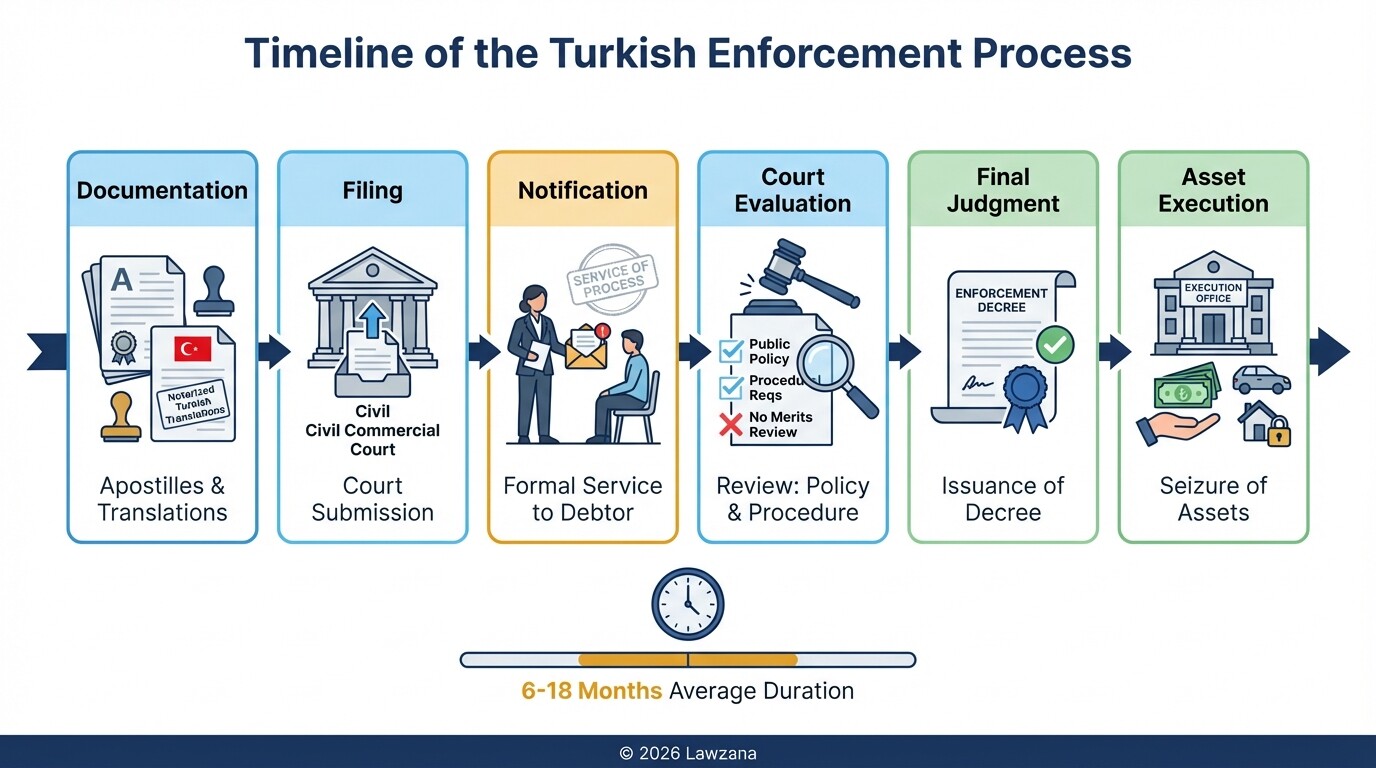
An enforcement action is initiated by filing a petition with the competent Civil Commercial Court (Asliye Ticaret Mahkemesi), usually located where the debtor resides or where their assets are located. The process typically takes between 6 to 18 months, depending on the court's workload and whether the decision is appealed.
The following documents are mandatory for the application:
- The Original Award: Or a duly certified copy, authenticated according to the laws of the country of origin.
- The Arbitration Agreement: The original contract or a certified copy containing the arbitration clause.
- Apostille: All foreign documents must bear an Apostille certificate per the Hague Convention.
- Official Translations: Notarized Turkish translations of all documents.
- Power of Attorney: If represented by a lawyer, a specific Turkish power of attorney (notarized and apostilled).
| Step | Action | Estimated Timeline |
|---|---|---|
| 1 | Preparation of documents & translations | 2-4 weeks |
| 2 | Filing the lawsuit in Commercial Court | 1 week |
| 3 | Notification to the defendant | 4-8 weeks |
| 4 | Court hearings and evaluation | 6-12 months |
| 5 | Final Judgment & Appeal (if applicable) | 6-12 months |
Can you freeze a debtor's assets in Turkey during the enforcement process?
Yes, creditors can apply for a "Precautionary Attachment" (İhtiyati Haciz) to prevent the debtor from hiding or transferring assets while the enforcement suit is ongoing. This is a critical tool for foreign creditors seeking to ensure that a future court victory actually results in financial recovery.
Under Turkish Execution and Bankruptcy Law, the court may grant an interim injunction if the creditor can show a "prima facie" case that the award is valid and that there is a risk the debt will not be paid. In most cases, the court will require the creditor to deposit a "guarantee" (usually 10% to 15% of the claim amount) into the court's bank account to cover potential damages to the debtor if the enforcement is ultimately denied.
Common Misconceptions about Turkish Enforcement
- "I can restart the trial in Turkey": This is false. Turkish courts are bound by the findings of the arbitrator. You cannot introduce new evidence or argue the merits of the contract again.
- "Enforcement is automatic": Even with the New York Convention, enforcement is not "automatic." You must file a lawsuit, pay court fees, and obtain a Turkish court order before the award can be sent to the Execution Office.
- "If I win, I get my money immediately": The defendant has the right to appeal the enforcement decision to the Regional Appellate Court and then to the Court of Cassation. While an appeal does not always stay the execution, it can significantly delay the finality of the process.
FAQs
How much does it cost to enforce an award in Turkey?
The primary costs include a fixed court application fee, translation costs, and potentially a percentage-based fee if the award is for a specific sum of money. However, unlike standard local lawsuits, enforcement suits for foreign awards often benefit from "fixed" fees rather than proportional fees, making them relatively cost-effective.
Can an award in a foreign currency be enforced?
Yes. Arbitral awards in foreign currencies like USD or EUR can be enforced in Turkey. During the execution phase, the amount is usually converted into Turkish Lira (TRY) based on the exchange rate on the date of the execution request or the date of payment, depending on the creditor's preference.
What happens if the debtor has no assets in Turkey?
If the debtor has no assets, bank accounts, or real estate in Turkey, a Turkish enforcement order will have no practical effect. It is highly recommended to perform an asset search before initiating the "Tanıma ve Tenfiz" process.
When to Hire a Lawyer
Enforcing a foreign award in Turkey is a procedural minefield where a single missing apostille or a mistranslated clause can lead to a dismissal. You should consult a Turkish legal expert if:
- The debtor is challenging the award based on "public policy."
- You need to locate and freeze assets quickly via a precautionary attachment.
- The arbitration agreement was complex or involved multiple parties and jurisdictions.
- You are dealing with a state-owned entity where sovereign immunity issues may arise.
Next Steps
- Audit Your Documents: Ensure you have the original signed arbitration agreement and the final award.
- Obtain Apostilles: Secure Hague Convention apostilles for all original documents in the country where they were issued.
- Conduct an Asset Search: Identify the debtor's bank accounts, real estate, or receivables within Turkish borders.
- Engage Local Counsel: Retain a Turkish lawyer to draft the enforcement petition and handle the mandatory translations and notarization.
- File for Interim Measures: If there is a risk of asset dissipation, instruct your lawyer to file for a precautionary attachment simultaneously with the enforcement suit.
For more information on the Turkish judicial system, you can visit the official Ministry of Justice website or review the Mevzuat database for the full text of Law No. 5718.