- India's Digital Personal Data Protection (DPDP) Act applies to any foreign tech startup processing data to offer goods or services to individuals in India, regardless of physical presence.
- Regulatory fines for failing to prevent a data breach can reach up to ₹250 crore (approximately $30 million USD) per instance.
- Consent under Indian law must be free, specific, informed, unconditional, and unambiguous, with notices available in English and local Indian languages.
- Cross-border data transfers are permitted by default, but the government retains the right to restrict transfers to specific countries via a "negative list."
- Remote B2B SaaS platforms can reduce direct liability by structuring their contracts to act as Data Processors rather than Data Fiduciaries.
Navigating India's Digital Personal Data Protection Rules
India's primary framework governing digital privacy is the Digital Personal Data Protection (DPDP) Act, 2023, which introduces strict mandates for how companies collect, process, and store user data. Foreign tech startups must align their technical architectures and legal frameworks with these rules to operate legally in the Indian market.
The law applies extraterritorially. If your startup is based in the United States, Europe, or elsewhere, but you profile users in India or offer them software, applications, or digital services, you fall under the DPDP Act. Startups are classified as "Data Fiduciaries" (the entity determining the purpose of processing) and users as "Data Principals." Unlike older frameworks, the DPDP Act minimizes data retention, meaning you must delete personal data as soon as the specific purpose for collecting it has been fulfilled or when the user withdraws consent.
Steps to Draft Compliant Privacy Policies and Terms of Service
A legally compliant privacy policy in India requires providing a clear, itemized notice to the user before or at the time of requesting consent. You must detail exactly what data is collected, the specific purpose for processing it, and the contact details of your designated Grievance Officer.
To ensure your startup's local Terms of Service and Privacy Policy hold up to regulatory scrutiny, follow this checklist:
- Draft a Clear Notice: Create a standalone notice explaining what personal data is being collected and why. This cannot be buried deep within a lengthy Terms of Service document.
- Implement Verifiable Consent: Design your user interface so that consent requires an affirmative, clear action (like checking an unticked box). Pre-ticked boxes are legally invalid in India.
- Offer Multi-Language Support: Ensure your privacy notice can be viewed in English and the 22 languages specified in the Eighth Schedule of the Indian Constitution, as required by the user.
- Include Withdrawal Mechanisms: Provide a technical mechanism for users to withdraw consent as easily as they gave it.
- Detail Grievance Redressal: Clearly list the name, email address, and physical address (if applicable) of your Grievance Officer, along with estimated response times.
Sample DPDP-Compliant Consent Clause
When presenting your privacy notice, avoid sweeping legal jargon. Use a precise clause for data collection:
"I hereby consent to [Startup Name] collecting and processing my [Specific Data: e.g., email address and phone number] solely for the purpose of [Specific Purpose: e.g., authenticating my account and sending software updates]. I understand that I can withdraw this consent at any time by visiting my account settings or contacting [Grievance Officer Email]."
Common Mistakes in Executing Cross-Border Data Transfers
Cross-border data transfers from India are generally permitted, but the most critical legal mistake foreign startups make is failing to monitor the Central Government's "negative list" of restricted jurisdictions. Technical mistakes often involve inadequate encryption during transit or commingling Indian consumer data with global datasets without localizing data tags.
Startups frequently assume that because they use top-tier cloud providers like AWS or Azure, their data transfers are automatically compliant. However, under the DPDP Act, the Data Fiduciary (your startup) is ultimately liable for the data. If you transfer data to a third-party processor in another country, you must have a valid contract binding them to strict data protection standards. Failing to execute a robust Data Processing Agreement (DPA) that explicitly references Indian legal standards leaves the startup exposed to massive regulatory penalties.
Alternative Compliance Strategies for Remote B2B SaaS Providers
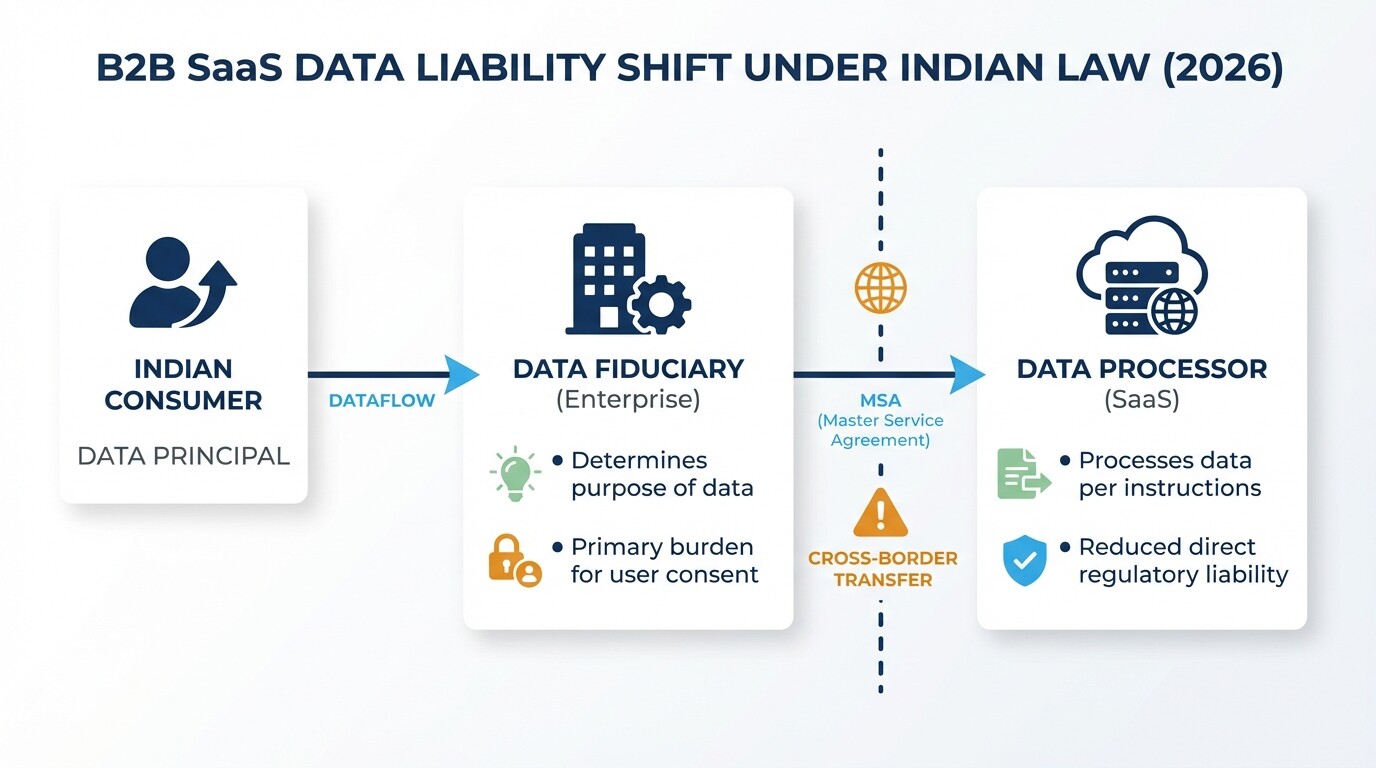
Remote B2B SaaS providers operating outside India can streamline compliance by acting strictly as "Data Processors" for their Indian enterprise clients, rather than direct "Data Fiduciaries." This strategy shifts the primary legal burden of obtaining user consent to the local Indian client while requiring the SaaS provider to implement robust technical safeguards.
If your SaaS platform processes employee or customer data on behalf of an Indian corporation, structure your Master Service Agreement (MSA) to explicitly state that the Indian client determines the purpose and means of data processing. Your startup's only obligation is to process the data according to the client's instructions and to protect it from breaches. This reduces your direct exposure to Indian consumers and regulators, though it is highly recommended to engage corporate and commercial lawyers in India to review these B2B contracts for local enforceability.
Preventing Disputes: International Data Breaches and Consumer Rights
Preventing data-related disputes requires establishing a local grievance redressal mechanism and adhering to strict breach notification protocols. If a data breach occurs, foreign startups must immediately notify the Data Protection Board of India (DPBI) and the affected users to mitigate penalties and class-action risks.
Under Indian regulations, the timeline for reporting cybersecurity incidents is remarkably tight. The Indian Computer Emergency Response Team (CERT-In) mandates that severe cybersecurity incidents-including targeted unauthorized access or data leaks-must be reported within six hours of the startup noticing the incident. Startups must build incident response plans that connect global IT security teams with Indian legal counsel to ensure these short reporting windows are met. Additionally, failing to respond to user requests for data deletion or correction within the prescribed timeline can trigger user complaints directly to the DPBI, resulting in audits and fines.
Common Misconceptions About Indian Data Privacy
- Misconception: "We are GDPR compliant, so we are automatically compliant in India." While GDPR is a strong foundation, India's DPDP Act has distinct differences. For example, the DPDP Act does not recognize "legitimate interest" as broadly as the GDPR does for processing data, and India has stricter, uncompromising rules regarding verifiable consent for processing the data of minors (anyone under 18).
- Misconception: "Because we have no servers or offices in India, these laws do not apply to us." The DPDP Act relies on the target market, not physical presence. If your digital service targets individuals in India, you are fully subject to the law, its compliance mechanisms, and its financial penalties.
Frequently Asked Questions
What is the maximum penalty for a data breach in India?
Under the DPDP Act, the penalty for failing to take reasonable security safeguards to prevent a personal data breach can reach up to ₹250 crore (approximately $30 million USD).
Do foreign tech startups need a Data Protection Officer (DPO) in India?
A dedicated DPO based in India is only required if the government classifies your startup as a "Significant Data Fiduciary." This classification depends on the volume and sensitivity of the data processed, as well as the potential risk to consumer rights or state security.
Can Indian user data be processed and stored on US servers?
Yes, under current Indian law, you can transfer, process, and store personal data on servers in the United States. India uses a "negative list" approach, meaning transfers are allowed globally except to specific countries restricted by the government.
When to Hire a Lawyer and Next Steps
Foreign tech startups should hire local legal counsel well before launching their product in the Indian market or before onboarding their first Indian enterprise client. You need a legal expert when drafting localized Privacy Policies, structuring Data Processing Agreements with local vendors, or determining if your data volume categorizes you as a Significant Data Fiduciary.
Next Steps:
- Map out exactly what personal data your software collects from Indian users and where it is stored globally.
- Update your user onboarding flows to ensure affirmative, unambiguous consent is captured without pre-ticked boxes.
- Establish a rapid incident response protocol to meet India's strict 6-hour cybersecurity breach reporting requirements.