How to Change Resident Directors in Indian Subsidiaries
- Indian companies must maintain at least one director who resides in India for a minimum of 182 days per financial year.
- Companies must file Form DIR-12 with the Ministry of Corporate Affairs (MCA) within 30 days of any board member appointment or resignation.
- Foreign nationals can serve as directors but must obtain a Director Identification Number (DIN) and a Digital Signature Certificate (DSC) before their appointment.
- Board transitions require careful timing to prevent the company from temporarily falling below statutory minimums.
The Mandatory Resident Director Requirement in India
Under the Companies Act, 2013, every company registered in India must have at least one director who stays in the country for a minimum of 182 days during the financial year. This rule ensures a domestic representative is physically available and accountable for the subsidiary's legal compliance.
Section 149(3) enforces this mandate. For newly incorporated companies, the 182-day requirement applies proportionately at the end of the first financial year. The resident director does not need to be an Indian citizen, provided their physical presence meets the time threshold. Failing to maintain a resident director is a compliance breach carrying penalties between INR 50,000 and INR 500,000 for the company and its active officers.
Step-by-Step Checklist for Changing Directors
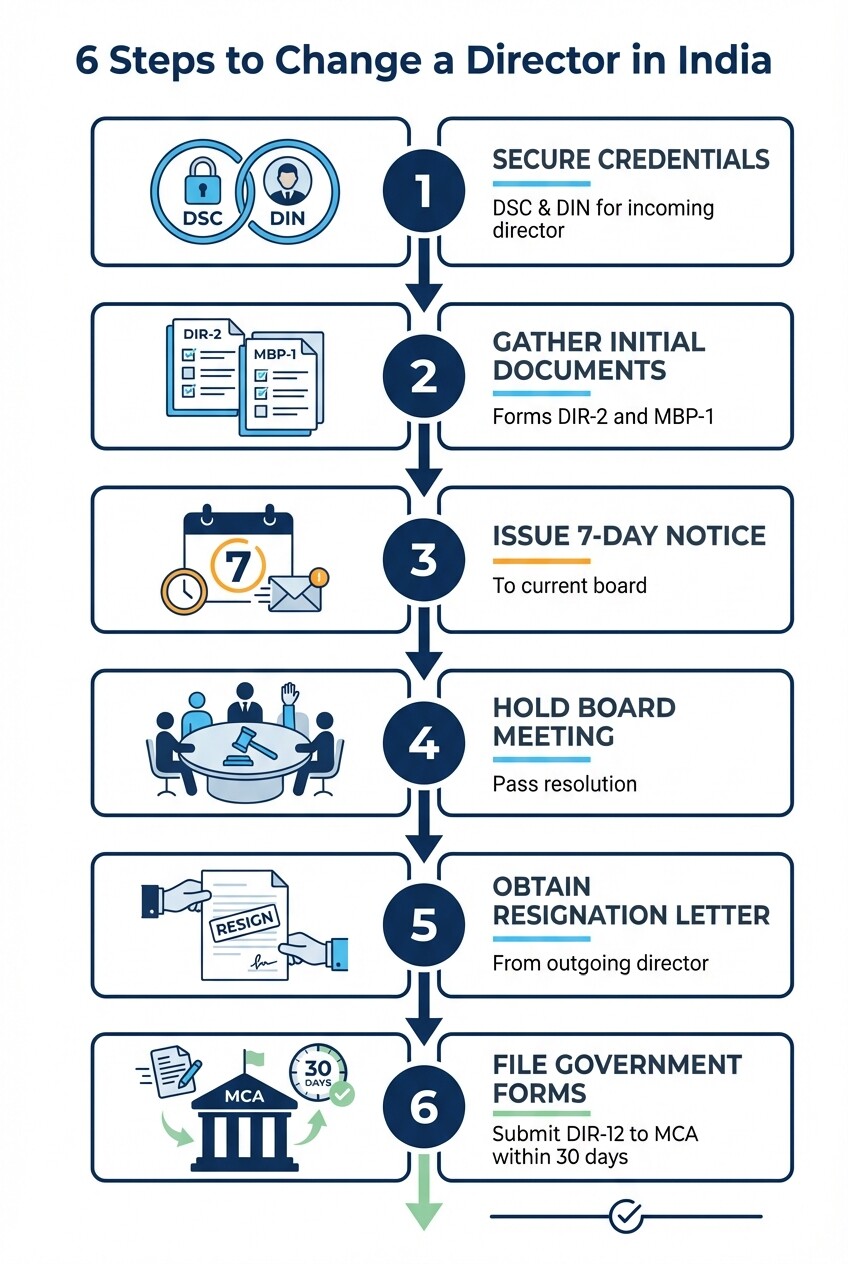
Replacing a director in an Indian subsidiary requires passing valid board resolutions, obtaining digital credentials, and filing standardized government forms. Use this checklist to execute the transition.
- Secure electronic credentials: Obtain a Digital Signature Certificate (DSC) and Director Identification Number (DIN) for the incoming director.
- Gather initial documents: Collect the formal consent to act as director (Form DIR-2) and the disclosure of interest in other entities (Form MBP-1) from the new appointee.
- Issue meeting notice: Send a formal notice to all current board members at least seven days before the Board of Directors meeting.
- Hold the board meeting: Pass the resolution accepting the resignation of the outgoing director and appointing the new director.
- Obtain resignation letter: Secure the signed resignation letter from the departing director.
- File government forms: Submit Form DIR-12 to the Ministry of Corporate Affairs within 30 days of the resolution date.
Securing DSC and DIN for Foreign Appointees
Foreign nationals must obtain a DSC and a DIN before they can legally assume a directorship and sign official government filings. The applicant does not need to travel to India; the entire credentialing process can be completed remotely.
The DSC is a secure digital key issued by authorized Indian certifying authorities. Foreign applicants must provide passport copies and address proofs. These documents must be notarized and apostilled in their home country. Once the DSC is active, the individual applies for a DIN. Existing companies file Form DIR-3 for this step, which requires a counter-signature from an active director or company secretary.
Executing Remote Board Resolutions and Quorums
Companies can hold board meetings via video conferencing to approve director changes. Indian corporate law permits participation through audiovisual means for most standard board decisions.
A valid quorum requires the presence of one-third of the total board strength or two directors, whichever is greater. When issuing the meeting notice, you must state that directors can participate via video conference and provide the technical contact details. During the meeting, roll call protocols require each remote director to state their name, confirm their location, and declare that no one else has access to the meeting.
Strict 30-Day Timeline for Filing Form DIR-12
You must file Form DIR-12 with the MCA within exactly 30 days of a director's appointment or resignation. The countdown begins on the effective date recorded in the board resolution.
Form DIR-12 updates the official register. It requires the digital signature of an authorized director or the company secretary, plus certification by a practicing professional such as a Chartered Accountant, Company Secretary, or Cost Accountant. Missing the 30-day filing deadline triggers compounding late fees based on the length of the delay.
Common Misconceptions When Transitioning Directors
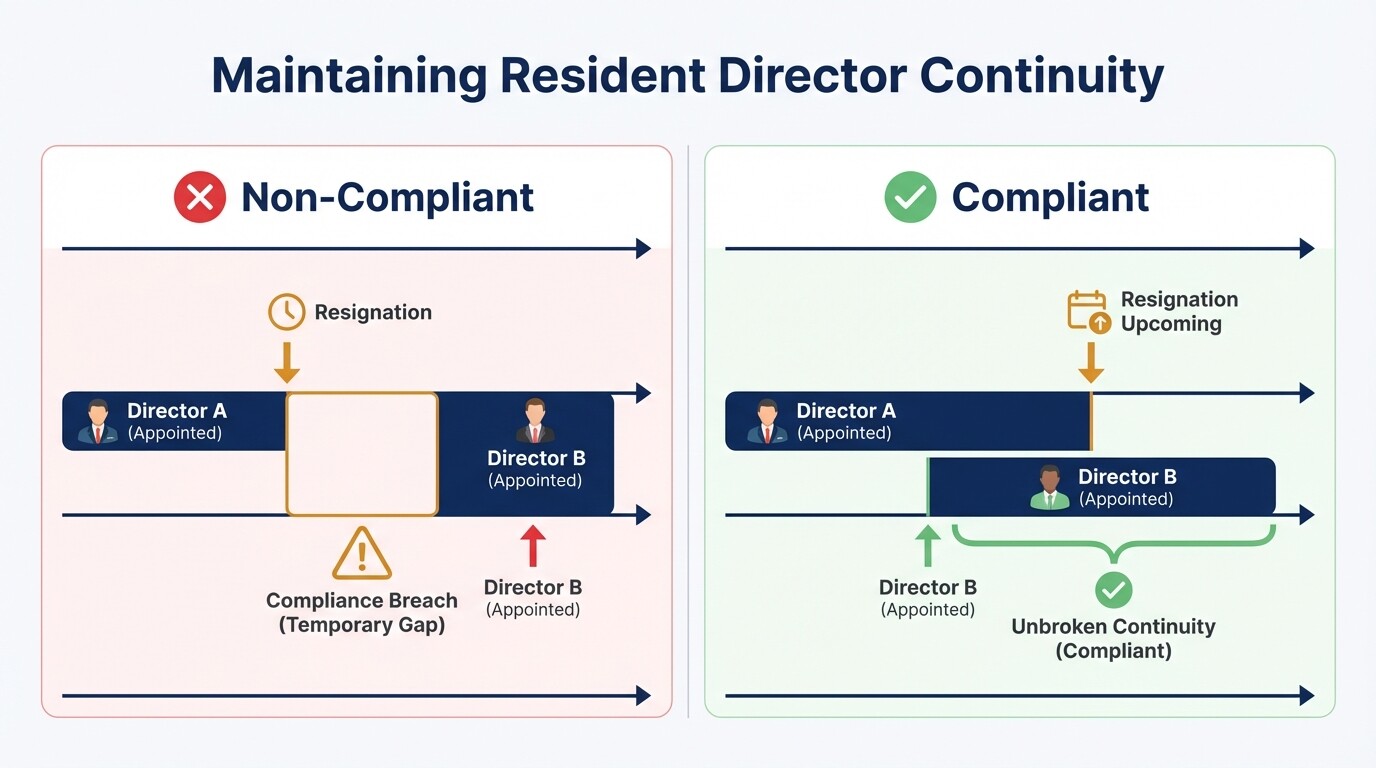
Multinational companies often mishandle director transitions by applying their home country's corporate laws to their Indian subsidiary. Correcting these assumptions prevents compliance failures.
- Temporary residency gaps: Companies cannot allow the board to temporarily fall below the minimum resident director requirement. The law requires unbroken continuity. A new resident director must be appointed before or simultaneously with the outgoing resident director's resignation.
- Resignation timing: An outgoing director's resignation is only complete for the company once formally accepted in a board meeting and filed with the MCA via Form DIR-12. The outgoing director may also independently file Form DIR-11 with the government to protect against personal liability.
- Address verification: Foreign directors must provide a valid foreign residential address. A standard utility bill is insufficient. Proof of address must be notarized and apostilled or consularized in their home country for the DIN application to be approved.
When to Hire a Lawyer
Engaging legal counsel helps manage the documentation standards of the Ministry of Corporate Affairs for cross-border board appointments. An experienced professional ensures filings are precise.
Seek legal assistance when appointing foreign nationals who require complex apostilled documentation from their home countries. Counsel is also necessary to structure board transitions without violating statutory minimums, or if your company misses the 30-day filing window and needs to petition the government for a condonation of delay. You can consult corporate governance lawyers in India who handle subsidiary compliance.
Next Steps
- Identify the new director candidates and confirm their willingness to serve.
- Start the document notarization and apostille process for foreign appointees to avoid DSC and DIN application delays.
- Draft the necessary board resolutions and schedule the video-conferencing meeting.
- Coordinate with an Indian corporate secretary or legal professional to file Form DIR-12 before the 30-day deadline.