


- Corporate Structure: The Private Company Limited by Shares (LTD) is the standard vehicle for foreign tech headquarters, requiring at least one European Economic Area (EEA) resident director or a non-resident bond.
- Tax Efficiency: Ireland offers a 12.5% corporate tax rate for active trading income, though multinational groups exceeding €750 million in global revenue are subject to the 15% Pillar Two minimum rate.
- IP Incentives: Transferring intellectual property to an Irish holding entity unlocks access to the Knowledge Development Box (KDB) and a 25% R&D tax credit.
- Talent Relocation: Hiring expat executives requires compliance with the Critical Skills Employment Permit process and offers tax advantages through the Special Assignee Relief Programme (SARP).
- Regulatory Base: An Irish headquarters provides unrestricted access to the EU single market post-Brexit, acting as a primary establishment for General Data Protection Regulation (GDPR) compliance.
Foreign Investment Guide: Establishing Your Irish Tech Headquarters
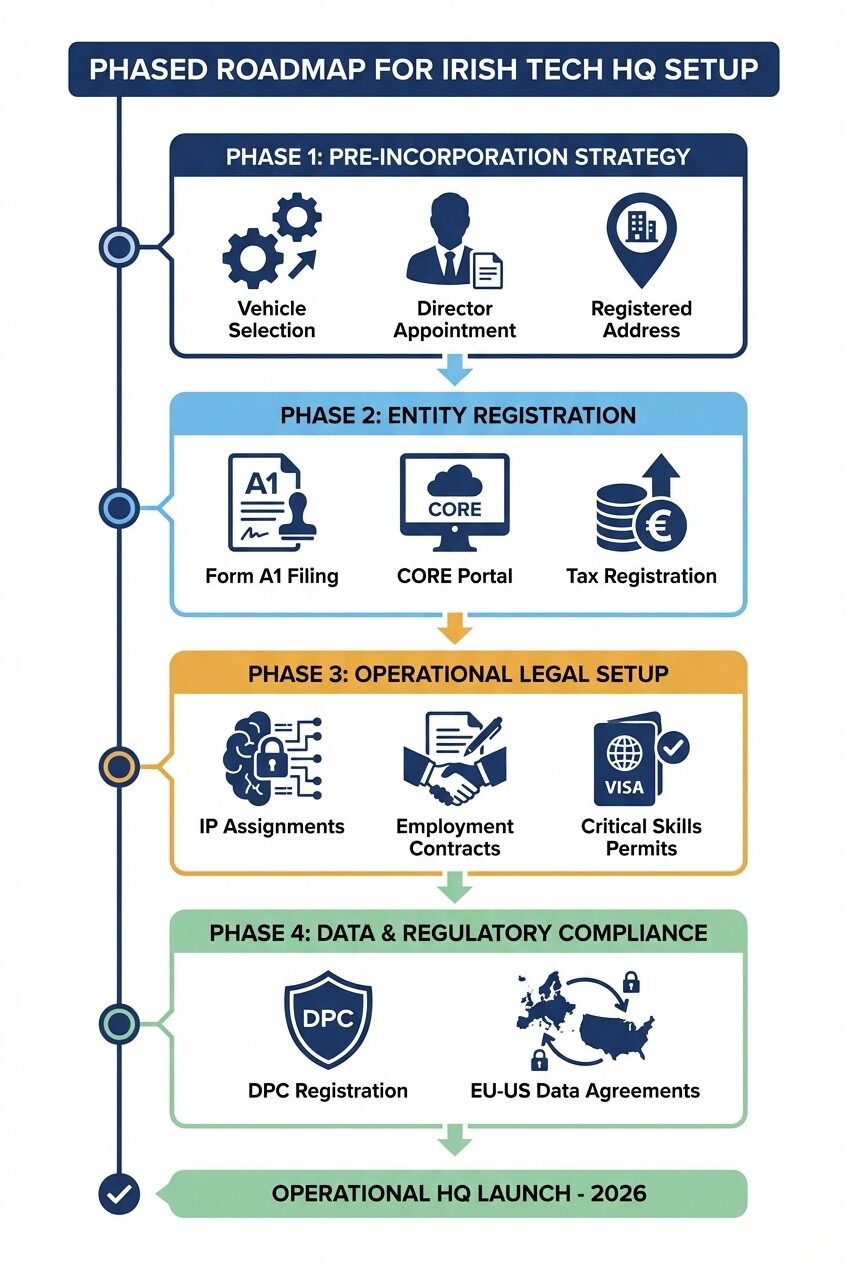
Executing a successful corporate expansion into Ireland requires a phased approach to legal structuring, tax compliance, and regulatory alignment. This guide serves as a practical roadmap for foreign technology firms establishing a European base.
Phase 1: Pre-Incorporation Strategy
- Determine the appropriate corporate vehicle (LTD, DAC, or PLC).
- Appoint an EEA-resident director or secure a Section 137 Non-Resident Director Bond.
- Identify the physical registered office address within the Republic of Ireland.
Phase 2: Entity Registration
- Draft the company constitution and execute Form A1.
- File registration documents electronically through the Companies Online Registration Environment (CORE).
- Register with the Revenue Commissioners for Corporation Tax, Employer PAYE, and Value-Added Tax (VAT).
Phase 3: Operational Legal Setup
- Execute intra-group intellectual property assignments and licensing agreements.
- Draft Irish-compliant employment contracts for relocating executives and local hires.
- Apply for Critical Skills Employment Permits for non-EEA staff.
Phase 4: Data and Regulatory Compliance
- Register with the Data Protection Commission (DPC) as your lead supervisory authority.
- Implement data processing agreements compliant with EU-US data transfer mechanisms.
Registering a Private Company Limited by Shares (LTD)
Registering an LTD requires filing Form A1 and a single-document company constitution with the Companies Registration Office (CRO). This structure limits shareholder liability to the amount of unpaid shares and allows for a single director, making it the most efficient and preferred choice for foreign tech subsidiaries.
Governed by the Companies Act 2014, the LTD simplifies corporate governance for foreign investors. It removes the requirement to hold an Annual General Meeting (AGM) and allows the company to have unlimited corporate capacity.
The standard registration process involves the following practical steps:
- Name Reservation: Ensure the proposed company name is distinguishable from existing Irish entities.
- Document Execution: The directors and subscribers must sign the constitution and Form A1.
- CRO Filing: Submit the documents via the CORE portal. The standard electronic filing fee is €50.
- Beneficial Ownership: Within five months of incorporation, the company must register its ultimate beneficial owners (holding more than 25% of shares) with the Central Register of Beneficial Ownership (RBO).
Standard incorporation takes three to five business days once all correctly signed documents are received by the CRO.
Documenting Intellectual Property Transfers
Transferring intellectual property to an Irish holding company requires executing formal IP assignment agreements that clearly delineate ownership rights, economic benefits, and geographical scope. Properly documenting these transfers is critical to accessing Ireland's Knowledge Development Box (KDB) tax incentives and capital allowances for intangible assets.
Foreign tech firms must demonstrate economic substance in Ireland to benefit from IP-related tax incentives. The documentation must clearly show that the Irish entity assumes the risks and performs the key functions related to the development, enhancement, and exploitation of the IP.
Key legal considerations for IP transfers include:
- Valuation: IP must be transferred at fair market value to comply with Irish transfer pricing rules.
- Stamp Duty: While the transfer of certain intellectual property is exempt from Irish stamp duty, the agreements must be carefully drafted to ensure the exemption applies.
- R&D Tax Credits: Documenting the localized development of new technology allows the Irish entity to claim a 25% tax credit on qualifying research and development expenditures.
Alternative Holding Structures for Multinational Tax Compliance
While the LTD is the standard subsidiary vehicle, multinational tech companies often use a Designated Activity Company (DAC) or Public Limited Company (PLC) as a holding entity to issue specialized debt instruments or list on public exchanges. Selecting the right structure ensures corporate flexibility while maintaining compliance with global tax frameworks like the OECD Pillar Two minimum tax rate.
A DAC is frequently utilized in joint ventures or complex financing structures because its constitution contains a specific objects clause, limiting what the company can do. This provides comfort to institutional investors and creditors.
| Feature | Private Company Limited by Shares (LTD) | Designated Activity Company (DAC) | Public Limited Company (PLC) |
|---|---|---|---|
| Primary Use Case | Standard operating subsidiary | Debt issuance, joint ventures | Public market listings |
| Director Requirement | Minimum of 1 | Minimum of 2 | Minimum of 2 |
| Share Capital | No minimum requirement | No minimum requirement | Minimum €25,000 |
| Objects Clause | Not required | Required (activities are limited) | Required |
| AGM Requirement | Can be waived | Generally required | Mandatory |
Regardless of the structure, holding companies must navigate Ireland's corporate tax regime. While the famous 12.5% rate applies to active trading income for most companies, large multinationals (over €750 million global revenue) are subject to a 15% effective tax rate under the Pillar Two rules adopted by the EU.
Employment Contract Essentials for Relocating Expat Executives
Relocating foreign executives to an Irish tech headquarters requires employment contracts that comply with the Terms of Employment (Information) Act. Companies must align these contracts with the requirements of the Critical Skills Employment Permit to secure long-term residency for key non-EEA personnel.
Irish employment law is heavily regulated, and standard US "at-will" employment concepts do not apply. Contracts for relocating executives must clearly define the terms of the assignment, taxation, and statutory rights.
Essential clauses for executive relocation contracts include:
- Remuneration in Euros: To comply with employment permit requirements, base salary must be stated in Euros (minimum €38,000 for specific critical skills, or €64,000 for general roles).
- SARP Eligibility: Language confirming support for the Special Assignee Relief Programme (SARP), which provides a 30% income tax exemption on salary above €100,000 for qualifying relocated employees.
- Notice Periods: Statutory minimum notice periods apply, though executive contracts typically require three to six months of notice from either party.
- Restrictive Covenants: Non-compete and non-solicit clauses must be reasonable in duration (typically 6 to 12 months) and geographically limited to be enforceable in Irish courts.
Post-Brexit Regulatory Alignment and Data Hosting Rules for 2026
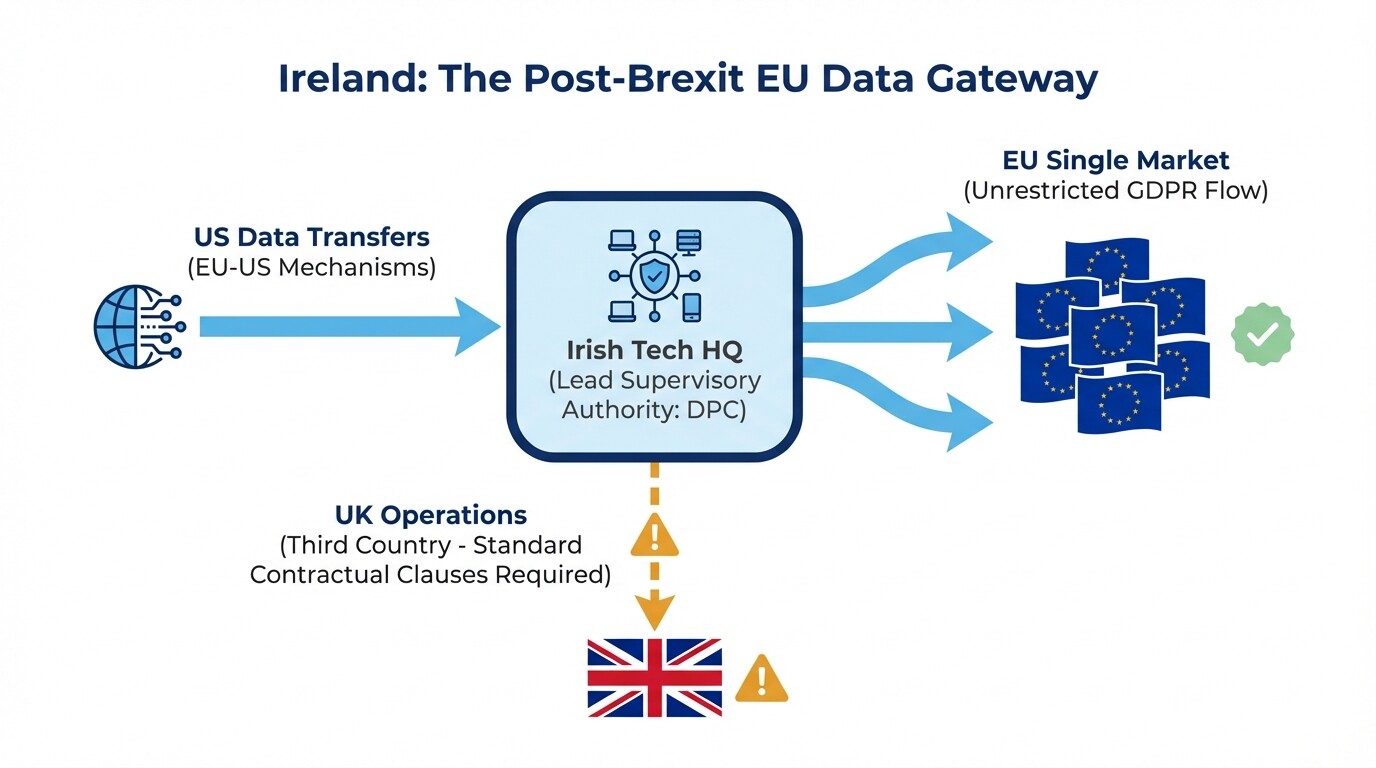
Operating an EU tech headquarters from Ireland requires strict alignment with the General Data Protection Regulation (GDPR) and supervision by the Irish Data Protection Commission (DPC). Looking toward 2026, companies must prepare for stricter EU data hosting rules, the enforcement of the EU Data Act, and localized data processing mandates.
Ireland is the primary gateway for US data transfers to Europe. Post-Brexit, the UK is treated as a third country, meaning data flows between an Irish HQ and a UK branch require standard contractual clauses or reliance on adequacy decisions.
For tech firms planning compliance for 2026, the regulatory focus includes:
- Lead Supervisory Authority: Establishing your main establishment in Ireland allows you to use the "One-Stop-Shop" mechanism, dealing primarily with the DPC rather than regulators in every EU member state.
- EU Data Act Enforcement: By 2026, companies offering connected devices (IoT) and related services must ensure users can easily access and port their generated data.
- EU AI Act Compliance: Tech firms deploying artificial intelligence will need to establish strict risk management systems and localized data governance frameworks within their Irish operations.
Common Misconceptions About Irish Foreign Direct Investment
- The 12.5% tax rate applies to all corporate income. The 12.5% rate applies only to active trading income. Passive income, such as certain royalties, rental income, or interest, is taxed at 25%. Furthermore, companies lacking real economic substance (employees, physical office, local decision-making) cannot avail of the trading rate.
- You must have an Irish citizen on the board of directors. Citizenship is irrelevant to Irish company law. The requirement is residency. An Irish company must have at least one director resident in a member state of the European Economic Area (EEA). If this is not possible, the company can purchase a non-resident director bond.
- US employment contracts can be used with minor modifications. Importing a US employment contract is a critical compliance failure. Irish law forbids "at-will" termination, mandates specific paid leave, strictly regulates working hours under the Organization of Working Time Act, and requires formal disciplinary procedures before dismissal.
Frequently Asked Questions
How much does it cost to set up an Irish tech subsidiary?
The baseline government fee for electronic incorporation is €50. However, comprehensive legal structuring, tax registration, drafting an Irish constitution, and securing a registered office typically range from €1,500 to €4,000 depending on the complexity of the share structure.
How long does company registration take in Ireland?
Once all directors have signed the required documents and they are submitted to the Companies Registration Office (CRO), the incorporation process takes three to five business days. Tax registration with the Revenue Commissioners takes an additional two to four weeks.
What is a Section 137 Non-Resident Director Bond?
If a company does not have a director residing in the EEA, it must secure a bond to the value of €25,000. This insurance policy protects the Irish state against the company's failure to pay certain fines or penalties. The bond typically costs around €1,500 for a two-year period.
Do I need to visit Ireland to set up the company?
No. The entire incorporation process, including document execution and filing, can be completed remotely using electronic signatures or couriered original documents. However, opening an Irish corporate bank account will often require an in-person meeting or extensive remote KYC verification with the bank.
When to Hire a Business Registration Lawyer
Foreign direct investment involves complex cross-border tax, employment, and regulatory considerations. You should engage corporate counsel when structuring complex share classes, transferring high-value intellectual property into the Irish jurisdiction, or drafting localized employment agreements for your executive team. Legal guidance is also essential to ensure your corporate structure meets the "economic substance" requirements demanded by the Irish Revenue Commissioners.
Next Steps for Setting Up Your Tech HQ
Start by outlining your corporate structure and identifying the individuals who will serve as directors and shareholders. Next, secure your registered office address and initiate the drafting of your company constitution. To ensure your expansion is compliant with EU regulations and optimized for local tax incentives, consult with experienced business registration lawyers in Ireland to manage the incorporation and regulatory filings.