


Key Takeaways
Antitrust scrutiny in the European Union routinely targets the technology sector. Because Brexit left Ireland as the primary English-speaking, common-law jurisdiction in the EU, many US tech companies base their European headquarters in Dublin. This makes Ireland the primary jurisdictional battleground for regulatory enforcement. Managing these interventions requires strict coordination between corporate headquarters and local legal teams.
- The Competition and Consumer Protection Commission (CCPC) has broad powers to conduct unannounced inspections and demand digital records.
- Recent legislation allows the CCPC to impose administrative financial sanctions up to 10% of a company's global turnover without going through a criminal court.
- Offering behavioral or structural commitments early can close an investigation without an admission of liability.
- Internal communications from US-based in-house counsel generally lack legal professional privilege protections under EU law.
- Defense strategies in Ireland must align with parallel European Commission investigations to prevent contradictory outcomes.
Phases and Timeline of a CCPC Investigation
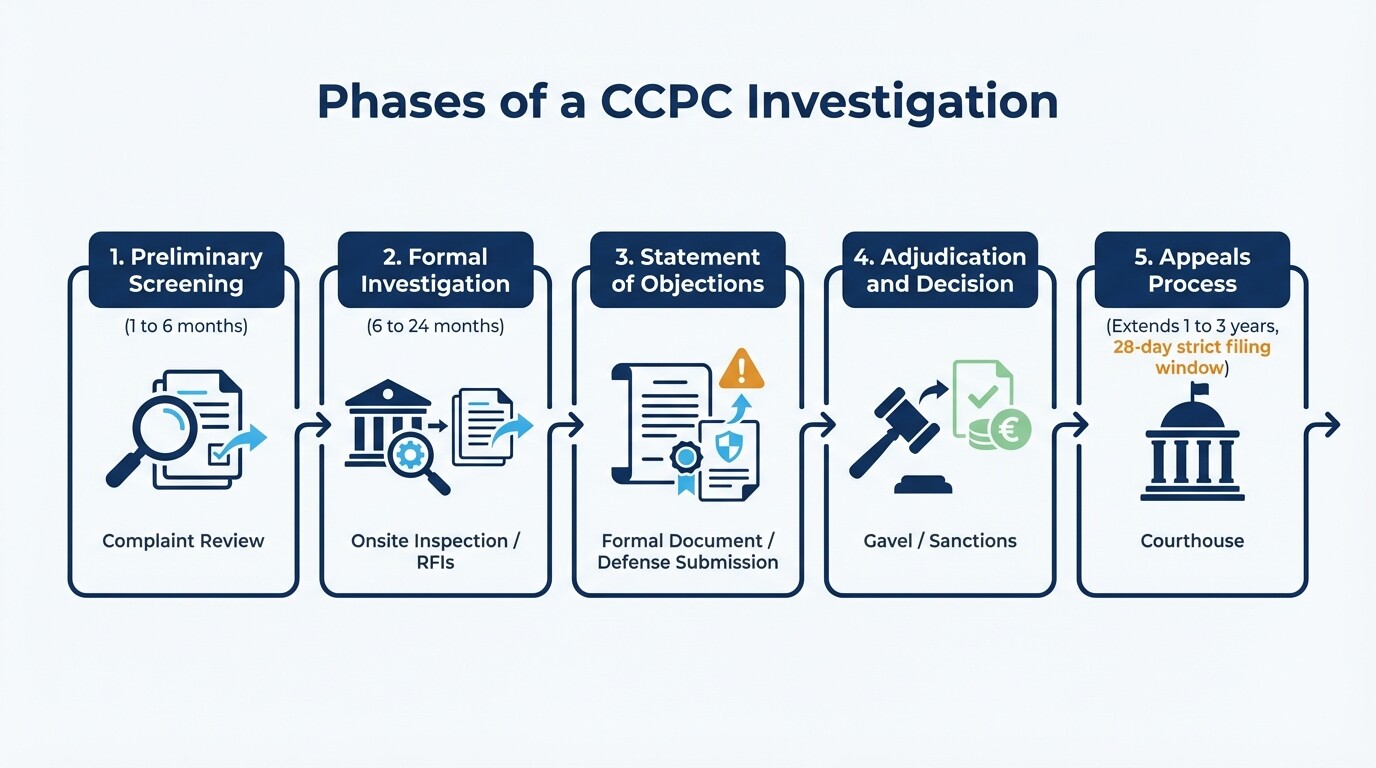
A standard CCPC investigation moves through four main phases: screening, formal investigation, statement of objections, and final adjudication. The timeline ranges from 12 months for local cases to several years for complex technology markets involving parallel EU probes.
- Preliminary Screening (1 to 6 months): The CCPC reviews complaints, whistleblower reports, or market intelligence to decide if formal action is warranted.
- Formal Investigation (6 to 24 months): The authority gathers evidence via unannounced onsite inspections, formal Requests for Information (RFIs), and witness interviews.
- Statement of Objections: If investigators find evidence of anti-competitive behavior, they issue a formal document detailing the allegations. The defending company then submits a written defense and may request an oral hearing.
- Adjudication and Decision: An independent panel reviews the evidence. They can issue infringement decisions, impose financial sanctions, or close the case.
- Appeals Process: Companies typically have 28 days to appeal CCPC administrative decisions to the Irish High Court. Missing this window makes the sanctions final and immediately payable. Appeals extend the total timeline by one to three years.
Managing Dawn Raids and Information Requests
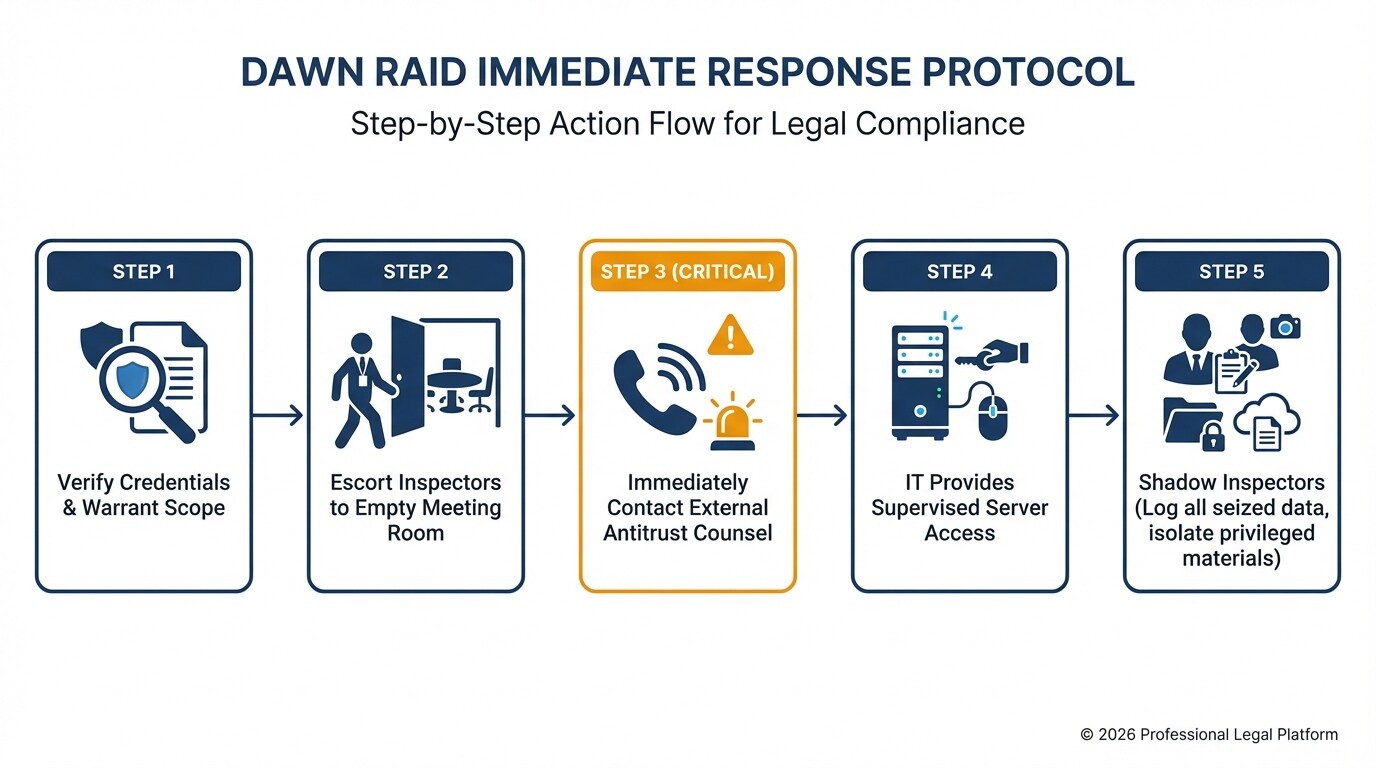
Responding to unannounced inspections (dawn raids) and formal RFIs requires strict protocol adherence. Mishandling initial regulatory interactions often triggers separate administrative fines for obstruction or providing misleading data.
Onsite Staff Response
Reception staff and site managers must immediately verify the inspectors' credentials and the scope of the search warrant. They should ask inspectors to wait in an empty meeting room until external antitrust counsel arrives. Regulators are not legally obligated to wait, but they often agree to a short delay.
Data and Server Seizures
Inspectors hold broad legal authority to image computer hard drives, access cloud servers, and review corporate mobile devices. US tech firms must ensure their IT departments cooperate by providing administrative access. Legal teams should actively shadow the inspectors to log every seized document and isolate legally privileged materials.
RFI Deadlines
RFIs typically impose strict deadlines ranging from two to four weeks. Failing to meet these deadlines or submitting incomplete datasets often results in daily penalty payments that accumulate until full compliance is achieved.
Alternatives to Litigation: Negotiating Commitments
Companies can resolve antitrust investigations without a formal infringement decision by offering legally binding commitments to the CCPC. These agreements bypass lengthy litigation by structurally or behaviorally altering how the firm operates within the European Economic Area.
- Behavioral Commitments: The company agrees to change specific business practices. For tech firms, this often means altering licensing terms, ending exclusive contracts, or opening API access to third-party developers.
- Structural Commitments: In severe monopolization or merger cases, the company agrees to sell specific divisions or assets to restore market competition.
- Market Testing: The CCPC typically publishes proposed commitments to gather feedback from competitors and consumers. If the market test is positive, the CCPC makes the commitments legally binding and closes the investigation.
- Compliance Monitoring: The CCPC appoints an independent monitoring trustee, paid for by the company, to ensure strict adherence to the terms over several years.
Assessing Fines and Multi-Jurisdictional Strategy
Under the Competition (Amendment) Act 2022, the CCPC can impose administrative financial sanctions up to €10 million or 10% of a company's total worldwide turnover, whichever is greater. Extreme breaches like price-fixing or bid-rigging remain criminal offenses in Ireland. Individuals involved in these hardcore cartels face substantial personal fines and up to 10 years in prison.
- Turnover Calculation: Fines are based on the global consolidated revenue of the entire corporate group, not just the Irish subsidiary.
- Aggravating and Mitigating Factors: Fines increase for repeat offenses or obstruction. Demonstrating cooperation or implementing a robust compliance program post-infringement reduces the final penalty.
- The Leniency Program: The first company to report a secret cartel and provide substantial evidence receives full immunity from financial sanctions. Subsequent applicants receive fine reductions based on the timing and value of their evidence.
- ECN Coordination: The CCPC routinely shares evidence and strategy with the European Commission and other member states. Regulators in Brussels will scrutinize defense arguments submitted in Dublin, making consistent cross-border messaging essential.
Pre-Litigation Compliance Audit Checklist
Routine antitrust compliance audits minimize the risk of dawn raids and identify restrictive agreements early. Use the following checklist to evaluate your Irish and EU operations annually.
- Document Retention: Verify that auto-delete policies on corporate messaging apps comply with EU regulatory requirements for business records.
- Pricing Algorithms: Audit dynamic pricing software to ensure algorithms are not inadvertently coordinating with competitor pricing models.
- Exclusivity Agreements: Review vendor and developer contracts to identify exclusivity clauses that might lock competitors out of the market.
- Emergency Readiness: Distribute updated contact lists for local Irish counsel to all reception and IT staff at the Dublin headquarters.
- Trade Associations: Audit employee participation in industry consortiums to prevent improper information exchange.
- Privilege Segregation: Ensure correspondence from external EU-qualified lawyers is clearly separated from general business advice to protect legal professional privilege during an inspection.
Common Misconceptions About Irish Antitrust Law
American executives sometimes misunderstand how EU and Irish antitrust enforcement overlaps. Misjudging the CCPC's enforcement powers or the scope of legal privilege easily compromises a defense.
- Jurisdictional limits: Many executives assume the CCPC only cares about the local Irish market. The CCPC enforces the Treaty on the Functioning of the European Union (TFEU) and frequently acts on behalf of the broader European market.
- In-house privilege limits: Under US law, advice from internal corporate lawyers is highly protected. Under EU law during Commission investigations, communications with in-house counsel are generally not protected by legal professional privilege. While Irish domestic law offers slightly more protection, relying on internal privilege remains highly risky.
- Formal contracts are required for violations: Companies often assume they are safe without written price-fixing agreements. Regulators routinely prove collusion using circumstantial evidence, informal text messages, or parallel conduct.
When to Hire a Lawyer
You must engage local Irish antitrust counsel immediately upon receiving a formal Request for Information or experiencing an unannounced CCPC inspection. Engaging representation during the preliminary screening phase allows companies to shape the narrative before regulators draft formal charges.
Navigating the intersection of US corporate strategy, Irish administrative law, and EU directives requires specialized local knowledge. Retaining experienced antitrust litigation lawyers in Ireland ensures your company is prepared to negotiate commitments, protect privileged data, and mitigate heavy financial exposure.
Next Steps
Proactive engagement and operational readiness are the best defenses against antitrust scrutiny. Follow these immediate steps to secure your regulatory posture.
- Appoint a Legal Liaison: Designate an executive based in Ireland as the primary point of contact for external counsel and the CCPC.
- Conduct a Mock Dawn Raid: Work with external counsel to run an unannounced inspection drill at your Irish headquarters to test IT and reception readiness.
- Audit High-Risk Contracts: Initiate a legal review of your top revenue-generating partner contracts in the EU to identify problematic exclusivity or pricing clauses.
- Update Staff Training: Deploy antitrust compliance training tailored to your sales, marketing, and product teams operating in Europe.