Key Takeaways
Planning an acquisition in Italy requires choosing between a share purchase and an asset purchase. This structural decision directly dictates your tax liability, employee transfer obligations, and exposure to historical debts.
- Share deals transfer the entire corporate entity and its historical liabilities to the buyer.
- Asset deals allow buyers to acquire specific business components, though buying an ongoing "business branch" still triggers certain joint liabilities under Italian law.
- Article 2112 of the Italian Civil Code mandates that employees automatically transfer with their existing rights when an ongoing business is purchased.
- Foreign investors must notify the Italian government before acquiring assets in strategic sectors under the "Golden Power" regulations.
- Transaction costs vary widely, with share deals generally subject to flat registration taxes and asset deals triggering proportional taxes based on the asset types involved.
M&A Share Purchase vs Asset Purchase Comparison
A share purchase involves buying the equity of an Italian company, meaning you inherit all its assets, contracts, and past liabilities. An asset purchase involves buying specific tangible and intangible assets, which generally leaves historical liabilities with the seller unless you acquire an operational business branch.
| Feature | Share Purchase (M&A) | Asset Purchase (Business Branch) |
|---|---|---|
| Historical Liabilities | Buyer assumes all past tax, legal, and operational debts. | Buyer assumes specific joint liabilities (tax and labor) but avoids general corporate debts. |
| Asset Selection | Buyer takes everything owned by the target company. | Buyer can selectively exclude unwanted assets or contracts. |
| Contract Transfer | Contracts remain valid automatically as the corporate entity continues. | Contracts require third-party consent to transfer to the new owner. |
| Tax Structure | Typically subject to a nominal flat registration tax. | Subject to proportional registration tax based on asset values (e.g., real estate, goodwill). |
| Complexity | High due diligence requirements to uncover hidden liabilities. | Complex drafting required to clearly define which assets transfer. |
Italian Acquisition Legal Checklist
Executing an acquisition in Italy requires structured due diligence to uncover hidden liabilities and ensure regulatory compliance. Use this checklist to evaluate targets and structure your purchase agreement effectively.
Corporate and Structural Due Diligence
- Verify the target company's corporate standing with the Italian Register of Companies.
- Review the Articles of Association for pre-emption rights or change-of-control clauses that could block a share transfer.
- Identify all current shareholders and secure necessary board or shareholder resolutions approving the sale.
Financial and Tax Liability Checks
- Audit the last three years of financial statements filed with the local Chamber of Commerce.
- Request a certificate of tax compliance from the Italian Revenue Agency to uncover outstanding tax debts.
- For asset purchases, verify joint tax liability risks under Article 14 of Legislative Decree 472/1997.
Employment and Labor Law Compliance
- Inventory all current employment contracts, including collective bargaining agreements applied to the workforce.
- Calculate accrued severance pay (TFR) liabilities that will transfer with the employees.
- Initiate the mandatory 25-day trade union notification process if the target employs more than 15 workers.
Commercial and Operational Review
- Review major supplier and customer contracts for change-of-control termination rights.
- Verify ownership of key intellectual property through the Italian Patent and Trademark Office.
- Confirm that all physical premises comply with Italian environmental and safety regulations.
Labor Law Implications for Italian Acquisitions
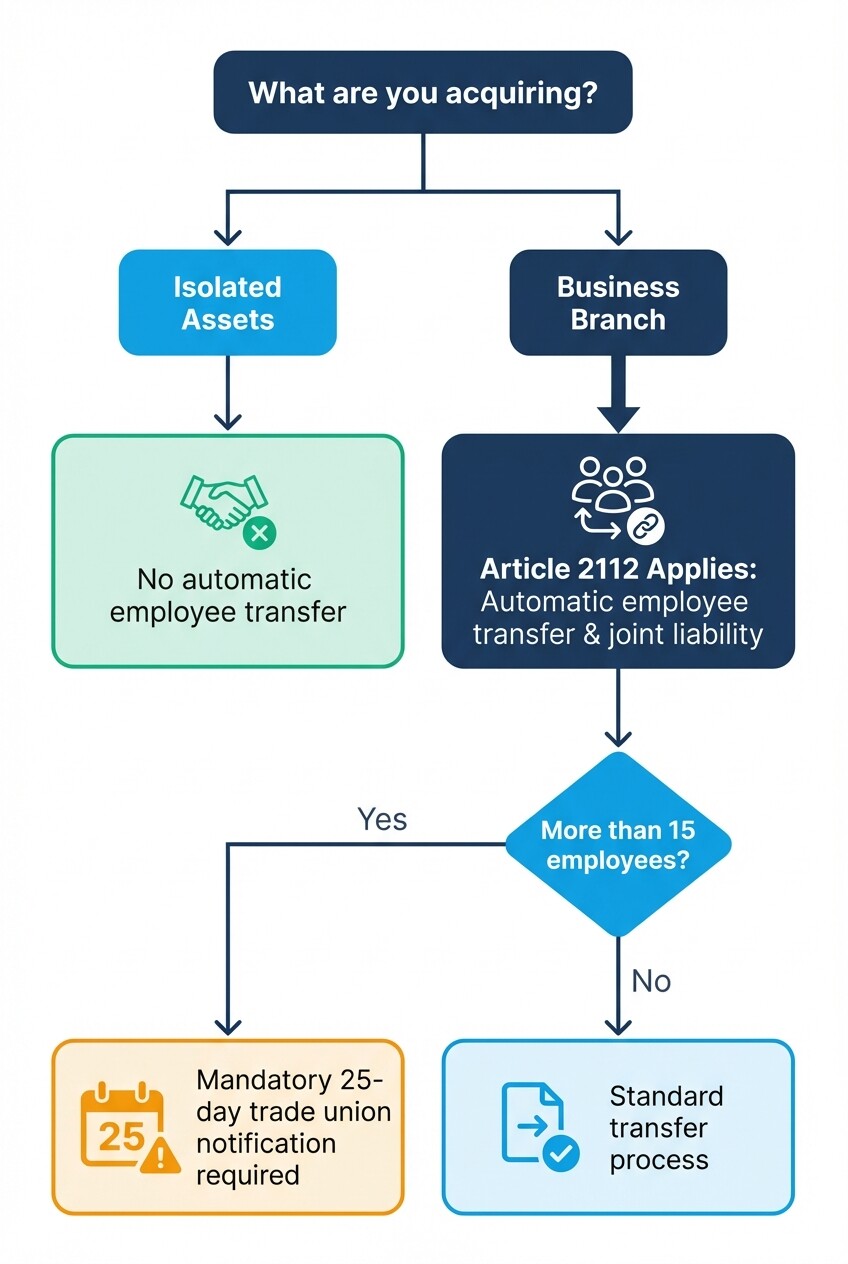
Under Italian labor law, buying an operational business automatically transfers existing employees to the new owner, whereas buying isolated assets does not. Article 2112 of the Italian Civil Code protects workers by ensuring their employment continues under the exact same terms and conditions.
When structuring your deal, you must differentiate between acquiring a collection of random assets and acquiring a "business branch" capable of operating independently. If Italian courts deem the acquired assets a functional business branch, Article 2112 automatically applies. The buyer and seller become jointly liable for all unpaid wages and accrued severance pay owed to the transferred employees at the time of the sale.
Additionally, if the business employs more than 15 people, Italian law mandates a strict consultation process. The buyer and seller must notify the relevant trade unions at least 25 days before signing a binding purchase agreement. Failure to conduct this consultation can lead to union lawsuits and injunctions delaying the transaction.
Navigating Italy's Golden Power FDI Screening
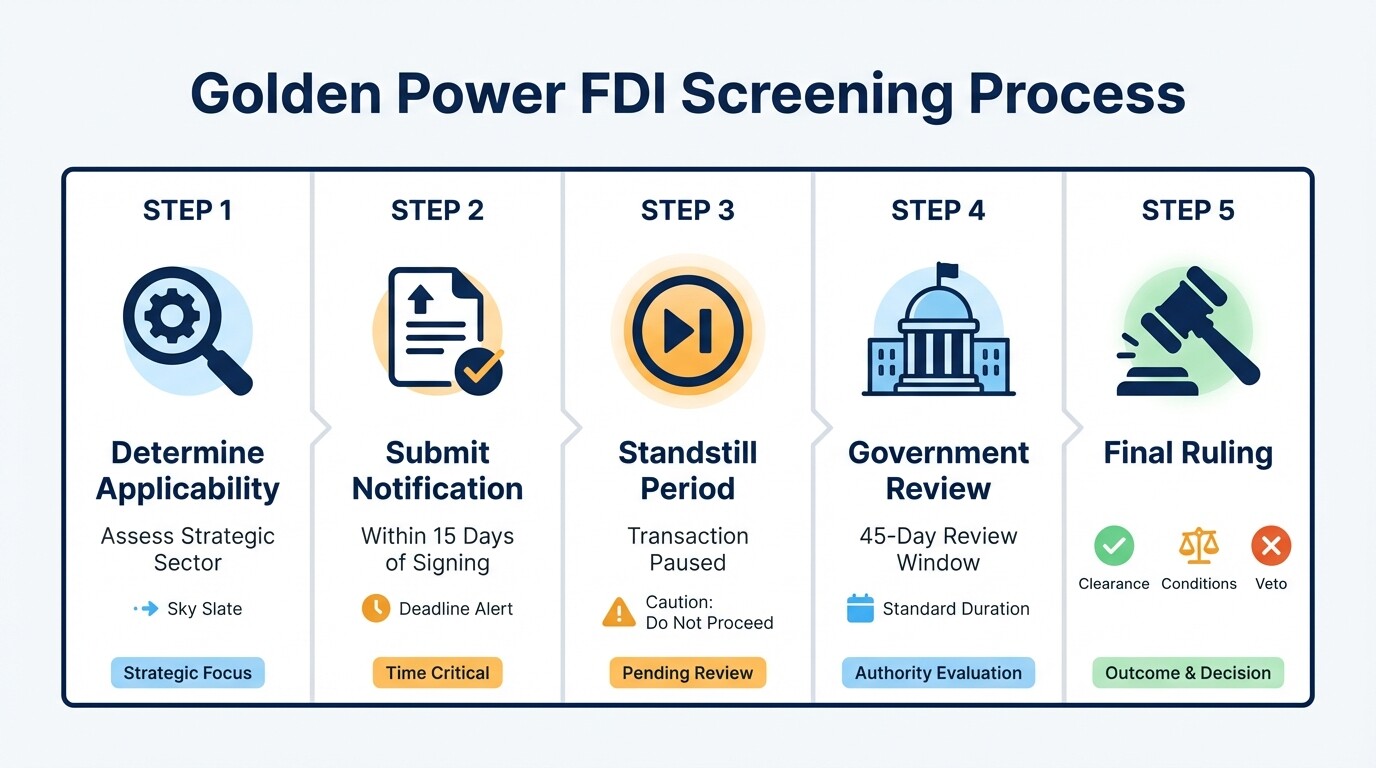
Italy's Golden Power framework allows the government to block or impose strict conditions on foreign direct investments in strategic sectors like defense, energy, communications, healthcare, and advanced technology. Foreign buyers must formally notify the Italian government before finalizing a transaction in these protected industries.
The screening process follows strict statutory deadlines and requirements outlined by the Presidency of the Council of Ministers:
- Determine Applicability: Assess whether the target company operates in a strategic sector or possesses sensitive data and technologies.
- Submit Formal Notification: The acquiring company must submit a detailed notification to the government within 15 days of signing a binding resolution or agreement.
- Standstill Period: The transaction cannot legally close while the government reviews the notification. Closing early renders the transaction null and void.
- Government Review: The government has 45 days to review the transaction, though this period can pause if authorities request additional information.
- Final Ruling: The government will either clear the transaction, approve it with mandatory conditions, or veto the acquisition entirely.
Acquisition Cost Estimates and Taxes in Italy
Structuring your transaction correctly minimizes registration taxes and transactional costs in Italy. Share deals typically incur a flat registration tax, while asset purchases trigger proportional taxes based on the asset types involved.
For a share purchase, buyers generally pay a flat registration tax of EUR 200. However, notary fees to execute the share transfer are mandatory and scale with the transaction value, typically ranging from EUR 2,000 to over EUR 15,000 for mid-market deals. Legal and financial due diligence costs for share deals are higher due to the assumption of all historical liabilities, generally running between EUR 20,000 and EUR 75,000 depending on the target's complexity.
Asset purchases face a more complex tax regime. The transaction is subject to a proportional registration tax applied to the fair market value of the assets. The standard rate for a business branch transfer is 3 percent, but this jumps to 9 percent for any included real estate. Inventory and receivables are taxed at lower rates. Engaging tax advisors to correctly allocate the purchase price among different asset classes is critical to optimizing this tax burden.
Alternatives to Full Acquisitions in Italy
A complete buyout is not the only way to enter the Italian market. Foreign companies often use joint ventures or minority investments to reduce capital outlay and share regulatory risks while testing market viability.
Forming a Joint Venture with an established Italian partner provides immediate access to local distribution networks and regulatory knowledge. Joint ventures can be structured as contractual partnerships or by incorporating a new jointly-owned Italian corporate entity. Strategic minority investments offer another alternative, allowing foreign buyers to take a 10 to 30 percent equity stake in an Italian target. This provides board representation and market insight without triggering the heavy due diligence burdens and integration costs of a full acquisition.
Common Misconceptions About Buying an Italian Business
Foreign investors often misunderstand Italian labor protections and liability transfers, leading to costly post-closing surprises. Clarifying these rules early prevents deal collapse and financial penalties.
A frequent mistake is assuming that an asset purchase completely erases all historical liabilities. While an asset purchase shields you from general corporate debts, Italian law imposes strict joint liability on the buyer for unpaid employee wages, severance obligations, and certain historical tax debts tied to the acquired business branch.
Another misconception is that a buyer can freely terminate redundant employees immediately after an acquisition. Italian labor law explicitly states that a business transfer is not a valid legal ground for dismissal. Any post-acquisition restructuring requires strict economic justification and often necessitates complex negotiations with local trade unions.
Frequently Asked Questions
Do I need a public notary to buy a company in Italy?
Yes, Italian law requires a public notary to execute and register the official transfer deeds for both share and asset purchases. The notary ensures compliance with local corporate laws and registers the transaction with the Italian Register of Companies.
What is the difference between an asset and a business branch in Italian law?
An asset is an isolated item like a single machine or trademark. A business branch is an organized collection of assets capable of operating independently. Buying a business branch automatically transfers employees and specific joint liabilities, whereas buying isolated assets does not.
How long does an M&A transaction take in Italy?
A standard mid-market acquisition typically takes three to six months from the initial letter of intent to closing. This timeline extends significantly if the transaction requires antitrust clearance, trade union consultations, or Golden Power approval.
Are non-disclosure agreements enforceable in Italy?
Yes, non-disclosure agreements are highly enforceable in Italy and are a mandatory first step before sharing financial or technical data. They are governed by the Italian Civil Code and protect trade secrets during the preliminary evaluation phase.
When to Hire an Italian M&A Lawyer
Engaging legal counsel early ensures your letter of intent aligns with Italian statutory requirements and protects your negotiation leverage. A specialized lawyer navigates local regulations, conducts comprehensive due diligence, and negotiates the purchase agreement to limit your post-closing exposure.
Attempting to apply foreign acquisition templates directly to an Italian target frequently results in unenforceable clauses and regulatory penalties. You can find qualified Merger & Acquisition lawyers in Italy to guide you through the local corporate registry and tax authority requirements.
Next Steps for Your Italian Acquisition
Moving forward requires assembling your deal team and defining your strategic parameters before engaging potential targets. Start by signing a binding non-disclosure agreement to safely request preliminary financial statements and corporate records from the seller.
Once you verify the target aligns with your strategic goals, draft a non-binding letter of intent outlining the proposed valuation, deal structure, and exclusivity period. This document secures your right to conduct deep legal and financial due diligence without interference from competing buyers.