- Mandatory Minimums: Commercial leases in Italy are strictly governed by Law 392/1978, requiring a minimum "6+6" year duration for most businesses.
- Goodwill Indemnity: Tenants in retail or consumer-facing businesses are legally entitled to 18 months of rent as compensation if the landlord terminates the lease.
- Restricted Termination: Tenants can only terminate a lease early if they have "grave reasons" or have specifically negotiated a "free withdrawal" clause.
- Rent Control: Annual rent increases are capped based on the ISTAT inflation index, preventing landlords from imposing arbitrary hikes.
- Mandatory Registration: All commercial leases must be registered with the Agenzia delle Entrate (Italian Revenue Agency) within 30 days of signing to be legally valid.
Essential Commercial Lease Clause Checklist
For international businesses entering the Italian market, the lease agreement is the most critical document in your operational setup. Because Italian law (Codice Civile and Law 392/1978) provides heavy protections for tenants, landlords often try to include clauses that bypass these rights.
Use this checklist to ensure your contract includes mandatory protections and favorable international standards:
| Clause Category | Requirement | Benefit to Tenant |
|---|---|---|
| Duration | Ensure a "6+6" year structure (or 9+9 for hotels). | Guarantees long-term operational stability. |
| Early Termination | Negotiate a "Recesso Convenzionale" (Free Withdrawal) clause. | Allows exit without proving "grave reasons." |
| Goodwill Indemnity | Verify the right to 18 months' rent compensation. | Provides a financial cushion if forced to relocate. |
| Rent Indexation | Limit ISTAT adjustments to 75% (standard) or 100% (large leases). | Predictable cost management against inflation. |
| Subletting | Expressly allow subletting/assignment during M&A or restructuring. | Facilitates corporate changes without lease breach. |
| Maintenance | Distinguish between "Ordinary" (Tenant) and "Extraordinary" (Landlord). | Limits tenant liability to daily wear and tear. |
Sample Early Termination Clause (Recesso Convenzionale)
"Notwithstanding the statutory right to terminate for grave reasons, the Tenant shall have the right to withdraw from this Lease Agreement at any time after the first [Number] months by providing the Landlord with [Number] months' prior written notice via registered mail (PEC or Raccomandata A/R). In such event, no indemnity for loss of goodwill shall be due to the Tenant."
Understanding the Mandatory 6+6 Year Duration
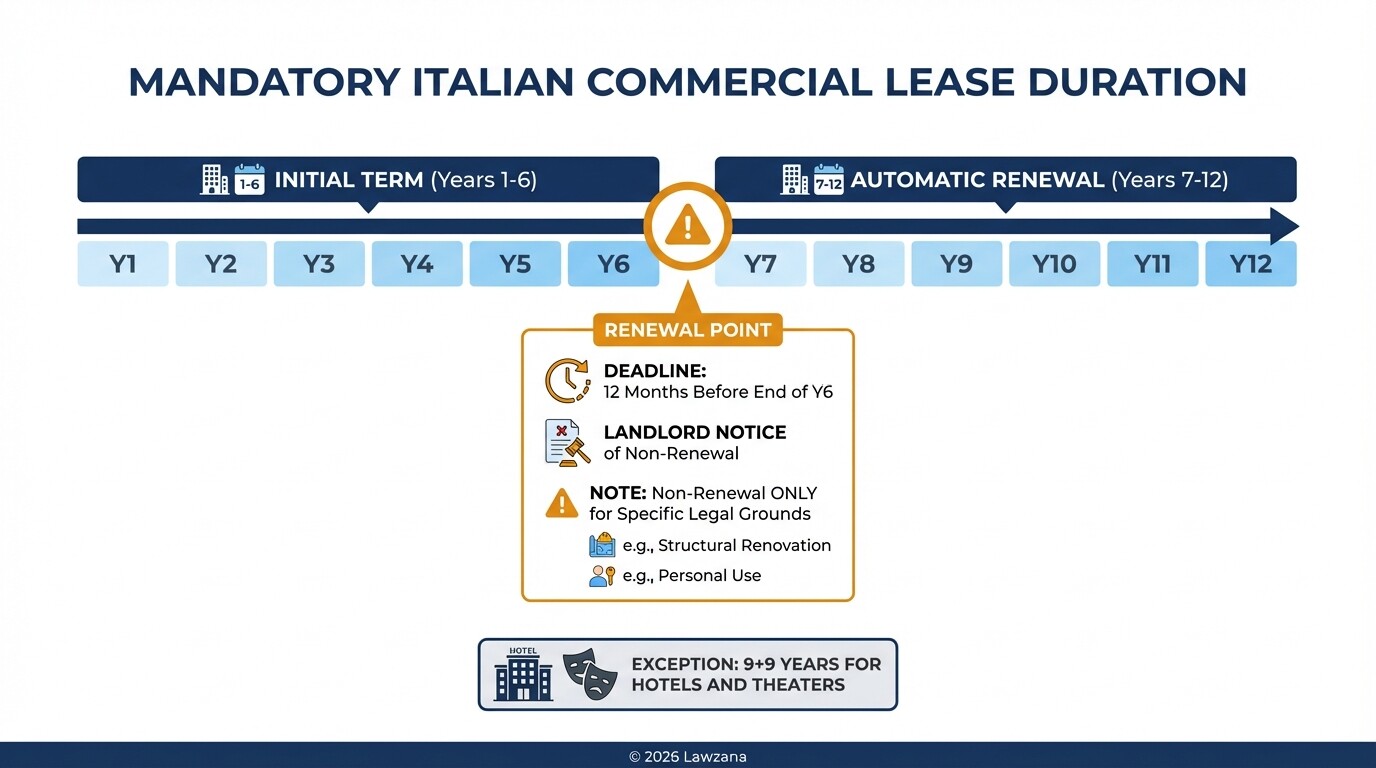
Commercial leases in Italy must have a minimum duration of six years, with an automatic renewal for an additional six years. This "6+6" structure is mandatory for industrial, commercial, artisanal, and professional activities, while hotels and theaters require a "9+9" duration.
Any clause attempting to shorten these terms is legally null and void, and the law will automatically overwrite it to the 6 or 9-year minimum. The landlord can only deny the first renewal (after the initial six years) under very specific circumstances, such as needing the property for their own use or needing to perform structural renovations that require the building to be empty. If the landlord does not send a formal notice of non-renewal at least 12 months before the expiry, the lease automatically renews under the same conditions.
Right to Indemnity for Loss of Goodwill
The "Indemnity for Loss of Goodwill" (Indennità per la perdita dell'avviamento) is a mandatory payment made by the landlord to the tenant when a commercial lease ends. This payment is designed to compensate the tenant for the loss of their business location and the potential "clientele" the landlord might inherit.
For standard commercial activities involving contact with the public (like retail or showrooms), the indemnity is equal to 18 months of the last rent payment. If the landlord (or a new tenant) starts a business in the same sector within one year of the lease termination, the indemnity is doubled to 36 months.
- Exceptions: This indemnity is NOT due if the tenant terminates the lease, if the tenant is evicted for breach of contract, or if the tenant goes through bankruptcy proceedings.
- Waiver: In standard leases, the tenant cannot waive this right in advance. However, for "Large Leases" (where annual rent exceeds €250,000), parties can negotiate different terms.
Rent Indexation and ISTAT Inflation Adjustments
Rent increases in Italy are not at the landlord's total discretion; they are strictly tied to the ISTAT Consumer Price Index (FOI). This ensures that rent adjustments reflect the actual change in the cost of living and inflation rather than market speculation.
For standard commercial leases, the annual rent increase cannot exceed 75% of the ISTAT index change. For example, if inflation is 4%, the landlord can only increase the rent by 3%. The lease must explicitly state that the increase is requested annually.
- Large Leases: For contracts with an annual rent higher than €250,000, the parties are free to negotiate indexation up to 100% of the ISTAT index or even different adjustment methods.
- Timing: The adjustment can only be applied starting from the second year of the lease.
Assignment and Subletting in Corporate Restructuring
In Italy, the tenant has a unique statutory right to sublet the property or assign the lease even without the landlord's specific consent, provided the business itself is also transferred. This is governed by Article 36 of Law 392/1978.
If an international business undergoes a merger, acquisition, or internal restructuring that involves the transfer of a "business branch" (ramo d'azienda), the lease can follow that business branch. The tenant must notify the landlord via registered mail. The landlord can only object for "serious reasons" (typically related to the financial instability of the new tenant) within 30 days of receiving the notice.
This protection is vital for multinational corporations that may need to shift operations between subsidiaries without losing their physical footprint in major Italian cities.
Early Termination for Grave Reasons and Notice Periods
Under Italian law, a tenant always has the right to terminate a lease at any time if "grave reasons" (gravi motivi) exist. This requires a six-month notice period sent via registered mail.
What constitutes a "grave reason" is often a point of litigation. It must be an event that is:
- Extraneous to the tenant's will (unforeseeable).
- Unforeseeable at the time the lease was signed.
- Objective, making the continuation of the lease economically or practically impossible.
Commonly accepted grave reasons include a significant economic crisis affecting the specific industry or a sudden structural change in the local market. Because proving "grave reasons" is difficult, international businesses should always negotiate a "Recesso Convenzionale" (as shown in the sample clause above). This allows the tenant to leave for any reason after a certain period, provided they give the agreed-upon notice (usually 6 months).
Common Misconceptions About Italian Leases
"We can negotiate a 3-year trial lease."
This is a common mistake. Any lease for commercial activity will automatically be treated as a 6-year lease by Italian courts. The only exception is "transitory" leases for very short-term needs, but these are difficult to justify for a standard business operation and are strictly scrutinized.
"The landlord can keep the security deposit for any reason."
Security deposits (Deposito cauzionale) are capped by law at three months' rent. The deposit must be held in an interest-bearing account, and the interest must be paid to the tenant annually unless agreed otherwise. The landlord can only withhold the deposit at the end of the lease to cover specific, documented damages to the property or unpaid rent.
"If I sign the contract, it's valid immediately."
A lease is only fully enforceable and "opposable" to third parties if it is registered with the Agenzia delle Entrate. Registration involves a tax (typically 1% of the annual rent, split 50/50 between landlord and tenant) and a stamp duty. Without registration, the contract is considered null and void in the eyes of the Italian tax authorities.
FAQs
What is the typical security deposit for a commercial lease in Italy?
The standard security deposit is 3 months' rent. Alternatively, many landlords now accept a bank guarantee (fideiussione bancaria) instead of cash, which allows the business to keep its liquidity while providing the landlord with security.
Who pays the registration tax on the lease?
By law, the registration tax (typically 1% of the annual rent) is shared equally (50/50) between the landlord and the tenant. However, the parties can agree that the tenant pays more, though this is rare in professional negotiations.
Can the landlord increase the rent if the market value of the area goes up?
No. During the 6+6 year term, the landlord cannot increase the rent based on market value. They are limited strictly to the ISTAT inflation adjustments. Market-based increases can only be negotiated when a brand-new contract is signed after the 12-year cycle ends.
What are 'extraordinary maintenance' costs?
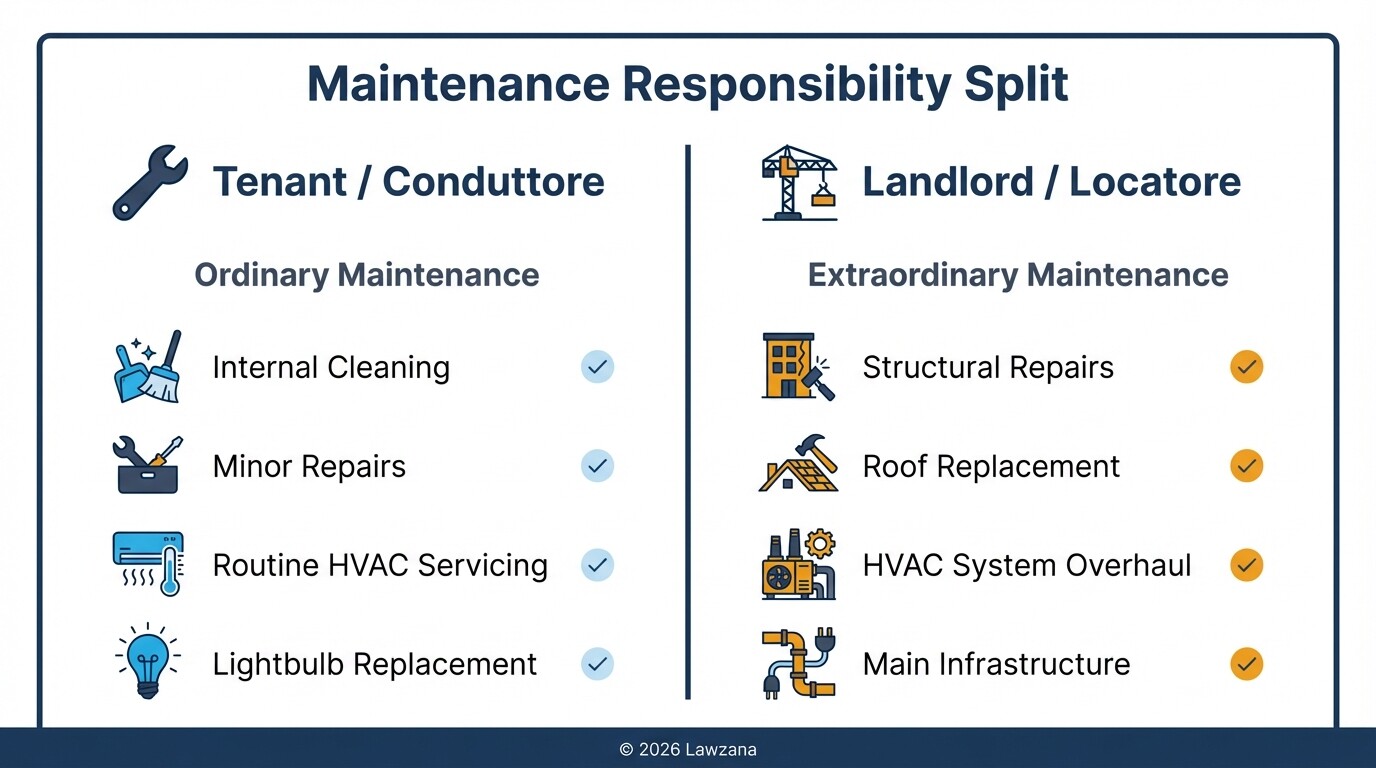
Extraordinary maintenance refers to structural repairs, such as fixing the roof, replacing the HVAC system, or structural plumbing. Under the Italian Civil Code, these costs are the responsibility of the landlord. Tenants are only responsible for "ordinary" maintenance (cleaning, minor repairs, lightbulb replacement).
When to Hire a Lawyer
Commercial leasing in Italy is heavily regulated to favor the tenant, but the complexity of Law 392/1978 and the Civil Code means that "standard" contracts offered by landlords often contain hidden pitfalls. You should consult a lawyer if:
- You are negotiating a "Large Lease" (rent over €250,000) where statutory protections can be waived.
- The landlord is asking you to waive the Goodwill Indemnity.
- You are restructuring your company and need to transfer the lease to a new entity.
- You need to terminate a lease early and do not have a "free withdrawal" clause.
- You are renting a property with "historical" status (immobili vincolati), as specific cultural heritage laws may apply.
Next Steps
- Request a Draft: Ask the landlord for their standard Contratto di Locazione Commerciale and check the duration and indexation clauses.
- Verify the ISTAT Clause: Ensure the indexation is capped at 75% for standard leases.
- Perform Due Diligence: Use the Agenzia delle Entrate portal to verify the property's cadastral category (it must be Category C/1 for retail or A/10 for offices).
- Negotiate Withdrawal: Prioritize adding a "free withdrawal" clause to allow flexibility beyond the "grave reasons" statutory requirement.
- Secure a Bank Guarantee: Contact your bank early to set up the fideiussione if you prefer not to tie up three months of cash in a deposit.