


- Forced Heirship applies by default: Italian law guarantees a specific portion of your estate (legittima) to your spouse, children, and parents, even if your will states otherwise.
- EU Regulation 650/2012 is critical: Unless you explicitly state in your will that the law of your nationality should apply, Italian inheritance law will govern your entire estate if you are a habitual resident of Italy.
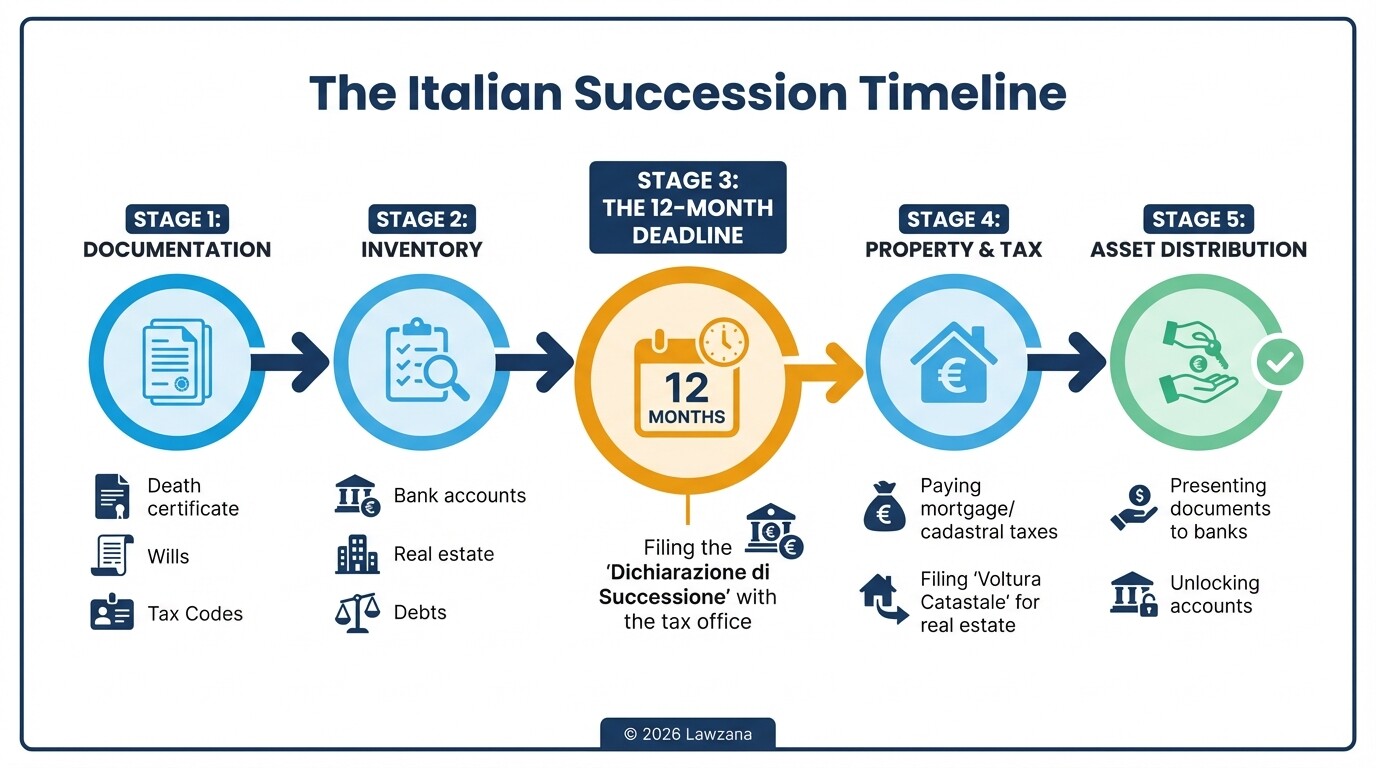
- Strict 12-month deadline: The Dichiarazione di Successione (Inheritance Tax Return) must be filed within one year of the date of death to avoid significant penalties.
- Tax-friendly for close relatives: Italy offers generous tax exemptions, with spouses and direct descendants paying 0% tax on assets valued up to €1 million per person.
- Professional assistance is essential: Managing cross-border successions requires navigating the intersection of Italian civil law and international tax treaties.
Understanding forced heirship and 'Legittima' in Italy
Italian inheritance law operates on the principle of forced heirship, which reserves a specific percentage of an estate for "protected heirs." These heirs, known as legittimari, include the surviving spouse, children, and, in some cases, parents. Even if a will is present, the testator can only freely dispose of a portion of their assets (the quota disponibile), while the rest must go to the protected heirs.
The reserved portions vary based on the number of heirs involved:
- Sole Spouse: Entitled to 50% of the estate and the right to inhabit the family home.
- One Child: Entitled to 50% of the estate.
- Spouse and One Child: Each is entitled to 33.3% of the estate.
- Spouse and Two or More Children: The spouse receives 25%, and the children share 50% equally.
- Parents (if no children): Entitled to 33.3% of the estate (or 25% if there is also a surviving spouse).
If a will violates these quotas, protected heirs have the right to challenge the document through a legal action known as an "action for reduction" (azione di riduzione). This ensures that the mandatory minimums are restored from the estate's assets.
How EU Succession Regulation (650/2012) affects your will
EU Regulation No. 650/2012, often called "Brussels IV," simplifies cross-border successions by determining which country's law applies to an estate. By default, the law of the country where the deceased had their "habitual residence" at the time of death governs the entire succession. For expats living in Italy, this means Italian forced heirship rules apply to all assets worldwide, unless a specific choice of law is made.
Expats can avoid the strictures of Italian forced heirship by including a "Choice of Law" clause in their will. This clause allows you to designate the law of your nationality to govern your estate instead of the law of your residence. For American or British expats, this is a vital tool to ensure that your estate is distributed according to the principles of testamentary freedom common in your home country.
However, even if you choose your national law, the physical transfer of Italian real estate must still follow Italian administrative procedures. It is highly recommended to have a specific Italian will (or a global will that mentions Italian assets) to streamline the process for your heirs and avoid the need for complex translations and legalizations of foreign probate documents.
Step-by-Step Checklist for Managing an Italian Succession
Managing a cross-border estate requires immediate action to comply with Italian fiscal and civil regulations. Use this checklist to ensure no deadlines are missed and assets are properly transferred.
- Obtain the Death Certificate: If the death occurred outside Italy, the certificate must be translated into Italian and apostilled.
- Verify the Existence of a Will: Search the Italian National Registry of Wills (Registro Generale dei Testamenti) and check for any foreign wills.
- Obtain Italian Tax Codes (Codice Fiscale): All foreign heirs must have an Italian tax code to receive assets or file tax returns in Italy.
- Open the Succession: Consult a professional to determine if the succession is "testate" (with a will) or "intestate" (without a will).
- Inventory the Assets: Identify all Italian bank accounts, real estate, vehicles, and investments. For real estate, obtain recent visure catastali (cadastral records).
- File the 'Dichiarazione di Successione': This must be submitted electronically to the Agenzia delle Entrate within 12 months of death.
- Pay Mortgage and Cadastral Taxes: These are due upon filing the succession return if real estate is involved.
- Complete the 'Voltura Catastale': This step updates the land registry records to reflect the new owners of the property.
- Release Bank Funds: Present the certificate of filed succession to banks to unlock and transfer funds to the heirs.
Inheritance tax rates and exemptions for family members
Italy is considered a relatively low-tax jurisdiction for inheritance, particularly for close family members. The inheritance tax (imposta sulle successioni) is calculated based on the relationship between the deceased and the heir, with specific thresholds (exemptions) applied to each category.
| Relationship to Deceased | Tax Rate | Exemption Threshold (per heir) |
|---|---|---|
| Spouse and Children | 4% | €1,000,000 |
| Siblings | 6% | €100,000 |
| Other Relatives (up to 4th degree) | 6% | No exemption |
| All Other Persons | 8% | No exemption |
For heirs with a certified severe disability, the exemption threshold increases to €1,500,000 regardless of their relationship to the deceased. It is important to note that these taxes apply to the "net value" of the estate, meaning liabilities and debts of the deceased are deducted before the tax is calculated.
Managing Italian real estate transfers after a death
Transferring ownership of an Italian villa or apartment is a multi-stage process that involves both the tax office and the land registry. Filing the Dichiarazione di Successione is the first step, but it does not automatically update the title of the property.
When real estate is inherited, heirs must pay two specific "transcription" taxes regardless of the inheritance tax threshold:
- Imposta Ipotecaria (Mortgage Tax): 2% of the cadastral value.
- Imposta Catastale (Cadastral Tax): 1% of the cadastral value.
If an heir intends to use the inherited property as their primary residence (Prima Casa), these taxes may be reduced to a flat fee of €200 each. Following the tax payment, the Voltura Catastale must be filed with the Provincial Office of the Territory within 30 days of filing the succession. This ensures the public record accurately reflects the new ownership, which is a prerequisite for any future sale of the property.
Common Misconceptions
- "I have a US/UK will, so Italian law doesn't apply to me." This is false. Without a specific "Choice of Law" clause citing your nationality, Italian forced heirship rules will automatically apply to your Italian assets (and potentially your global assets) if you are a resident of Italy.
- "Inheritance tax in Italy is extremely high." Actually, Italy has some of the highest tax exemptions in Europe for direct family members. Many estates fall entirely under the €1 million threshold and pay zero inheritance tax, though administrative property taxes still apply.
- "The bank will release funds as soon as I show the death certificate." Italian banks are very strict. They will typically freeze all accounts upon notification of death and will not release funds until they receive a formal "Succession Statement" stamped by the Italian Tax Office.
FAQ
How long does the succession process take in Italy?
While the tax return must be filed within 12 months, the administrative process of transferring property and unlocking bank accounts typically takes between 3 to 6 months after the filing, depending on the complexity of the assets.
Can I disinherit a child under Italian law?
Generally, no. Children are protected heirs. However, if you are an expat, you can use EU Regulation 650/2012 to choose the law of your nationality in your will, which may allow for disinheritance if your home country's law permits it.
Do I need to go to Italy to manage the succession?
No, most procedures can be handled remotely. You can grant a Power of Attorney (Procura Speciale) to an Italian lawyer or professional who can file the tax returns, pay the necessary taxes, and manage the property transfers on your behalf.
What happens if I miss the 12-month filing deadline?
Missing the deadline results in administrative penalties and interest. The penalties increase the longer the delay continues, though the Ministry of Justice and Tax Office do allow for "voluntary correction" (ravvedimento operoso) to reduce these fines if you come forward before an audit.
When to Hire a Lawyer
Navigating Italian inheritance law is complex, especially when foreign wills, international tax treaties, and real estate are involved. You should consult an Italian inheritance specialist if:
- The estate involves real estate or significant financial assets in Italy.
- The deceased was a foreign national or lived outside their country of citizenship.
- There is no will, or the existing will conflicts with Italian forced heirship rules.
- Heirs are located in different countries, requiring cross-border coordination.
- You need to claim the "Choice of Law" exemption under EU Regulation 650/2012.
Next Steps
- Locate all testamentary documents: Gather any wills made in Italy or abroad.
- Request a 'Certificato di Morte': Ensure the death certificate is in a format accepted by Italian authorities.
- Consult a legal expert: Seek a professional who understands both Italian civil law and international private law to review your specific situation.
- Secure the property: If the deceased owned real estate in Italy, ensure it is secure and that local taxes (like IMU) continue to be paid during the transition.