


Managing a supply chain in Italy requires a balance between maintaining professional relationships and strictly enforcing contractual rights. When a supplier fails to meet their obligations, the Italian Civil Code provides specific mechanisms to protect your business interests and recover losses.
What are common supplier breaches in Italy and how do you prove them?
Commercial breaches in Italy typically fall into three categories: total non-performance, delayed performance, or defective performance (non-conformity). To succeed in a legal claim, you must demonstrate that the breach is "material," meaning it significantly impacts the value or utility of the contract under Article 1455 of the Italian Civil Code.
To build a high-authority case, you should gather the following evidence:
- Contractual Documents: The original signed agreement, including any "General Terms and Conditions" which are often found on the back of purchase orders.
- The Paper Trail: All correspondence regarding the breach must be documented. In Italy, the Posta Elettronica Certificata (PEC) is the gold standard; regular emails have lower evidentiary weight.
- Technical Assessments: For defective goods, hire an independent expert (Perito) to draft a technical report immediately upon discovery of the defect.
- Proof of Damage: Collect invoices, lost contracts from your own clients, and records of additional costs incurred to find a replacement supplier.
How do you send a formal legal notice to an Italian supplier?
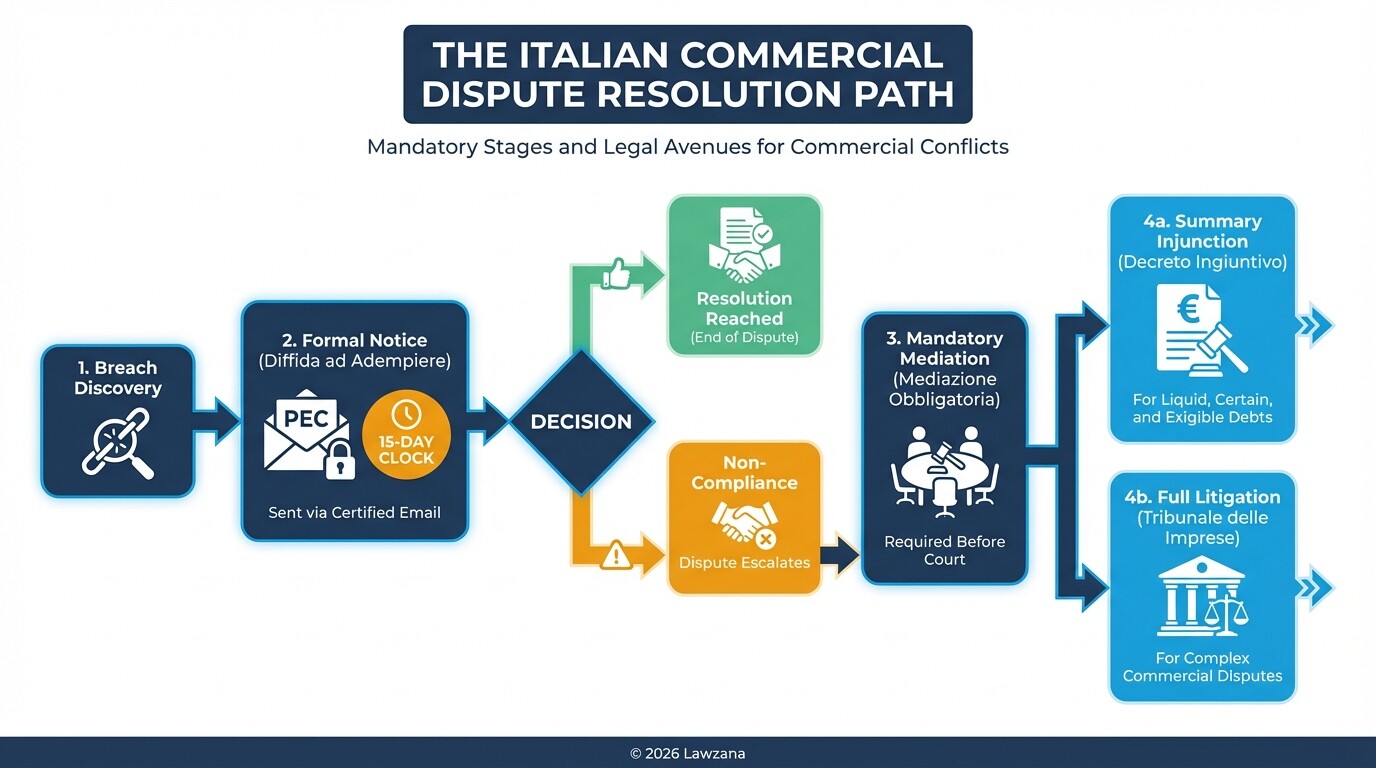
To legally formalize a dispute, you must send a Diffida ad Adempiere (Notice to Perform) according to Article 1454 of the Civil Code. This is a formal written warning stating that if the supplier does not fulfill their obligations within a specific timeframe-usually no less than 15 days-the contract will be considered automatically dissolved.
An effective legal notice must include:
- Specific Description of the Breach: Clearly state what was missed (e.g., "Failure to deliver 500 units by the June 1st deadline").
- The Grace Period: Explicitly grant at least 15 days for the supplier to remedy the situation.
- The Dissolution Clause: You must state that failure to comply within the deadline will result in the "ipso jure" (automatic) termination of the contract.
- Method of Delivery: This notice must be sent via PEC or Registered Mail with Return Receipt (Raccomandata A/R). Without proof of delivery through these specific channels, the notice may be legally void.
Should you choose mediation or litigation for an Italian business dispute?
In Italy, many commercial disputes are subject to Mandatory Mediation (Mediazione Obbligatoria). This means that before you can file a lawsuit in court, you must attempt to resolve the issue through a certified mediation body (Organismo di Mediazione); failure to do so can result in your court case being declared inadmissible.
Comparing Your Options in Italy
| Feature | Mediation (Mediazione) | Litigation (Tribunale) |
|---|---|---|
| Duration | 3 to 6 months | 2 to 4 years |
| Cost | Fixed fees based on dispute value | High (legal fees + court taxes) |
| Privacy | Completely confidential | Public record |
| Control | Parties decide the outcome | Judge decides based on law |
| Finality | Agreement has the force of an injunction | Appealable to higher courts |
If mediation fails, the case moves to the Tribunale delle Imprese. These specialized sections of the Italian court system handle matters involving company law and complex commercial contracts. They generally offer more expertise and slightly faster timelines than standard civil courts.
How can you recover damages and manage ongoing supply obligations?
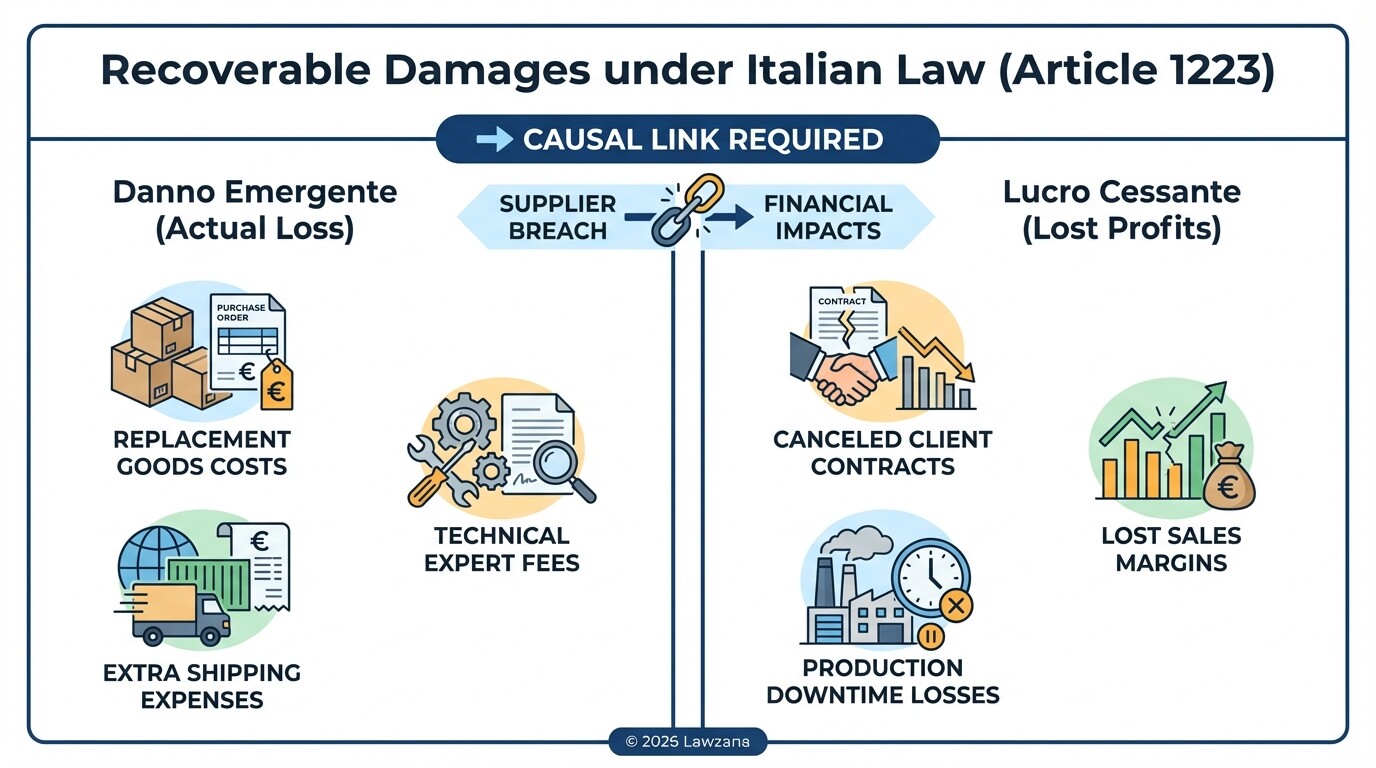
You are entitled to compensation for both "danno emergente" (actual losses incurred) and "lucro cessante" (lost profits) resulting from a supplier's breach. Under Italian law, you must prove a direct "causal link" between the supplier's failure and your financial loss.
If you are in an ongoing relationship, you may invoke the Eccezione di Inadempimento (Exception of Non-Performance) under Article 1460. This allows you to legally refuse to perform your side of the contract (such as making a payment) if the supplier has not performed theirs, provided your refusal is made in good faith.
Steps to Recover Damages:
- Quantify the Loss: Detail every Euro lost due to the delay or defect.
- Mitigate Damages: Italian law requires you to take reasonable steps to minimize your loss (e.g., sourcing from another supplier at a fair market price).
- Seek an Injunction: If you have an undisputed credit, your lawyer can apply for a Decreto Ingiuntivo (Injunction to Pay), which is a much faster way to recover money than a full trial.
Which contract clauses prevent future supplier disputes in Italy?
Preventing disputes begins with the drafting phase. To protect your business in Italy, you should move beyond standard templates and include clauses specifically recognized by the Italian Civil Code (Codice Civile).
Key clauses to negotiate include:
- Clausola Penale (Penalty Clause): Pre-determines the amount of damages the supplier must pay in case of a specific breach (e.g., €500 for every day of delay), avoiding the need to prove the exact amount of loss in court.
- Clausola Risolutiva Espressa (Express Termination Clause): Lists specific breaches that allow you to terminate the contract immediately without waiting 15 days or going to mediation.
- Choice of Forum & Law: Explicitly state that disputes will be settled in a specific city's court (e.g., Milan is the most active commercial hub) to avoid jurisdictional confusion.
- Hardship/Force Majeure: Clearly define what constitutes an "unforeseeable event" to prevent the supplier from using external economic factors as an excuse for non-performance.
Common Misconceptions About Italian Commercial Law
"Italian courts take 10 years to reach a decision." While the Italian legal system has a reputation for being slow, the specialized Tribunale delle Imprese and the increased use of Decreto Ingiuntivo (summary judgments) have significantly shortened timelines for clear-cut debt collection and commercial breaches.
"An email is enough to terminate a contract." In Italy, a standard email is easily contested. Unless the contract specifically allows for standard email, you must use PEC or registered mail to ensure the termination is legally binding and recognized by a judge.
"If they don't deliver, I don't have to pay anything ever." You must be careful. If you withhold payment that is disproportionate to the breach, you could be found in "bad faith." Always consult a lawyer before stopping payments to ensure your actions are protected under Article 1460.
FAQ
What is the statute of limitations for a commercial dispute in Italy?
In most commercial cases, the statute of limitations (prescrizione) is 10 years. However, for specific issues like defects in sold goods, the timeframe is much shorter-you must report the defect within 8 days of discovery and file a claim within one year of delivery.
Can I recover my legal fees if I win the case?
Yes, Italy follows the "loser pays" principle (soccombenza). The judge typically orders the losing party to reimburse the winner's legal costs, though the amount is often based on standardized court tables rather than the actual fees paid to your lawyer.
Is an oral agreement with a supplier valid in Italy?
Yes, oral agreements are generally valid for the supply of goods and services. However, they are notoriously difficult to prove. Without written evidence or witnesses, enforcing an oral contract in an Italian court is extremely challenging.
When to Hire a Lawyer
You should engage an Italian commercial lawyer as soon as a breach occurs or when a supplier fails to respond to your initial informal complaints. In Italy, the "form" of legal communication is just as important as the "content." A lawyer is essential for drafting a valid Diffida ad Adempiere, navigating mandatory mediation, or filing for an injunction (Decreto Ingiuntivo) to recover funds quickly.
Next Steps
- Audit Your Evidence: Gather all PEC messages, invoices, and the original contract.
- Assess the Breach: Determine if the breach is "material" and quantify the financial impact on your operations.
- Send the PEC: Have a legal professional draft and send a formal Notice to Perform.
- Initiate Mediation: If the supplier remains non-compliant, contact a mediation body to start the mandatory dispute resolution process.
- Secure an Injunction: If the supplier owes a specific sum of money, skip the long trial and ask your lawyer to apply for a Decreto Ingiuntivo at the Ministry of Justice.