- Joint custody is the default: Under Italian law, affidamento condiviso (joint custody) is the legal standard, ensuring the child maintains a continuous relationship with both parents regardless of nationality.
- Habitual residence is critical: Jurisdiction for custody is typically determined by where the child primarily lives, not the parents' citizenship or where the marriage occurred.
- Relocation requires consent: Moving a child outside of Italy or even to a different Italian city requires the express written consent of the other parent or a court order.
- CTUs are pivotal: Court-appointed psychologists (CTU) often hold the most influence over the final ruling by providing "neutral" assessments of the family dynamic.
- Hague Convention compliance: Italy strictly enforces the Hague Convention on the Civil Aspects of International Child Abduction to prevent the unilateral removal of children across borders.
What criteria do Italian courts use to determine the best interests of the child?
Italian courts prioritize the "superior interest of the minor" (superiore interesse del minore) by evaluating which living arrangement best preserves the child's physical, psychological, and emotional well-being. The court seeks to maintain "bigenitorialità"-the right of the child to have a meaningful and consistent relationship with both parents and their respective extended families.
To determine these interests, judges assess several specific factors:
- Continuity of Care: Which parent has historically managed the child's daily routines, schooling, and medical needs.
- Stability of the Environment: The court prefers keeping the child in their "habitual residence" to avoid disrupting their social circle and education.
- The Child's Voice: Children aged 12 and older (or younger if they show "discernment") have a legal right to be heard during proceedings.
- Parental Conflict Levels: The ability of each parent to foster a positive relationship between the child and the other parent is a significant factor.
- Proximity to Support Networks: Access to grandparents, siblings, and established community ties within Italy.
How does joint custody (affidamento condiviso) differ from sole custody in Italy?
In Italy, affidamento condiviso (joint custody) grants both parents equal decision-making power regarding the child's education, health, and upbringing, even if the child primarily resides with one parent. Affidamento esclusivo (sole custody) is an exception, granted only when joint custody is proven to be detrimental to the child's welfare, such as in cases of abuse, neglect, or total parental incapacity.
| Feature | Joint Custody (Condiviso) | Sole Custody (Esclusivo) |
|---|---|---|
| Decision Making | Major decisions require mutual agreement. | One parent makes major decisions alone. |
| Frequency | The standard ruling in nearly all cases. | Rare; requires proof of "prejudice" to the child. |
| Placement | Child usually has a "prevalent residence" with one parent. | Child lives with the custodial parent. |
| Visitation | Non-residential parent has a broad visitation schedule. | Non-custodial parent may have restricted or supervised visits. |
| Child Support | Typically paid by the non-residential parent. | Paid by the non-custodial parent. |
It is important to note that even in joint custody, the court will designate one parent's home as the "prevalent residence" (collocamento) for administrative purposes, though the "visitation" schedule is increasingly designed to be as balanced as possible.
What are the legal restrictions on moving a child abroad without consent?
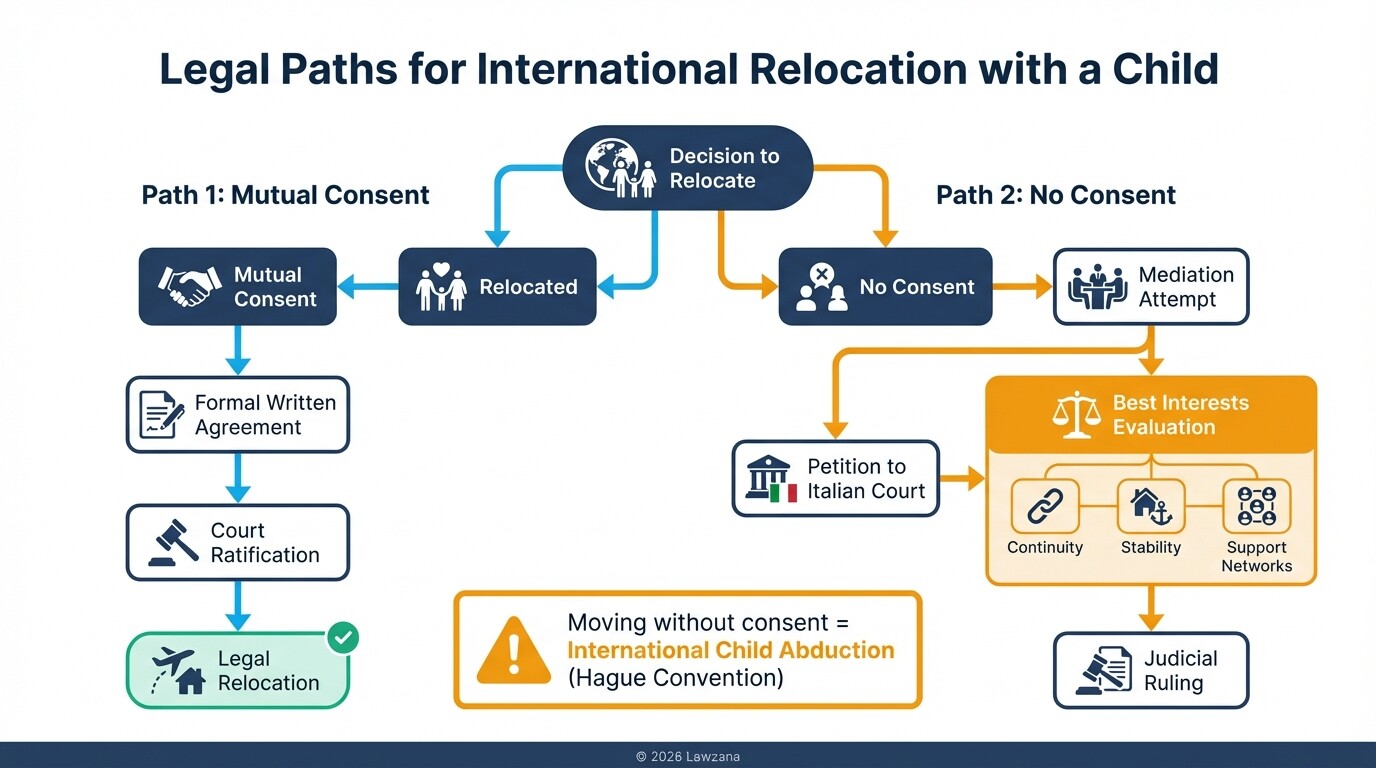
A parent cannot legally relocate a child to another country-or even a distant city within Italy-without the formal written consent of the other parent or authorization from the court. If an expat parent moves a child across international borders without this permission, it is classified as international child abduction under the Hague Convention.
If you are seeking to relocate, you must follow these steps:
- Attempt Mediation: Seek a written agreement (accordo) with the other parent regarding the move and a new visitation schedule.
- Petition the Court: If the other parent refuses, you must file a petition with the Tribunale per i Minorenni or the civil court (depending on the case status) to request a change in the child's residence.
- Prove the Benefit: You must demonstrate that the move is in the child's best interest (e.g., better educational opportunities, closer family support) rather than just a personal preference for the parent.
- Proposed Visitation: You must provide a concrete plan for how the child will maintain a relationship with the parent staying in Italy, often including longer summer stays and frequent video calls.
Failure to obtain permission can lead to the court ordering the immediate return of the child to Italy and may severely damage your chances of maintaining custody in future proceedings.
How are foreign custody orders enforced through Italian judicial authorities?
Foreign custody orders are enforced in Italy through a process called "Exequatur" or via specific EU regulations, depending on where the original order was issued. For orders from EU member states (excluding Denmark), Regulation (EU) 2019/1111 (Brussels II ter) allows for the direct recognition and enforcement of judgments without a complex re-litigation process.
For orders from non-EU countries, the process involves:
- Verification of Jurisdiction: The Italian court ensures the foreign court had the authority to issue the order.
- Due Process Review: The court confirms that the defendant was properly notified and given a fair chance to be heard in the original country.
- Public Policy Check: The order must not conflict with Italian "public policy" (ordine pubblico), which includes the fundamental rights of the child.
- The 1996 Hague Convention: If the country is a signatory to the Hague Convention of 19 October 1996, simplified procedures for the protection of minors apply.
Once recognized, a foreign order has the same legal standing as a ruling from an Italian court, allowing the police or social services to intervene if the order is violated.
What is the role of court-appointed experts (CTU) in custody disputes?
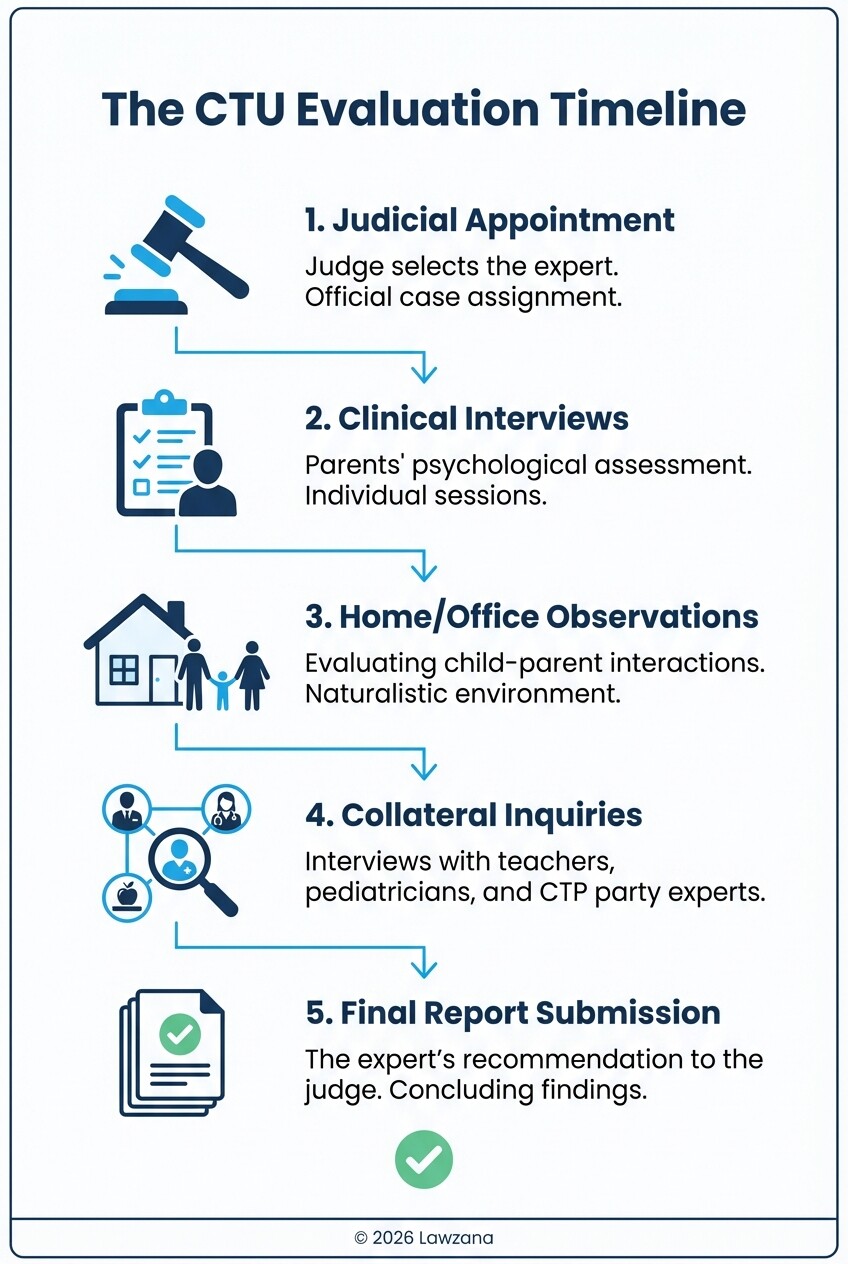
The Consulente Tecnico d'Ufficio (CTU) is a neutral psychologist or psychiatrist appointed by the judge to evaluate the parental fitness of both parties and the psychological needs of the child. Because Italian judges are legal experts rather than mental health professionals, the CTU's final report often serves as the blueprint for the court's ultimate decision.
The CTU process typically involves:
- Observations: The expert watches the child interact with each parent in a controlled environment or at home.
- Clinical Interviews: Both parents undergo psychological assessments and interviews to evaluate their emotional stability and parenting style.
- Collateral Contacts: The CTU may speak with teachers, pediatricians, and extended family members.
- Party Experts (CTP): Each parent has the right to hire their own private expert (Consulente Tecnico di Parte) to shadow the CTU, review their methods, and submit counter-arguments.
The cost of a CTU can range from €2,000 to €5,000 or more, usually split between the parents or paid by the party requesting the evaluation.
Common Misconceptions About Italian Custody
Myth 1: "The mother always gets custody in Italy." While mothers are still frequently designated as the "residential parent" for very young children, Italian law is strictly gender-neutral. The "tender years" doctrine has been replaced by the "bigenitorialità" principle, which favors whichever parent provides more stability.
Myth 2: "If I have sole custody in my home country, I can ignore Italian rules." If the child is "habitually resident" in Italy, Italian courts have jurisdiction regardless of previous foreign orders. You must domesticate your foreign order in Italy to ensure it is enforceable.
Myth 3: "I can take my child on vacation abroad without asking." While short vacations are usually covered under standard visitation rights, many Italian custody orders specify that any international travel requires informing the other parent or obtaining a signed "travel authorization" (atto di assenso) for passport purposes.
FAQ
How long do custody proceedings take in Italy?
A temporary order regarding residence and support is often issued within 3 to 6 months. However, a final, definitive ruling involving a CTU evaluation can take 12 to 24 months depending on the court's backlog.
At what age can a child decide which parent to live with?
There is no "magic age" where a child chooses. While children must be heard at age 12, the judge considers their opinion as one factor among many. A child's preference is given more weight as they approach 14 or 15.
What are the costs involved in a custody case?
Legal fees vary widely by region and complexity, but a contested case typically costs between €3,000 and €10,000 per parent. This does not include the costs for the CTU or translation of foreign documents.
Can I lose custody if I don't speak Italian?
No. Language is not a basis for determining parental fitness. However, you may be required to demonstrate that you can facilitate the child's integration into their local Italian community and schooling.
When to Hire a Lawyer
You should consult an Italian family law attorney immediately if:
- You or your spouse are planning to move out of the shared family home.
- There is a disagreement regarding the child's international travel or relocation.
- You have been served with a summons from an Italian court or a Hague Convention petition.
- You need to enforce a custody order issued by a court outside of Italy.
- The other parent is obstructing your visitation rights or "gatekeeping" the child.
Next Steps
- Gather Documentation: Collect birth certificates, school records, and any existing foreign court orders. All foreign documents must be translated into Italian by a certified translator and often require an Apostille.
- Establish Habitual Residence: Document the child's ties to Italy, including school enrollment and medical registrations (tessera sanitaria).
- Seek Mediation: Italy encourages mediazione familiare (family mediation). Attempting this can show the court you are acting in good faith.
- Secure Legal Counsel: Choose a lawyer specialized in "International Family Law" who understands both the Italian Civil Code and international treaties.