- Foreign firms have eight days from the discovery of a defect to notify an Italian supplier, or they risk losing all warranty rights under Article 1495 of the Italian Civil Code.
- The "Decreto Ingiuntivo" is a highly efficient summary judgment tool that allows creditors to obtain an enforceable payment order without a full trial if they possess written evidence.
- While Italian courts have a reputation for being slow, recent reforms (the Cartabia Reform) have significantly streamlined commercial proceedings to meet EU standards.
- Mandatory mediation is often a prerequisite for litigation in Italy; failing to engage in good faith can result in judicial sanctions.
- Choice of law and jurisdiction clauses must be explicitly drafted to avoid the default application of Italian law, which heavily favors the "characteristic performance" of the supplier.
What statutory protections do buyers have under the Italian Civil Code?
Commercial buyers in Italy are protected by a robust framework within the Italian Civil Code (Codice Civile) that guarantees the quality and functionality of goods. These protections primarily fall under the "Contract of Sale" (Compravendita) provisions, specifically Articles 1470 through 1547, which imply warranties against latent defects and lack of promised qualities.
Key statutory protections include:
- Warranty Against Defects (Art. 1490): The seller must guarantee that the item sold is free from defects that make it unfit for its intended use or appreciably diminish its value.
- Right to Termination (Art. 1492): If a defect is found, the buyer can choose between the "actio redhibitoria" (dissolving the contract and seeking a refund) or the "actio aestimatoria" (keeping the goods but at a reduced price).
- Damage Claims (Art. 1494): Beyond price reductions, the seller is liable for damages unless they can prove they were unaware of the defects through no fault of their own.
- Aliud pro Alio: This is a judge-made doctrine used when a supplier delivers something completely different from what was ordered. Unlike standard defects, this allows for a 10-year statute of limitations rather than the strict one-year limit.
How does the 'Decreto Ingiuntivo' accelerate debt collection?
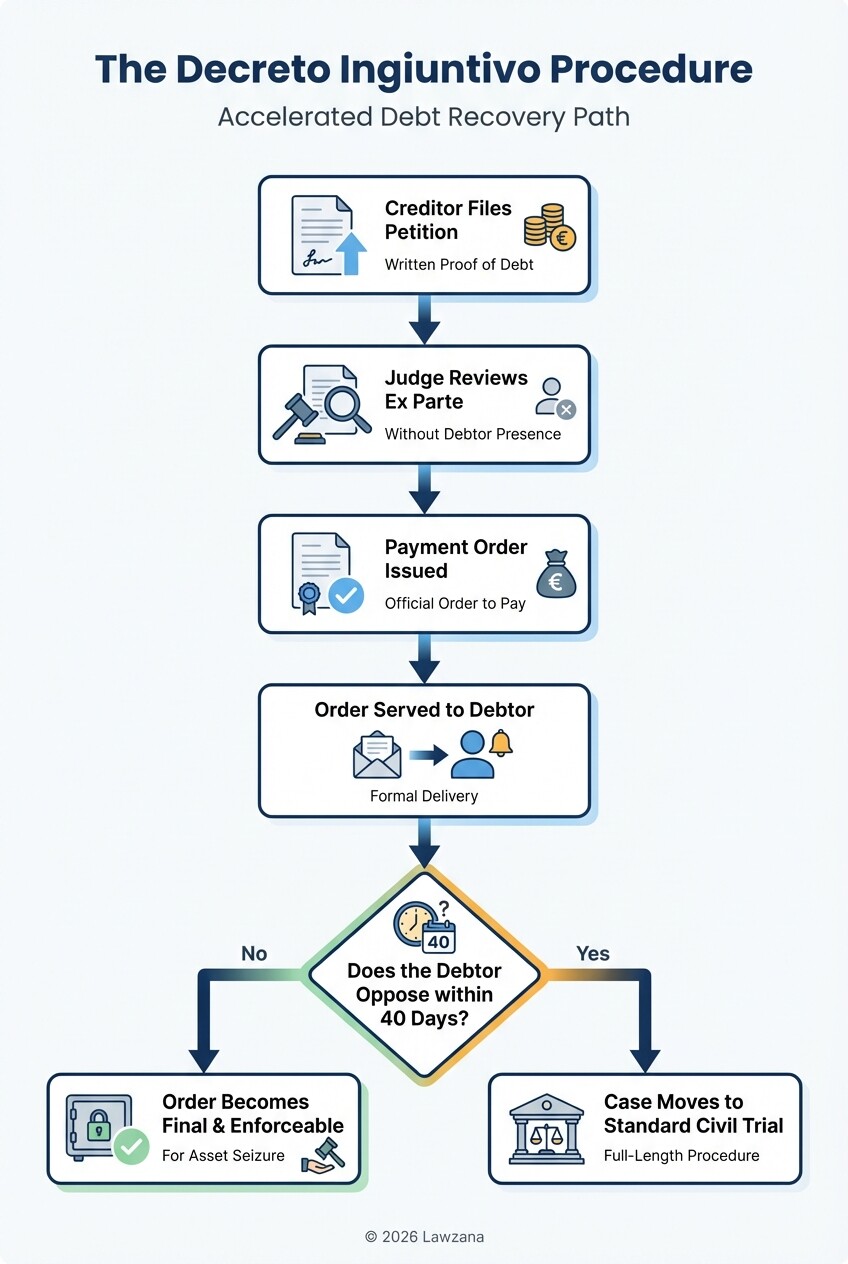
The "Decreto Ingiuntivo" is a summary payment order issued by a judge ex parte (without the debtor present) based on written evidence of a certain, liquid, and collectible debt. For a foreign firm waiting on a refund or a supplier seeking payment, this procedure avoids the years-long wait of a standard civil trial.
The process typically follows these steps:
- Application: The creditor files a petition with the court, providing invoices, contracts, or shipping documents as proof of debt.
- Issuance: If the evidence is sufficient, the judge issues the order within weeks, commanding the debtor to pay within 40 days.
- Service: The creditor must serve this order to the Italian counterparty.
- Opposition: The debtor has 40 days to file an "opposition." If they do not, the order becomes a final judgment and is immediately enforceable through asset seizure.
- Provisional Enforceability: In some cases, such as when the debt is proven by a signed acknowledgment, the judge may grant "immediate enforceability," meaning the 40-day waiting period for collection is waived.
When should a firm use Italian courts vs. international forums?
Determining jurisdiction depends on whether the parties have signed a specific forum selection clause and whether they are located within the European Union. Under EU Regulation 1215/2012 (Brussels I bis), the default rule is that the defendant should be sued in the courts of their domicile (Italy), but parties are free to agree otherwise.
| Consideration | Italian Courts | International Arbitration |
|---|---|---|
| Cost | Generally lower; fees are based on a fixed percentage of the claim value. | Significantly higher; includes arbitrator fees and venue costs. |
| Speed | 2 to 4 years for a full trial (faster with summary tools). | 12 to 18 months on average. |
| Enforceability | Direct enforcement in Italy; easy enforcement within the EU. | Enforceable globally via the New York Convention. |
| Technicality | Best for standard supply contracts governed by Italian law. | Best for complex, high-value technical disputes. |
Foreign firms should opt for Italian courts when the evidence is straightforward (e.g., unpaid invoices) to take advantage of the Decreto Ingiuntivo. However, for complex manufacturing IP disputes, international arbitration in a neutral third country (like Switzerland) may offer more confidentiality and expertise.
How do you prove product non-conformity in Italian commercial litigation?
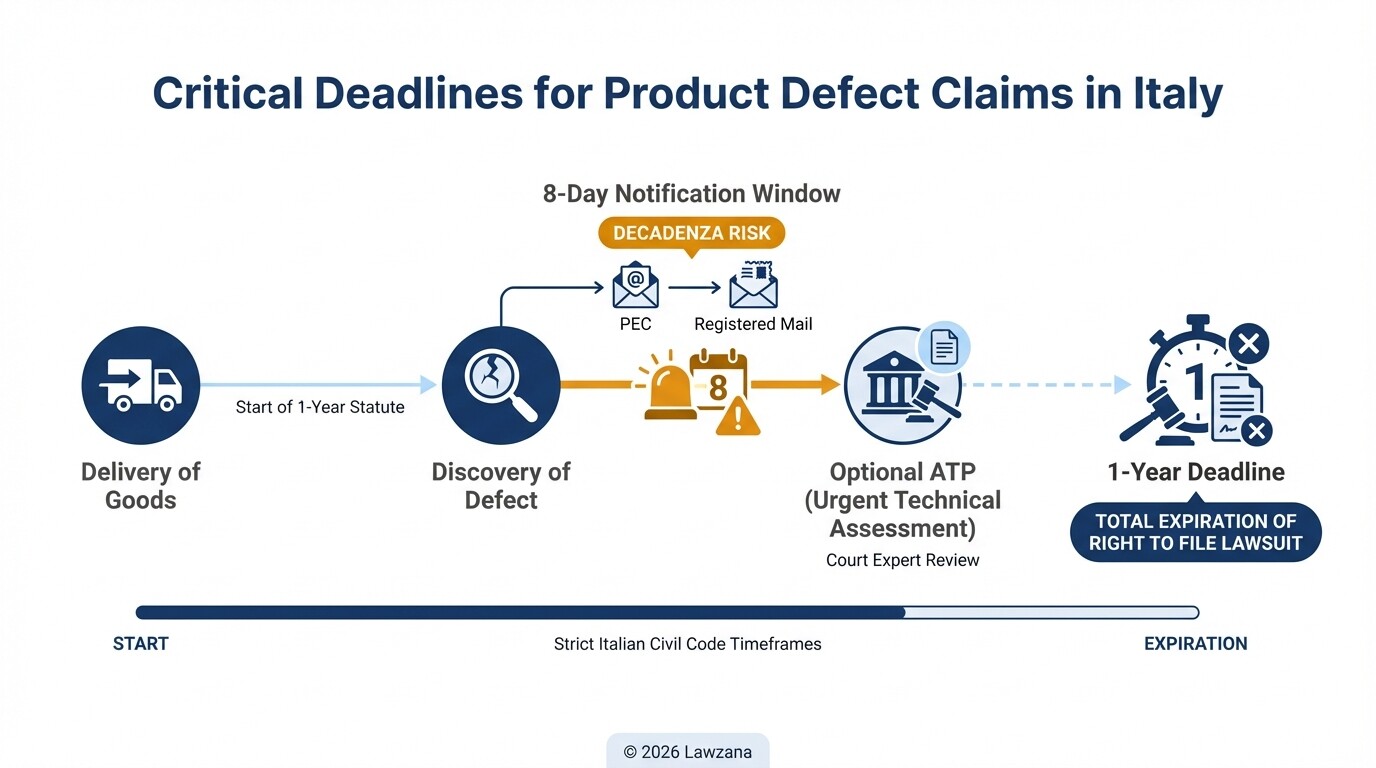
Proving that a product does not match contract specifications requires strict adherence to the "burden of proof" rules found in Article 2697 of the Civil Code. In Italian litigation, the buyer must not only prove the defect exists but also demonstrate that they reported it within the mandatory legal timeframes.
To successfully prove non-conformity, follow this protocol:
- The 8-Day Rule: You must notify the supplier of "latent" defects within eight days of discovery via Registered Email (PEC) or formal courier. Failing this "decadenza" period usually kills the legal claim.
- Accertamento Tecnico Preventivo (ATP): Before a full trial, you can request an "Urgent Technical Assessment." The court appoints an independent expert (CTU) to examine the goods immediately. This report often serves as the primary evidence and frequently leads to a settlement.
- Documentary Evidence: Maintain all "Documenti di Trasporto" (DDT), quality control logs, and correspondence. In Italy, written evidence carries significantly more weight than witness testimony in commercial matters.
- Statute of Limitations: Be aware that the right to sue for defects expires exactly one year after delivery, regardless of when the defect was discovered.
What is the impact of force majeure in Italian manufacturing contracts?
Force majeure is not explicitly defined as a single article in the Italian Civil Code but is derived from the concepts of "impossibility of performance" (Art. 1218 and 1256). For a supplier to be excused from delivery failures, they must prove the event was unpredictable, unavoidable, and external to their control.
Impacts on supply chain disputes include:
- Temporary Impossibility: If the event (e.g., a port strike or energy blackout) is temporary, the supplier's obligation is suspended, not canceled. They are not liable for delay damages during this window.
- Total Impossibility: If the performance becomes permanently impossible, the contract is dissolved, and the supplier must return any prepayments (Art. 1463).
- Excessive Onerousness (Art. 1467): If extraordinary and unpredictable events make performance much more expensive (e.g., a 500% spike in raw material costs), the supplier can ask the court to dissolve the contract unless the buyer agrees to a fair price adjustment.
- Contractual Overlap: Most modern Italian manufacturing contracts include specific force majeure clauses. Italian courts generally respect these clauses, even if they deviate from the default Civil Code rules, provided they are not "unconscionable."
Common Misconceptions About Italian Litigation
Myth 1: "Italian trials always take ten years."
While the Italian judicial system has historically been slow, commercial courts (Sezioni Specializzate in materia di Impresa) are dedicated to business disputes and move much faster than general civil courts. With the 2023 Cartabia Reform, there is a renewed legislative push to conclude first-instance commercial trials within 18-24 months.
Myth 2: "Standard emails are sufficient for legal notices."
In Italy, a standard "Gmail" or "Outlook" email is often insufficient to prove receipt in a court of law if the counterparty denies receiving it. To satisfy the 8-day notice requirement for defects, foreign firms should use PEC (Posta Elettronica Certificata), which provides legal certainty of delivery equivalent to a registered letter.
Myth 3: "The losing party always pays all legal fees."
Italy follows the "loser pays" principle, but it is not absolute. Judges have the discretion to "offset" or split costs if the case is complex or if the plaintiff only partially wins. Furthermore, the fees awarded are based on statutory tariffs (Parametri Forensi) which may be lower than the actual hourly rates charged by international law firms.
FAQ
Can I sue an Italian supplier in my home country?
This depends on your contract. If the contract is silent and you are in the EU, you generally must sue in Italy. If you are outside the EU (e.g., USA), jurisdiction depends on international treaties and whether the Italian firm has a presence in your country.
What is the 'Mediazione' process?
Before many commercial trials can proceed, parties are legally required to attempt mediation with a neutral third party. This process lasts a maximum of three months and is designed to reduce the backlog of the Italian court system.
How much does it cost to start a lawsuit in Italy?
You must pay a "Contributo Unificato" (court filing fee), which is a sliding scale based on the value of the dispute. For a €100,000 claim, the filing fee is approximately €1,214.
Are oral agreements binding in Italian supply chains?
Yes, under the principle of "freedom of form," oral contracts are valid. However, proving the terms of an oral agreement in an Italian court is extremely difficult, as certain types of evidence (like witness testimony for high-value contracts) are restricted.
When to Hire a Lawyer
You should engage an Italian commercial litigator if:
- You have received defective goods and the 8-day notification window is approaching.
- An Italian supplier has stopped communicating while holding your advance payment.
- You have been served with a "Decreto Ingiuntivo" and have only 40 days to respond.
- You are negotiating a high-value manufacturing agreement and need to ensure the jurisdiction and "force majeure" clauses are enforceable under Italian law.
Next Steps
- Audit Your Notifications: Check if you have sent a formal notice of defect via PEC or registered mail for any current disputes.
- Gather Documentary Evidence: Organize all signed contracts, "Documenti di Trasporto" (DDT), and technical specifications.
- Verify the Supplier's Status: Use the Italian Business Register (Registro Imprese) to check if the company is in liquidation or bankruptcy.
- Consult Local Counsel: Request a preliminary assessment of whether your claim qualifies for a summary "Decreto Ingiuntivo" to save time and costs.
- Review Jurisdiction: Check your existing contracts for "Foro Competente" (Competent Forum) clauses to determine where you must file your claim.